Audacious Audio

Sort By:  Post Date TitlePublish Date

dCS Varèse Music System D/A Processor

Photo: Paul Miller

It was during a visit to my music room by five members of the small Off-Islanders Audio Society that the magic of the dCS Varèse Music System ($267,500 as reviewed; $305,000 with CD/SACD transport) became clear.

One member had requested the 24/192 version of "Splendido Sundance" from Saturday Night in San Francisco (24/192 FLAC, Columbia-Legacy/Qobuz), performed by Al Di Meola, John McLaughlin, and Paco de Lucía and recorded live in the Warfield Theatre on December 6, 1980. I'd attended the unveiling of the LP remastering of this recording, presented by the album's co-executive producer, Abey Fon, in the Audio Reference room at High End Munich 2024. The system, which was first class, included a VPI Titan turntable, D'Agostino Relentless preamplifier and Relentless 800 mono amplifiers, a VTL TP-6.5 Series II Signature phono preamplifier, Wilson Audio XVX loudspeakers, Nordost cabling, a Stromtank power generator, and an unheard three-piece dCS Vivaldi APEX music system.

Innuos ZENith Next-Gen Streamer-Server

The Innuos ZENith Next-Gen ($20,700 as equipped) does what streamer-servers do: store music files, read them into memory, and send them on to a D/A converter to make music. In Innuos's complex (yet logical) lineup of streamers and streamer-servers, the ZENith Next-Gen sits just below the flagship Statement and above the ZENith Mk.3. The ZENith Mk.3 remains in the Innuos lineup for now but will be replaced at AXPONA shortly after this issue hits mailboxes and newsstands.

Though similar in many respects, with a very similar appearance, these two products—the ZENith Next-Gen and the ZENith Mk.3—are very different beasts. There is one rather obvious difference: a CD slot on the Mk.3 (with, of course, a CD drive inside), which makes it easy to rip CDs to the server's internal memory. This feature is absent from the more purist ZENith Next-Gen. But with the Next-Gen you can have your cake and eat it: Attach any USB CD ripper to one of the USB ports, and it will work just the same as the built-in ripper on the Mk.3. The other differences between the Mk.3 and the Next-Gen are less obvious, but those differences go much deeper; see the Details section in this review.

J.Sikora Standard Max Supreme turntable, KV9 Max Zirconium tonearm

In his review of the J.Sikora Initial turntable, Stereophile's resident artist/sage Herb Reichert wrote, "Extended bathing, lighting candles, making tea, and preparing food are ritual work forms that prepare my senses to accept both pleasure and illumination."

When it comes to playing records, I too have a ritual. It involves carefully cleaning the vinyl, first on a Pro-Ject VC-33, followed by immersion in a HumminGuru Ultrasonic vinyl cleaner. Before and after, I inspect the record's grooves with a pricey VisibleDust Quasar R magnifier. Only then—black coffee hot, glasses cleaned, stylus brushed free of contaminants, notepad at hand—am I ready to receive the messages ingrained in a shiny black vinyl disc.

Grimm Audio LS1c active loudspeaker system

It's not unusual for audiophiles to have fond childhood recollections of the old family stereo, but Eelco Grimm's memory of his dad's audio system probably stands alone. It's not just that Piet Grimm, a professional pilot for the Dutch air defense, had a pair of very fine Infinity speakers, a Pioneer receiver, and a Technics turntable. Others surely did, too. It's more that he purchased the system from a military PX shop at a US air force base in Germany, then happily flew the equipment home to the Netherlands on his Northrop F5 supersonic fighter plane. That's not run-of-the-mill cool, that's Top Gun cool.

Years later, Eelco, too, started taking stereo gear to new altitudes, becoming a designer of high-end speakers and electronics. After Grimm Audio, a 15-person enterprise, moved to a building near Eindhoven airport in the southern Netherlands, he realized that it stands in almost the exact spot where his dad used to park his fighter jet.

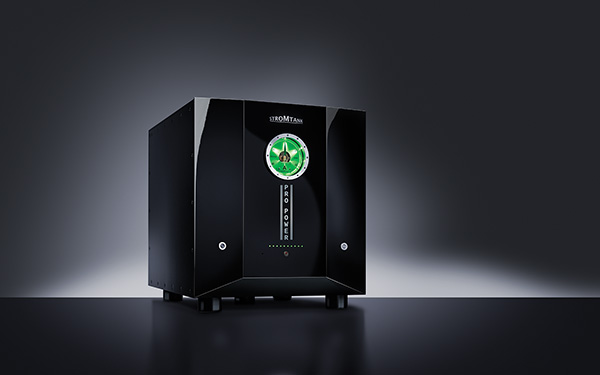
Stromtank S-4000 ProPower MK-II XT computer-controlled battery power source

In my enthusiastic 2022 review of the Stromtank S-1000 ($16,900), I described the Stromtank as a computer-controlled lithium iron phosphate (LiFePO4) battery array that, coupled with its AC inverters and all the trimmings, supplies clean, constant, stable off-grid AC power to hi-fi components. By softly depressing a single button on the front panel, Stromtank owners can easily switch from wall-connected mode (when the Stromtank's dimmable front-panel meter is blue) to a disconnected, battery-only state (when the meter is green). At the end of a listening session, users can return to blue mode to recharge the battery array.

Focal Diva Utopia Wireless Streaming Active Loudspeaker

What if there was a character in Stanley Kubrick's classic movie 2001: A Space Odyssey who was an audiophile? Aboard the Discovery One interplanetary space ship, what would his system look like? He'd probably have a pair of ultramodern speakers that could pluck sound out of the ether. He'd control the system with something like a present-day smartphone or tablet, commanding the HAL 9000 computer to play his favorite songs. The speakers would stand unobtrusively in a white room with 1970s modern-minimalist furniture, no rack of components to drive them, no wires connecting them, no shelves of physical media to play. And they would fill the room with music.

I am sitting earthbound in my living room almost a quarter-century beyond the year 2001, living a similar scenario with the Focal Diva Utopia streaming amplified wireless speaker system. My living room is not at all reminiscent of the Discovery One with its rotating central interior (footnote 1). But with the Diva Utopia system, I feel more in a sci-fi future young me might have imagined than with any hi-fi component I've reviewed so far. About the only thing the Diva Utopia has in common with the stereo systems I grew up with—and with my current reference system—is two floorstanding cabinets and diaphragms that move air to make sound.

EMM Labs DA2i D/A processor

More than five years have passed since I evaluated the original, Canada-made DV2 D/A converter ($30,000 in 2019) from EMM Labs. Since then, I've heard it and other top DACs—many of them at audio shows; some in my reference system—and my appreciation for what the original DV2 could deliver has only increased.

Now arrive two new components, the DV2's twin successors: the DV2i, an "integrated" stereo D/A converter with a software-driven, high-resolution digital volume control, and the subject of this review, the DA2i, a straight D/A with no volume control. Both cost $35,000.

Soulution 727 preamplifier

Almost 14 years have passed since a review of a Soulution product appeared in the pages of Stereophile. Given the Swiss company's steady ascent in the high-end pantheon, it is high time that we again reached into the German-speaking region of Switzerland north of the Swiss Alps to evaluate another of the reference products from a company equally renowned for its sonic achievements and refined and elegant design aesthetic.

Enter the full-function Soulution 727 preamplifier ($74,975), whose optional MC/MM phono section ($11,975) will be evaluated in a future issue. Because Soulution claims that the 727 "sets benchmarks in terms of noise, phase errors, common mode rejection and distortion," one would hope that there's far more than 62lb of classy casework and an easy-to-handle lightweight remote to account for its price.

Wilson Audio Specialties The WATT/Puppy Loudspeaker

Since the original WATT/Puppy concept kicked off in the late 1980s, there has been a 40-year evolution leading to the latest version reviewed here. The loudspeaker's price in 2025 is around $40,000/pair compared to the original's $8000. While inflation alone would have lifted the price to $25,000/pair, the current price takes into account the many technological and design improvements. While remaining physically separable, the upper "WATT" (Wilson Audio Tiny Tot) component, namely the head unit of the latest design, can no longer be run as a small full-range loudspeaker in its own right. This is because the mid/treble crossover, which was originally in the WATT, is now relocated to the lower "Puppy" section. Certainly, that original two-box "full range," strongly sculpted WATT/Puppy stack radically broke the mold in deviating from those rather plain, coffin-shaped tower loudspeakers that were popular in this category.

The late David Wilson originally created the WATT as a shelf-mount studio monitor to help produce his recordings. At the time, this compact two-way promised near–state-of-the-art sound quality, especially transparency, indicative of very low self-noise. This quality also helped to maximize dynamic range and contrast. Later, David used the WATT as the foundation for a three-way floorstanding design by matching it to a low-frequency system (the Puppy), which also stood in as a physical platform for the WATT. This idea became reality in the successful W/P line of bass augmented systems.

Audia Flight FLS10 integrated amplifier

The dogma of separates has long reigned supreme among audiophiles: If you're serious about sound quality, you're supposed to need a dedicated preamp and power amp. The logic goes that separates reduce interference and offer maximum control over your sound. But there's an argument to be made that integrated amplifiers are more practical ... and potentially better-sounding.

The beauty of an integrated amp lies in its synergy. Audio engineers know exactly how the pre and power sections will interact; the two are literally designed to work together. On paper at least, that means optimized impedance matching, and signal integrity that can rival and perhaps surpass separates. How do you know whether a standalone preamp is a great match for a power amp? For most of us, it's through trial and error. It isn't unusual for restless stereo aficionados to own multiple combos over the years, in search of the ideal one. That gets costly.

Then there's the fact that an integrated amp helps declutter a room, appealing to minimalists and people whose living spaces are less than cavernous. Another plus: no need to shell out for audiophile-grade interconnects.

Advertisement
Advertisement
Advertisement