

Superphon Revelation preamplifier

Superphon's Revelation Basic preamplifier is made by Stan Warren, formerly the "S" of PS Audio, so it should come as no surprise that the Revelation Basic and the PS Audio Source sound much alike. The Revelation Basic sells for $399, assembled (no kit available). Like the Source, the Revelation has an outboard AC power transformer to minimize hum problems. But unlike the Source, the Revelation has dual volume controls (a pain) and lacks moving-coil capability.

 The philosophy promoted by many mainstream stereo magazines (and thus often the belief of the general public) is that one should spend a minimum amount of one's hi-fi budget on electronics and front ends, and a maximum amount on loudspeakers. Since all electronics sound alike and it's the loudspeaker that really produces the sound, the highest overall performance is obtained by putting expensive loudspeakers at the end of a chain of inexpensive electronics. Cables? Don't waste your money.
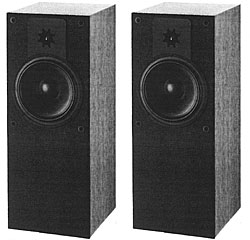 Audio journalists tend to wander the corridors of a CES in a minor state of shell-shock. There are no carnival-barkers outside the rooms enticing one to enter (not yet, at any rate), but the sounds and reputations oozing from the open doorways yield little to the "hurry, hurry, hurry" crowd. The Signet room has always, it seems, been one of the quieter oases, often eschewing sound altogether while contentedly displaying their phono cartridges, cables, and various accessories. On a recent CES hunt, I was therefore intrigued to find them demonstrating two new loudspeakers, of all things, to the milling throngs.


 Now Hear This (NHT) was founded to produce low-cost loudspeakers a breed apart from the mass-market variety often found at the lower price points. Co-founder Ken Kantor has a long history in the hi-fi business as a designer at Acoustic Research, NAD, and as a design consultant to some large Japanese manufacturers. NHT's line ranges from the $180/pair Model Zero to the $1200 Model 100.
At $480/pair, the Model 1.3 is midway in NHT's product line. Finished in a gloss-black high-pressure laminate, the 1.3 is elegant, even beautiful, and is distinguished by its unusual angled front baffle. This design means that the rear baffle is nonparallel to the driver, thus reducing the amount of internal cabinet energy reflected back toward the woofer. This is said to improve imaging and midrange purity by reducing comb filtering. In addition, the angled baffle puts the listener directly on-axis with the loudspeakers pointing straight ahead. This increases the ratio of direct-to-reflected sound reaching the listener and further improves imaging.
Now Hear This (NHT) was founded to produce low-cost loudspeakers a breed apart from the mass-market variety often found at the lower price points. Co-founder Ken Kantor has a long history in the hi-fi business as a designer at Acoustic Research, NAD, and as a design consultant to some large Japanese manufacturers. NHT's line ranges from the $180/pair Model Zero to the $1200 Model 100.
At $480/pair, the Model 1.3 is midway in NHT's product line. Finished in a gloss-black high-pressure laminate, the 1.3 is elegant, even beautiful, and is distinguished by its unusual angled front baffle. This design means that the rear baffle is nonparallel to the driver, thus reducing the amount of internal cabinet energy reflected back toward the woofer. This is said to improve imaging and midrange purity by reducing comb filtering. In addition, the angled baffle puts the listener directly on-axis with the loudspeakers pointing straight ahead. This increases the ratio of direct-to-reflected sound reaching the listener and further improves imaging.