Floor Loudspeaker Reviews

Sort By:  Post Date TitlePublish Date

Bowers & Wilkins 802 D3 Diamond loudspeaker

"This is getting to be a habit."

That's how I ended the first paragraph of my review of Bowers & Wilkins' 800 Diamond speaker, in the May 2011 issue; apparently, Stereophile's habit of reviewing models from B&W's 800 series remains unbroken.

Later in that review, I said that "The 800 Diamond doesn't look radically different from its predecessors." That doesn't apply to the 802 D3 Diamond ($22,000/pair). It's still a three-way system with tapered-tube high-frequency and midrange enclosures, stacked and nestled into a generous bass enclosure that's vented on the bottom into the space between it and its plinth.

Marten Coltrane 3 loudspeaker

Marten is a small Swedish loudspeaker manufacturer with great aspirations, some of which the company has largely met. Leif Mårten Olofsson founded Marten and designs the speakers, while brother Jörgen Olofsson runs the business as CEO—a division of creative and administrative labors similar to the working relationship between David and Norman Chesky, the founders of Chesky Records and HDtracks.

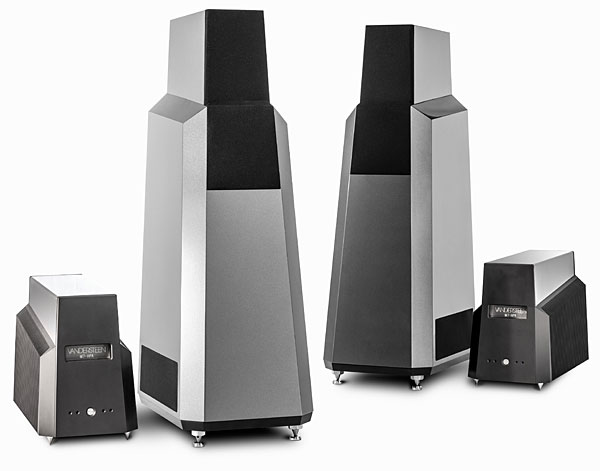
Vandersteen Model Seven Mk.II loudspeaker & M7-HPA monoblock power amplifier

Driving the Model Sevens at the 2014 CES were Vandersteen's then-new M7-HPA monoblocks, which provide a high-pass–filtered output (above 100Hz) to the upper-frequency drive-units of the Model Seven. At the time, I made a note to myself that I would like one day to try these amplifiers with the Sevens in my own room. That opportunity came later rather than sooner, after Vandersteen had updated the Model Seven to Mk.II status.

Wilson Audio Specialties Sabrina loudspeaker

I first encountered the work of Dave Wilson in the late 1970s. He was then a recording engineer responsible for some great-sounding records, including pianist Mark P. Wetch's Ragtime Razzmatazz (LP, Wilson Audio W-808), which quickly became one of my favorite system-demo records.

Then Wilson turned his attention to designing loudspeakers. His first model was the Wilson Audio Modular Monitor, reviewed for Stereophile by its then-publisher, Larry Archibald, in August 1983, who described it as "the most enjoyable speaker system I've listened to, and significantly valuable as a diagnostic tool." At $35,000/pair ($83,577 in today's dollars), the WAMM may have been the most expensive speaker then on the market.

Metaphor 2 loudspeaker

"Wow!" Jerome Harris—jazz guitarist, bassist, and composer—stopped talking and listened intently to the rough-mixdown dub of his latest album, Hidden in Plain View: The Music of Eric Dolphy (New World 80472-2 CD) (footnote 1). He'd brought it by my house in order to hear it on another system before pronouncing judgment. "That sounds like us! And I ought to know because I was there..."

It wasn't the first time the Metaphor 2s had totally transfixed a visitor with their accurate portrayal of a musical event. This time, however, they'd done it to one of the participants of that specific performance. It isn't as if it was easy stuff to disentangle, either. Jerome's disc is texturally dense: Marty Ehrlich and Don Byron on reeds, Ray Anderson on trombone, E.J. Allen on trumpet, Bill Ware on vibes, Bobby Previte on drums, and Jerome himself on acoustic bass guitar—occasionally all wailing away simultaneously. The Metaphor 2s have the articulation to sort out all of those interweaving melody and rhythm lines, the frequency balance to render them with astonishing timbral veracity, and the speed to ensure that, even with four drivers in a large enclosure, it all arrives at the same time and with swing aplenty. Does it sound as though I'm describing one hell of a speaker? I think so anyway.

Beveridge 2SW loudspeaker system

This is an electrostatic column speaker, 6' tall and costing $6000/pair. An integral, fan-cooled amplifier is located in the base. The 2SW is said to cover almost the entire frequency range and is based on a patent, number 3,668,335, issued to manufacturer/designer Harold Beveridge on June 6, 1972. Internal acoustic lenses in front of the electrostatic panels widen the speaker's dispersion: In the Beveridge literature, it says "This 6-foot high device consolidated the entire frequency range into a vertical line source, and uniformly disperses it over a horizontal pattern, 180 degrees wide. The beaming characteristics of the high frequencies are ingeniously translated into the same dispersive pattern as the low frequencies, creating a perfectly balanced cylindrical sound wave front."

YG Acoustics Carmel 2 loudspeaker

For me, one of the highlights of 2013 was being able to live with the Sonja 1.3, the flagship loudspeaker model from Colorado-based YG Acoustics. I reviewed this tall, massive, three-enclosure tour de force of a design, which costs $106,800/pair, in July 2013, and was not surprised when, for the December 2013 issue, Stereophile's writers voted it one of the magazine's two Loudspeakers of the Year. So when I was asked last spring if I wanted to review the new version of the smallest and least-expensive model in YGA's lineup, the request fell on receptive ears.

GoldenEar Triton Five loudspeaker

With each review I've written for Stereophile, I've redoubled my efforts to choose my adjectives prudently—to curb my penchant for overstatement. I've been feeling a need to speak more concisely and maturely about what my ears, mind, and heart experience while listening to music through a component that's new to me. So today, at the start of this review, I ask myself: What adjectives must I use to describe the character of GoldenEar Technology's new Triton Five tower loudspeaker ($1999.98/pair)? Which words will best use our shared audiophile lexicon to give you a working vision of what I experienced?

Acoustic Research MGC-1 loudspeaker

There's virtue in being in the right place at the right time. The right place in this story was the headquarters of Acoustic Research in Boston, MA, and the right time was just a couple of weeks or so before the subject of this piece was to be shown (but not heard) at a press conference in New York. Even within that short two weeks, the rot started to set in. What I saw (and heard) in Boston on that occasion was a loudspeaker that stakes a reasonable claim on being revolutionary. A rare event that. The project name was The Magic Box and I was hoping that is what it might have been called when it went on sale. The Magic Box does, after all, conjure up an image of something a little special, and it's also easy to remember.
Advertisement
Advertisement
Advertisement