

KEF R700 loudspeaker

In the late 1980s, KEF, then as now a leader in bringing new technology to loudspeaker design, developed a unique coincident driver that positioned the tweeter in the throat of the midrange/woofer cone. In a flash of inspiration, they dubbed it the Uni-Q, and the driver immediately not only found its way into the company's more upscale speaker designs, but also became a key element in a major European research project on room acoustics. That study's results appear to have been inconclusive, but the Uni-Q lives on as the defining element of KEF loudspeakers.
 A visiting manufacturer recently told us here at Stereophile of an ongoing informal "survey" he was conducting. He would ask strangers to name three brands of loudspeakers. Their responses were not what I would have expected. They almost invariably named Japanese companiestwo of the most commonly mentioned were Hitachi and Panasonic. Other than my spell-checker insisting that I change "Hitachi" to "hibachi," I have nothing in particular against these two manufacturers; they are well-recognized in many product categories. But loudspeakers? I can only guess that the respondents were dredging up the only consumer electronics companies that came readily to mind.
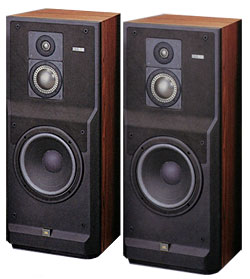
My list for most recognized loudspeaker brands would most certainly have included JBL. How could it not? They have been involved in home high-fidelity since 1954. And for years before that in professional audioprimarily motion picture theater sound, a field in which they are still active. In short, they were around before there was such a thing as "hi-fi."
A visiting manufacturer recently told us here at Stereophile of an ongoing informal "survey" he was conducting. He would ask strangers to name three brands of loudspeakers. Their responses were not what I would have expected. They almost invariably named Japanese companiestwo of the most commonly mentioned were Hitachi and Panasonic. Other than my spell-checker insisting that I change "Hitachi" to "hibachi," I have nothing in particular against these two manufacturers; they are well-recognized in many product categories. But loudspeakers? I can only guess that the respondents were dredging up the only consumer electronics companies that came readily to mind.
My list for most recognized loudspeaker brands would most certainly have included JBL. How could it not? They have been involved in home high-fidelity since 1954. And for years before that in professional audioprimarily motion picture theater sound, a field in which they are still active. In short, they were around before there was such a thing as "hi-fi." I wish I could be enthusiastic about the Acoustat Spectra 11an electrostatic/dynamic hybrid selling for $999/pair. At first glance, the Acoustat Spectra 11 looks like a good deal. They could almost be called knock-offs of the Martin-Logan Sequelsthey're about the same size. As with the Sequels, there are moving-coil bass cabinets below, electrostatic panels on top. The Spectra 11 cannot be bi-wired and does not come with spikes. Tiptoes are recommended, and I used them. I let the speakers run in for about 24 hours before doing any serious listening.
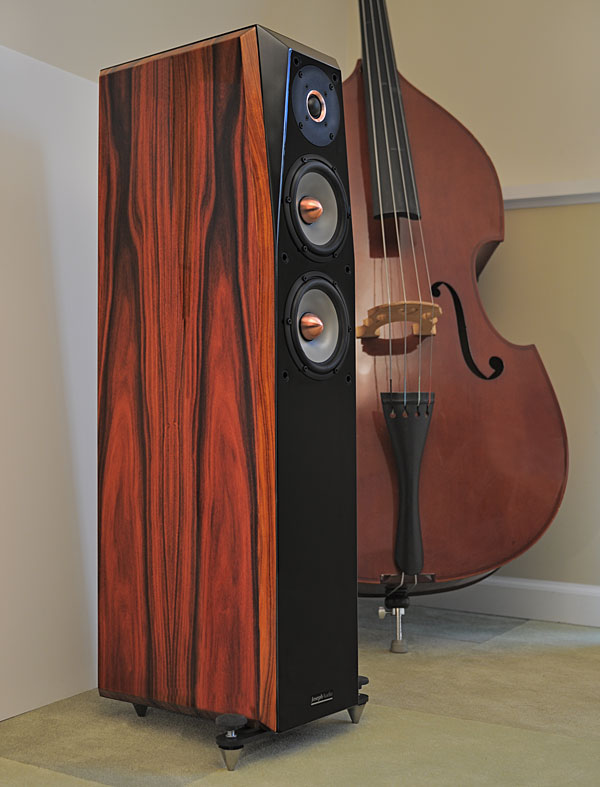

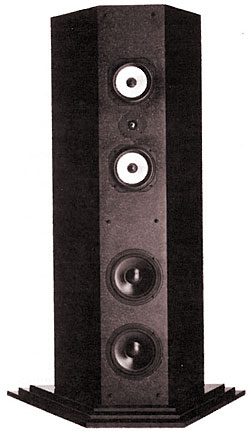 While Clearfield Audio may be a new name to many of you, it represents the marriage of two well-established members of the high-end community: Counterpoint and designer Albert Von Schweikert. Counterpoint had been working to add speakers to its product lineup for some time. The partnership with Von Schweikert, whom Stereophile readers will remember as the designer of the Vortex Screen favorably reviewed by Robert Harley in July 1989, fills out Counterpoint's high-end product line from sourcethe company showed a CD transport at the June 1993 CESto speaker.
The Metropolitan
While Clearfield Audio may be a new name to many of you, it represents the marriage of two well-established members of the high-end community: Counterpoint and designer Albert Von Schweikert. Counterpoint had been working to add speakers to its product lineup for some time. The partnership with Von Schweikert, whom Stereophile readers will remember as the designer of the Vortex Screen favorably reviewed by Robert Harley in July 1989, fills out Counterpoint's high-end product line from sourcethe company showed a CD transport at the June 1993 CESto speaker.
The Metropolitan
 When I saw the Unity Audio Signature 3 speakers ($1895/pair) arrive in one box, I was happy. Not just because it meant there would be that much more space left in my basement. No, because it means that Unity is saving money on packaging costs. That means they can spend more money on things like super-nice crossover components. That means...well, I think you know what that means. After all, any piece of audio gear is only as good as the parts it's made from.
To get these overgrown bookends to stand up, you slide little black boards into the slots in their bottoms. Each board is held in place by two set screws, and sticks out to support the speaker with two of the four spikes. The board also tilts the speaker back a little. How do they get sufficient bass out of such slim cabinets?
When I saw the Unity Audio Signature 3 speakers ($1895/pair) arrive in one box, I was happy. Not just because it meant there would be that much more space left in my basement. No, because it means that Unity is saving money on packaging costs. That means they can spend more money on things like super-nice crossover components. That means...well, I think you know what that means. After all, any piece of audio gear is only as good as the parts it's made from.
To get these overgrown bookends to stand up, you slide little black boards into the slots in their bottoms. Each board is held in place by two set screws, and sticks out to support the speaker with two of the four spikes. The board also tilts the speaker back a little. How do they get sufficient bass out of such slim cabinets?