Floor Loudspeaker Reviews

Sort By:  Post Date TitlePublish Date

Focal Diva Utopia Wireless Streaming Active Loudspeaker

What if there was a character in Stanley Kubrick's classic movie 2001: A Space Odyssey who was an audiophile? Aboard the Discovery One interplanetary space ship, what would his system look like? He'd probably have a pair of ultramodern speakers that could pluck sound out of the ether. He'd control the system with something like a present-day smartphone or tablet, commanding the HAL 9000 computer to play his favorite songs. The speakers would stand unobtrusively in a white room with 1970s modern-minimalist furniture, no rack of components to drive them, no wires connecting them, no shelves of physical media to play. And they would fill the room with music.

I am sitting earthbound in my living room almost a quarter-century beyond the year 2001, living a similar scenario with the Focal Diva Utopia streaming amplified wireless speaker system. My living room is not at all reminiscent of the Discovery One with its rotating central interior (footnote 1). But with the Diva Utopia system, I feel more in a sci-fi future young me might have imagined than with any hi-fi component I've reviewed so far. About the only thing the Diva Utopia has in common with the stereo systems I grew up with—and with my current reference system—is two floorstanding cabinets and diaphragms that move air to make sound.

MoFi Electronics SourcePoint 888 loudspeaker

A recent high point in my career as a reviewer was writing about the MoFi Electronics SourcePoint 10 standmount loudspeaker for the February 2023 issue of Stereophile. Priced at $2999/pair, the two-way SourcePoint 10 featured an innovative 10" coaxial (HF/LF) drive unit and impressed me with its clean, superbly well-defined low frequencies, natural-sounding midrange, and the ability to play loudly without strain.

The SourcePoint 10 was the first MoFi speaker to be designed by Andrew Jones, whose earlier designs for KEF, Infinity, Pioneer, TAD, and ELAC had all taken up residence in Stereophile's Recommended Components listings over the years. The second of Andrew's designs for MoFi was the SourcePoint 8, which was favorably reviewed by Kalman Rubinson in September 2023. Priced at a competitive $1999/pair, the SourcePoint 8 also used a coaxial drive unit, but as the name suggests, the woofer diameter was 8" rather than 10". KR was also impressed by what he heard, writing that the SourcePoint 8 was a balanced, wide-range speaker that demonstrated how satisfying a small, relatively affordable loudspeaker can be.

Now we have Andrew Jones's third design for MoFi, the floorstanding SourcePoint 888, which costs $4999/pair.

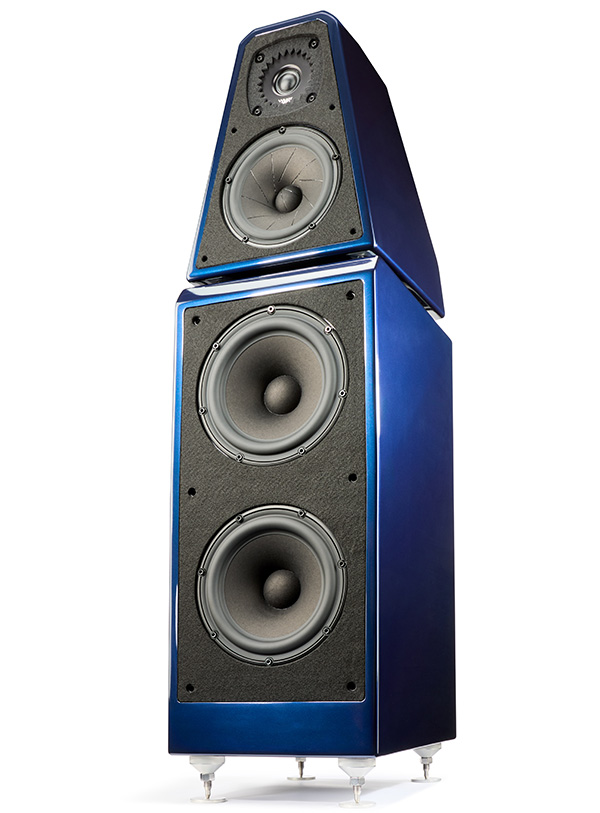
Wilson Audio Specialties The WATT/Puppy Loudspeaker

Since the original WATT/Puppy concept kicked off in the late 1980s, there has been a 40-year evolution leading to the latest version reviewed here. The loudspeaker's price in 2025 is around $40,000/pair compared to the original's $8000. While inflation alone would have lifted the price to $25,000/pair, the current price takes into account the many technological and design improvements. While remaining physically separable, the upper "WATT" (Wilson Audio Tiny Tot) component, namely the head unit of the latest design, can no longer be run as a small full-range loudspeaker in its own right. This is because the mid/treble crossover, which was originally in the WATT, is now relocated to the lower "Puppy" section. Certainly, that original two-box "full range," strongly sculpted WATT/Puppy stack radically broke the mold in deviating from those rather plain, coffin-shaped tower loudspeakers that were popular in this category.

The late David Wilson originally created the WATT as a shelf-mount studio monitor to help produce his recordings. At the time, this compact two-way promised near–state-of-the-art sound quality, especially transparency, indicative of very low self-noise. This quality also helped to maximize dynamic range and contrast. Later, David used the WATT as the foundation for a three-way floorstanding design by matching it to a low-frequency system (the Puppy), which also stood in as a physical platform for the WATT. This idea became reality in the successful W/P line of bass augmented systems.

Estelon X Diamond Mk II loudspeaker

Taste is a funny thing. Love cilantro? Millions swear it tastes like soap. Similarly, design cognoscenti will gush over a minimalist Scandinavian sofa that others dismiss as just a pricey plank with delusions of grandeur.

There's no accounting for taste, or so the truism goes. But arguing over preferences is exactly what many audiophiles do. Similarly, Stereophile reviewers are all about parsing and evaluating sound, and how a product looks isn't usually a big part of the equation. But I'll buck that convention and say that the radically shaped Estelon X Diamond Mk IIs aren't just the most visually sublime speakers I've laid eyes on; they ought to be part of the Cooper Hewitt Museum's permanent collection. Or MOMA's.

Sonus faber Sonetto V G2 loudspeaker

Here's a hard truth: A written review of a full-sized speaker—any speaker, really—is, at best, semi-useful. We all listen differently, we have different musical tastes, our system electronics are different, and our listening rooms vary a lot. You will gain a general picture of a speaker's capabilities and foibles from John Atkinson's measurements, and I can tell you how the speakers sound to me, in my room. But that's it. You need to hear them for yourself before making a buying decision. The best I can do is tell you how my music brain felt when the speakers were in my house and making music.

But hey, that's better than nothing. If you're in the market for a pair of modestly sized, reasonably priced floorstanding loudspeakers, I encourage you to read on as I describe the lively musical times I spent with the Sonus faber Sonetto V G2s ($6499/pair).

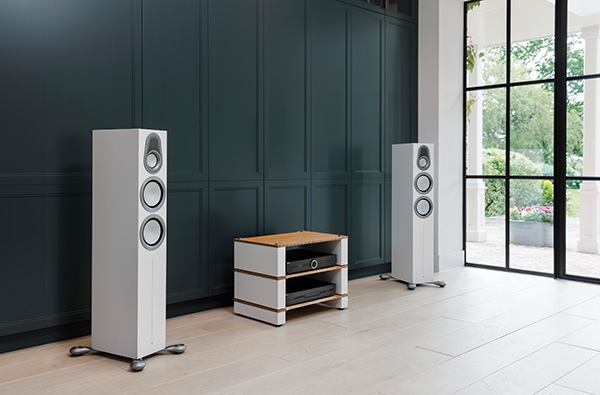
Monitor Audio Gold 300 6G loudspeaker

An ancient connection: Monitor Audio began in 1972 when John Bartlett, founder of the innovative retail chain Audio T, introduced me to Mike Beeny, manager of an Audio T branch near Cambridge, and Mo Iqbal, a local electronics wizard. Mike suggested that Mo and I join him to start a loudspeaker company. Monitor was a fashionable hi-fi term, and I suggested we name it Monitor Audio Ltd. Each director put £300 into the company account. It was registered as a PLC at an address in Teversham, Cambridgeshire. We rented an upper floor office in a warehouse close to Mo's home, since Mo worked all hours. There was additional workspace in his huge double garage. Mike directed sales, Mo was responsible for production management and accounts, and I took the position of technical director for research and development. I also helped supervise production. Lorna Parker was our office secretary.

After launching a handful of increasingly viable designs, we reached a then-astonishing turnover of £1 million in our first year and enjoyed a very successful showing at the Paris Festival du Son. But by this point, I was close to an overwork-related breakdown and reluctantly resigned.

Avantgarde Duo SD iTRON G3 active loudspeaker

Active speakers make sense. The amplifiers, crossovers, and drivers are designed as a unit, so the design isn't compromised by the need to interface with components with unknown electrical or acoustical characteristics (except for the room, and that can't be helped). Concurrent design and testing of the various pieces can result in an integrated, through-designed system. Plus, the elegant simplicity that active speakers bring to a system just appeals to me.

Like many audiophiles, I've found myself intrigued by the variety of approaches that are taken to achieve the same goals: point source, line source, panels, horns. Whenever I've heard horns paired with a flea-powered amp, the dynamics have always impressed. I've consistently heard a jump factor that makes music feel remarkably alive. The combination of these two traits, though—horns plus active—is quite rare.

SVS Ultra Evolution Pinnacle loudspeaker

How many times have you been told by parents and teachers that everything successful must be built on a strong foundation? It's true in music, where the low frequencies are the foundation the music rests on, like the basement framing a building. If you get that part wrong, where are you? Sitting in the mud, that's where. With no chance to address beauty in the midrange, texture and air above, or other tasty things.

Youngstown, Ohio–based loudspeaker manufacturer SVS made foundations its specialty, starting at the company's very beginning in 1998, when it started by designing subwoofers and only subwoofers. The company didn't start offering regular loudspeakers, with midranges and high frequencies, until 2012. Over time, SVS's high-value speakers got more ambitious until earlier this year, at AXPONA, it introduced its most ambitious loudspeaker yet, the full-range, three-way Ultra Evolution Pinnacle ($4999.98/pair).

Piega Coax 811 Gen2 loudspeaker

It's funny how we discover some music in unexpected, twisting ways. A friend recently sent me the real estate listing for a beautiful home in Deer Isle, Maine, about an hour from where I live. I gawked at the pictures and calculated I'd need to work for Stereophile for another 127 years before I'd have enough dough to buy it. Then I noticed something unusual on one of the walls of the place: lots of gold records. Google helped me figure out that the house had belonged to the late singer-songwriter Dan Fogelberg. I knew the name but was unfamiliar with his music. Minutes later, I was playing the studio version of "Nether Lands," seemingly named after my country of birth. A beautifully orchestrated piece with restrained woodwinds and soaring strings, it reminded me of the best of Van Dyke Parks and of some post–Pet Sounds Brian Wilson songs. I played it straight through three times.

Part of the reason I was so smitten with the recording lay in the engaging, naturalistic presentation it received from the handmade-in-Switzerland Piega Gen2 811 floorstanders ($30,000/pair) that had just made their way to my listening room.

Dynaudio Contour 30i loudspeaker

Ah, Denmark. Land of the Vikings and blue-eyed, blond-haired folk with faces sculpted just so. I loved my week there as a Stereophile correspondent and member of a scraggly scrum of audio journalists whisked to DALI headquarters on a promotional junket.

Aside from its universal attractiveness, what struck me during my stay in the southernmost and smallest of the Scandinavian countries was how by North American standards the more densely populated cities I visited, Copenhagen and Aarhus, seemed orderly and clean. Cars, pedestrians, and cyclists kept tightly to their lanes. I saw no cigarette butts on the sidewalk and only sparse pockets of graffiti. There seemed to be a natural, sequential flow to everything—an evenness and balance that was close to idyllic.

Outside its bigger cities, Denmark looks pastoral, with long stretches of grassy fields sporadically interrupted by broad bodies of water, and bucolic towns that seem to have sprouted in the middle of nowhere. It's in these towns that a lot of Danish hi-fi is made: DALI in Nørager (population 1143); Dynaudio in Skanderborg (population 20,000). Skanderborg contains evidence of human settlements belonging to the earliest Nordic Stone Age, starting some 100,000 years ago.

Dynaudio doesn't go back quite that far; the company was founded in 1977...

Advertisement
Advertisement
Advertisement