Historical

Sort By:  Post Date TitlePublish Date

The Horse's Mouth (Stereo Review's 1983 cable tests)
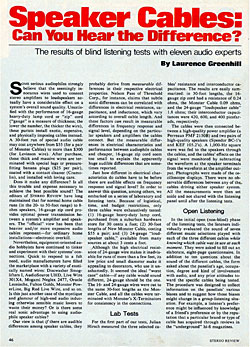
It's not often that you get a chance to have extensive discussions with the horse's mouth, but we recently had that opportunity. Since July of this year there has been extensive discussion in the audio community, particularly the high-end segment, of Larry Greenhill's article">http://bruce.coppola.name/audio/Greenhill.pdf">article on speaker cable listening tests in the August, 1983 issue of Stereo Review (footnote 1). From recent talks with author Greenhill we've learned that the most interesting story was not in Stereo Review; instead it can be found in the varying reactions from different quarters, and what they say about the high-end industry in general.
The Smaller Advent loudspeaker

One day last year, my friend Larry and I were talking about our college-fraternity days and loudspeakers. Those were four of the best years of my life. Strong friendships were formed, and ever since, we've kept in touch with most of our fraternity's brothers-in-heart. Ours was not a jock house, nor was it the last bastion of rampant male sexuality—it was, after all, an MIT frat house. But it was full of music lovers who fell neatly into three camps: the California School owned JBL Decades, the New England School had Smaller Advents, and the Renegades boasted bootlegged Bose 901s (footnote 1).

The Sound of Transistors

Editor's Note: Those of us who cut our engineering teeth on tubes still remember the advent of the solid-state amplifier with mixed feelings. Yes, they were lighter and cheaper per watt than the thermionic hulks we loved so much, but they broke all the time (thanks to the germanium transistor) and sounded like—well, let J. Gordon Holt tell us what they sounded like in an "As We See It" article from Vol.1 No.10, first published in May 1965. We also develop the theme with a JGH review of an early transistorized amp, as well as a selection of readers' letters from the early days of Stereophile. Enjoy.John Atkinson

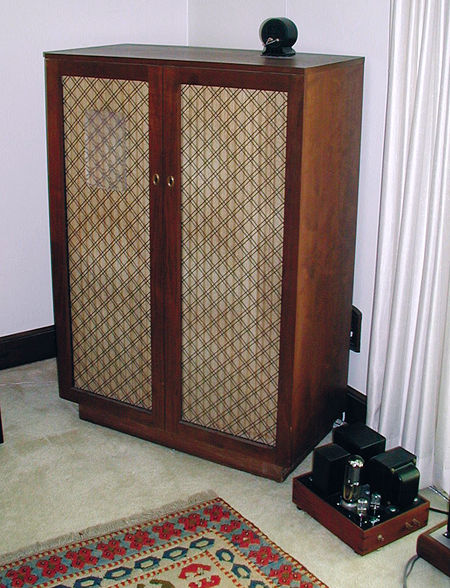
Watkins WE-1 loudspeaker

First I should clear up what may be an ambiguity in the driver-lineup spec for these speakers. In each system, three 8" cone units serve as woofers. Two of these crossover from the midrange drivers at 100Hz. Crossover to the third 8-incher, the subwoofer, is at 40Hz. Thus, two woofers are active from 100Hz down to 40Hz, and all three are active below 40. In other words, the third woofer does not come into play until the frequency drops to the point where the radiating area of two 8-inchers starts to become inadequate for moving air, at which point the additional area of the third speaker is thrown in. Below 40Hz, all three are working together.

Bozak Concert Grand B-410 loudspeaker

The Bozak Concert Grand is a loudspeaker dreams are made of. I was just a boy, but I remember to this day the impressive pictures of them in Audio magazine. I thought they must be the best loudspeakers ever made because they were so big—they would let more of the music come out. I suspect the Bozaks beckoned to me in some primal way, just as those giant construction trucks do—the ones that have tires bigger than a man.

Fisher 500-C vintage stereo receiver

Back in 1964, Avery Fisher, founder and president of the Fisher Radio Corporation, wrote a short note for the 500-C Stereophonic FM Multiplex Receiver owner's manual. In that note he said, "a door has opened for you, and your family, on virtually unlimited years of musical enjoyment."

How to Write an Ad

Everyone knows that advertising people make more money than ordinary people, but many assume that the high pay is because ad writing is so difficult. This is not true. Low-income people can write advertisements, too, so just in case somebody should accost you on the street and ask you to write an advertisement, here is how you may go about it.

A New Size For Stereophile

By now you've no doubt realized that Stereophile has changed its size—from 5½" by 8 7/16" to 7½" by 10¼". (All right—maybe you didn't know the exact dimensions of the change, but that's what they are.) We have Edward Chen, Publisher of Stereophile's Chinese edition, to thank for our new size. It is the same size as the Chinese Stereophile and a common size in the Far East. We've been admiring it in Chinese for the last two-and-a-half years, and we thought it would make sense in English as well.

Advertisement
Advertisement
Advertisement