Historical

Sort By:  Post Date TitlePublish Date

Infinity Servo-Statik 1 loudspeaker

An equipment reviewer for one of the consumer hi-fi magazines once confided to a manufacturer that he found it hard to like electrostatics because of the kind of people who usually like electrostatics. His implication—that certain kinds of people gravitate towards certain kinds of sound—is an interesting thought, and one that might bear some further investigation. But there is no questioning the fact that electrostatic speakers in general do have a particular kind of sound, that might be characterized as "polite."

B&W Matrix 801 Series 2 loudspeaker

Since the introduction of the original B&W 801 monitor loudspeaker in 1980, it has been adopted as a reference by several recording studios around the world, Over the past five years, I have seen 801s present in just about every recording session with which I have been artistically involved. While the original 801 monitor had its strong points, I was never satisfied with the detached and muddy-sounding bass, discontinuous driver balance, and low sensitivity. Unless this speaker was driven by an enormous solid-state power amplifier, with an elevated high-frequency response, the tubby and slow bass response often obliterated any detail in the two bottom octaves of musical material.

Audio Research SP9 preamplifier

Following the introduction of their very expensive, tube/FET hybrid SP11 preamplifier, there were rumors that Audio Research was working on a hybrid tube/transistor preamplifier targeted to cost less than $2000. The rumors were confirmed when ARC showed a black-and-white photo of the SP9 at the 1987 Winter CES. Obviously, like all magazines, we were impatient to receive a review sample, but the first review of the SP9 actually appeared in the summer '87 issue of Peter Moncrieff's IAR Hotline. Peter's review was almost intemperately enthusiastic, comparing the SP9 positively with early samples of the SP11 and suggesting that its sound quality was considerably better than would be expected from its $1695 asking price. Naturally, we were anticipating good things when our review sample arrived in Santa Fe in late July.

MartinLogan CLS loudspeaker

The quest for a full-range electrostatic loudspeaker has occupied many engineers' minds for many years. The problems are manifold: large physical size (which can lead to room placement problems and poor dispersion), the difficulty of achieving high sound pressure levels, the need for a potentially sound-degrading step-up transformer, and the unsuitability for production-line manufacture. Even so, the potential rewards are so great that one can understand why loudspeaker designers keep on attempting the apparently impossible. Epoch-making models do appear at infrequent intervals, keeping the flame burning since the appearance of the original Quad in 1955: Acoustat, Sound Lab, and Beveridge in the US, Stax in Japan, Audiostatic in Holland, Quad, of course, in England, and now MartinLogan.

Bose 901 loudspeaker

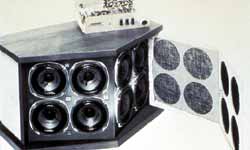
The Bose 901 has created more of a stir in audio circles than any other loudspeaker we can think of, with the possible exception of the original Acoustic Research system. Much of the 901's popularity is attributable to Julian Hirsch's rave report in Stereo Review, and there is no doubt but that Amar Bose's compellingly convincing ads had their effect, too. But these things alone could hardly account for the 901's popularity.

Quad ESL-63 loudspeaker

Warning to Purists: Despite certain qualities about the ESL-63 speakers which you will probably like, Quad equipment is not designed primarily for audiophiles, but for serious-music (call that "classical") listeners who play records more for musical enjoyment than for the sound. Quad's loudspeakers do not reproduce very deep bass and will not play at aurally traumatizing volume levels, and Quad's preamplifier is compromised through the addition of tone controls and filters, all for the purpose of making old, mediocre, and/or worn recordings sound as listenable as possible.

Celestion SL700 loudspeaker

"Who Stole The Bass?" asked Anthony H. Cordesman, writing about minimonitors in the April/May 1987 Stereophile (Vol.10 No.3). And for the designer of a box loudspeaker, the fundamental design decision, at any price level, is how much bass extension to aim for. It will always be possible to design a speaker with extension down to 20Hz, but will the result be musically and commercially successful? Will the designer end up with a speaker hypertrophied in that one area at the expense of every other? Will, indeed, the result be feasible technically? For example, for a given cabinet volume, gains in low-frequency extension have to be balanced against corresponding drops in sensitivity, and it is quite possible that to go for 20Hz extension will result in a 60dB/W/m sensitivity, equating with a speaker that only plays extremely quietly, and thus of no use to anyone.

Quad 405 power amplifier

This is something we don't see too often: an entirely new approach to power amplifier design. As Quad points out in its literature for the 405, class-A operation of transistors provides the lowest distortion, but drastically limits the amount of power an output transistor can deliver without overheating. (Most transistor amps use class-AB output operation, in which each of a pair of power transistors handles part of each signal cycle and shuts down during the other part. Imperfect synchronism between the two halves causes the familiar "crossover distortion," which accounts for most solid-state sound. In class-A operation, each output transistor draws current though the entirety of each signal cycle, eliminating the crossover transition but doubling the amount of time current is drawn, and thus tending to cause the transistor to heat up more.)
Advertisement
Advertisement
Advertisement