Historical

Sort By:  Post Date TitlePublish Date

The Blind leading the Deaf

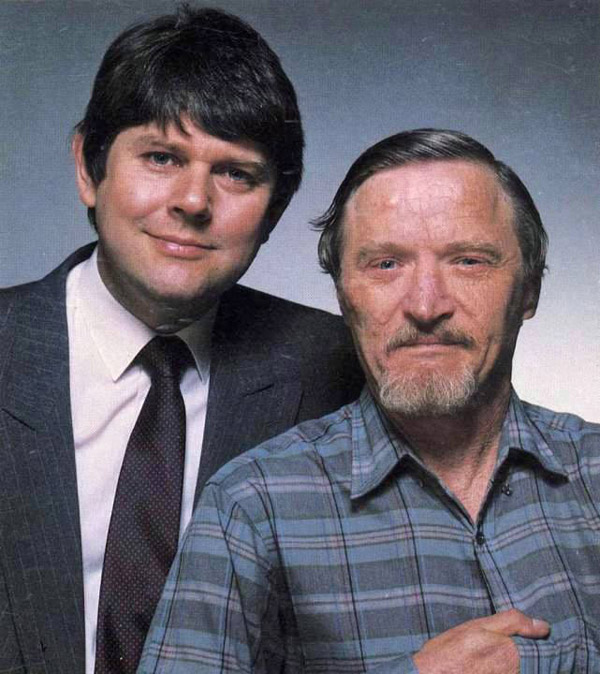
As the person who "invented" subjective testing, I have followed with great interest the many articles in the mainstream audio press which purport to prove that none of us can really hear all the differences we claim to hear, particularly those between amplifiers. My reaction has usually been: "Why didn't they invite me to participate? I would have heard the differences under their double-blind listening conditions." I could make that assertion with supreme confidence because I had never been involved in any such test.

I Have Heard the Future...(DSP Room Acoustics Correction)

Dateline—Chicago, May 30, 9:00pm. Exploding fireworks lit up the sky above the Chicago river as 200 leading high-end designers gathered in the Hotel Intercontinental for Stereophile's 30th Anniversary banquet. After a repast of four gourmet courses and five wines, the time came for after-dinner speeches to celebrate Stereophile's past and high-end audio's future. Publisher">http://www.stereophile.com/asweseeit/593">Publisher Larry Archibald described his adventurous transition from the high-end car business to risky publishing. Introducing J">http://www.stereophile.com/historical/712">J. Gordon Holt, he praised JGH's uniquely lucid writing and his unflinching insistence that equipment designed to reproduce music should be judged on its ability to do just that—the unconventional view that launched high-end audio.

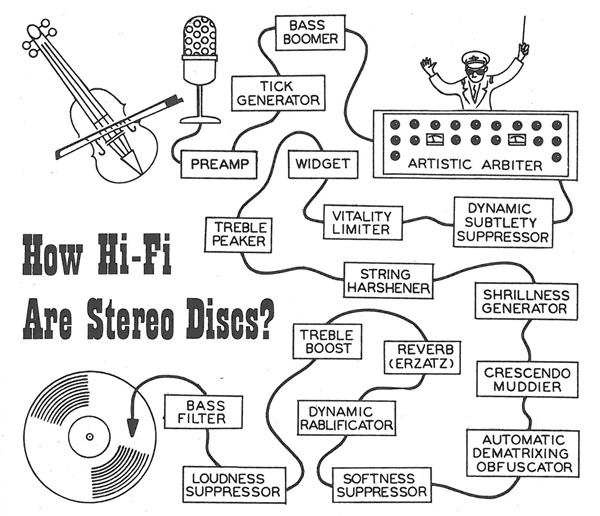
How Hi-Fi are Stereo Discs?

Editor's Note from 1992: This seminal J. Gordon Holt essay on how the art of recording natural sound became compromised in favor of unmusical artificiality for good commercial reasons was originally published in August 1964, in Vol.1 No.8. Though most people these days listen to classical music from CDs, not LPs, in the intervening decades, recording technology has not changed for the better as much as one might have hoped. Nevertheless, the days of wretched multimiking excess described by Gordon are past, and it's rare to find the music treated with the lack of respect typical of a mid-'60s Columbia session. Although some of the smaller companies—Reference Recordings, Delos, Chesky, Mapleshade, Dorian, and Sheffield Lab in the US; Meridian, Nimbus, and Hyperion in the UK—consistently use honest, minimal miking, it is not unknown for the majors in the '90s to do likewise. And the use of time delay for spot microphones, pioneered by Denon in the mid-'80s, means that instruments that might tend to become obscured at orchestral climaxes can now be brought up in level without unnaturally time-smearing the sound. I still find it sad, however, that it is rare to hear the sheer dynamic range of a live ensemble successfully captured on a commercial recording.—John Atkinson

Ralph—The Real Dog

Ralph died last week (September 11, 1991), his great and faithful heart stopped in the aftermath of an affliction not too uncommon for older, larger dogs—a gastric torsion. He was approximately 12 years old.

Dahlquist DQ-10 loudspeaker

The Dalhquist DQ-10 loudspeaker has not as yet been formally submitted for review. (The designer tells us he is still working on the low end.) We auditioned a pair at the one local dealer we could find who had the DQ-10s on demo, and were immensely impressed. Obviously, Jon Dahlquist is on to something that other speaker designers have been overlooking, for, despite the multiplicity of driver speakers in the system, the DQ-10 sounds like one big speaker. There is no awareness of crossovers or separate drivers (except at the low end, about which more subsequently), and the overall sound has a degree of focus and coherence that is surpassed only by the Quad full-range electrostatic, which don't go as low at the bottom or as far out at the top.

35 Years...And Just Getting Started

Thirty-five years ago this month, the first issue of a new">http://www.stereophile.com/features/708">new audio magazine—cover price 50 cents—cautiously made its way out of a Philadelphia suburb. Its black'n'white cover featured a chessboard adorned with tubes and XLR plugs. Its 20 advertising-free pages included a feature on how">http://www.stereophile.com/historical/108">how to write an ad for an audio product, which had been penned by one Lucius Wordburger, a footnote helpfully pointing out that this was the nom de plume for one J">http://www.stereophile.com/historical/712">J. Gordon Holt, "who wishes to remain anonymous."

The Horse's Mouth (Stereo Review's 1983 cable tests)

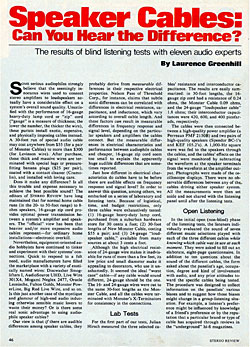
It's not often that you get a chance to have extensive discussions with the horse's mouth, but we recently had that opportunity. Since July of this year there has been extensive discussion in the audio community, particularly the high-end segment, of Larry Greenhill's article">http://bruce.coppola.name/audio/Greenhill.pdf">article on speaker cable listening tests in the August, 1983 issue of Stereo Review (footnote 1). From recent talks with author Greenhill we've learned that the most interesting story was not in Stereo Review; instead it can be found in the varying reactions from different quarters, and what they say about the high-end industry in general.

Advertisement
Advertisement
Advertisement