J. Gordon Holt

Sort By:  Post Date TitlePublish Date

Recording of August 1980: Capriccio Italien & Capriccio Espagnol
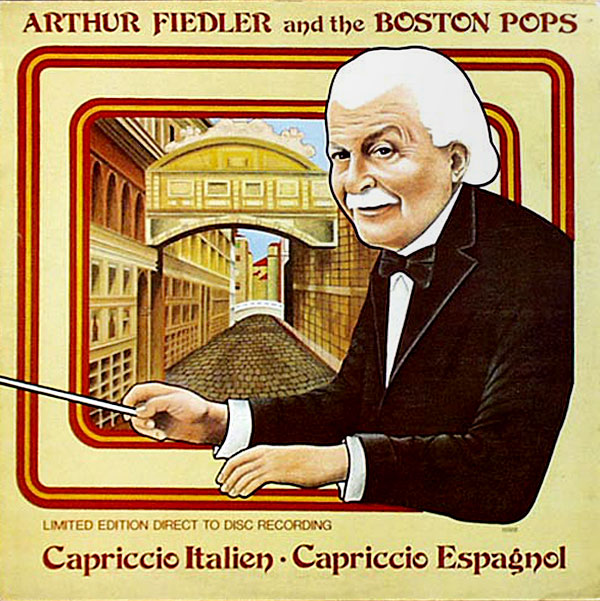
TCHAIKOVSKY: Capriccio Italien
RIMSKY-KORSAKOV: Capriccio Espagnol

Boston Pops conducted by Arthur Fiedler.
Crystal Clear CCS-7003 (Direct-cut LP). Ed Wodenjak, prod.; Bert Whyte, eng.; George Piros, Richard Simpson, Stan Ricker, mastering; John Meyer, special equipment; John Curl, console design.

One of Crystal Clear's earlier releases (1978), this has very distant, directionally vague sound, but the sound (stupendous by standards of only a few years ago) cannot stand in the way of two of the most exciting performances of these potboilers that have ever been committed to disc.
Controversy: The Single Speaker Dem Myth

The issue is this business of "single-speaker" listening and demonstration, which has become fashionable in the UK.

The premise: bringing a second pair of loudspeakers into your auditioning room upsets the sound of the pair you're listening so badly that the first speaker's ability to correctly reproduce the timbre of musical instruments is destroyed. This observation is almost surely correct.

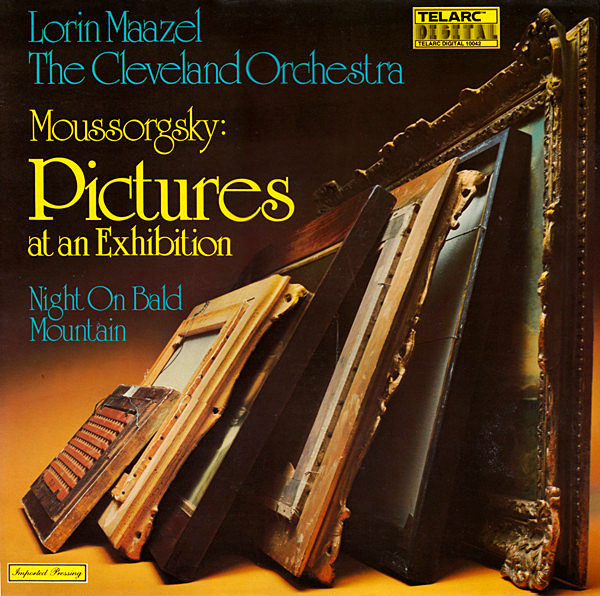
Recording of June 1980: Pictures at an Exhibition, Night on Bald Mountain

MOUSSORGSKY: Pictures at an Exhibition, Night on Bald Mountain
Cleveland Orchestra, Lorin Maazel, cond.
Telarc 80042 (LP). Recorded at Masonic Auditorium, Cleveland, OH. Edited at Soundstream, Inc. Mastered at JVC Cutting Center. Robert Woods, prod.; Jack Renner, eng.; Stan Ricker, mastering eng. DAA.

This is unquestionably the best recording Telarc has done to date. It is almost impossible to fault. If I were to pick nits, I would complain about a slight lack of air in the strings. The rest is, simply, superlatives!

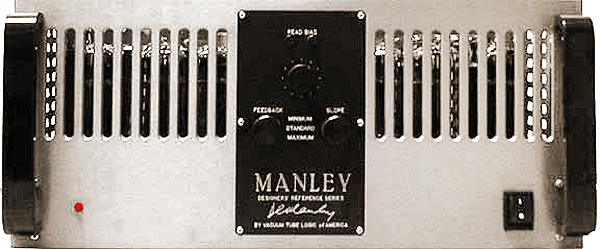
VTL/Manley Reference 350 power amplifier

Manley is not a new company; it's the last name of the president and chief designer of VTL, David Manley, whose Model 300 has been my reference standard power amp for the past two years. In fact, Manley is not even a new brand name; it's the name of VTL's "deluxe" line of electronics, built (ostensibly) to industrial standards of ruggedness and reliability.

It's customary to think of "the tube sound" as being warm, rich, weak through the deep bass, fat through the midbass, forward through the midrange, bright through the middle highs, and soft at the extreme top, with superb rendition of depth and spaciousness. The "solid-state sound," by contrast, is generally thought to be cool, detailed, and pristine, with powerful deep bass, controlled midbass, rather reticent (laid-back) midrange and mid-highs, and a somewhat crisp high end, with variable (roulette-style) reproduction of depth and spatiality.

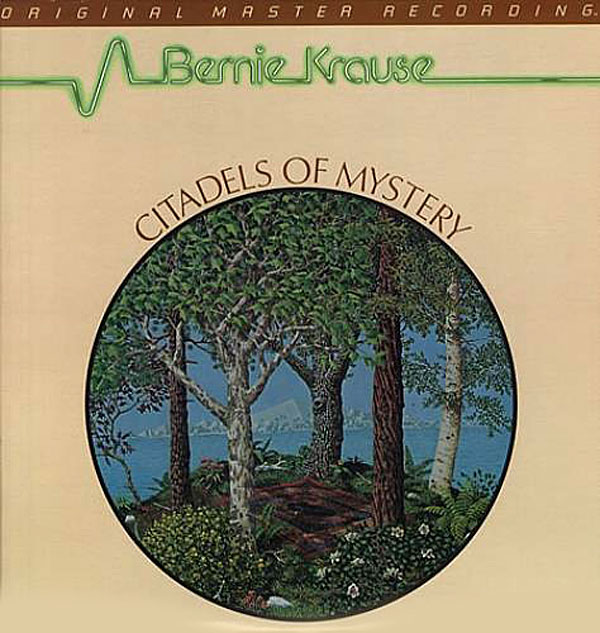
Recording of November 1981: Citadels of Mystery

Bernie Krause: Citadels of Mystery
Mobile Fidelity MFSL 1-505 (LP).

This is a very hyped, contrived recording, but then nobody ever pretended that this kind of musical construction was supposed to approximate the sound of a live performance. The strings are quite steely on this but, in all other respects, the recording is is stupendous—unctuously rich, smooth and limpidly clear, with some awesomely taut low end and cuttingly crisp percussion sounds.

Don't Tell Your Friends!

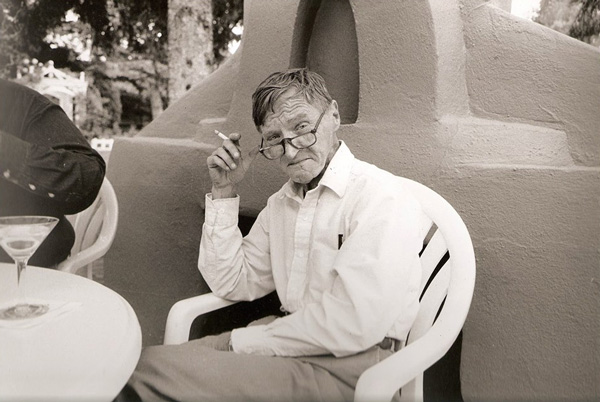
Stereophile's founder, J. Gordon Holt, photographed toward the end of his life by Steven Stone.

Editor's Note: The forthcoming August 2017 issue of Stereophile is No.451, but 55 years ago this summer, J. Gordon Holt was putting together the first issue of what initially was to be called The Stereophile. Here is Gordon's editorial leader from that issue, published in November 1962.

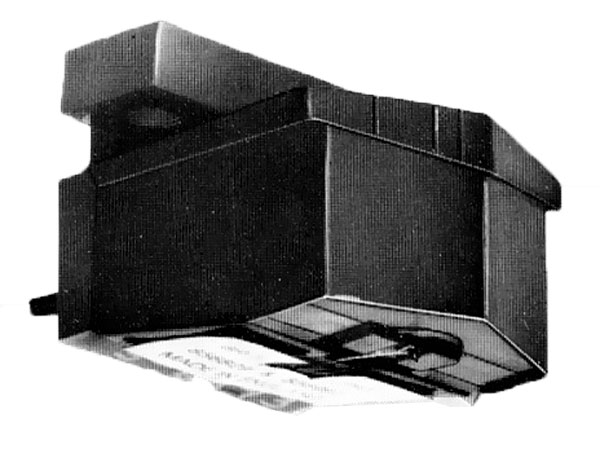
Decca Mark V phono cartridge

The Decca Mark V is the latest version of that English firm's unique "tip-sensing" stereo-matrix-ing pickups. The "matrixing" apellation refers to the fact that the Decca pickups do not use 45°–45° sensing coils, but use instead a combination of vertical and lateral-sensing coils. There is a single coil for lateral sensing, with its pole pieces brought down next to the tip. This is the tip-sensing feature, whose major attribute is that the stylus motions don't have to be conveyed along the length of an armature before reaching the transducing pole pieces. Thus there is virtually no possibility of the stylus vibrations being modified through flexing of the armature prior to their transduction into audio signals.

Denon DL-103 phono cartridge

This low-output moving-coil cartridge can be fitted with different styli. The basic DL-103 has a 0.5-mil spherical tip, the DL-103S a Shibata tip. As of the spring of 1975, the '103S is being imported by American Audioport, Inc., in Columbia, MO. the '103 is being brought in directly from Japan by a few dealers. Our '103 was loaned by Music & Sound of California, the '103S came from Audioport.

They are not too similar in sound. The DL-103S is incredibly clean-tracking, with a light, airy high end, a subtle zizz on string tone, and a very slightly withdrawn quality similar to the sound of the Supex 900E, but not as overly rich-sounding as the Supex.

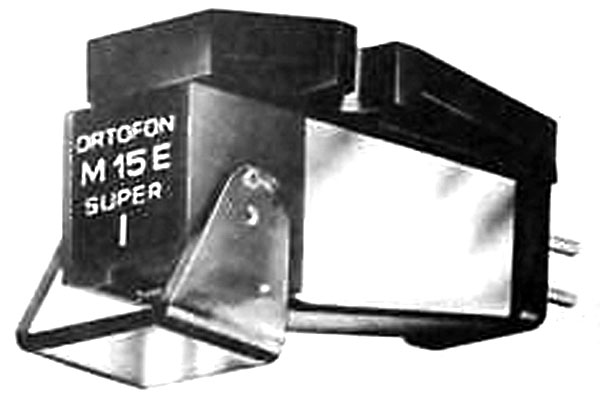
Ortofon M15 Super phono cartridge

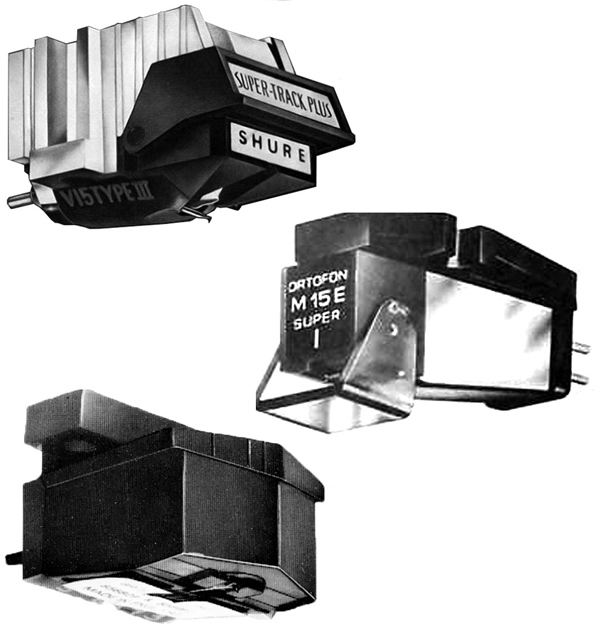
The M15 Super is the first high-output pickup to come from Ortofon. Previous ones required either step-up transformers or a booster preamp, and it is only fairly recently that either kind of step-up device was available with high-enough quality to avoid a noticeable degradation of the sound. Early step-up transformers muddied the bass, and previously-available booster preamps added noise or hardness or both to the sound. Now that there are excellent transformers available from Ortofon and other sources, and at least one extraordinarily good booster preamp (the Mark Levinson, at an extraordinarily high price—$170), Ortofon's latest and best pickup doesn't require the use of either.
Advertisement
Advertisement
Advertisement