Reference

Sort By:  Post Date TitlePublish Date

Copying and Sharing Recorded Music (The Dos and Don'ts of Copyright Law)
The introduction in 1982 of the compact disc ushered in the age of digital audio. Audiophiles now have lots of new digital toys and technologies at their disposal, including SACD, DVD-Audio, MP3 players, hard-drive–based CD players, and digital equalization and room correction, to name a few. Videophiles have similarly benefited from digital technology, with an armamentarium that includes high-definition television, DVD-Video, Blu-ray, HD DVD (the latter two still on the horizon), DLP, LCoS, and D-ILA, among others. Action-based films have also benefited from breathtaking, digitally enhanced special effects. Even those of us who still prefer LPs must acknowledge—reluctantly, perhaps—the incredible impact that digital has had on our hobby (footnote 1).

The Essex Echo 1995: Electrical Signal Propagation & Cable Theory

Editor's Note: The matter of whether—and if so, how—speaker cables and interconnects can affect the sound of an audio system has vexed the audiophile community since Jean Hiraga, Robert Fulton, and others first made us aware of the subject in the mid-1970s. Most of the arguments since then have involved a great deal of heat but not much light. Back in August 1985, Professor Malcolm Omar Hawksford Ph.D (of the UK's University of Essex and a Fellow of the Audio Engineering Society) wrote an article for the British magazine Hi-Fi News & Record Review, of which I was then Editor, in which he examined AC signal transmission from first principles. Among his conclusions was the indication that there is an optimal conductor diameter for audio-signal transmission, something that I imagined might lead to something of a conciliation between the two sides in the debate. Or at least when a skeptic proclaimed that "The Laws of Physics" don't allow for cables to affect audio performance, it could be gently pointed out to him or her that "The Laws of Physics" predict exactly the opposite.

Contingent Dither

If there is one thing I've learned in almost 28 years (ouch) of audio writing, it's that audience reaction is fickle. Sometimes readers will swallow the most contentious pronouncements without indigestion, only to choke on throwaway lines you've invested with little importance. It just goes to confirm that human communication involves senders and receivers, and they aren't always in synchrony.

Time Dilation, Part 2

If you missed Part">http://www.stereophile.com/features/105kh">Part 1 of this article (Stereophile, January 2005), or it has faded in your memory, here's a résumé. (Readers who recall Part 1 with crystalline clarity, please skip to paragraph four.) The accurate measuring of loudspeakers requires that the measurements be taken in a reflection-free environment. Traditionally, this has meant that the speaker be placed atop a tall pole outdoors or in an anechoic chamber. Both of these options are hedged around with unwelcome implications of cost and practicality. To overcome these and allow quasi-anechoic measurements to be performed in normal, reverberant rooms, time-windowed measurement methods were developed that allow the user to analyze only that portion of the speaker's impulse response that arrives at the microphone ahead of the first room reflection. MLSSA from DRA">http://www.mlssa.com">DRA Labs is the best-known measurement system to work on this principle, and both John Atkinson and I use it in the course of preparing our loudspeaker reviews.

Time Dilation, Part 1

Pick an expletive—one you would normally use to express deep intellectual frustration—but don't vocalize it. Hold it in reserve for a few minutes, letting it simmer to concentrate its intensity. I'll tell you when to let rip.

Red Shift: Doppler distortion in loudspeakers

In the world of digital audio, jitter has been a focus of audiophile attention for well over a decade. It is blamed for many of the sonic ills of which CD and other digital media have been accused. But here's a puzzle: The major source of frequency intermodulation distortion in audio systems—the loudspeaker—has largely escaped such withering inquiry. Why?

A Question of Bits

Someday we may speak wistfully to our grandchildren about the "golden age" of digital audio when consumer formats (CD and DAT) contained a bitstream that was an exact bit-for-bit duplicate of the original studio master recording—not a digitally compressed, filtered, copy-resistant version whose sound is "close enough" to the original. Digitally compressed formats such as DCC and MiniDisc represent, in effect, a return to the pre-CD era when consumer-release formats were always understood to be imperfect copies of the studio original. Even the most ardent audiophile accepted the fact that LPs and mass-produced tapes did not, and could not, sound as good as the master tapes they were derived from.

Bits is Bits?

High-quality digital audio systems require that all digital interfaces in the signal path exhibit signal transparency. The widely adopted AES/EBU and S/PDIF interfaces have been criticized for a lack of signal transparency; here we (footnote 1) address possible problems with such interfaces and present methods for improving the interface standard.

Jitter & the Digital Interface

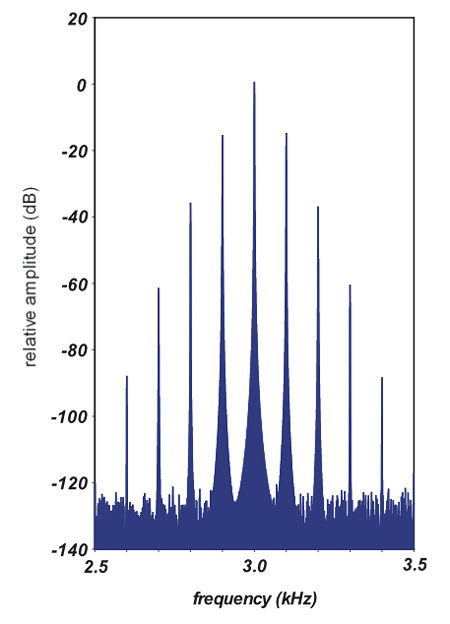
Until recently, all problems in digital audio systems were blamed on either the analog/digital converters (ADCs) used in mastering or the digital/analog converters (DACs) needed for playback (footnote 1). As the performance of both ADCs and DACs improved, however, a previously unrecognized mechanism for distortion was unmasked: jitter. As we shall see, jitter—or, more correctly, word-clock jitter—can be a significant limitation in the technical and sonic performance of digital audio systems (footnote 2).

Cutting Corners

If anyone ever thinks to compile a list of the 100 seminal audio papers that should be found in every tech-aware audiophile's filing cabinet, Harry Olson's "Direct Radiator Loudspeaker Enclosures" deserves to feature in it. Originally presented at the second Audio Engineering Society Convention, in October 1950, it was published in Audio Engineering in 1951. In 1969—in a rare and certain acknowledgement of its classic status—the AES republished it in its Journal (footnote 1).

Advertisement
Advertisement
Advertisement