Solid State Power Amp Reviews

Sort By:  Post Date TitlePublish Date

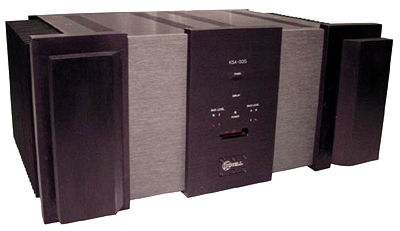
Krell KSA-50S power amplifier

In the fall of 1982, I had just become the Editor of the English magazine Hi-Fi News & Record Review. Hi-fi was in a state of flux. The Compact Disc had just made its debut in Japan, but the British and American launches were six months and a year away, respectively. The Linn orthodoxy prevailed about the role of the source in system performance, but there was no agreement about what was and was not important when it came to enhancing the musical experience. "Objectivists" insisted that amplifiers and even loudspeakers had pretty much reached a design plateau where no further improvement was necessary or even desirable, while "subjectivists" were fragmented. All I was aware of was that my system, based on Celestion SL6 loudspeakers, needed more of an undefinable something.

Quad 405 power amplifier

This is something we don't see too often: an entirely new approach to power amplifier design. As Quad points out in its literature for the 405, class-A operation of transistors provides the lowest distortion, but drastically limits the amount of power an output transistor can deliver without overheating. (Most transistor amps use class-AB output operation, in which each of a pair of power transistors handles part of each signal cycle and shuts down during the other part. Imperfect synchronism between the two halves causes the familiar "crossover distortion," which accounts for most solid-state sound. In class-A operation, each output transistor draws current though the entirety of each signal cycle, eliminating the crossover transition but doubling the amount of time current is drawn, and thus tending to cause the transistor to heat up more.)

B&K ST-140 power amplifier

I must admit that even before I connected up this amplifier I was put off by the accompanying literature. B&K makes some persuasive points about the validity (or rather the lack thereof) of some traditional amplifier tests, but the literature was so loaded with flagrant grammaticides, syntactical ineptitudes, and outright errors that I could not help but wonder if the same lack of concern had gone into the product itself (eg, the term "infrasonic" is used throughout to mean "ultrasonic"). Good copy editors aren't that hard to find; B&K should have found one.

Adcom GFA-555 power amplifier

I am reluctant to call any given transistor power amplifier a "best buy" or "breakthrough." From my talks with designers and other audiophiles, it is clear that the state of the art in power amplifiers is about to change. From where I stand, the Adcom GFA-555 is the first sample of this new wave. It is so clearly superior to past amplifiers in the low- to mid-priced range—not to mention most amplifiers two to three times its pric—that I can unhesitatingly recommend it for even the most demanding high end system.

YBA 2 HC power amplifier

"My car is supercharged, not turbocharged, so you see there's no throttle lag," explained Yves-Bernard André as he reversed at what seemed like 80mph up a narrow cobbled Paris street. "D'accord," I mumbled, afraid to loosen the white-knuckled grip I had on the passenger grab handles. Yves-Bernard's car may have been pointing the right way down the one-way street, but it was not actually traveling in that direction. Okay, so it was 2am and the good residents of the Dix-septième Arrondissement were busy stacking Zs (en français, "emplier les ronflements"). But I still didn't think we would've been able to explain the logic of the situation to the gendarmes (les flics, en français).
Advertisement
Advertisement
Advertisement