Solid State Power Amp Reviews

Sort By:  Post Date TitlePublish Date

Schiit Audio Aegir power amplifier

Class-D audio amplifiers: What's the argument for them? Class-A audio amplifiers: What's the argument against them? Class-AB amplifiers: Why does everybody make them? Each of these amplifier output architectures has strengths and weaknesses. Each will interface more or less successfully with a given loudspeaker in a given room. Each has a distinctive sonic signature. Consequently, as knowledgeable audiophiles with a laundry list of system-building goals, we are required to choose the amplifier type that best suits our speakers, our room, and our individual musical-aesthetic predilections.

Dynaco Stereo 120 transistor power amplifier

One by one, the major amplifier manufacturers have acceded to the pressures of the marketplace and introduced "solid-state" models, whether or not these happened to sound as good as their previous tube-type units. Dynaco was one of the last of the hold outs, preferring, according to their advertisements, to wait until they could produce a solid-state unit that was at least as good as their best tube types. Now, they've taken the plunge at last, with their Stereo 120.

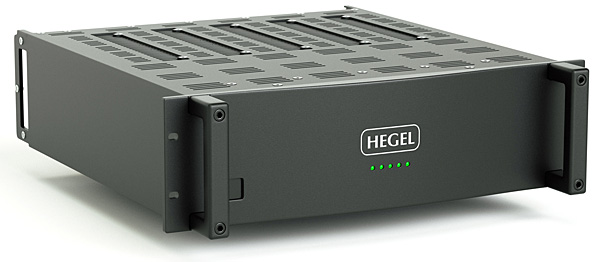
Music in the Round #97: Hegel C53 and DSPeaker Anti-Mode X4

Sometime near the turn of this century, I wandered into a demo room at a Consumer Electronics Show and discovered, in the exhibit of a company I'd never heard of, an integrated amplifier that sounded clean and refreshing. It was the only product Hegel Music Systems displayed at that CES, and I don't recall its name or the associated equipment, but I've always remembered that model's striking appearance and impressive sound quality.

Verity Audio Monsalvat Amp-60 power amplifier

I first encountered Verity Audio's Monsalvat Amp-60 stereo power amplifier ($58,000) in October 2017, in one of the largest single-system rooms at the Rocky Mountain Audio Fest. After hearing the Amp-60 and Verity's Monsalvat Pre-2 preamplifier drive Verity's Lohengrin IIS loudspeakers ($133,000/pair), I enthused about the "most impressive range of colors and supreme sense of spaciousness" that contributed to the system's "absolutely beguiling" sound.

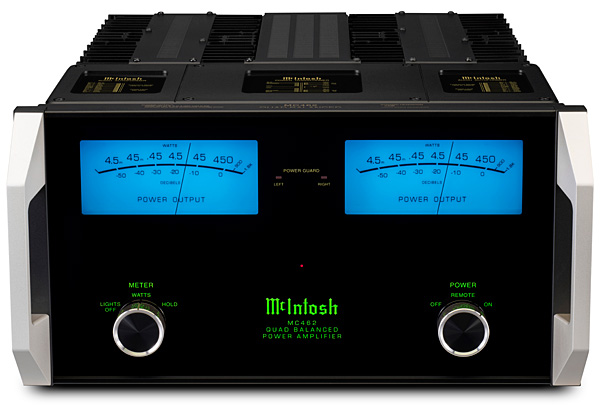
McIntosh Laboratory MC462 power amplifier

It hit me not long ago: I need more Mac in my life! I promptly purchased the current production version of McIntosh Laboratory's time-honored MC275 tubed amplifier, to mate to the Mac C2300 tubed preamplifier I already owned. The recently reinvigorated debate in these pages comparing solid-state and single-ended tube designs got me to thinking. One thing led to another, and voilà! McIntosh's latest solid-state stereo amplifier, the MC462 Quad Balanced ($9000), arrived, bolted to a shipping pallet and encased in two big, heavy, nested boxes. All that packaging weighs 33 lb—the amp inside weighs 115 lb. If you want to lift it onto a rack, you'll need two people, a serious handcart, and a strong, deep shelf.

Carver Silver Seven-t monoblock power amplifier

In 1988, Bob Carver set out to design the best amplifier he possibly could, without regard for cost. It was more of an ego exercise than an attempt to build a product with wide commercial appeal. The result was the four-chassis, $17,500 Silver Seven.

Interestingly, Bob Carver chose vacuum tubes to realize his dream of building the ultimate power amplifier. The Silver Seven uses fourteen KT88 output tubes per channel, and puts out 375W into 8 ohms. Bob built three pairs of Silver Sevens, not expecting to sell many at the $17,500 asking price. When those sold quickly, another 10 pairs were manufactured. Now, demand is so great that Silver Sevens are built in groups of 30 pairs.

First Watt SIT-3 power amplifier

I am obliged to begin this review of First Watt's new stereo power amplifier, the SIT-3, with an explanation of how I believe a power amplifier should be reviewed. Why? Because the 18Wpc SIT-3 is a unique and historically important design that can't be wired up to just any loudspeaker and then critiqued on the basis of its bass power, treble brightness, or midrange acuity.

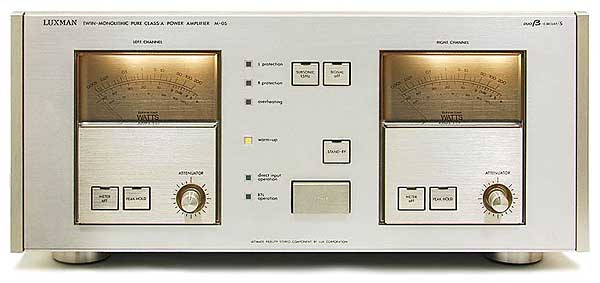
Luxman M-05 power amplifier

Japanese audiophiles venerate American high-end audio components, paying huge sums for vintage Marantz tube amplifiers, racks of Levinson ML-2s, and early Audio Research tube preamplifiers. The balance of trade, at the high end anyway, hasn't been reciprocated: Japanese high-end amplifiers and preamplifiers have not received as positive a reception in the US. Perhaps it was a matter of styling, but the sonics of the Sony Esprit line and the class-A Stax amplifiers did not receive the following they might have, had the products been American.

Constellation Performance Centaur II 500 power amplifier

I am finding hard to grasp that it is almost 50 years since I first went to a hi-fi show. That show, held at London's Olympia exhibition center, was notable both for Yamaha's launch of a loudspeaker with a speaker diaphragm shaped like a human ear, and for being the first time I saw the drop-dead gorgeous Transcriptors Hydraulic Reference turntable, which was later featured in the film A Clockwork Orange. The most recent show I attended was AXPONA, held last April in the Chicago suburb of Schaumburg. There I saw no ear-shaped drive-units, but the final room I visited featured sound that the 1969 me could have only fantasized about.
Advertisement
Advertisement
Advertisement