Solid State Preamp Reviews

Sort By:  Post Date TitlePublish Date

Ayre Acoustics K-3 preamplifier

The challenge for Ayre's Charley Hansen was formidable. Having already designed a world-class preamplifier—the highly acclaimed $7100 K-1 (see Wes Phillips' review in March 1997)—Hansen set out to offer audiophiles "80 to 90%" of the K-1's sound and build quality at a price more of them can afford. Not that the new K-3 is a piece of "budget" gear. It's not. But at $4500, the fully loaded K-3, complete with phono section and remote control, is within reach of many.

Spatial Coherence TVA-1 preamplifier

There are some standing jokes in the audio industry about the qualities a piece of equipment must have in order to be truly "high-end." One definition is that it must be unavailable, unreliable, and dangerous. Another is that it will sound great, break, and its manufacturer go out of business. By meeting at least half of these variables, the Spatial Coherence TVA-1 preamplifier qualifies as a classic audiophile product.

MBL Noble Line N11 line preamplifier

During the four years that I've reviewed for Stereophile, I've had the privilege of evaluating products from some of the world's best-known audiophile companies: Audio Research, Bel Canto, CH Precision, dCS, D'Agostino, Dynaudio, EMM Labs, Jadis, Krell, Nordost, and Wilson, among others. But one long-standing manufacturer whose exhibits at audio shows invariably inspire ecstatic reports, Germany's MBL, has remained outside my purview.

Great American Sound Thaedra preamplifier

Our first sample of this preamplifier was returned to the manufacturer before we had completed our tests on it, and was replaced with the latest version (ours is serial number 500108). Enough time elapsed between the time we shipped back the first sample and the time we got around to auditioning the second that we are unable to report on any sonic differences between the two.

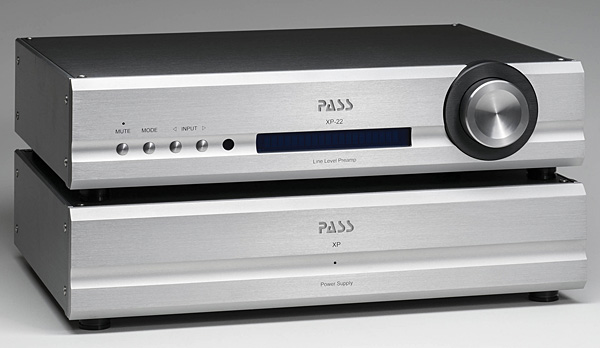
Pass Laboratories XP-22 line preamplifier

For those who listen with their ears and not their brain, perfectionist hi-fi offers many surprises.

A friend called me up a few weeks ago and asked if the DAC we both own had received an automatic firmware update he hadn't heard about; something had changed, it wasn't good, and he couldn't figure out what it was. His system's sound was suddenly pale and unfocused.

There had been no firmware update.

Exposure XVII preamplifier

Thomas R. Marshall's famous phrase, "What this country needs is a good five-cent cigar," should be modified for the 1990s to be "What this world needs is a good $1500 preamplifier."

It's hard to find a good full-function preamp (ie, one that includes a phono stage) at a reasonable price these days. There are plenty of great preamps on the market, but they tend to be expensive or line-stage only—or expensive line stages. Moreover, many manufacturers are omitting phono stages altogether, on the assumption that people don't listen to LPs anymore.

Audia Flight FLS1 preamplifier

Our conservative two-channel audio world doesn't easily accept change. Not that many years ago, even remote control was considered a sign of electronic moral decay certain to degrade sound quality. Today, home theater–like operating systems, with their fluorescent-screen hells and microprocessor-controlled functionality are commonplace, even in the highest of fi. Consumers accustomed to the convenience of audio/video processors now demand it on every price tier of two-channel hi-fi, though purists who think sound quality is commensurate with inconvenience can have that if they want it.

J E Sugden Masterclass LA-4 line preamplifier

Like most serious pursuers of the audio hobby, I've known about J E Sugden & Co. Ltd. for years. For many of those years, though, it was easy to forget about them, and I mostly did—until, quite recently, Sugden gear began popping up at audio shows, including the 2016 Rocky Mountain Audio Fest. In his report on that show, Herb Reichert described the midrange of Sugden's A21SE Signature, a pure class-A integrated amplifier, driving DeVore Fidelity speakers, as "shroom-like" and contrasted the sound with what he called class-D's "fake cocaine." That got my attention.
Advertisement
Advertisement
Advertisement