Solid State Preamp Reviews

Sort By:  Post Date TitlePublish Date

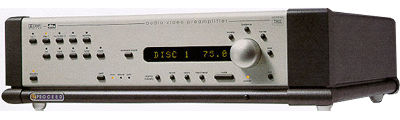
Mark Levinson No.380S preamplifier

"Comping," they call it at Madrigal. Once a circuit and its board layout have been finalized, passive components are substituted one by one in an exhaustive series of listening tests to determine the places where use of a premium part, or one of closer tolerances, results in an audible benefit. This fine-tuning process cannot be open-ended, however, as products do have to shipped. So what happens when new parts become available, or new manufacturing processes allow a better-sounding part to be used without financial penalty?

Krell KRC-HR preamplifier & Audio Standard power amplifier

About a decade ago, I read in Stereophile about the SRC, an add-on remote-control unit manufactured by Acoustic Research. I bought one the next day ('swhat happens when you work across the street from a hi-fi shop). Suddenly I was able to make incremental changes in volume and balance from my listening position—and let me tell you that that's the way to do it. What a phenomenal difference in realistic dynamics and soundstaging.

Ayre Acoustics K-1 preamplifier

The Glimmer Twins were right: If you can't always get what you want, sometimes, you just might find, you get what you need. Take Ayre's K-1 preamplifier, for instance. I'd been trying to get Ayre to send me their $3750 V-3 power amplifier since the moment I started writing for Stereophile; after approximately a year and a half, I finally got a phone call from then Marketing Director Bruce Van Allen.

Krell KBL preamplifier

About three weeks ago, while perusing the gear in a local audio retail establishment, I overheard a salesman, who could well have been selling used cars, giving a classic spiel to an obviously confused customer. "You see, sir, all preamplifiers basically sound alike, especially with line-level inputs. The only differences are in the number of features." He went on to tell his prey that spending big bucks for high-end products such as Krell or Mark Levinson (neither of which he sold) would be a big mistake. I choked back my automatic response of a certain bovine term, but thought it better to continue my fly-on-the-wall masquerade.

Mark Levinson No.26 preamplifier & No.20 monoblock power amplifier

I must admit, right from the outset, that I find reviewing electronic components harder than reviewing loudspeakers; the faults are less immediately obvious. No preamplifier, for example, suffers from the frequency-response problems endemic to even good loudspeakers. And power amplifiers? If you were to believe the older generation of engineers—which includes some quite young people!—then we reached a plateau of perfection in amplifier design some time after the Scopes Monkey Trial but well before embarking on the rich and exciting lifestyles afforded us by Reaganomics. (In the UK, it is generally felt by these people that the date coincided with the introduction of Quad's first current-dumping amplifier, the 405, in 1976.)

Advertisement
Advertisement
Advertisement