Think Pieces

Sort By:  Post Date TitlePublish Date

I'll Take Mine Unleaded

"It's not just it doesn't work as well, it doesn't sound as good!"

Veteran audio reviewer Martin Colloms and I were taking a preprandial walk across London's Hampstead Heath, following Cream's reunion concerts at the Royal Albert Hall last May. Martin was getting animated:

"And don't ask about the whiskers!"

Of course, I had to ask about the whiskers.

Books, Guitars, & Hi-Fi

I'm still using a Mac mini as a music server, using iTunes on this host server to stream music to my listening-room system via the Apple Airport Express WiFi hub. However, as the Airport Express is limited to CD-quality music, I tend to use them for nonserious listening, when I am involved in some other activity. One of those activities this past week or so was reading a new book from erstwhile Stereophile record reviewer Allen St. John: Clapton's Guitar: Watching Wayne Henderson Build the Perfect Instrument (hardcover, 288pp; Free Press, New York, $25).

Just How "Absolute" Is Recorded Sound?

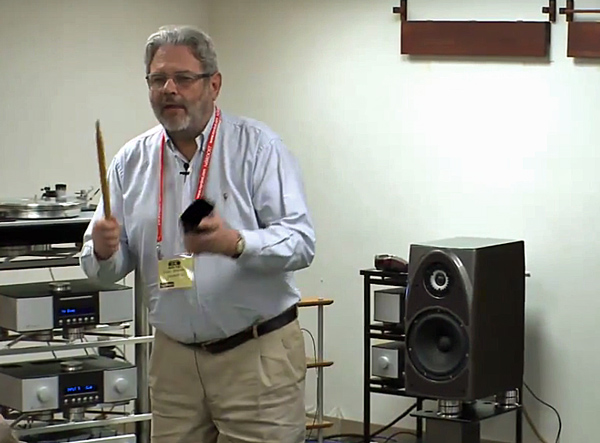
John Atkinson at the 2012 Rocky Mountain Audio Fest

Since I gave this presentation at the Rocky Mountain Audio Fest in October 2012, based on one of the topics in my Richard C. Heyser Memorial Lecture and mentioned in my March 2013 "As We See It," I have repeated it at Music Matters evenings at Definitive Audio in Seattle and Listen-Up in Denver, and at audiophile society meetings in Minneapolis, California's Central Coast, and Connecticut. I will be repeating the presentation at a Music Matters event at Georgia retailer Audio Alternative, Wednesday April 24, at 6pm, at T.H.E. Show Newport Beach, at 12 noon, May 31, and at The Audiophile Society in Brooklyn, NY on June 22.

"If it sounds good..."

"...and measures bad, then you're measuring the wrong thing!" If one motto could sum up this magazine's philosophy, this would be it. Too many times we have discovered components that sounded musically fabulous while offering measured performance that was, at best, merely competent. Yet recently, I'm starting to lose confidence in that old saw.

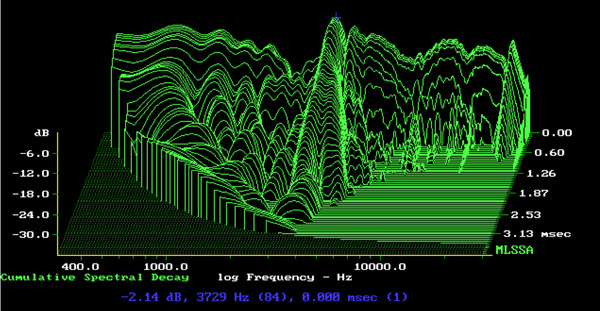
On a number of occasions, I or another of Stereophile's reviewing team has heard a product sounding flawed in ways later revealed by measurements. A closed story, you might think—but consider the NEAR-50M loudspeaker reviewed by Dick Olsher in this issue. Despite hearing many good things in the speaker's sound, Dick was bothered by a tonal-balance problem in the low treble. He was also disturbed by a lack of integration between the tweeter and midrange unit. When I measured the '50M, my response graphs (footnote 1) pretty much explained why Dick heard what he heard. Nevertheless, other reviews of this loudspeaker have been ecstatic in their praise, one even stating that it was "one of the most transparent and balanced dynamic loudspeakers available at any price" (my italics).

Musical Voices

Wandering through Tower Records the other night, I was struck by the amazing diversity of music available to us. There's music from every part of the globe, for every taste and interest, from "show-me-the-good-parts" compilations of classical highlights to obscure releases by unknown artists. There's music for the ecstatic, music for the angry, music for the straight, the gay, the bent, and the twisted. The subcategories replicate like rabbits, as if in a demographer's nightmare. Genus spawn species, which quickly mutates into subspecies, race, tribe: cult begets subcult.

Do Musicophiles Enjoy Audio?

Paul Gowan's letter in the October 1989 Stereophile hinted that, whether or not audiophiles enjoy music, it should be true that the emotional experience we derive from music is what really matters. There, barefaced, lies the problem: who are "we"? A well-known Latin epigram affirms that in matters of taste there is no point in discussion. And a Greek epigram (coined in fact by Max Beerbohm in his Oxford novel Zuleika Dobson) suggests that "for people who like that kind of thing, that is the kind of thing they like."

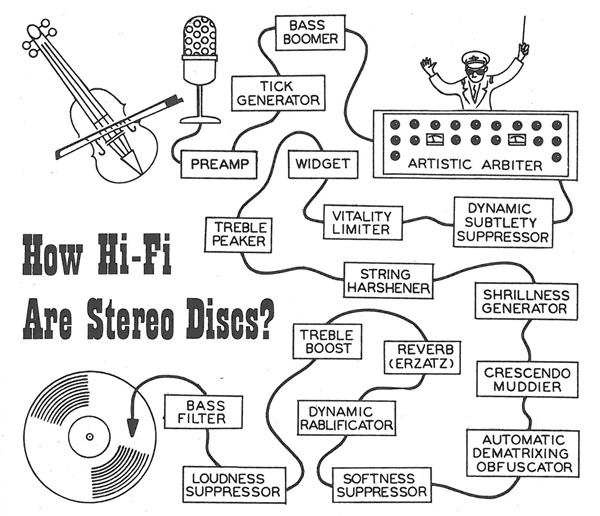
How Hi-Fi are Stereo Discs?

Editor's Note from 1992: This seminal J. Gordon Holt essay on how the art of recording natural sound became compromised in favor of unmusical artificiality for good commercial reasons was originally published in August 1964, in Vol.1 No.8. Though most people these days listen to classical music from CDs, not LPs, in the intervening decades, recording technology has not changed for the better as much as one might have hoped. Nevertheless, the days of wretched multimiking excess described by Gordon are past, and it's rare to find the music treated with the lack of respect typical of a mid-'60s Columbia session. Although some of the smaller companies—Reference Recordings, Delos, Chesky, Mapleshade, Dorian, and Sheffield Lab in the US; Meridian, Nimbus, and Hyperion in the UK—consistently use honest, minimal miking, it is not unknown for the majors in the '90s to do likewise. And the use of time delay for spot microphones, pioneered by Denon in the mid-'80s, means that instruments that might tend to become obscured at orchestral climaxes can now be brought up in level without unnaturally time-smearing the sound. I still find it sad, however, that it is rare to hear the sheer dynamic range of a live ensemble successfully captured on a commercial recording.—John Atkinson

The Swift Boating of Audiophiles

The "Want to make an easy $1,000,000?" e-mail wasn't a scam from Nigeria but an alert from Paul DiComo, late of Polk Audio and now of Definitive Technology, about a double-blind cable-identification challenge made by The Annoying Randi, a magician and debunker of paranormal events who goes by the name of "The Amazing Randi."

Advertisement
Advertisement
Advertisement