Tube Power Amp Reviews

Sort By:  Post Date TitlePublish Date

Cary Audio CAD-805RS monoblock power amplifier

There's no place for fashion in epidemiology, aeronautical engineering, or the mining and storage of uranium. Fortunately, domestic audio is less serious, its goals more scattered and ambiguous, than those and a thousand other pursuits.

And so, throughout the 20th century, any number of trends in domestic audio popped up their heads, some remembered as fads, others as legitimate approaches to playback. Among the latter are amplifiers whose output sections operate in single-ended mode, in which the entire signal waveform is amplified by a single device.

Counterpoint SA-4 monoblock power amplifier

Some audio products deliver truly superb sound of a kind that really makes all the frustrations of building a high-end system worthwhile; they also require exceptional attention and care. The Counterpoint SA-4 is a case in point. With the right speakers, it competes for the title of "Most Transparent Amplifier Available at Any Price." On the other hand, this amplifier steadily loses output power as speaker impedance drops; it must be carefully matched to the right speaker. Then, and only then, can it produce one of the finest musical experiences available.

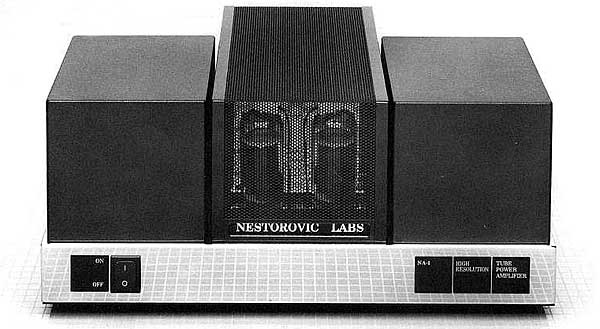
Nestorovic Alpha-1 power amplifier

The great debate that has long separated audiophiles is tubes vs solid-state. Other topics, CD for example, may temporarily steal the spotlight, but year-in and year-out no other subject is the cause of as much controversy as whether tubed or solid-state circuitry produces the more accurate sound. As is typical with long-standing feuds, the split runs deep, and tempers often flare.

Doshi Audio Monoblock V3.0 power amplifier

Doshi Audio first crossed my radar at the 2010 Rocky Mountain Audio Fest, where I wrote that the sound of the company's tubed monoblocks and preamp, connected to Wilson Audio Sasha loudspeakers via Transparent XL cables, "excelled in midrange strength as the system threw an exciting soundstage." After auditions of Doshi-Wilson pairings at many subsequent shows had convinced me that Doshi's products could truly sing, I contacted company owner and product designer Nishith "Nick" Doshi to inquire about reviewing one of his amps.

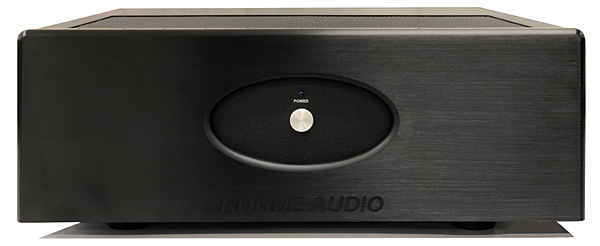
Rogue Audio Stereo 100 power amplifier

When I began writing for Stereophile, I dreaded doing comparisons. They were stressful and tedious—and what if I got them wrong? But I quickly learned: Not only do readers enjoy comparisons, they need them. How else might they imagine the relative merits of the component under consideration? Once I realized this, I began acquiring a range of reference amplifiers.

But conspicuously missing from my audio menagerie has been a fast, neutral, 100Wpc tube amp to put more pop, fire, and maybe a little glow, into the Harbeth M30.2s.

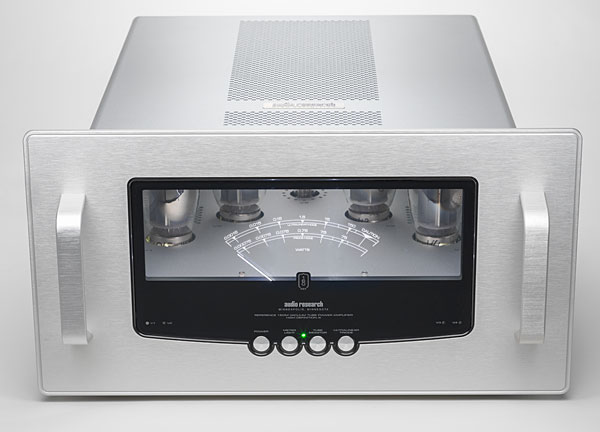
Audio Research Reference 160M monoblock power amplifier

At a recent dealer event in Seattle, after being impressed by the musical rightness of an Audio Research Corp. LS28 preamplifier and VT80SE power amplifier driving a pair of Sonus Faber Guarneri loudspeakers, I spoke with ARC's Dave Gordon about reviewing one of the company's new amplifiers. Less than a month later, two ARC Reference 160M tubed monoblock amplifiers ($30,000/pair) were headed my way.

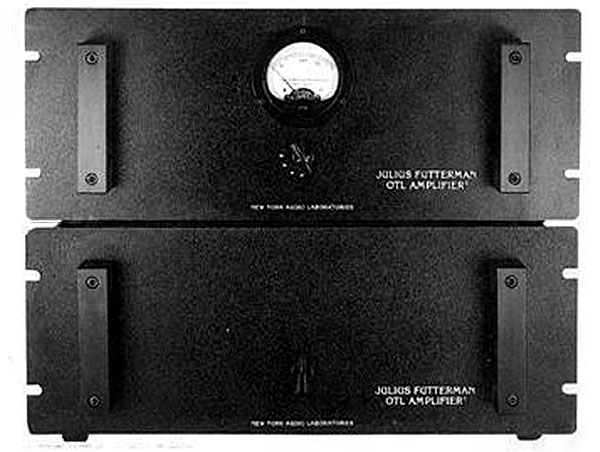
New York Audio Laboratories Futterman OTL-1 power amplifier

Few people in the high end know the difference between glorious excess and wretched folly as well as Harvey Rosenberg. Harvey's audio equipment always strives towards the glorious folly of providing the most romantic sound possible with modern technology. This may explain why his relatively small company, New York Audio Laboratories, can build an amplifier like the Futterman OTL-1, which costs a glorious $12,000 a stereo pair and actively competes for the title of best amplifier in the world.

BorderPatrol P21 EXD power amplifier

Back at the beginning of 2017, Greg Roberts, of Volti Audio, devised a clever way to bring his Rival floorstanders up to my penthouse pad, for what resulted in a rave review of those horn-loaded wunderspeakers.

I live on the top floor of a seven-story, elevatorless building on a busy street in Greenwich Village. A vertical challenge? No problem! Roberts is resourceful in many things, from speaker design to his former profession, the building of custom homes. Affixing a pair of unguent-saturated straps to the screws on each side of a Rival, we lifted and transported the 106-lb speaker high in the gritty Manhattan sky as if it were child's play.

Ypsilon Electronics Hyperion monoblock power amplifier

Designers of hybrid amplifiers can use solid-state devices in an amp's input stage and tubes in its driver and output stages, as Music Reference's Roger Modjeski did in his RM-200 Mk.II—or they can use tubes in the input and transistors in the output, as Ypsilon Electronics' Demetris Baklavas prefers.

The advantage of solid-state at the input stage can be lower noise. In the RM-200 Mk.II's fully balanced design, carefully matched input devices result in high common-mode rejection and low-noise operation close to the levels achieved with the best input transformers. The RM-200 Mk.II's signal/noise ratio measured a healthy 95.4dB.

Jadis JA200 Mk.II monoblock power amplifier

"How natural the sound," wrote Jonathan Scull in March 1994, in his Follow-Up on the original Jadis JA 200 monoblock amplifier, which then cost $18,990/pair. "How easy it was to follow the musical line and fall into the music. How deep, controlled, tight, and satisfying the bass. How magnifique the midrange—the traditional strength of the Jadis presentation. How full and satisfying the lower midrange. How open, airy, how right the highs—not at all hard, but very extended and natural. How involving their presentation. How full, how harmonically correct, how wonderfully compelling. How magical."
Advertisement
Advertisement
Advertisement