As We See It

Sort By:  Post Date TitlePublish Date

"Truthiness" in hi-fi
Stereophile has discussed the pandemic occasionally because of its relevance to our industry and our listening lives. But for the most part, I've steered the magazine away from politics and current events, and I will continue to do so. In this essay, though, I will engage, glancingly, not with politics or current events but with an idea that's drawn from them. I'm doing it to make a point about audio.
An argument for measurements

In my early years of writing about audio (footnote 1), I was known—to the extent that I was known at all—as something of an objectivist. I was, after all, working as an editor at a leading science journal at the time, just a few years out from a brief career as an actual scientist, still in recovery from the physics PhD I'd earned a decade or so before.

Mikey Bats 302

Issue 54 of The Absolute Sound, cover-dated July/August 1988, had arrived in my mailbox. I had been warned that this issue contained a report from Stereophile's third hi-fi show, which had been held in Santa Monica the previous April. Although it wasn't listed in the issue's table of contents, I found the show report on page 186, written by Michael Fremer, who was listed on the magazine's masthead as "Senior Editor: Pop Mix."

In My Room

Listening rooms are real, imperfect places. Their character arises from their defects. I like real, imperfect things (footnote 1).

Not that there's such a thing as a perfect listening room. Every domestic listening room shares the same basic problem: Its most fundamental nature—its size and shape, the amount of space it carves out—results in resonances that can profoundly alter the sound of reproduced music, especially in the bass.

Hoisted on your own petard?

After completing a PhD in electrical engineering at Imperial College London, Floyd E. Toole joined Canada's National Research Council (NRC), where he would stay for more than 26 years doing audio-related research. He continued his research at Harman International after leaving the NRC in 1991. When Toole left Harman in 2007 (footnote 1), Harman kept the work up under NRC alum Sean Olive—which fact surely has much to do with the excellence of their current loudspeaker lineup.

Art Dudley: A Primal Light

Photo: Sasha Matson

In April 14, 1895, Mahler's Symphony No.2, "Resurrection," premiered in Berlin (footnote 1). Mahler wrote a program for this symphony prior to a performance six years later, in Dresden. Here is what he wrote about the first movement, Allegro maestoso:

"We are standing near the grave of a well-loved man. His whole life, his struggles, his sufferings and his accomplishments on earth pass before us. And now, in this solemn and deeply stirring moment, when the confusion and distractions of everyday life are lifted like a hood from our eyes, a voice of awe-inspiring solemnity chills our heart, a voice that, blinded by the mirage of everyday life, we usually ignore: 'What next?' it says. 'What is life and what is death? Will we live on eternally? Is it all an empty dream or do our life and death have meaning?'"

DisConcerted

On Sunday, March 22, at 8pm, the state of New York shut down, governor's orders. Here in the Big City, most stores are closed—even Starbucks, or at least the ones near me. In my neighborhood, up on Broadway, a grocery store is open, and a drugstore, a hardware store, and a couple of bodegas. Some bars and restaurants are open for takeout only, some advertising COCKTAILS TO GO in big black letters painted on bedsheets—New Orleans comes to NYC. (Meanwhile, New Orleans itself, also a coronavirus hotspot, apparently is desolate, the bars closed, a hard thing to picture.)

. . . and I feel fine

The High End 2020 show, scheduled to take place in Munich in mid-May, was canceled due to concerns about the coronavirus. The California Audio Show, which usually takes place in late July, is also off, although the reason for its cancelation isn't clear. And as we've just learned, AXPONA, the biggest show in the Western Hemisphere, has been postponed from its original dates (around the time this issue hits mailboxes and newsstands) to the second weekend of August.

The reason, of course, is concern about the spread of COVID-19.

Hi-Fi Arcana I

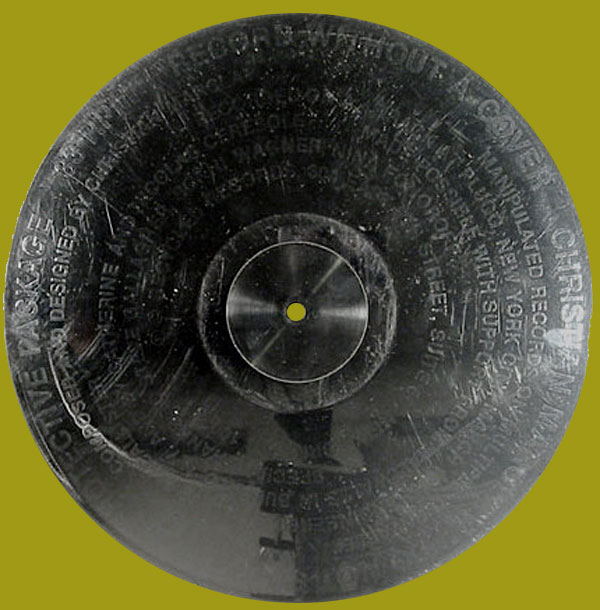
Some Stereophile readers will surely remember—some may even have in their collections—Christian Marclay's 1985 vinyl release Record Without a Cover, surely one of the oddest records ever, right up there with the dying-rabbit record and the seven-inch single that's tinted yellow by the band's actual urine.
Advertisement
Advertisement
Advertisement