We were driving to a friend's house to celebrate her dad's 92nd birthday. Halfway there, a bright yellow, ground-hugging insect pulled in front of my car from across street. "Wow, that's a Lamborghini Countach!" I exclaimed. You don't often see one of those in my neighborhood—or in any neighborhood.
 "What is?" my mother-in-law responded without irony. "That car!" I squeaked, staring transfixed at the car's least dramatic angle. My childlike tone had my wife and mother-in-law chortling until, still mesmerized, I missed a familiar turn and began involuntarily following the Lamborghini down the wrong street.
"Michael!!" they shrieked simultaneously, as if I'd followed the Countach off a cliff. Good for them: had they not yelled and forced me to snap to, I would have just kept following. When you're going to a 92nd-birthday party, late is not good.
I don't know who owned that car, but I do know that, unlike some envious audiophiles I meet online, I didn't resent the guy driving a car of my desires that I'll never be able to afford. Good for him is not the same as bad for me. I'm thankful that such a machine exists and that there are people able to afford it. In other words, I begin this review still feeling somewhat defensive about the response to my January review of Continuum Audio Labs' $100,000 Caliburn/Cobra/Castellon combo.
This four-box CD player costs $43,440. It won't play SACD or DVD-Audio discs. Nor does it oversample or upsample. Its digital architecture is strictly 16-bit. In that regard, it's more like some of the "legendary"-sounding $69 boomboxes you may have read about that supposedly offer superior, even magical sound precisely because they don't dick around with the digits.
Please don't be mad at this Zanden assemblage or resentful of the folks who can afford it, and for God's sake don't get on my case for reviewing it. Try to be thankful that an artisan and inventor like Kazutoshi Yamada would consider investing his time and talent in conceiving and executing such a visual wonder. (I'm not giving away the sonic store in the introduction.)
Model 2000 Premium CD transport
"What is?" my mother-in-law responded without irony. "That car!" I squeaked, staring transfixed at the car's least dramatic angle. My childlike tone had my wife and mother-in-law chortling until, still mesmerized, I missed a familiar turn and began involuntarily following the Lamborghini down the wrong street.
"Michael!!" they shrieked simultaneously, as if I'd followed the Countach off a cliff. Good for them: had they not yelled and forced me to snap to, I would have just kept following. When you're going to a 92nd-birthday party, late is not good.
I don't know who owned that car, but I do know that, unlike some envious audiophiles I meet online, I didn't resent the guy driving a car of my desires that I'll never be able to afford. Good for him is not the same as bad for me. I'm thankful that such a machine exists and that there are people able to afford it. In other words, I begin this review still feeling somewhat defensive about the response to my January review of Continuum Audio Labs' $100,000 Caliburn/Cobra/Castellon combo.
This four-box CD player costs $43,440. It won't play SACD or DVD-Audio discs. Nor does it oversample or upsample. Its digital architecture is strictly 16-bit. In that regard, it's more like some of the "legendary"-sounding $69 boomboxes you may have read about that supposedly offer superior, even magical sound precisely because they don't dick around with the digits.
Please don't be mad at this Zanden assemblage or resentful of the folks who can afford it, and for God's sake don't get on my case for reviewing it. Try to be thankful that an artisan and inventor like Kazutoshi Yamada would consider investing his time and talent in conceiving and executing such a visual wonder. (I'm not giving away the sonic store in the introduction.)
Model 2000 Premium CD transport
According to importer Eric Pheils of Zanden Audio North America, the Model 2000 Premium transport uses "the world's most accurate crystal clock in consumer audio." For now, I can only take his and Yamada-san's word for that. Later, there will be John Atkinson's measurements. I love that Stereophile does that. Pheils claims that "others" use rubidium clocks. All others? Some others? I don't know. Zanden uses crystal because, while its temperature stability is not quite as high as that of rubidium, Yamada-san thinks it sounds better. That's partly because Zanden's clocks are custom-designed to output 8.4672MHz, which is the internal clock setting of the custom-modified, die-cast, Philips PRO-2M mechanism on which the 2000P transport is based, and that is said to maintain the digital data's musical integrity by eliminating the need for direct digital synthesizer (DDS) interfaces. Jitter, phase noise, and clock errors are said to be eliminated. The throne-like, top-loading transport is mounted on an acrylic platform that rests on four specially damped feet of highly polished stainless steel. It's a thing of beauty. Zanden claims that its sandwich construction of brushed aluminum and acrylic gives it great structural integrity as well.
To play a disc, you lift off the 2000P's heavy top cover as you would the lid from a pot, then gently drop a CD into a well precision-machined out of the solid aluminum chassis. Replace the lid and it activates a tiny contact embedded in the spindle. The disc then automatically boots up and its ToC appears on the familiar Philips screen.
The transport gets its power from two multipin umbilicals connected to a low-profile outboard supply, this exquisitely finished on all sides (including the bottom plate) in Zanden's aesthetic specialty: curvaceous, gleaming stainless steel polished to a mirror finish. The standalone power supply and the transport's extensive use of noise damping and exclusive RF blocking materials are said to help make the 2000P physically and electronically quiet and clean in operation.
The rear-panel facilities include AES/EBU, S/PDIF, and I2S outputs, as well as a BNC word-clock output, along with 7- and 10-pin power-supply inputs. The build quality, ergonomics, and functionality of the remote control, which is smoothly machined and finished in brushed-satin aluminum and semitranslucent acrylic, is commensurate with the high price tag, though backlighting would be a nice upgrade.
All that, and a CD transport that exudes the sexiness of (dare I say it?) a turntable, is what $27,970 will buy you.
Model 5000 Mk.IV/Signature 16-bit D/A converter
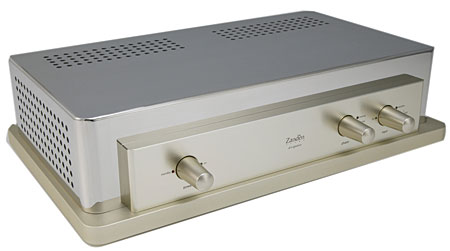
The Model 5000 Mk.IV/Signature was designed to achieve "Linear full bandwidth phase," something the Zanden literature claims is an area where all other digitally filtered DACs fall short. Do they? Does the Zanden achieve it? Zanden's approach is to use its own, patented analog filter, which the company claims has the best phase characteristics of any filter on the market. The 5000 Mk.IV doesn't include digital brick-wall filtering or, as I've already pointed out, any oversampling or upsampling. This DAC is strictly premium "old school" (ca 1985): Philips' TDA-1541A "double crown," which Zanden feels is "the best sounding chip ever made," and which hasn't been made since the late 1990s. The output is tube-driven via a single 6922 using Zanden's patented single-stage, zero-feedback circuit. Needless to say, Zanden claims to use the highest-quality parts and construction throughout. Like the 2000P transport, the 5000S DAC is a two-box design. The chassis base and the rear and front panels are made of 16mm-thick aluminum, while the curving cover of polished stainless steel causes headshakes of admiration from competitors and lust from my friends.
A tube-rectified power supply using one 6X4 and two 6CA4 tubes provides an unbridgeable vacuum gap that is said to block noise from entering the system—the same rationale Brinkmann uses for its vacuum-tubed motor drive. The power supply, housed in yet another case of exquisitely mirrored stainless steel, is meant to be displayed, not hidden away on a bottom shelf, as I was forced to do.
Three front-mounted knobs control On/Off, absolute polarity, and input choice. The rear panel features I2S, AES/EBU, BNC, and RCA S/PDIF inputs, analog outs, and a multipin power-supply jack. And that's what $15,470 buys you.
Put them together and what do you get?
The Zanden combo is not brand new. The 5000S DAC has been around in various iterations for a few years, the 2000P transport was introduced two years ago, and the I2S link between them, which separately sends the clock information and each musical channel, was used a decade ago by the now-defunct Audio Alchemy company between its DAC and transport. But believe me, the 2000 Premium and 5000 Mk.IV/Signature are still worth writing about.
I linked them using Zanden's supplied I2S cable (which is fitted with what look like Ethernet connectors housed in XLR shells) because that's the way Zanden's instructions said it would sound best. I also tried various RCA/RCA digital cables, none of which sounded remotely as good as the I2S connection.
Using analog source material recorded to the Alesis Masterlink's hard drive, I compared the hard disk's playback using the Masterlink's D/A with CD-Rs burned from the Masterlink and played back through the Zanden transport and DAC connected first via the S/PDIF connection then by I2S. Direct A/B comparisons of the Masterlink's HD and the CD-R via S/PDIF demonstrated the clarity of the Zanden's transient resolution and its utter freedom from grain and edge (which Zanden claims is a result of the phase-linear analog reconstruction filter). This superior performance was not due to tube output-based "softening"—there was nothing soft or rolled-off about the upper octaves, which were fast, extended, and airy. Yet impressive as the Zanden sounded overall, both sources still sounded slightly hardened, coarse, and "digital," in the cliché'd sense of that word.
"What is?" my mother-in-law responded without irony. "That car!" I squeaked, staring transfixed at the car's least dramatic angle. My childlike tone had my wife and mother-in-law chortling until, still mesmerized, I missed a familiar turn and began involuntarily following the Lamborghini down the wrong street.
"Michael!!" they shrieked simultaneously, as if I'd followed the Countach off a cliff. Good for them: had they not yelled and forced me to snap to, I would have just kept following. When you're going to a 92nd-birthday party, late is not good.
According to importer Eric Pheils of Zanden Audio North America, the Model 2000 Premium transport uses "the world's most accurate crystal clock in consumer audio." For now, I can only take his and Yamada-san's word for that. Later, there will be John Atkinson's measurements. I love that Stereophile does that. Pheils claims that "others" use rubidium clocks. All others? Some others? I don't know. Zanden uses crystal because, while its temperature stability is not quite as high as that of rubidium, Yamada-san thinks it sounds better. That's partly because Zanden's clocks are custom-designed to output 8.4672MHz, which is the internal clock setting of the custom-modified, die-cast, Philips PRO-2M mechanism on which the 2000P transport is based, and that is said to maintain the digital data's musical integrity by eliminating the need for direct digital synthesizer (DDS) interfaces. Jitter, phase noise, and clock errors are said to be eliminated. The throne-like, top-loading transport is mounted on an acrylic platform that rests on four specially damped feet of highly polished stainless steel. It's a thing of beauty. Zanden claims that its sandwich construction of brushed aluminum and acrylic gives it great structural integrity as well.
The Model 5000 Mk.IV/Signature was designed to achieve "Linear full bandwidth phase," something the Zanden literature claims is an area where all other digitally filtered DACs fall short. Do they? Does the Zanden achieve it? Zanden's approach is to use its own, patented analog filter, which the company claims has the best phase characteristics of any filter on the market. The 5000 Mk.IV doesn't include digital brick-wall filtering or, as I've already pointed out, any oversampling or upsampling. This DAC is strictly premium "old school" (ca 1985): Philips' TDA-1541A "double crown," which Zanden feels is "the best sounding chip ever made," and which hasn't been made since the late 1990s. The output is tube-driven via a single 6922 using Zanden's patented single-stage, zero-feedback circuit. Needless to say, Zanden claims to use the highest-quality parts and construction throughout. Like the 2000P transport, the 5000S DAC is a two-box design. The chassis base and the rear and front panels are made of 16mm-thick aluminum, while the curving cover of polished stainless steel causes headshakes of admiration from competitors and lust from my friends.
The Zanden combo is not brand new. The 5000S DAC has been around in various iterations for a few years, the 2000P transport was introduced two years ago, and the I2S link between them, which separately sends the clock information and each musical channel, was used a decade ago by the now-defunct Audio Alchemy company between its DAC and transport. But believe me, the 2000 Premium and 5000 Mk.IV/Signature are still worth writing about.