AnalogPlanet.com has gone live. Allan Toussaint should title an album. Elvis Costello should write a song. I'm running the website, and will continue to write this monthly column for Stereophile, as well as equipment reviews (though fewer of the latter) (footnote 1).
The new site also includes reviews of analog components originally published in Stereophile, and currently features the first 124 installments of "Analog Corner," almost none of which has ever been available online. (Installments 205–325 of Analog Corner can be found here.) Let the hunt for contradictions begin! I've gotten letters that say, "You know, back in the April 1996 issue you wrote blah-blah-blah, but in April 2012 you wrote bleh-bleh-bleh, which is a complete contradiction. What gives?" My answer, as always, is "You tell me!"
AnalogPlanet.com also incorporates more than a decade's worth of content from my own website, MusicAngle.com, which has now been shut down, as well as feature articles, interviews, and reviews originally published in my print magazine, The Tracking Angle, from 1994 to 1998. (Old MusicAngle.com links will be redirected to the versions ported to AnalogPlanet.com.)
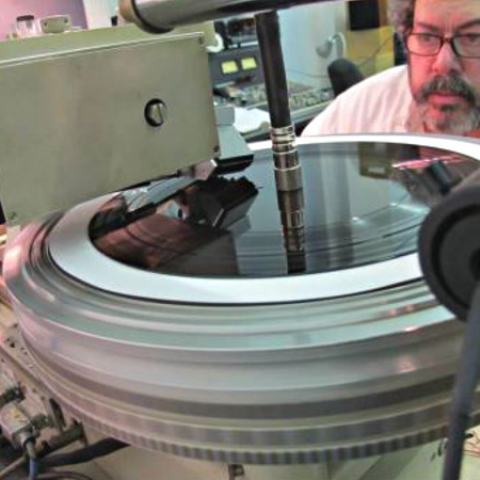
There's room on AnalogPlanet to go into greater detail than I could ever have space for here—including, for example, about how to use a digital microscope to set stylus rake angle (SRA), how to use a digital oscilloscope to set cartridge azimuth, and how to measure the horizontal and vertical resonant frequencies of tonearms and cartridges. (Speaking of SRA, be sure to download Jon M. Risch and Bruce R. Maier's "More Than One Vertical Tracking Angle," originally published in the March 1981 issue of Audio, and reprinted courtesy of Bonnier Corporation. My friend Wally Malewicz, of Wally Tools fame, sent me a copy a few years ago; it's the source of my advocacy of a set-and-forget SRA of 92°.)
The site will also include reviews of cartridges, tonearms, turntables, and phono preamps, tips on setup and buying used LPs, and whatever else analog needs including. On AnalogPlanet, I can review something someone else has already reviewed in Stereophile and give you a second opinion, and vice versa. I hear you: "More cable reviews, please!"
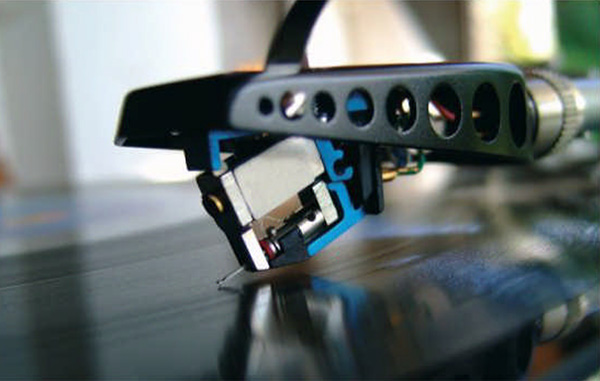 H&S Ice Blue moving-coil cartridge
Products with good backstories are always easier to review—like the ingenious preamplifier circuit Sully Sullenberger devised just after the bird strike forced his landing in the Hudson River. It doesn't get much easier than that.
Yes, I'm kidding, but sometimes you just don't know what to think. We actually received e-mails informing us that the new AnalogPlanet.com logo has the tonearm backward. We knew that, but it was the only way to have it and the platter serve as the lo in analog. I realize that anal is also part of analog, but really, sometimes you do just have to let go.
Eugene Stoecki, designer of the H&S Ice Blue ($9000, footnote 2), tells me that he was, for 10 years, Ortofon's technical director in Germany, when Erik Rohmann (for whom the MCRohmann cartridge was named) was the Danish company's president and owner. In that position, Stoecki "refined the quality control and testing procedures of Ortofon (MC 30 Golden Ear Panel), influenced design and technical features of MC technology" such as the move to higher-output, low-impedance designs, and was involved in the Ortofon Measurement Group, which designed the TC-3000 cartridge and turntable test computer. "It was not an easy task to improve the sound quality of 'the best MC cartridges in the world,'" Stoecki writes, but said that he has succeeded by reimagining the generator system housing, which he thought was a "weak point in an otherwise supreme cartridge design."
Interestingly, not that it matters, despite his association with Ortofon, Stoecki didn't claim that he'd actually ever designed and built a cartridge before. And he says that, other than the generator housing, he hasn't really created anything new—an amazingly honest admission, I thought.
So what has Stoecki done? Is this $9000 cartridge a stripped MCRohmann or other Ortofon cartridge? Of course not. But it does make use of one Ortofon innovation, the Wide Range Damping (WRD) system used in the A90, Windfeld, and other upper-end Ortofons. Ortofon claims a patent, so I'm not sure how H&S is using it. Perhaps a "professional courtesy"?
The WRD sandwiches a small, heavy platinum disc between two rubber dampers, each of which has a different compliance, hence resonant frequency. This innovation is said to produce "perfect damping" or elimination of distortion and resonances throughout the audioband, the results being superior tracking and a linear response in the upper octaves—qualities evident to owners of Ortofon's Windfeld and A90 cartridges, which have among the smoothest, most linear frequency responses, at least to the ear, of any cartridges out there. The A90 has the added benefit of a nonresonant, selective laser melt (SLM) housing. I remember getting a call from a reviewer for another magazine who'd just received an A90. "Is this the most linear cartridge you've ever heard or what?" he blurted. Yes indeed.
In most respects, the Ice Blue's basic specifications are more different from than similar to the A90's. Its cantilever is of tapered aluminum (not boron), the stylus is an 8×40µm line-contact (vs the A90's 5×100µm Replicant 100, a tracing champ), and the coil wire is 99.99%-pure silver (vs the Ortofon's 99.9999%-pure copper). The Ice Blue's generator system is also considerably larger than the A90's.
The Ice Blue is a true low-output MC cartridge, with a very low output of 200µV at 1kHz/5cm/s. The A90's output is also low, but about 30% higher: 270µV. Either requires a high-gain, low-noise phono preamplifier, with a step-up transformer a good first-stage bet.
The H&S and Ortofon designs are more similar than different in terms of lateral and vertical tracking, compliance, and other specs. The recommended tracking force for both is 2.3gm. And while at 5.5 ohms the Ice Blue's internal impedance/DC resistance is specced 1.5 ohms higher than the A90's, its recommended loading is 100 ohms (vs the A90's >10 ohms).
At 7.2gm, the "nude" Ice Blue weighs 0.8gm less than the A90. The Ice Blue's generator resides in a extremely rigid frame of aviation-grade aluminum, said to be "specially shaped," in which are incorporated "shock absorbers" placed at unspecified, "well-defined" areas. One is visible at the generator's rear end.
As a reviewer, I can forgive the designer for shipping the Ice Blue in a wooden box from which the Ortofon logo had been not entirely scrubbed. Had I just paid $9000 for one, I'd be less forgiving.
Installing the H&S in my Kuzma 4Point tonearm was relatively easy; the Ice Blue's line-contact stylus is somewhat less fussy about stylus rake angle (SRA) than the A90's Replicant 100. Using a digital oscilloscope to set the azimuth, I found the channel separation at 1kHz to be in excess of 30dB in both channels and within 2.5dB of each other. That's very, very good, and what one should expect from a $9000 cartridge produced by a quality-control expert.
While the rule of thumb for loading a cartridge is "10 times the internal impedance," it's only a rule of thumb. Over a wide range of phono preamps, I've found the 4 ohm A90's loading spec of >10 ohms realistic, with 30–50 ohms optimal. I found the Ice Blue's recommended loading spec of 100 ohms to be provisional. Fifty ohms tamed the top end and smoothed out the cartridge's overall performance with the Manley Laboratories Chinook phono preamplifier (reviewed below). The Ypsilon combo of VPS-100 phono preamp and MC 16 step-up transformer, with 150 ohm parallel loading resistors, produced the equivalent of loading the Ice Blue with 85 ohms, which is as low as I can currently go, and that was low enough. (I'm waiting for all-new, "nude" Vishay metal-foil resistors.)
Sound: Hooked up to a phono preamp that could deal with its low output, the Ice Blue proved to be yet another in a recent series of remarkably neutral cartridges, though its overall personality was somewhat forward in the treble region, it emphasized attack at the expense of sustain, and its decay was somewhat truncated.
The Ice Blue won't appeal to those who want a cartridge to supply warmth or sheen, or those who like an ultra-refined, delicate, or polite top end more suited to classical music than to jazz or, especially, rock (eg, my limited experiences with Benz cartridges).
Like the Ortofon A90 and the Lyra Atlas, the H&S Ice Blue had a superbly well-balanced sound: deep, taut bass, a transparent midband, and a fast, clean, extended top end. If a recording had excess high-frequency energy, I heard it. If it had deep, powerful, extended bass, that's what the Ice Blue delivered, free of bloat or excess energy, bass transients fully expressed.
 The recent reissue of Patricia Barber's Nightclub, mastered by Bob Ludwig from the digital tapes, cut by Doug Sax, and pressed on two 180gm LPs (Premonition), should please all fans of the singer, even those who leave audio-show demo rooms screaming, "Enough Barber already!" That would be me, but this is one of her best, and engineer Jim Anderson's recording is a transparent, three-dimensional gem with crystalline, shimmering highs and deep, expressive bass. The Ice Blue delivered it all effectively, though the Lyra Atlas was both equally revealing of low-level detail and dynamically more supple, particularly microdynamically—it better expressed the small-scale shifts that reveal the breath of life and make recorded music sound almost live. And while the A90 couldn't match the Ice Blue or the Atlas in macrodynamic slam, it rivaled the Lyra's detail retrieval and surpassed the Ice Blue's, though not by much.
When I played Nathan Milstein's recording of the Beethoven Violin Concerto, with Erich Leinsdorf conducting the Philharmonia Orchestra (red vinyl, UK Columbia/Franklin Mint SAX 2508), the string silkiness and other instrumental textures weren't quite as palpable through the Ice Blue as I remembered hearing from the Atlas. Swapping to the Atlas brought them back. Strong on the initial attack, the Ice Blue was a better rock and jazz than a classical cartridge—at least in my system.
The Ice Blue produced a wide soundstage—not surprising, given the degree of channel separation I measured—though that stage was somewhat forward, and not quite as deep as the A90's or the Atlas's.
The Ice Blue struck me as being a very fine overall performer, particularly tonally, but I have difficult wrapping my brain around its price. For even an established company—Lyra, say—$9000 would push the cost of a cartridge to the outer limits. But Lyra has, over decades, also steadily pushed the envelopes of design and execution; the resulting steady improvements in sound and their commensurate cost increases follow an understandable trajectory. Ortofon, with its long history of technological innovation and exceptional-sounding products, released the spectacular A90 for $4300. A new company offering its very first cartridge—one that, however well executed, is not long on technological achievement, and that sounds very but not exceptionally good—is, in my opinion, a tough sell at $9000.
Though the H&S Ice Blue exhibited somewhat wider range overall, I preferred the Ortofon A90 at less than half the price. But were I to spend close to $10,000 for a cartridge, I'd choose the asymmetrically structured Lyra Atlas that I reviewed in May 2012 ($9500), which has a yokeless dual-magnet motor system and whose cantilever assembly is mounted directly to its body, among other notable design features. Still to come is Ortofon's new Anna ($8500), which, like the A90, features an SLM body and a completely new magnet system.
I don't know H&S's cost structure—the distribution deals it makes with importers, how much it spent devising the rigid aluminum frame that holds the Ice Blue's generator, or how long it takes to make an Ice Blue—but had the cartridge's price been closer to $5000 than $10,000, it would be far more attractive, and much easier to recommend.
The recent reissue of Patricia Barber's Nightclub, mastered by Bob Ludwig from the digital tapes, cut by Doug Sax, and pressed on two 180gm LPs (Premonition), should please all fans of the singer, even those who leave audio-show demo rooms screaming, "Enough Barber already!" That would be me, but this is one of her best, and engineer Jim Anderson's recording is a transparent, three-dimensional gem with crystalline, shimmering highs and deep, expressive bass. The Ice Blue delivered it all effectively, though the Lyra Atlas was both equally revealing of low-level detail and dynamically more supple, particularly microdynamically—it better expressed the small-scale shifts that reveal the breath of life and make recorded music sound almost live. And while the A90 couldn't match the Ice Blue or the Atlas in macrodynamic slam, it rivaled the Lyra's detail retrieval and surpassed the Ice Blue's, though not by much.
When I played Nathan Milstein's recording of the Beethoven Violin Concerto, with Erich Leinsdorf conducting the Philharmonia Orchestra (red vinyl, UK Columbia/Franklin Mint SAX 2508), the string silkiness and other instrumental textures weren't quite as palpable through the Ice Blue as I remembered hearing from the Atlas. Swapping to the Atlas brought them back. Strong on the initial attack, the Ice Blue was a better rock and jazz than a classical cartridge—at least in my system.
The Ice Blue produced a wide soundstage—not surprising, given the degree of channel separation I measured—though that stage was somewhat forward, and not quite as deep as the A90's or the Atlas's.
The Ice Blue struck me as being a very fine overall performer, particularly tonally, but I have difficult wrapping my brain around its price. For even an established company—Lyra, say—$9000 would push the cost of a cartridge to the outer limits. But Lyra has, over decades, also steadily pushed the envelopes of design and execution; the resulting steady improvements in sound and their commensurate cost increases follow an understandable trajectory. Ortofon, with its long history of technological innovation and exceptional-sounding products, released the spectacular A90 for $4300. A new company offering its very first cartridge—one that, however well executed, is not long on technological achievement, and that sounds very but not exceptionally good—is, in my opinion, a tough sell at $9000.
Though the H&S Ice Blue exhibited somewhat wider range overall, I preferred the Ortofon A90 at less than half the price. But were I to spend close to $10,000 for a cartridge, I'd choose the asymmetrically structured Lyra Atlas that I reviewed in May 2012 ($9500), which has a yokeless dual-magnet motor system and whose cantilever assembly is mounted directly to its body, among other notable design features. Still to come is Ortofon's new Anna ($8500), which, like the A90, features an SLM body and a completely new magnet system.
I don't know H&S's cost structure—the distribution deals it makes with importers, how much it spent devising the rigid aluminum frame that holds the Ice Blue's generator, or how long it takes to make an Ice Blue—but had the cartridge's price been closer to $5000 than $10,000, it would be far more attractive, and much easier to recommend.
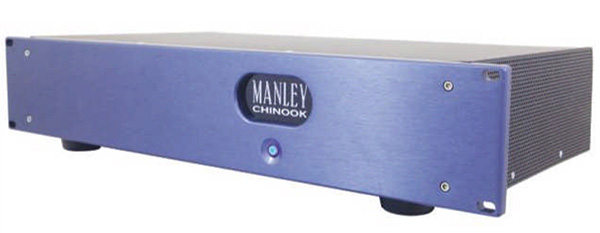 Manley Laboratories Chinook phono preamplifier
The Manley Laboratories (footnote 3) Steelhead phono preamplifier remains one of my favorite pieces of audio gear. The CD-Rs I made using it still sound spectacular. Its combination of ultra-flexibility, excellent signal/noise ratio, dynamic expressiveness, and low coloration remains hard to beat. Getting me to part with my Steelhead took the Ypsilon VPS-100 phono preamp, plus that company's outboard MC-10 and MC-16 step-up transformers, which remain unbeaten for transparency—but in a package that costs four times the Steelhead's price of $8000. Now comes Manley's Chinook (footnote 4): a one-box, tube-and-FET-cascode moving-coil/magnet phono preamp that produces more than a taste of the Steelhead's sound for only $2250. With the Chinook you lose a lot of the Steelhead's convenience and flexibility, as well as its unique, autoformer-based MC input and outboard power supply. However, you still get a beautifully made (in the US), feature-packed phono preamp named after a salmon, and, for an all-tube (no step-up transformers) amplification design capable of 60dB of gain, a very quiet one. Half of the Chinook's interior real estate is taken up by the power supply and its large toroidal power transformer.
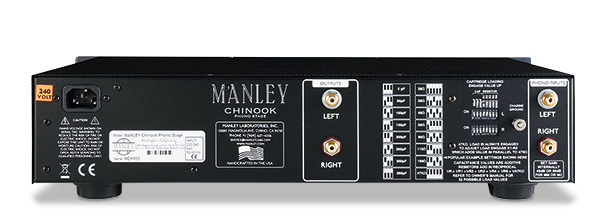 Switching between gains of 45dB (MM) and 60dB (MC) requires you to remove the Chinook's thin, perforated top plate; changing the resistive and capacitive loading is done via DIP switches on the rear panel—not nearly as flexible or convenient as the Steelhead . . . but consider that $5750 difference in price.
For resistive loading, there are five DIP switches per channel, for loads of from 26 to 787 ohms in 31 steps, plus 47k ohms for MM cartridges; seven options of capacitive loading are offered, from 50 to 350pF, which should be sufficient for all but the insufferably obsessed.
A pair of dual-triode 6922 tubes produces the gain, while a second, direct-coupled pair act as output drivers; between the tube pairs is the passive RIAA equalization. Any 6DJ8, 7308, or ECC88 tube can be used; for this review, I used the stock 6922 tubes.
Switching between gains of 45dB (MM) and 60dB (MC) requires you to remove the Chinook's thin, perforated top plate; changing the resistive and capacitive loading is done via DIP switches on the rear panel—not nearly as flexible or convenient as the Steelhead . . . but consider that $5750 difference in price.
For resistive loading, there are five DIP switches per channel, for loads of from 26 to 787 ohms in 31 steps, plus 47k ohms for MM cartridges; seven options of capacitive loading are offered, from 50 to 350pF, which should be sufficient for all but the insufferably obsessed.
A pair of dual-triode 6922 tubes produces the gain, while a second, direct-coupled pair act as output drivers; between the tube pairs is the passive RIAA equalization. Any 6DJ8, 7308, or ECC88 tube can be used; for this review, I used the stock 6922 tubes.
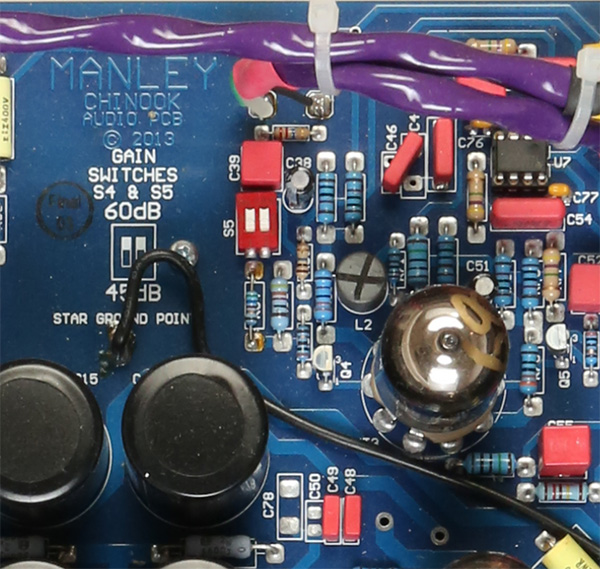 EveAnna Manley says that the output configuration has "beefy current-driving capabilities," with a super-low output impedance that can drive long lengths of cable.
The Chinook incorporates the "four-corner" RIAA circuit, which includes a time constant of 3.18µs, nicknamed "Neumann" because many, if not most, modern lacquers are cut using a Neumann cutter head, which protects itself by limiting at 50kHz the otherwise rising RIAA pre-emphasis curve. While this "corner" is not part of the RIAA spec, proponents argue that it should be added in the RIAA playback spec to better mirror the pre-emphasis curve used in cutting. There's a great deal of controversy about this: Keith Howard and John Atkinson, among others, don't think this fourth corner is a good idea. But that anyone in 2012 is still willing to argue about such minutiae indicates to me that there's plenty of life left in the analog beast. (If you want to delve more deeply, see Keith Howard's detailed discussion here.)
But whatever the fourth corner's measurable or audible effects, I couldn't hear them—though of course I didn't get to hear the Chinook with three corners, so I don't know what Corner Four might have added or subtracted from its sound.
How did the Chinook sound? It was remarkably quiet, even when confronted with the H&S Ice Blue's 200µV output. And while I haven't had a Steelhead here for a long time, the Chinook revived my memory of it by not sounding overtly "tubey," which I think is a plus. Instead, it combined the sense of relaxation and abundant musical flow that tubes do so well, with the neutral tonal balance of good solid-state designs.
EveAnna Manley says that the output configuration has "beefy current-driving capabilities," with a super-low output impedance that can drive long lengths of cable.
The Chinook incorporates the "four-corner" RIAA circuit, which includes a time constant of 3.18µs, nicknamed "Neumann" because many, if not most, modern lacquers are cut using a Neumann cutter head, which protects itself by limiting at 50kHz the otherwise rising RIAA pre-emphasis curve. While this "corner" is not part of the RIAA spec, proponents argue that it should be added in the RIAA playback spec to better mirror the pre-emphasis curve used in cutting. There's a great deal of controversy about this: Keith Howard and John Atkinson, among others, don't think this fourth corner is a good idea. But that anyone in 2012 is still willing to argue about such minutiae indicates to me that there's plenty of life left in the analog beast. (If you want to delve more deeply, see Keith Howard's detailed discussion here.)
But whatever the fourth corner's measurable or audible effects, I couldn't hear them—though of course I didn't get to hear the Chinook with three corners, so I don't know what Corner Four might have added or subtracted from its sound.
How did the Chinook sound? It was remarkably quiet, even when confronted with the H&S Ice Blue's 200µV output. And while I haven't had a Steelhead here for a long time, the Chinook revived my memory of it by not sounding overtly "tubey," which I think is a plus. Instead, it combined the sense of relaxation and abundant musical flow that tubes do so well, with the neutral tonal balance of good solid-state designs.
 The Chinook's transient attack was very clean and ever so slightly on the soft side of neutral, which is far preferable to the edge, etch, and hypercleanness of lesser solid-state phono preamps. Its sustain was generous, as was the decay, thanks in part to its subjectively excellent signal/noise ratio. The bass was well extended and reasonably taut, and every aspect of good soundstaging and imaging was present and accounted for.
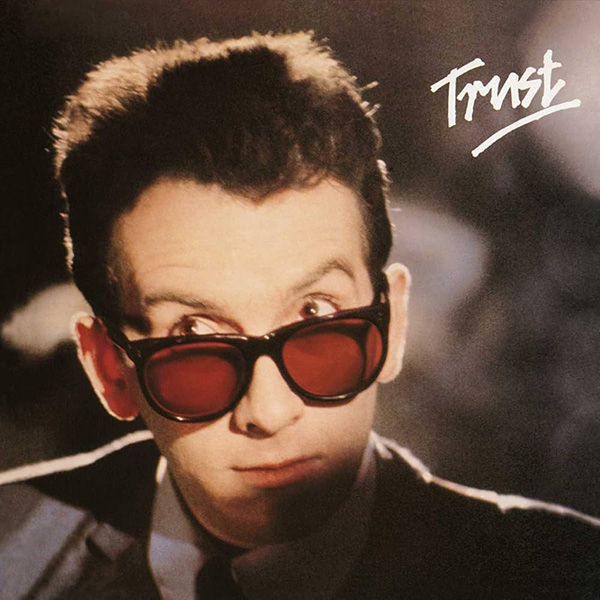
I played some old, familiar records, such as the original UK "Porky Prime Cut" pressing of Elvis Costello's Trust (F Beat XXLP II), which has some of the most convincingly recorded drums and cymbals you're likely to hear on a rock album (footnote 5). "From a Whisper to a Scream," obliquely referenced in the title of this column, features a duet of Costello and Squeeze's Glen Tilbrook, each voice panned slightly toward the center, to appear adjacent to the left and right speakers. There should be no doubt about where each singer seems to be standing, and each should be locked in his own space, clearly untethered from the speaker near him. The Chinook locked them in, producing well-defined, three-dimensional singing heads. Vocal sibilants were cleanly rendered with just the right amount of grit, neither too soft nor too etched.
In most ways, the Chinook sounded as advertised, very much like the Steelhead, probably shaving off a bit here and there in subtle sins of omission. However, it fell noticeably short in macrodynamics—though it was still very good even there, especially considering the price.
The Chinook's dynamics were good; but as best I can recall its sound, the Steelhead, with its much larger power supply, summoned up greater overall slam and majesty, and was better able to grip and define the dynamic rhythmic contours of explosive musical passages.
But look: the Steelhead's basically excellent sound—its silky sheen, and a graceful, almost inaudibly subtle warmth that I felt more than heard—remains intact in the Chinook. What Manley Labs has had to carefully and gently scrape away in order to lower the Chinook's cost is proportionately far less than the big chunk of change they've hacked from the Steelhead's price.
If you can't afford a Steelhead, and the Chinook's $2250 price is still a stretch, do yourself a huge favor: Get off the couch and s-t-r-e-t-c-h-!
The Chinook's transient attack was very clean and ever so slightly on the soft side of neutral, which is far preferable to the edge, etch, and hypercleanness of lesser solid-state phono preamps. Its sustain was generous, as was the decay, thanks in part to its subjectively excellent signal/noise ratio. The bass was well extended and reasonably taut, and every aspect of good soundstaging and imaging was present and accounted for.
I played some old, familiar records, such as the original UK "Porky Prime Cut" pressing of Elvis Costello's Trust (F Beat XXLP II), which has some of the most convincingly recorded drums and cymbals you're likely to hear on a rock album (footnote 5). "From a Whisper to a Scream," obliquely referenced in the title of this column, features a duet of Costello and Squeeze's Glen Tilbrook, each voice panned slightly toward the center, to appear adjacent to the left and right speakers. There should be no doubt about where each singer seems to be standing, and each should be locked in his own space, clearly untethered from the speaker near him. The Chinook locked them in, producing well-defined, three-dimensional singing heads. Vocal sibilants were cleanly rendered with just the right amount of grit, neither too soft nor too etched.
In most ways, the Chinook sounded as advertised, very much like the Steelhead, probably shaving off a bit here and there in subtle sins of omission. However, it fell noticeably short in macrodynamics—though it was still very good even there, especially considering the price.
The Chinook's dynamics were good; but as best I can recall its sound, the Steelhead, with its much larger power supply, summoned up greater overall slam and majesty, and was better able to grip and define the dynamic rhythmic contours of explosive musical passages.
But look: the Steelhead's basically excellent sound—its silky sheen, and a graceful, almost inaudibly subtle warmth that I felt more than heard—remains intact in the Chinook. What Manley Labs has had to carefully and gently scrape away in order to lower the Chinook's cost is proportionately far less than the big chunk of change they've hacked from the Steelhead's price.
If you can't afford a Steelhead, and the Chinook's $2250 price is still a stretch, do yourself a huge favor: Get off the couch and s-t-r-e-t-c-h-!
Footnote 1: Michael Fremer stepped down from Stereophile and AnalogPlanet.com in 2022. See this announcement.—Ed. Footnote 2: H&S Cartridge Clinic, 85408 Gammelsdorf, Germany. (2012); no loner in business (2026). US distributor: Bertrand Audio Imports, 49 Fairview Avenue, Nashua, NH 03060 (2012). Tel: (603) 883-1982. Web: www.bertrandaudio.com Footnote 3: Manley Laboratories, LLC., 13880 Magnolia Avenue, Chino, CA 91710. Tel: (909) 627-4256. Fax: (909) 628-2482. Web: www.manley.com
Footnote 4: A subsequent review of the Chinook can be found here.—Ed.
Footnote 5: Legendary English mastering engineer George Peckham used to inscribe "A Porky Prime Cut" on the lacquers he cut.—John Atkinson
H&S Ice Blue moving-coil cartridgeProducts with good backstories are always easier to review—like the ingenious preamplifier circuit Sully Sullenberger devised just after the bird strike forced his landing in the Hudson River. It doesn't get much easier than that.
The recent reissue of Patricia Barber's Nightclub, mastered by Bob Ludwig from the digital tapes, cut by Doug Sax, and pressed on two 180gm LPs (Premonition), should please all fans of the singer, even those who leave audio-show demo rooms screaming, "Enough Barber already!" That would be me, but this is one of her best, and engineer Jim Anderson's recording is a transparent, three-dimensional gem with crystalline, shimmering highs and deep, expressive bass. The Ice Blue delivered it all effectively, though the Lyra Atlas was both equally revealing of low-level detail and dynamically more supple, particularly microdynamically—it better expressed the small-scale shifts that reveal the breath of life and make recorded music sound almost live. And while the A90 couldn't match the Ice Blue or the Atlas in macrodynamic slam, it rivaled the Lyra's detail retrieval and surpassed the Ice Blue's, though not by much.
When I played Nathan Milstein's recording of the Beethoven Violin Concerto, with Erich Leinsdorf conducting the Philharmonia Orchestra (red vinyl, UK Columbia/Franklin Mint SAX 2508), the string silkiness and other instrumental textures weren't quite as palpable through the Ice Blue as I remembered hearing from the Atlas. Swapping to the Atlas brought them back. Strong on the initial attack, the Ice Blue was a better rock and jazz than a classical cartridge—at least in my system.
The Ice Blue produced a wide soundstage—not surprising, given the degree of channel separation I measured—though that stage was somewhat forward, and not quite as deep as the A90's or the Atlas's.
Manley Laboratories Chinook phono preamplifierThe Manley Laboratories (footnote 3) Steelhead phono preamplifier remains one of my favorite pieces of audio gear. The CD-Rs I made using it still sound spectacular. Its combination of ultra-flexibility, excellent signal/noise ratio, dynamic expressiveness, and low coloration remains hard to beat. Getting me to part with my Steelhead took the Ypsilon VPS-100 phono preamp, plus that company's outboard MC-10 and MC-16 step-up transformers, which remain unbeaten for transparency—but in a package that costs four times the Steelhead's price of $8000. Now comes Manley's Chinook (footnote 4): a one-box, tube-and-FET-cascode moving-coil/magnet phono preamp that produces more than a taste of the Steelhead's sound for only $2250. With the Chinook you lose a lot of the Steelhead's convenience and flexibility, as well as its unique, autoformer-based MC input and outboard power supply. However, you still get a beautifully made (in the US), feature-packed phono preamp named after a salmon, and, for an all-tube (no step-up transformers) amplification design capable of 60dB of gain, a very quiet one. Half of the Chinook's interior real estate is taken up by the power supply and its large toroidal power transformer.
Switching between gains of 45dB (MM) and 60dB (MC) requires you to remove the Chinook's thin, perforated top plate; changing the resistive and capacitive loading is done via DIP switches on the rear panel—not nearly as flexible or convenient as the Steelhead . . . but consider that $5750 difference in price.
For resistive loading, there are five DIP switches per channel, for loads of from 26 to 787 ohms in 31 steps, plus 47k ohms for MM cartridges; seven options of capacitive loading are offered, from 50 to 350pF, which should be sufficient for all but the insufferably obsessed.
A pair of dual-triode 6922 tubes produces the gain, while a second, direct-coupled pair act as output drivers; between the tube pairs is the passive RIAA equalization. Any 6DJ8, 7308, or ECC88 tube can be used; for this review, I used the stock 6922 tubes.
EveAnna Manley says that the output configuration has "beefy current-driving capabilities," with a super-low output impedance that can drive long lengths of cable.
The Chinook incorporates the "four-corner" RIAA circuit, which includes a time constant of 3.18µs, nicknamed "Neumann" because many, if not most, modern lacquers are cut using a Neumann cutter head, which protects itself by limiting at 50kHz the otherwise rising RIAA pre-emphasis curve. While this "corner" is not part of the RIAA spec, proponents argue that it should be added in the RIAA playback spec to better mirror the pre-emphasis curve used in cutting. There's a great deal of controversy about this: Keith Howard and John Atkinson, among others, don't think this fourth corner is a good idea. But that anyone in 2012 is still willing to argue about such minutiae indicates to me that there's plenty of life left in the analog beast. (If you want to delve more deeply, see Keith Howard's detailed discussion here.)
But whatever the fourth corner's measurable or audible effects, I couldn't hear them—though of course I didn't get to hear the Chinook with three corners, so I don't know what Corner Four might have added or subtracted from its sound.
The Chinook's transient attack was very clean and ever so slightly on the soft side of neutral, which is far preferable to the edge, etch, and hypercleanness of lesser solid-state phono preamps. Its sustain was generous, as was the decay, thanks in part to its subjectively excellent signal/noise ratio. The bass was well extended and reasonably taut, and every aspect of good soundstaging and imaging was present and accounted for.
I played some old, familiar records, such as the original UK "Porky Prime Cut" pressing of Elvis Costello's Trust (F Beat XXLP II), which has some of the most convincingly recorded drums and cymbals you're likely to hear on a rock album (footnote 5). "From a Whisper to a Scream," obliquely referenced in the title of this column, features a duet of Costello and Squeeze's Glen Tilbrook, each voice panned slightly toward the center, to appear adjacent to the left and right speakers. There should be no doubt about where each singer seems to be standing, and each should be locked in his own space, clearly untethered from the speaker near him. The Chinook locked them in, producing well-defined, three-dimensional singing heads. Vocal sibilants were cleanly rendered with just the right amount of grit, neither too soft nor too etched.
Footnote 1: Michael Fremer stepped down from Stereophile and AnalogPlanet.com in 2022. See this announcement.—Ed. Footnote 2: H&S Cartridge Clinic, 85408 Gammelsdorf, Germany. (2012); no loner in business (2026). US distributor: Bertrand Audio Imports, 49 Fairview Avenue, Nashua, NH 03060 (2012). Tel: (603) 883-1982. Web: www.bertrandaudio.com Footnote 3: Manley Laboratories, LLC., 13880 Magnolia Avenue, Chino, CA 91710. Tel: (909) 627-4256. Fax: (909) 628-2482. Web: www.manley.com