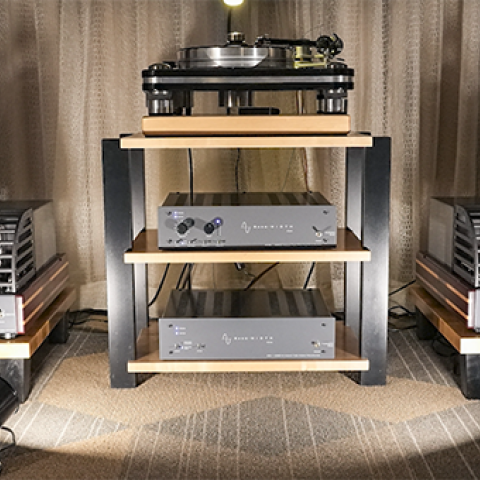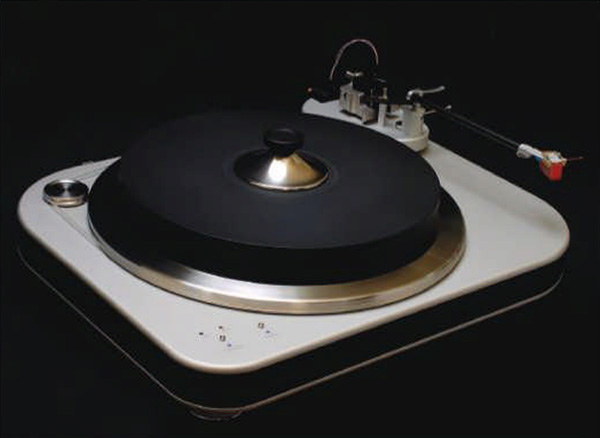
Allen Perkins's Spiral Groove SG1.1 turntable ($25,000; footnote 1) is a remarkably dense, compact, belt-driven design that weighs a surprising 75lb. With the motor isolated inside its 18.5" wide by 15" deep plinth, the SG1.1 has a small footprint, and its height of ca 5", including feet, permits a flexibility of placement seldom found with premium-priced turntables.
The design, reminiscent of a three-dimensional jigsaw puzzle, is far more complex and ingenious than it might at first appear, and while the SG1.1 superficially resembles a few other turntables now on the market, those took their styling cues (but only those) from Perkins's late-1990s RPM turntables, which were not particularly well marketed.
Design Features
The SG1.1 has a split plinth, its two halves separated by four strategically placed Sorbothane pads under heavy pressure. Each half comprises two aluminum plates. The thinner top plate contains the arm-mount system (more about that shortly), which is isolated from the thicker lower plate. The lower plate contains the bearing system, no part of which touches the arm-mount platform. This well-damped system thus produces a stable tonearm/platter alignment in which none of the component parts of either assembly touches any parts of the other assembly.
The thick upper section of the lower plinth, decoupled by the Sorbothane from the upper assembly, holds the motor, which itself is isolated on its own platform. The feet are secured to the lower plate, which doesn't touch the motor platform. This system thus isolates the tonearm mount from platter bearing, bearing system from motor, and motor from feet.
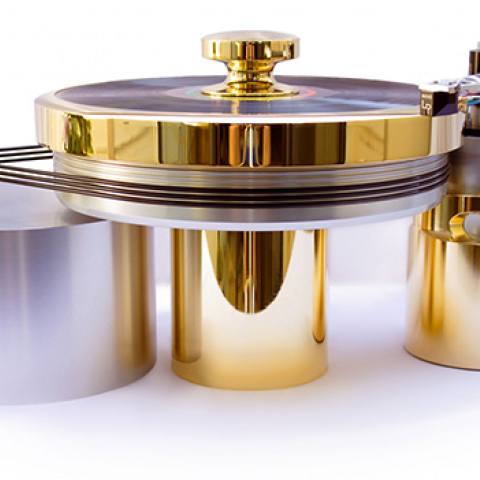
The 22lb platter is a layer cake of, from top to bottom, graphite, vinyl, and phenolic. Attached to the bottom layer is a heavy, grooved, 14"-diameter ring of stainless steel, into a groove in which fits the drive belt, a compliant O-ring. The steel ring's clearance of the plinth's top plate is breathtakingly tight—any machining variances would easily be visible. When the platter spins, there was only the slightest hint of gap variation—and only when I put my eye right up to the gap.
The platter bearing—an inverted sapphire disc and a precision ball bearing—is unlike any of the bearing systems, inverted or otherwise, found in the vast majority of turntables made today. Protruding from and bolted to the upper half of the plinth's thicker plate is a large-diameter shaft of hardened steel, the outer surface of which is machined to produce the three rings that are the bearing's contact points. The bearing gap is machined to an ultralow tolerance of 0.0003". The center of the shaft has been bored out about a third of the way down to produce a hole, in which sits a precision steel ball. The large-diameter bearing sleeve attaches to the platter's bottom, phenolic layer. Centered within the sleeve is an aluminum post terminated on its bottom face with a sapphire disc. When the platter/sleeve assembly is lowered onto the bearing, the sapphire disc presses against the hardened steel ball sitting in the bearing, and the three bearing rings contact the sleeve.
In this unique design, the middle shaft ring is at the rotational plane of the ball/disc contact point, which is also on the same plane as the drive belt. The bearing system is thus rightly claimed to not be susceptible to rocking or oscillation.
A pair of disc magnets at the bottom of the bearing sleeve, and an opposed pair on the body (Perkins eschews the word plinth, which he says is an architectural term inappropriate to the description of turntables) reduces to a few pounds the weight at the interface of the ball and the sapphire thrust pad. The spindle is decoupled to reduce transmission of whatever little bearing noise the system produces.
Drive is via a low-voltage, AC synchronous motor driven by an outboard, phase-adjusted sinewave generator that makes possible a ±10% range of speed adjustment. Incoming AC is first converted to DC, then the supply synthesizes a sinewave signal with switchable frequencies and adjustable phase. On startup, the motor runs at full torque. When the platter reaches the chosen speed, the current is reduced, which quiets and smooths motor operation.
Speed (33 1/3 or 45rpm) is selected and adjustments made via pushbuttons and trim pots on the plinth. As the platter's speed increases, an LED flashes with increasing rapidity, and glows steadily when the desired speed is reached. The SG1.1 is slow on the uptake—it took a while to get up to speed—but that's by design.
You'll Leica the Tonearm Mounting System!: Allen Perkins likes Leica cameras. One day, while changing lenses, he realized that the camera's bayonet lens mounting system must be 100% accurate and repeatable. Why not incorporate such a mount into a turntable and arm mount? So he did.
At the right corner of the SG1.1's plinth is a round opening with a bayonet-type receptacle similar to what's found on a camera body. The armboard incorporates the equivalent of what's found on a lens, allowing you to swap out tonearms as easily as switching camera lenses, and with equal precision.
Perkins Points Out: When the spindle is also the bearing shaft, as in typical turntable designs, a single part defines the center of rotation. Perkins points out that his design separates the bearing system from the platter so that a single part does not define the center.
Aligning the spindle, platter, and bearing to one center requires very high machining accuracy, Perkins told me, but achieving it produces a totally stable platform that prevents the already low noise generated by the bearing system from reaching the layer supporting the record. While expensive "zero-friction" bearings, too, can reduce noise, Perkins sees these as a misguided goal, assuming you can prevent the noise from reaching the record using less expensive but equally effective means.
 The Centroid Unipivot Tonearm
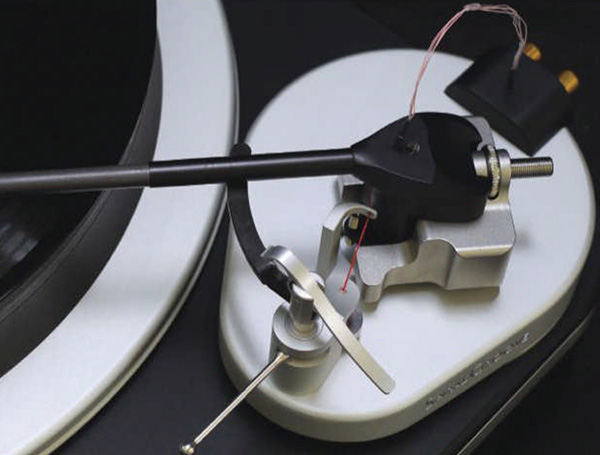
A total rethinking of his Immedia RPM2 tonearm of the 1990s, Perkins's Centroid ($6000), also a unipivot, maintains a number of the older arm's key design points, including placing the pivot point and the stylus in the same plane—even when you raise or lower the tonearm to adjust vertical tracking angle (VTA) or stylus rake angle (SRA). Keeping the stylus in the same plane as the pivot point greatly enhances the system's stability, Perkins says.
With most tonearms, adjusting the VTA or SRA is done by raising or lowering the entire arm, including the pivot assembly. With the Centroid, VTA and SRA are adjusted with a setscrew on the top of the arm, which raises or lowers it without changing the pivot point. This doesn't permit on-the-fly adjustment of VTA/SRA, but that's entirely unnecessary once you've set the SRA to 92°.
One of Perkins's main design goals focused on the tonearm's moment of inertia and its effect on the cartridge's alignment with the record groove. This is even more critical in a pure unipivot design, where the bearing consists of a single point and cup that can easily become unstable, causing the tail (the tonearm) to wag the dog (the stylus). But the lower the moment of inertia, the more easily the cartridge can respond to warps and other LP flaws.
The word centroid refers to a condition in which balance is achieved at an object's center of mass. Think of how difficult it is to control a broom when holding it by the end of the handle. As you move down the shaft toward the bristles, it gets easier. When you reach the center of mass, the broom's moment of inertia is lowest, and the ease with which you can move the broom is maximized.
The Centroid's patented counterweight places a portion of its mass lower than and forward of the pivot point. This puts the centroid—that is, the center of the arm's mass—in line with the bearing pin in the vertical plane, and slightly lower than the pivot point in the horizontal plane. These conditions, combined with the stylus tip in the groove being in the same plane as the centroid, and remaining there regardless of VTA/SRA setting, is said to produce a vanishingly low moment of inertia in the vertical plane, and extreme stability in all planes of play.
The micro-adjustable counterweight can accommodate cartridges weighing from 4 to 20gm, while a setscrew high on the counterweight's left side, near the pivot point, allows precise setting of azimuth with very small movements of the screw.
The tonearm bearing comprises a steel pin, and a sapphire jewel cup made in Switzerland, The design avoids a secondary pivot because that would to some degree unload the main bearing point and diminish the unipivot's advantage of a direct-coupled, low-impedance energy path. Perkins feels he's found a way to achieve complete stability without resorting to the crutch of a secondary bearing.
Equally full attention to detail has been paid to the design of the patented antiskating system. The amount of antiskating force applied is said to vary inversely to the position of the stylus across the record surface. Given that skating is affected by groove modulation and vinyl formulation, this claim may not be borne out in practice, even if it's true in theory.
The armtube, of aluminum clad in carbon fiber, is said to be rigid and lightweight, with excellent self-damping qualities. A damping trough machined into the armboard can be filled with silicone fluid (supplied); the desired amount of vertical damping is provided by lowering a setscrew into the fluid. From the cartridge clips to the Eichmann RCA jacks enclosed in the terminal block integrated into the armboard's rear, the tonearm wire is ultra-low-mass, 50-gauge, hyper-Litz copper wire.
As on the earlier arm, the Centroid's cueing mechanism is undamped, and operates with a horizontal lever that, once I'd gotten used to it, had me saying, "Why did it take so long to think of that? How come no one else is using it?" A universal version of the Centroid arm should be available by the time you read this, priced at $6000.
Setup
The Spiral Groove SG1.1 came out of its box in one piece, and was quickly ready to spin. I found it easy to set up the Centroid tonearm, but that's because I'd once owned an RPM2. The instructions are okay, but photos would really help. Perkins says dealers set up most turntables, but I still think photos and clearer prose would be helpful—in 2012, how hard is it to add pictures to an instruction manual? The Centroid arm has a unique system of cartridge setup that space doesn't permit describing here. By the time this issue is in your hands, details will be posted on Analogplanet.com. Unique Design Produces Exceptional Sound
After lowering the Lyra Atlas cartridge's stylus onto the first record and releasing the Mute button, I was sure I had the Simaudio Moon 810 phono preamp plugged into the wrong preamplifier input. That's how quiet the SG1.1 was. Then the music started, and the volume was high. In the context of inherent groove noise, the SG1.1-Centroid combo might be the quietest turntable-tonearm combo I've ever heard. In that department it rivaled, and perhaps surpassed, Continuum Audio Labs' Caliburn and Cobra. I think the SG1.1-Centroid is even quieter than the Wave Kinetics NVS I reviewed in the October issue.
Along with the SG1.1's quiet was its rock-solid rhythm'n'pacing, which also rivaled the best I've heard. That's not surprising, given that Allen Perkins is an excellent drummer. I'm sure he concentrated on those qualities while designing the 'table's prototype. The SG1.1 kept a tight, compact grip on rhythm. Its sound was noticeably fast and controlled, in the tradition of what Naim most prides itself on: solid, punchy, iron-gripped control.
Using Dr. Feickert Analogue's very handy Platter Speed iPhone app and 7" test record, I found that the Spiral Groove's maximum deviation from the 3150Hz test tone was ±0.17%. By comparison, the $20,000-more-expensive Wave Kinetics NVS measured –0.11%/+0.12%—only slightly better. But for whatever reason or reasons, the SG1.1's rhythmic performance and overall sound were more compelling and bracing and felt more tightly sprung. I know that because I ended up listening more to the SG1.1 than to any other turntable I've reviewed in recent memory, for the sheer pleasure of it.
The Feickert software's graph of the SG1.1's speed variation was, like the Onedof turntable's, symmetrical and sinusoidal. That of the Wave Kinetics, while varying less to either side of the 3150Hz center point, was more jagged, as (I suspect) its direct-drive motor controller worked to keep the speed precise. Perhaps that accounts for some of the dryness I noted (and which Jonathan Tinn, of Wave Kinetics' distributor Blue Light Audio, insists is what tape sounds like), and perhaps it's why I was drawn more to listen to both the Onedof (reviewed in July 2012) and SG1.1 than to the Wave Kinetics.
I found myself pulling out rhythmically compelling LPs, such as the Talking Heads' Remain in Light (Sire Records), which the Spiral Groove decoded with a kind of easy precision that started making sense of some heretofore impenetrable mixes on this album.
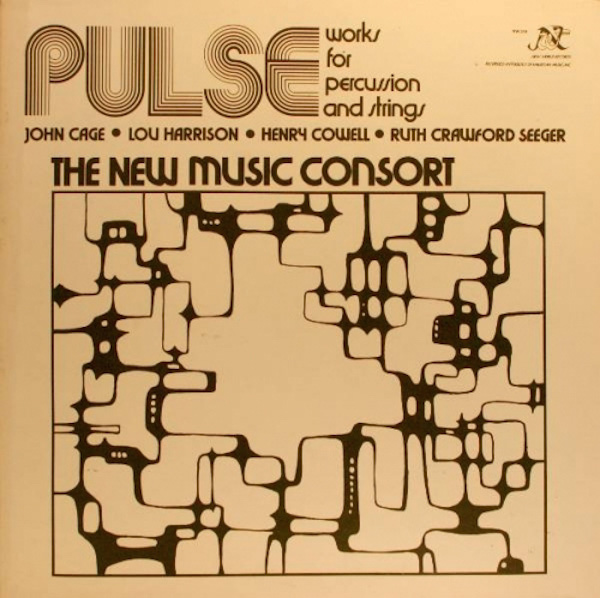 The percussion extravaganza and sonic spectacular Pulse: Works for Percussion and Strings, by the New Music Consort (LP, New World/Classic 319), demonstrated the SG1.1's exceptional rhythmic and spatial qualities and the stability of its images. But this disc also showed that while the Spiral Groove's microdynamic expressiveness was as precise and nuanced as I've heard (not surprising, given the quiet out of which small dynamic gestures emerged), macrodynamics, while very, very good, were somewhat compacted and less than fully explosive compared to those of the Continuum, the Wave Kinetics, or the Onedof. (These comparisons based on recordings I made at 24-bit/96kHz of each turntable playing selections from this disc, using the MSB A/D converter and an Alesis MasterLink hard-disk recorder.)
I also found that, for one reason or another, the Spiral Groove's exceptional background quiet did not translate into the blackest backgrounds for the music, though in that department it was still in the top tier.
The turntable-tonearm combo's reproduction of acoustic piano music was also mesmerizing, producing the most convincing verisimilitude. For instance, a reissue of Glenn Gould's recording of Beethoven's Piano Concerto 4, with Leonard Bernstein and the New York Philharmonic (LP, Columbia Masterworks/Impex IMP 60110), produced a piano that was liquid and delicately drawn, with transients that were precise without sounding etchy. Instrumental textures were reproduced with attack, sustain, and decay properly proportioned, and reverberant information correctly positioned relative to the physical boundaries of the orchestral image.
The percussion extravaganza and sonic spectacular Pulse: Works for Percussion and Strings, by the New Music Consort (LP, New World/Classic 319), demonstrated the SG1.1's exceptional rhythmic and spatial qualities and the stability of its images. But this disc also showed that while the Spiral Groove's microdynamic expressiveness was as precise and nuanced as I've heard (not surprising, given the quiet out of which small dynamic gestures emerged), macrodynamics, while very, very good, were somewhat compacted and less than fully explosive compared to those of the Continuum, the Wave Kinetics, or the Onedof. (These comparisons based on recordings I made at 24-bit/96kHz of each turntable playing selections from this disc, using the MSB A/D converter and an Alesis MasterLink hard-disk recorder.)
I also found that, for one reason or another, the Spiral Groove's exceptional background quiet did not translate into the blackest backgrounds for the music, though in that department it was still in the top tier.
The turntable-tonearm combo's reproduction of acoustic piano music was also mesmerizing, producing the most convincing verisimilitude. For instance, a reissue of Glenn Gould's recording of Beethoven's Piano Concerto 4, with Leonard Bernstein and the New York Philharmonic (LP, Columbia Masterworks/Impex IMP 60110), produced a piano that was liquid and delicately drawn, with transients that were precise without sounding etchy. Instrumental textures were reproduced with attack, sustain, and decay properly proportioned, and reverberant information correctly positioned relative to the physical boundaries of the orchestral image.
 A reissue of Thelonious Monk's The London Collection: Volume One (45rpm LPs, Black Lion/ORG Music ORGM-1052) was rhythmically locked in, and tonally and texturally as good as I've heard it, though again, macrodynamic expression was down a few notches from the Continuum—at less than one fifth the price.
The Spiral Groove's bass was superbly well controlled, rock solid, impactful, and well extended. The bottom end was nimble, tight, and well textured, but wasn't quite all the way there in terms of "testicular fortitude," a term first applied to audio by, to the best of my knowledge, my old boss, Harry Pearson, founder of The Abso!ute Sound. But that's something you'd notice only with speakers capable of producing monster bass, like the Wilson Alexandria XLFs I am currently using. Even then, unless you'd heard something like the Continuum, you wouldn't know what little is missing. Plus, the Spiral Groove's bottom-end tautness and control more than make up for the slight omission.
Conclusions:
A reissue of Thelonious Monk's The London Collection: Volume One (45rpm LPs, Black Lion/ORG Music ORGM-1052) was rhythmically locked in, and tonally and texturally as good as I've heard it, though again, macrodynamic expression was down a few notches from the Continuum—at less than one fifth the price.
The Spiral Groove's bass was superbly well controlled, rock solid, impactful, and well extended. The bottom end was nimble, tight, and well textured, but wasn't quite all the way there in terms of "testicular fortitude," a term first applied to audio by, to the best of my knowledge, my old boss, Harry Pearson, founder of The Abso!ute Sound. But that's something you'd notice only with speakers capable of producing monster bass, like the Wilson Alexandria XLFs I am currently using. Even then, unless you'd heard something like the Continuum, you wouldn't know what little is missing. Plus, the Spiral Groove's bottom-end tautness and control more than make up for the slight omission.
Conclusions:
The only reason I've said so little about the SG1.1-Centroid's midrange and top-end performance is that I'm out of space. But I'll end on the highest note: this turntable and tonearm's overall retrieval of detail may be the best of any such combo I've heard, other than Continuum's Caliburn-Cobra. You are guaranteed to hear details heretofore hidden in plain hearing from just about every record you play, in part because of the Spiral Grooves' absolutely neutral tonal balance and freedom from obvious colorations or resonances. Is it the 'table? the arm? the combination? Allen Perkins kindly sent me armboards for both my Kuzma 4Point and Graham Phantom Supreme arms so I could compare—but I'm still out of space. More next time. The engineering brilliance, machining excellence, build quality, remarkable compactness, and ease of setup and use of Spiral Groove's SG1.1 turntable and Centroid tonearm—and, of course, their engaging sound quality—make them landmark products that only an audiofool would dismiss for their small size and lack of flashy excess. They're on my short list for Product of the Year.
Footnote 1: The price includes custom armboard drilling for any non-Spiral Groove tonearm; Additional armboard for SG 1.1, mounted with stainless steel male bayonet fitting costs $1200 including custom drilling for any arm suitable for the SG 1.1. If a second Centroid is in use with the SG1.1, the additional stainless steel bayonet armboard mount costs $400. Brian Damkroger reviewed the less-expensive Spiral Groove SG2 turntable ($15,000) in June 2010. Spiral Groove, 1516 Fifth Street, Berkeley, CA 94710 (2012). Tel: (510) 559-2050 (2026). Web: http://immediasound.com/ (2026).
The SG1.1 has a split plinth, its two halves separated by four strategically placed Sorbothane pads under heavy pressure. Each half comprises two aluminum plates. The thinner top plate contains the arm-mount system (more about that shortly), which is isolated from the thicker lower plate. The lower plate contains the bearing system, no part of which touches the arm-mount platform. This well-damped system thus produces a stable tonearm/platter alignment in which none of the component parts of either assembly touches any parts of the other assembly.
The Centroid Unipivot TonearmA total rethinking of his Immedia RPM2 tonearm of the 1990s, Perkins's Centroid ($6000), also a unipivot, maintains a number of the older arm's key design points, including placing the pivot point and the stylus in the same plane—even when you raise or lower the tonearm to adjust vertical tracking angle (VTA) or stylus rake angle (SRA). Keeping the stylus in the same plane as the pivot point greatly enhances the system's stability, Perkins says.
The Spiral Groove SG1.1 came out of its box in one piece, and was quickly ready to spin. I found it easy to set up the Centroid tonearm, but that's because I'd once owned an RPM2. The instructions are okay, but photos would really help. Perkins says dealers set up most turntables, but I still think photos and clearer prose would be helpful—in 2012, how hard is it to add pictures to an instruction manual? The Centroid arm has a unique system of cartridge setup that space doesn't permit describing here. By the time this issue is in your hands, details will be posted on Analogplanet.com. Unique Design Produces Exceptional Sound
After lowering the Lyra Atlas cartridge's stylus onto the first record and releasing the Mute button, I was sure I had the Simaudio Moon 810 phono preamp plugged into the wrong preamplifier input. That's how quiet the SG1.1 was. Then the music started, and the volume was high. In the context of inherent groove noise, the SG1.1-Centroid combo might be the quietest turntable-tonearm combo I've ever heard. In that department it rivaled, and perhaps surpassed, Continuum Audio Labs' Caliburn and Cobra. I think the SG1.1-Centroid is even quieter than the Wave Kinetics NVS I reviewed in the October issue.
The percussion extravaganza and sonic spectacular Pulse: Works for Percussion and Strings, by the New Music Consort (LP, New World/Classic 319), demonstrated the SG1.1's exceptional rhythmic and spatial qualities and the stability of its images. But this disc also showed that while the Spiral Groove's microdynamic expressiveness was as precise and nuanced as I've heard (not surprising, given the quiet out of which small dynamic gestures emerged), macrodynamics, while very, very good, were somewhat compacted and less than fully explosive compared to those of the Continuum, the Wave Kinetics, or the Onedof. (These comparisons based on recordings I made at 24-bit/96kHz of each turntable playing selections from this disc, using the MSB A/D converter and an Alesis MasterLink hard-disk recorder.)
I also found that, for one reason or another, the Spiral Groove's exceptional background quiet did not translate into the blackest backgrounds for the music, though in that department it was still in the top tier.
A reissue of Thelonious Monk's The London Collection: Volume One (45rpm LPs, Black Lion/ORG Music ORGM-1052) was rhythmically locked in, and tonally and texturally as good as I've heard it, though again, macrodynamic expression was down a few notches from the Continuum—at less than one fifth the price.
The Spiral Groove's bass was superbly well controlled, rock solid, impactful, and well extended. The bottom end was nimble, tight, and well textured, but wasn't quite all the way there in terms of "testicular fortitude," a term first applied to audio by, to the best of my knowledge, my old boss, Harry Pearson, founder of The Abso!ute Sound. But that's something you'd notice only with speakers capable of producing monster bass, like the Wilson Alexandria XLFs I am currently using. Even then, unless you'd heard something like the Continuum, you wouldn't know what little is missing. Plus, the Spiral Groove's bottom-end tautness and control more than make up for the slight omission.
The only reason I've said so little about the SG1.1-Centroid's midrange and top-end performance is that I'm out of space. But I'll end on the highest note: this turntable and tonearm's overall retrieval of detail may be the best of any such combo I've heard, other than Continuum's Caliburn-Cobra. You are guaranteed to hear details heretofore hidden in plain hearing from just about every record you play, in part because of the Spiral Grooves' absolutely neutral tonal balance and freedom from obvious colorations or resonances. Is it the 'table? the arm? the combination? Allen Perkins kindly sent me armboards for both my Kuzma 4Point and Graham Phantom Supreme arms so I could compare—but I'm still out of space. More next time. The engineering brilliance, machining excellence, build quality, remarkable compactness, and ease of setup and use of Spiral Groove's SG1.1 turntable and Centroid tonearm—and, of course, their engaging sound quality—make them landmark products that only an audiofool would dismiss for their small size and lack of flashy excess. They're on my short list for Product of the Year.
Footnote 1: The price includes custom armboard drilling for any non-Spiral Groove tonearm; Additional armboard for SG 1.1, mounted with stainless steel male bayonet fitting costs $1200 including custom drilling for any arm suitable for the SG 1.1. If a second Centroid is in use with the SG1.1, the additional stainless steel bayonet armboard mount costs $400. Brian Damkroger reviewed the less-expensive Spiral Groove SG2 turntable ($15,000) in June 2010. Spiral Groove, 1516 Fifth Street, Berkeley, CA 94710 (2012). Tel: (510) 559-2050 (2026). Web: http://immediasound.com/ (2026).