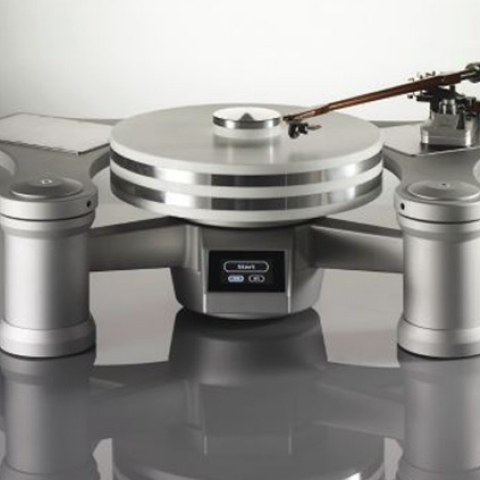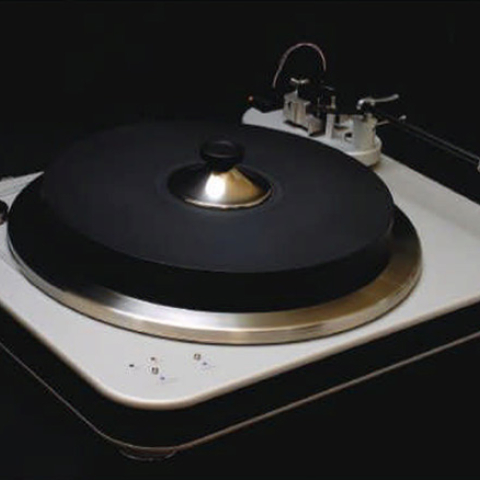
Will yet another $150,000 turntable fly in 2012? I'm speaking metaphorically, of course, but if any designer could make a turntable literally fly, it would be the Onedof's designer, Aleks Bakman.
Bakman's credits include structural analyses of airplane wing assemblies and engine attachments, and parts of the airframe and landing gear for helicopters. He's also worked for NASA, and participated in the design of the next generation of the Space Shuttle. (You can read more about his background on Onedof's website (footnote 1). You're guaranteed a laugh at the bottom of the page.)
Bakman earned a master's of science degree from the Georgia Institute of Technology's School of Mechanical Engineering, where he studied fluid dynamics, robotics, turbodynamics, tribology, rheology, applied mathematics, finite-element analysis, electronics, advanced dynamics, material science, and vibration theory. (While Bakman emigrated to the US from Russia, the Georgian school he attended was in Atlanta.) In short, Bakman brings to his design for a platter spinner levels of education and technical expertise that border on the ridiculous. He's also a passionate lover of music; his tales of musical deprivation while growing up in the former USSR sent chills up my spine. Bakman's tastes run from the Beatles and Procol Harum to jazz, and especially to classical. As the plane carrying Bakman to America in 1990 flew over the Statue of Liberty, the person in the seat next to him asked him what he was thinking. "Miles Davis," he replied.
In January, when I first met this rather intense individual and his turntable, at the Consumer Electronics Show, he played for me an excerpt from Nathan Milstein's 1961 recording of the Beethoven Violin Concerto, with Erich Leinsdorf conducting the Philharmonia Orchestra—a gorgeous-sounding, ultraquiet pressing on dark red vinyl from the Franklin Mint! (footnote 2)
So Bakman is a music lover. But he's also a rational technician—why would he still be interested in the old, outmoded, measurably inferior vinyl technology? Bakman may be an engineer but he also listens, with both his ears and his heart.
One Degree of Freedom
A decade ago, about the time Bakman's day job was attaching a high-resolution telescope to NASA's Mars Reconnaissance Orbiter, he set about designing and building a state-of-the-art turntable. As he skied down Colorado's 14,265-foot Quandary Peak, an idea came to him for a perfect, zero-tolerance, self-centering, nonresonant, frictionless platter bearing. That bearing is the heart of Bakman's Onedof turntable and the origin of its name, the One Degree of Freedom, abbreviated Onedof. Bakman lives in the Denver area, where all of the machining for his turntable is done, taking advantage of the talents of technicians and manufacturing facilities related to the aerospace industry—as well as of mathematicians, who helped with the 'table's motor-control system.
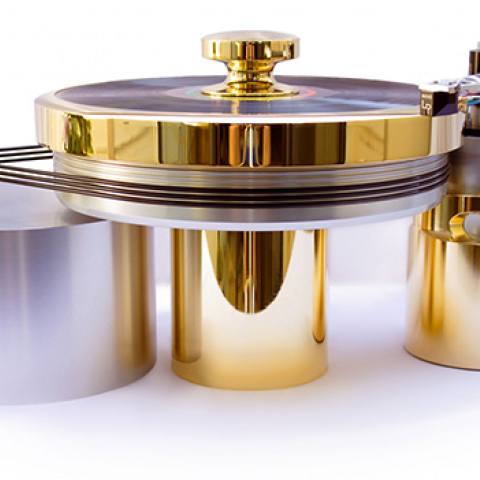
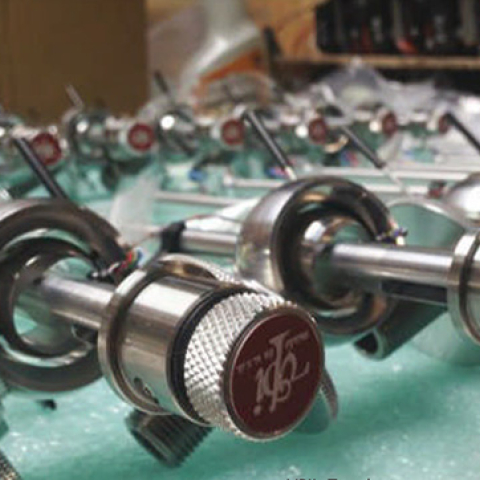
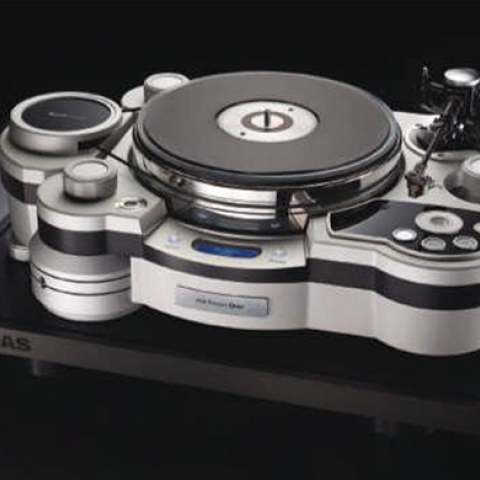
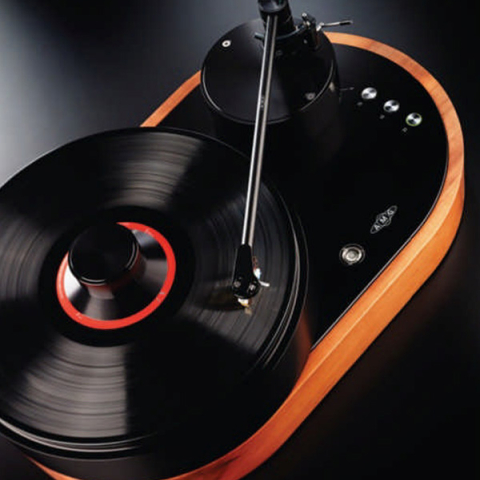
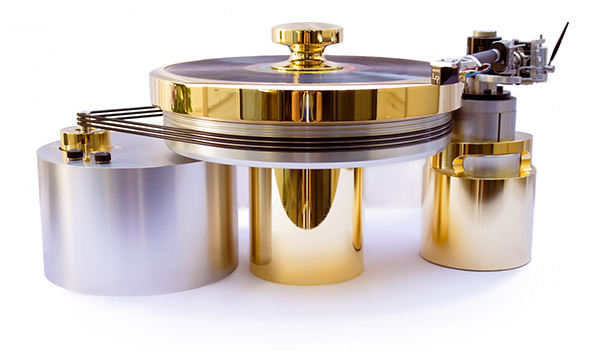
The Onedof turntable comprises three towers: the motor tower, the tonearm tower, and the massive platter bearing that also serves as the platter's pedestal. Bakman claims that it's the first turntable in history with a self-centering platter bearing suspended in a nonresonant liquid. Other than for true air-bearing designs, such as Andy Payor's Rockport Technologies System III Sirius, the Onedof's bearing is the only one I know of not supported by a thrust pad and ball. The Onedof's bearing features a rotating shaft supported by a stiff, self-pressurizing film of oil. The spindle is not damped in an oil bath, as in a traditional bearing, In such a bearing, the instability of the cylindrical housing creates horizontal "whirring" of the shaft, which translates into vertical wobbling of the platter.
According to Bakman, his design results in a "resonance-free liquid suspension with nonlinear stiffness—any tendency for the bearing to move from its desired centered position is instantaneously countered by pressurization of the oil." Considering the size of a cartridge's stylus and its minuscule meanderings within a record's groove, eliminating this movement at the bearing should produce sonic benefits—as would the elimination of the noise and friction of a thrust pad and ball.
The system has no rolling elements or points of solid contact to wear out, is said to generate virtually no heat, and the oil, sealed inside the bearing, can't thicken or become polluted. There is no solid load path—whatever resonances are generated by the stand on which the Onedof is placed never reach the system, and vice-versa.
The Onedof's 3"-tall platter is made of aluminum, out of which have been machined six sealed chambers filled with a high-viscosity oil in which are suspended solid particles. This is claimed to damp the platter, rendering it non-resonant. The bearing design makes it impossible to use a vacuum system to flatten the LP against the platter, so the Onedof employs a central weight and a massive outer ring of 24K-gold–plated metal that rides on and is centered by a pair of O-rings around the platter's circumference.
 Onedof Drive System
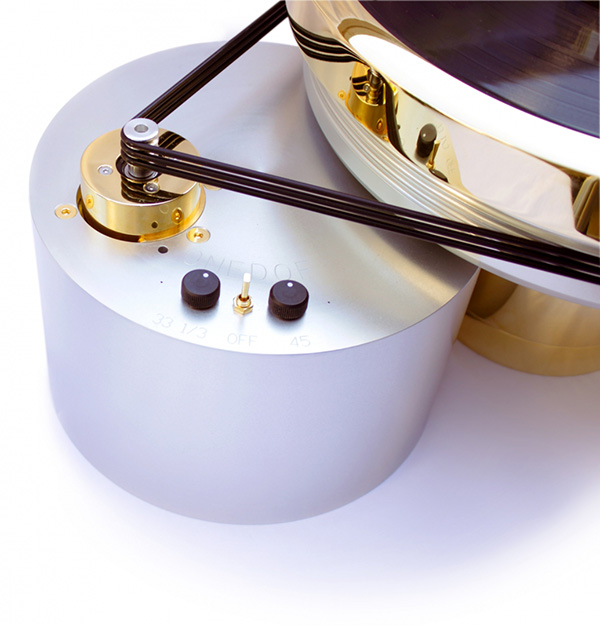
I asked Aleks Bakman to describe the motor and controller enclosed within the Onedof's massive outboard motor pod. I should have known he'd send me a treatise-like explanation that space does not permit reiterating in detail here—a guy needs a website for that! I'll just say here that Bakman uses a large, costly, non-cogging, Swiss-made AC synchronous motor and drive. The brushless, coreless motor, with skewed stator windings and preloaded bearings, controlled by a feedback-driven, custom-programmed Texas Instruments microprocessor, provides stable drive for the platter via three O-rings. Bakman says the O-ring material was carefully chosen to be soft enough to provide decoupling of vibrations from the motor, but stiff enough to quickly and accurately control the platter. Bakman is well aware of the problems associated with his choice of a grooved pulley and grooved platter, as opposed to a crowned pulley and smooth platter periphery, particularly with a three-belt system. He claims that a combination of precision machining and adjustable, lockable vertical positioning of the motor eliminates distortion-causing mismatches of the platter and pulley grooves, while his noise-canceling, feedback-controlled drive system is said to eliminate any problems caused by variations in belt thickness.
The Tonearm Tower
The Onedof's massive tonearm tower has more than 3" of vertical motion possible, adjusted via a smoothly rotating, finger-operated insert. Circular armboard inserts fit into an opening in an equally massive cantilevered platform that's bolted to the tower in a configuration that will be familiar to most analog devotees. Tightening a bolt on the platform's side locks the armboard in place. There's nothing unique or innovative here; it's just well designed, and particularly well executed.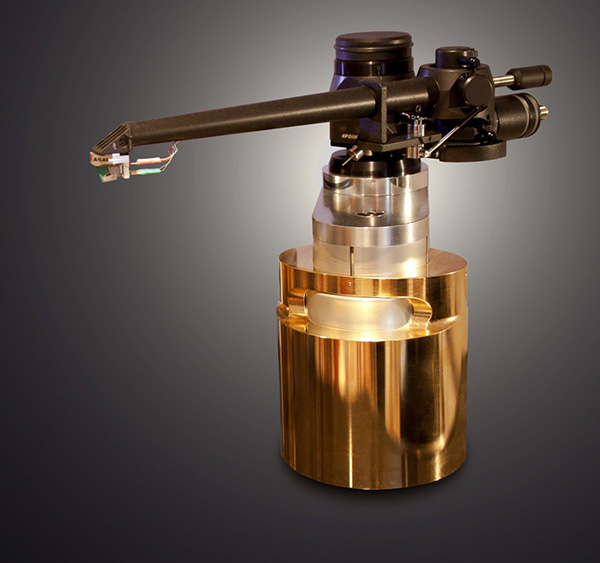 A $150,000 turntable?
Designing and building the Onedof's bearing was time-consuming and costly, and accounts for a large portion of the turntable's price of $150,000. Despite that high price, Bakman says the direct-sales markup is less than the industry standard of 40–50%. That's why the Onedof will be sold only "factory direct." "Will be"? At the time of writing, the Onedof is a one-off: The review sample I listened to is the only unit in existence. Bakman is prepared to build to order, and says that the complex machining should be relatively easy, now that all the computer programming is finished. Because of the Onedof's simple, modular design, should any part fail, it will simply be exchanged for a new one.
A few years ago, at a CES, Mark Doehmann, then with Continuum Audio Labs, showed me a prototype for a similar bearing, designed for Continuum by a Russian bearing expert based in Connecticut. Like Bakman's design, it was expensive to build, and would have elevated the Caliburn turntable's price to astronomical levels. (Shortly thereafter, Doehmann, who'd led the design team that developed the Caliburn, left the company.) The Continuum also costs $150,000, but that price includes a tonearm and a substantial stand topped by a magnetic isolation platform. Send Bakman a check for $150,000 and you get only a turntable.
Setup and Use
Bakman arrived at my house one day, unboxed the Onedof's three assemblages—platter and bearing, tonearm tower, and motor pod—and set it up relatively quickly on my Harmonic Resolution Systems SXR rack. The M3X base on the top shelf of the rack had been configured with six isolating feet, chosen based on the Onedof's weight of 110lb. Because the Onedof lacks a leveling system, any platform on which it sits must be carefully leveled, then periodically monitored for any deviation from true. The Onedof is surprisingly compact—it's shipped in a box that's a 20" cube—with a deceptively simple exterior; its lustrous gold plating makes it a major piece of eye candy. The only oddity was its plain rubber record mat, which, Bakman volunteered, costs him $5.
The Onedof's peripheral platter ring, like all such rings, can be clunky and difficult to use. If you don't lower it dead on, it can lock onto the O-rings at an odd angle and be difficult to pry off. Or it can sit lopsided, and heave alarmingly up and down when the platter spins.
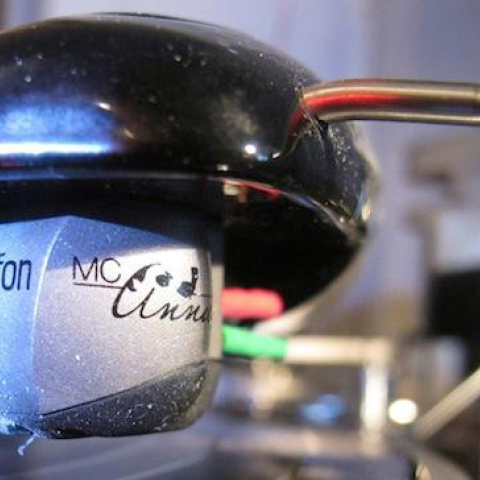
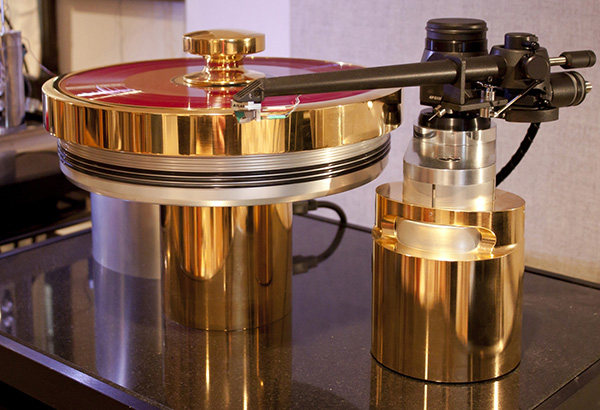 I first set up, on the Onedof's tonearm tower, a Phantom II Supreme arm I'd purchased from Graham Engineering, and installed in it a Lyra Titan i cartridge. This latest model of the Phantom includes a heavy circular tungsten insert inside a newly designed pivot housing of brass, which improves the unipivot bearing's mass-loading. The arm also now features a reworked counterweight and Magneglide lateral-stability systems, new internal wiring, and an armtube of titanium instead of ceramic.
Immediately obvious was the ultrasmooth, refined nature of the sound—but that had been obvious even at CES, when Bakman played Milstein's Beethoven through a system comprising Lamm electronics and Wilson Audio Specialties MAXX 3 speakers. Here, the electronics were an Ypsilon VPS-100 phono preamp, an Ypsilon MC-16 (or MC-10, depending on cartridge output) step-up transformer, a darTZeel NHB-18NS preamplifier, and darTZeel's NHB 458 monoblocks.
Comparisons
I first set up, on the Onedof's tonearm tower, a Phantom II Supreme arm I'd purchased from Graham Engineering, and installed in it a Lyra Titan i cartridge. This latest model of the Phantom includes a heavy circular tungsten insert inside a newly designed pivot housing of brass, which improves the unipivot bearing's mass-loading. The arm also now features a reworked counterweight and Magneglide lateral-stability systems, new internal wiring, and an armtube of titanium instead of ceramic.
Immediately obvious was the ultrasmooth, refined nature of the sound—but that had been obvious even at CES, when Bakman played Milstein's Beethoven through a system comprising Lamm electronics and Wilson Audio Specialties MAXX 3 speakers. Here, the electronics were an Ypsilon VPS-100 phono preamp, an Ypsilon MC-16 (or MC-10, depending on cartridge output) step-up transformer, a darTZeel NHB-18NS preamplifier, and darTZeel's NHB 458 monoblocks.
Comparisons
Comparing the Onedof–Graham–Lyra Titan i and Continuum Caliburn–Cobra–Lyra Atlas combos was tricky: the tonearms and cartridges were different. But one difference was obvious: the Ondeof combo sounded notably smoother and more "together," though at the considerable expense of dynamic contrasts, transient precision, transparency, and overall impact. On the other hand, the Continuum rig sounded a bit underdamped and slightly ragged in comparison. Hold your spitballs—both setups sounded stupendous. They just sounded stupendous in different ways. I began adjusting the amount of damping fluid in the Phantom's well because the Onedof combo sounded too smooth and somewhat overdamped—and that was with just enough fluid to rise above the pointed taper at the bearing's bottom end. I found two things: First, the Phantom II Supreme is far more sensitive than its predecessors to the level of its damping fluid; and second, far from providing a subtractively smoothed-over sound, the Onedof was remarkably revealing. That sound dramatically changed, depending on the tonearm and/or cartridge used. The Onedof is easily the quietest turntable I've encountered. I placed a stethoscope on the bearing with the platter spinning and heard zero noise. Ditto the motor pod. Despite the Onedof's lack of isolation, rapping a knuckle on the bearing housing produced silence through the speakers. I suspect that the Onedof's notable silkiness and smoothness aren't artifacts, but the results of its unique bearing.
When a second, loaner Lyra Atlas arrived, thanks to AudioQuest's Joe Harley, I was able to make more meaningful comparisons, aided by two more arrivals: MSB's Platinum A/D converter (+$22,000) and Platinum Diamond DAC IV D/A converter ($21,995). I repeatedly auditioned LP needle-drops at 24-bit/96kHz, made with the MSB converters and my Alesis Masterlink hard-disk recorder.
 One evening, friends came over, and after dinner I played a spectacular-sounding test pressing of the 25th-anniversary reissue of Paul Simon's Graceland, first on the Caliburn-Cobra-Atlas combo, then on the Onedof-Graham-Atlas (with arm damping optimized). My non-audiophile friends were amazed at how easily they could hear the differences between the two setups; their descriptions were as spot-on and descriptive as any I could come up with. Everything in "Diamonds on the Soles of Her Shoes," for instance, sounded smoother, more coherent overall, and velvety-rich on the Onedof. However, despite slightly harsher transients and somewhat gritty vocal sibilants, overall, everyone preferred the Continuum rig's greater dynamic contrasts, blacker backdrops, and the sense of music erupting from subterranean blackness (as opposed to just underground blackness), and especially the sharper initial attacks.
Everyone noticed how much more incisively and dynamically the Caliburn combo reproduced the huge drum wallops that punctuate the transition from the song's a cappella opening to the melodic section, and how it separated out many of the subtle percussive elements, that, with both turntables, elicited exclamations of "I've never heard that before!"
The next day I began making and recording more comparisons using the MSB convertors and my modified Alesis Masterlink, this time using Shelby Lynne's Just a Little Lovin' (test pressing, Lost Highway/Analogue Productions 80009789-01); Cassandra Wilson's Blue Light 'Til Dawn (2 LPs, Blue Note/Pure Pleasure 7 81357 1); an astonishing reissue of Weather Report's Heavy Weather (two 45rpm LPs, Columbia/ORG Music); violinist Arturo Delmoni and pianist Meg Bachman Vas's performance of Brahms's Hungarian Dance 1, WoO 1, from Songs My Mother Taught Me, remastered by Bob Ludwig (180gm LP, John Marks Records 001); and, finally, a wonderful mid-1990s reissue of Charles Gerhardt and the National Philharmonic Orchestra's Hollywood Screen Classics (RCA/Chesky CD71), part of a fabled series recorded by Kenneth E. Wilkinson at Walthamstow Town Hall, most of which was recently reissued on CD by Sony. I also recorded "Diamonds on the Soles of Her Shoes" using the Onedof's rubber mat, a lead-and-cork mat from Merrill-Scillia, and a graphite mat from Boston Audio.
One evening, friends came over, and after dinner I played a spectacular-sounding test pressing of the 25th-anniversary reissue of Paul Simon's Graceland, first on the Caliburn-Cobra-Atlas combo, then on the Onedof-Graham-Atlas (with arm damping optimized). My non-audiophile friends were amazed at how easily they could hear the differences between the two setups; their descriptions were as spot-on and descriptive as any I could come up with. Everything in "Diamonds on the Soles of Her Shoes," for instance, sounded smoother, more coherent overall, and velvety-rich on the Onedof. However, despite slightly harsher transients and somewhat gritty vocal sibilants, overall, everyone preferred the Continuum rig's greater dynamic contrasts, blacker backdrops, and the sense of music erupting from subterranean blackness (as opposed to just underground blackness), and especially the sharper initial attacks.
Everyone noticed how much more incisively and dynamically the Caliburn combo reproduced the huge drum wallops that punctuate the transition from the song's a cappella opening to the melodic section, and how it separated out many of the subtle percussive elements, that, with both turntables, elicited exclamations of "I've never heard that before!"
The next day I began making and recording more comparisons using the MSB convertors and my modified Alesis Masterlink, this time using Shelby Lynne's Just a Little Lovin' (test pressing, Lost Highway/Analogue Productions 80009789-01); Cassandra Wilson's Blue Light 'Til Dawn (2 LPs, Blue Note/Pure Pleasure 7 81357 1); an astonishing reissue of Weather Report's Heavy Weather (two 45rpm LPs, Columbia/ORG Music); violinist Arturo Delmoni and pianist Meg Bachman Vas's performance of Brahms's Hungarian Dance 1, WoO 1, from Songs My Mother Taught Me, remastered by Bob Ludwig (180gm LP, John Marks Records 001); and, finally, a wonderful mid-1990s reissue of Charles Gerhardt and the National Philharmonic Orchestra's Hollywood Screen Classics (RCA/Chesky CD71), part of a fabled series recorded by Kenneth E. Wilkinson at Walthamstow Town Hall, most of which was recently reissued on CD by Sony. I also recorded "Diamonds on the Soles of Her Shoes" using the Onedof's rubber mat, a lead-and-cork mat from Merrill-Scillia, and a graphite mat from Boston Audio.
 These comparisons only confirmed what I've already said. In every case, the Onedof-Graham-Atlas combo produced a velvety, luxurious, smooth, immersive, and more coherent picture overall, but one that was somewhat less dynamic, and with a softer attack, than that produced by the Continuum Caliburn-Cobra-Atlas. But the Onedof's smooth, extended sustain made for mesmerizing listening. And its accuracy and consistency of speed were among the best I've experienced from either belt- or direct-driven turntables, and were limited only by the lack of concentricity of individual LPs. Music seemed to sail from the grooves.
Tonearm Comparisons
These comparisons only confirmed what I've already said. In every case, the Onedof-Graham-Atlas combo produced a velvety, luxurious, smooth, immersive, and more coherent picture overall, but one that was somewhat less dynamic, and with a softer attack, than that produced by the Continuum Caliburn-Cobra-Atlas. But the Onedof's smooth, extended sustain made for mesmerizing listening. And its accuracy and consistency of speed were among the best I've experienced from either belt- or direct-driven turntables, and were limited only by the lack of concentricity of individual LPs. Music seemed to sail from the grooves.
Tonearm Comparisons
Then a second Kuzma 4Point tonearm arrived. I'd already bought one following my review in September 2011, but Franc Kuzma offered to lend me a second sample so I wouldn't have to remove the one installed as a second arm on the Caliburn. I installed the new Kuzma on the Onedof, along with the second Lyra Atlas. Later, I removed the Atlas from the Cobra and installed it in the Caliburn's 4Point.
Now I could record and compare even more variables! It was enough to make my head spin at 78rpm, but I did it so I could finally and, most important, compare the Caliburn and Ondeof using the same tonearm and cartridge. That also allowed a comparison of the Cobra, Graham Phantom II Supreme, and Kuzma 4Point arms.
First of all, the Merrill-Scillia lead-and-cork mat made a noticeable improvement over the Onedof's rubber one. It improved transparency, image definition and size, and, especially, increased the background quiet and the consistency of the decay, and clarified low-level detail in ways that were not at all subtle. It accomplished all of these pluses with no minuses (except perhaps for lead poisoning if you handle the thing too much). Not subtle, and Aleks Bakman also heard this when I did the digital A/Bs. The graphite mat, too, was better than the rubber, but not nearly as much as the lead and cork, at least on the ultra-revealing Onedof.
Next up, tonearms: Comparing the Kuzma 4Point and Graham Phantom II Supreme on the Onedof clearly demonstrated that while these arms are both top performers, rivaling each other in terms of ultralow coloration and general detail retrieval, the Kuzma was simply faster, tighter, and more physically coherent, and its transient performance was ideal. It produced an experience like listening to open-reel tape, with imaging and soundstaging stability superior to those of any arm I've heard, including the Continuum Cobra.
The Cobra is a great arm, but the Kuzma 4Point is simply better—perhaps because, unlike the Cobra, it has horizontal and vertical damping. Combine the Graham's smoothness and coherence with the Cobra's speed and dynamics , and you have the Kuzma 4Point minus any of the Cobra's slight uncertainty. This was made most clear by the voices of Shelby Lynne and Cassandra Wilson, and the Milstein recording.
These differences were clear and consistent on recording after recording. Recently, Ypsilon's designer, Demitris Backlavas, and the line's US importer, Brian Ackerman, stopped by for a few hours to listen to these recordings while I attended to some business, before we all drove to a tiny club in Piermont, New York, to see the British soul singer James Hunter. With no hesitation, they described the differences between the tonearms just as I described above.
 Back to turntables
With Kuzma 4Point arms and Lyra Atlas cartridges on both turntables, one could, in effect, cancel out the carriers and hear just the turntables. Their sounds weren't identical, but both let me know they were in deep, well-textured, complete musical control in ways that marked them as among the world's finest 'tables—though the Onedof sounded somewhat smoother and silkier, in the best senses of the words, as well as a touch less mechanical—as if its speed accuracy might be a tad better. But the Caliburn produced more explosive dynamics, the music emanating from the 'table's famously black depths.
Footnote 1: See www.onedof.com/onedof-turntable-designer-aleks-bakman. Onedof LLC, Denver, CO. Tel: (720) 979-6198. Web: www.onedof.com.
Footnote 2: Yes, those green-boxed Franklin Mint pressings are superb. How many have you passed up at garage sales? I found one online for 20 bucks; it sounds equally silky and tubey, and came with a second disc, of performances by violinists Joseph Szigeti and Zino Francescatti originally released by EMI and Columbia.
A decade ago, about the time Bakman's day job was attaching a high-resolution telescope to NASA's Mars Reconnaissance Orbiter, he set about designing and building a state-of-the-art turntable. As he skied down Colorado's 14,265-foot Quandary Peak, an idea came to him for a perfect, zero-tolerance, self-centering, nonresonant, frictionless platter bearing. That bearing is the heart of Bakman's Onedof turntable and the origin of its name, the One Degree of Freedom, abbreviated Onedof. Bakman lives in the Denver area, where all of the machining for his turntable is done, taking advantage of the talents of technicians and manufacturing facilities related to the aerospace industry—as well as of mathematicians, who helped with the 'table's motor-control system.
Onedof Drive SystemI asked Aleks Bakman to describe the motor and controller enclosed within the Onedof's massive outboard motor pod. I should have known he'd send me a treatise-like explanation that space does not permit reiterating in detail here—a guy needs a website for that! I'll just say here that Bakman uses a large, costly, non-cogging, Swiss-made AC synchronous motor and drive. The brushless, coreless motor, with skewed stator windings and preloaded bearings, controlled by a feedback-driven, custom-programmed Texas Instruments microprocessor, provides stable drive for the platter via three O-rings. Bakman says the O-ring material was carefully chosen to be soft enough to provide decoupling of vibrations from the motor, but stiff enough to quickly and accurately control the platter. Bakman is well aware of the problems associated with his choice of a grooved pulley and grooved platter, as opposed to a crowned pulley and smooth platter periphery, particularly with a three-belt system. He claims that a combination of precision machining and adjustable, lockable vertical positioning of the motor eliminates distortion-causing mismatches of the platter and pulley grooves, while his noise-canceling, feedback-controlled drive system is said to eliminate any problems caused by variations in belt thickness.
The Onedof's massive tonearm tower has more than 3" of vertical motion possible, adjusted via a smoothly rotating, finger-operated insert. Circular armboard inserts fit into an opening in an equally massive cantilevered platform that's bolted to the tower in a configuration that will be familiar to most analog devotees. Tightening a bolt on the platform's side locks the armboard in place. There's nothing unique or innovative here; it's just well designed, and particularly well executed.
A $150,000 turntable?Designing and building the Onedof's bearing was time-consuming and costly, and accounts for a large portion of the turntable's price of $150,000. Despite that high price, Bakman says the direct-sales markup is less than the industry standard of 40–50%. That's why the Onedof will be sold only "factory direct." "Will be"? At the time of writing, the Onedof is a one-off: The review sample I listened to is the only unit in existence. Bakman is prepared to build to order, and says that the complex machining should be relatively easy, now that all the computer programming is finished. Because of the Onedof's simple, modular design, should any part fail, it will simply be exchanged for a new one.
Bakman arrived at my house one day, unboxed the Onedof's three assemblages—platter and bearing, tonearm tower, and motor pod—and set it up relatively quickly on my Harmonic Resolution Systems SXR rack. The M3X base on the top shelf of the rack had been configured with six isolating feet, chosen based on the Onedof's weight of 110lb. Because the Onedof lacks a leveling system, any platform on which it sits must be carefully leveled, then periodically monitored for any deviation from true. The Onedof is surprisingly compact—it's shipped in a box that's a 20" cube—with a deceptively simple exterior; its lustrous gold plating makes it a major piece of eye candy. The only oddity was its plain rubber record mat, which, Bakman volunteered, costs him $5.
I first set up, on the Onedof's tonearm tower, a Phantom II Supreme arm I'd purchased from Graham Engineering, and installed in it a Lyra Titan i cartridge. This latest model of the Phantom includes a heavy circular tungsten insert inside a newly designed pivot housing of brass, which improves the unipivot bearing's mass-loading. The arm also now features a reworked counterweight and Magneglide lateral-stability systems, new internal wiring, and an armtube of titanium instead of ceramic.
Immediately obvious was the ultrasmooth, refined nature of the sound—but that had been obvious even at CES, when Bakman played Milstein's Beethoven through a system comprising Lamm electronics and Wilson Audio Specialties MAXX 3 speakers. Here, the electronics were an Ypsilon VPS-100 phono preamp, an Ypsilon MC-16 (or MC-10, depending on cartridge output) step-up transformer, a darTZeel NHB-18NS preamplifier, and darTZeel's NHB 458 monoblocks.
Comparing the Onedof–Graham–Lyra Titan i and Continuum Caliburn–Cobra–Lyra Atlas combos was tricky: the tonearms and cartridges were different. But one difference was obvious: the Ondeof combo sounded notably smoother and more "together," though at the considerable expense of dynamic contrasts, transient precision, transparency, and overall impact. On the other hand, the Continuum rig sounded a bit underdamped and slightly ragged in comparison. Hold your spitballs—both setups sounded stupendous. They just sounded stupendous in different ways. I began adjusting the amount of damping fluid in the Phantom's well because the Onedof combo sounded too smooth and somewhat overdamped—and that was with just enough fluid to rise above the pointed taper at the bearing's bottom end. I found two things: First, the Phantom II Supreme is far more sensitive than its predecessors to the level of its damping fluid; and second, far from providing a subtractively smoothed-over sound, the Onedof was remarkably revealing. That sound dramatically changed, depending on the tonearm and/or cartridge used. The Onedof is easily the quietest turntable I've encountered. I placed a stethoscope on the bearing with the platter spinning and heard zero noise. Ditto the motor pod. Despite the Onedof's lack of isolation, rapping a knuckle on the bearing housing produced silence through the speakers. I suspect that the Onedof's notable silkiness and smoothness aren't artifacts, but the results of its unique bearing.
One evening, friends came over, and after dinner I played a spectacular-sounding test pressing of the 25th-anniversary reissue of Paul Simon's Graceland, first on the Caliburn-Cobra-Atlas combo, then on the Onedof-Graham-Atlas (with arm damping optimized). My non-audiophile friends were amazed at how easily they could hear the differences between the two setups; their descriptions were as spot-on and descriptive as any I could come up with. Everything in "Diamonds on the Soles of Her Shoes," for instance, sounded smoother, more coherent overall, and velvety-rich on the Onedof. However, despite slightly harsher transients and somewhat gritty vocal sibilants, overall, everyone preferred the Continuum rig's greater dynamic contrasts, blacker backdrops, and the sense of music erupting from subterranean blackness (as opposed to just underground blackness), and especially the sharper initial attacks.
Everyone noticed how much more incisively and dynamically the Caliburn combo reproduced the huge drum wallops that punctuate the transition from the song's a cappella opening to the melodic section, and how it separated out many of the subtle percussive elements, that, with both turntables, elicited exclamations of "I've never heard that before!"
These comparisons only confirmed what I've already said. In every case, the Onedof-Graham-Atlas combo produced a velvety, luxurious, smooth, immersive, and more coherent picture overall, but one that was somewhat less dynamic, and with a softer attack, than that produced by the Continuum Caliburn-Cobra-Atlas. But the Onedof's smooth, extended sustain made for mesmerizing listening. And its accuracy and consistency of speed were among the best I've experienced from either belt- or direct-driven turntables, and were limited only by the lack of concentricity of individual LPs. Music seemed to sail from the grooves.
Tonearm ComparisonsThen a second Kuzma 4Point tonearm arrived. I'd already bought one following my review in September 2011, but Franc Kuzma offered to lend me a second sample so I wouldn't have to remove the one installed as a second arm on the Caliburn. I installed the new Kuzma on the Onedof, along with the second Lyra Atlas. Later, I removed the Atlas from the Cobra and installed it in the Caliburn's 4Point.
Back to turntablesWith Kuzma 4Point arms and Lyra Atlas cartridges on both turntables, one could, in effect, cancel out the carriers and hear just the turntables. Their sounds weren't identical, but both let me know they were in deep, well-textured, complete musical control in ways that marked them as among the world's finest 'tables—though the Onedof sounded somewhat smoother and silkier, in the best senses of the words, as well as a touch less mechanical—as if its speed accuracy might be a tad better. But the Caliburn produced more explosive dynamics, the music emanating from the 'table's famously black depths.
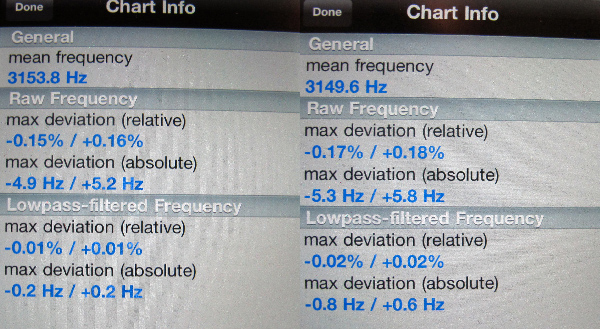
The Onedof's speed accuracy (left) and that of the Continuum Caliburn (right)
Dr. Feickert Analogue's PlatterSpeed app (available from the iTunes store) and test LP showed the Onedof's speed accuracy to be slightly better than the Caliburn's. However, I know that my Caliburn is a very early sample, and that in later production changes were made to both the motor and the speed-control unit, so I can't generalize.
Before the Onedof was disassembled and packed up, I listened again where I began: to Milstein and Leinsdorf's recording of Beethoven's Violin Concerto. These are the days of miracle and wonder!
Footnote 1: See www.onedof.com/onedof-turntable-designer-aleks-bakman. Onedof LLC, Denver, CO. Tel: (720) 979-6198. Web: www.onedof.com.