Founded in Glasgow, Scotland, in 1972, Linn Products Limited is in an elite club whose members have been around for 50 years or more. You're doing some things right if you can prosper in the quirky audiophile marketplace for more than 50 years (footnote 1). Ivor Tiefenbrun and his son Gilad have carried on a family trade, helming their company for all that time.
As if that wasn't enough stability, consider that the company's first commercial product, the Sondek LP12 turntable, has continued through many iterations to the present day. It is so well known in hi-fi that people simply call it "LP12," and everyone in the room knows what they're talking about.
Yet, during Linn's time on the planet, they've designed and brought to market a full range of audio components beyond the LP12; many hi-fi folks are proud owners of all-Linn systems. Along the way, there have been a number of firsts. In 1975, Linn patented the "isobaric loading" technique for loudspeakers. Call it ironic if you want to, but the creator of the LP12 was quite early to the hi-rez music streaming party.
In parallel with the hardware, Linn Records has put together a distinguished catalog of high-quality audiophile recordings, and they're still very much at it: In 2010, Gramophone magazine named Linn Records "Label of the Year."
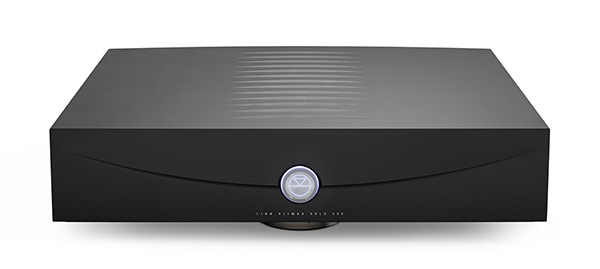
Though not as long-lived as the LP12, the newly redesigned Linn Klimax Solo 500 monoblock power amplifier ($64,760/pair) is no spring chicken. The name is shared with the first iteration of this amp, released more than 25 years ago, in 1999. Jonathan Scull reviewed it for this magazine.
A quarter-century is a good, long run for any audio component. I asked Joe Rodger, brand manager for Linn, how they approached replacing the original Solo. "The original Klimax Solo was a hugely significant engineering milestone for Linn. It was the first of our products to bear the 'Klimax' moniker. With our significant advancements in electrical engineering and in-house machining capability, it was time for us to replace the venerable Solo."
A comparison of the published specifications of the 1999 Solo to the specifications of today's version turns up some interesting similarities and differences. The new 500 costs about three times today what the 1999 version cost. The dimensions are similar: width and depth are almost the same, at around 14", but the height of the new model, including new footers, has gained about an inch. The rated output power between old and new is almost identical: Both are rated at 500W at 4 ohms; the original version was a bit more powerful into 8 ohms, at 290W vs the new amp's 250W. Both the old and the new amp operate in class-AB.
One striking difference between the specs of the old and new Solo 500s—and it is striking indeed—is distortion: THD+N was 0.02% in 1999 (footnote 2). It is 0.0005% today. How that improvement was accomplished is part of the story here.
High-end audio writers can be inventive in describing many things, including metal boxes. Here are a few words that could be accurately deployed to describe the Klimax Solo 500: "elegant," "minimalist," "balanced," "contemporary," "well-proportioned," "modernist," and "utilitarian."
To take a product as long-established as the original Solo and update its form as well as its functions is a delicate design assignment. It's apparent that much care and consideration went into updating the Linn Klimax Solo.
 Redistricting
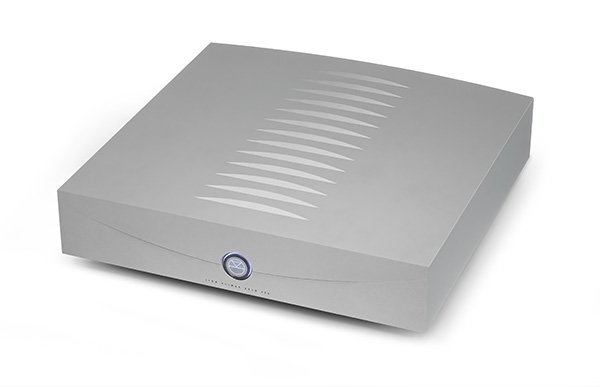
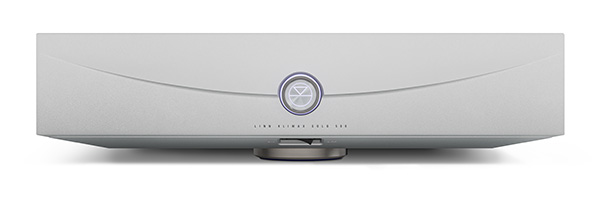
Looking down from the top at the elegant brushed-silver aluminum finish of the review samples, you see a row of 13 "gills with catch-light surfaces." That description—Linn's, of course—highlights their aesthetics, but these are functional elements: heatsinks. No screws are visible from the top or from the side. Underneath are three steel footers, a new design fitted with rubber O-rings for vibration control. Linn notes in their product materials that the "front face is new, a modern evolution of the signature Linn smile." That's the first I've heard of this trademark happy face. Linn takes pride in putting their logo in the center; the roundel illuminates when the amp is powered up. Having seen this elegant logo many times over the years, I am happy to learn (from Wikipedia) that this is "the simple geometric representation of the 'single point' bearing which was the unique selling point of the LP12 turntable."
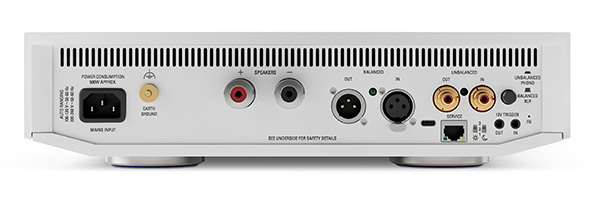
The rear-panel layout is straightforward, as befits a monoblock amplifier: This ain't no hyperactive "all-in-one" device. There are two small switches, one for Low Power Standby, the other to set the brightness of the front-panel roundel. There is one balanced input on XLR and one single-ended input on RCA. There's a button for selecting between them. There is one pair of Furutech FT-816 speaker taps, and an IEC inlet for AC power. There's a grounding terminal, two service connections (one Ethernet, the other mini-USB), and in and out 12V trigger connections.
The back panel does have one unusual feature—rather, two unusual features: balanced and unbalanced line-level outputs. Presumably, these pass-throughs are intended to allow line-level subwoofers to be connected in a convenient way.
 How do you turn the thing on and off? Without a manual, I looked very silly poking at the roundels on the front panel, thinking that might do it. Finally, I managed to locate the power on/ off switches, on the bottom panel toward the middle in the front. When powering on, the roundels go through an illumination cycle.
Linn described the parts content and layout to me this way: "We source some specialized board components from Europe, as there are still some manufacturers on the continent who produce the best performance, bar none. Whenever a new transistor, cap, resistor, etc., is [specified] for a board in our products, we build it onto a board and into a product and listen to it. Our raw card is sourced from here in Scotland, near Edinburgh. We design, lay out, and populate every single one of our PCBs ourselves in-house."
I wanted to learn more about how Linn managed to extract such high output power from such a small component. Were any tradeoffs necessary to get the thing so small? Nina Roscoe, the lead engineer for the Solo 500, responded. "The components we choose for handling the audio output power are all quite large, actually, and in the Solo 500 output stage there are four pairs of them in parallel. This is quite significantly over-rated in terms of current- and voltage-handling capability, but it ensures that the amp is always working in the linear range. Where we do try to minimize the size physically is in the layout of all the audio circuitry. Minimizing signal loops is key to preventing induction-related distortion, so it brings a significant performance benefit."
How do you turn the thing on and off? Without a manual, I looked very silly poking at the roundels on the front panel, thinking that might do it. Finally, I managed to locate the power on/ off switches, on the bottom panel toward the middle in the front. When powering on, the roundels go through an illumination cycle.
Linn described the parts content and layout to me this way: "We source some specialized board components from Europe, as there are still some manufacturers on the continent who produce the best performance, bar none. Whenever a new transistor, cap, resistor, etc., is [specified] for a board in our products, we build it onto a board and into a product and listen to it. Our raw card is sourced from here in Scotland, near Edinburgh. We design, lay out, and populate every single one of our PCBs ourselves in-house."
I wanted to learn more about how Linn managed to extract such high output power from such a small component. Were any tradeoffs necessary to get the thing so small? Nina Roscoe, the lead engineer for the Solo 500, responded. "The components we choose for handling the audio output power are all quite large, actually, and in the Solo 500 output stage there are four pairs of them in parallel. This is quite significantly over-rated in terms of current- and voltage-handling capability, but it ensures that the amp is always working in the linear range. Where we do try to minimize the size physically is in the layout of all the audio circuitry. Minimizing signal loops is key to preventing induction-related distortion, so it brings a significant performance benefit."
 Three features are new, or newly implemented, in the new Klimax Solo 500: "Adaptive Bias Control," a "Hybrid Cooling Matrix," and the "Utopik power supply." These elements contribute to what Senior Mechanical Engineer Alastair Bennett said is "85 times lower distortion measurements than its predecessor."
Adaptive Bias Control (ABC) was first applied by Linn for their Klimax Solo 800 monoblock amplifier, which was reviewed by my colleague Jason Serinus in 2024. In summarizing his measurements of the Solo 800, the usually unflappable John Atkinson wrote, "Wow!" The Solo 800 is a more expensive and powerful amp, but I would also describe the new Klimax Solo 500 using these same adjectives. I will be interested to see how measurements between the two models line up.
The calculations needed for ABC are carried out on an FPGA. FPGA is short for "field-programmable gate array"—which is essentially a powerful little computer inside an electronic device. In Linn's description: "Optimum bias current is established intelligently in real-time. The current supplied to each of the eight output transistors is measured, before being passed to an FPGA processor, which calculates the requisite bias at that precise moment. The Solo 500 is adjusting its own output to be ideal at all times. Adaptive Bias Control is a key factor in Klimax Solo 500's devastatingly low noise floor."
Adaptive Bias Control keeps the bias in a range where there's no crossover distortion. When I discussed Linn's approach to this problem with Editor Jim Austin, he commented, "What Linn is explaining here, I believe, is a biasing scheme—it's how the Linn amp intelligently adjusts the bias to stay as high as needed without allowing crossover distortion to occur."
Operating in tandem with Adaptive Bias Control is Linn's Utopik power supply, which was also initially applied in the Klimax Solo 800. This power supply employs "auto-voltage rails," which adapt (again in real time) to the audio signal to deliver necessary power for the proper dynamics and amplitude—but no more than is needed. Rail voltages range from ±30V to ±75V, with a maximum continuous power of 240W. This helps keep internal temperatures low and steady, which in turn helps to keep performance stable.
The more I have experienced a variety of high-end amplification, as an owner and as a reviewer, the more attention I pay to distortion and noise specifications, which I believe correlate with soundstage detail, timbre, and texture, and other aspects of music re-creation. Even when the numbers are already so small that you might think they don't make a difference, they still do.
Three features are new, or newly implemented, in the new Klimax Solo 500: "Adaptive Bias Control," a "Hybrid Cooling Matrix," and the "Utopik power supply." These elements contribute to what Senior Mechanical Engineer Alastair Bennett said is "85 times lower distortion measurements than its predecessor."
Adaptive Bias Control (ABC) was first applied by Linn for their Klimax Solo 800 monoblock amplifier, which was reviewed by my colleague Jason Serinus in 2024. In summarizing his measurements of the Solo 800, the usually unflappable John Atkinson wrote, "Wow!" The Solo 800 is a more expensive and powerful amp, but I would also describe the new Klimax Solo 500 using these same adjectives. I will be interested to see how measurements between the two models line up.
The calculations needed for ABC are carried out on an FPGA. FPGA is short for "field-programmable gate array"—which is essentially a powerful little computer inside an electronic device. In Linn's description: "Optimum bias current is established intelligently in real-time. The current supplied to each of the eight output transistors is measured, before being passed to an FPGA processor, which calculates the requisite bias at that precise moment. The Solo 500 is adjusting its own output to be ideal at all times. Adaptive Bias Control is a key factor in Klimax Solo 500's devastatingly low noise floor."
Adaptive Bias Control keeps the bias in a range where there's no crossover distortion. When I discussed Linn's approach to this problem with Editor Jim Austin, he commented, "What Linn is explaining here, I believe, is a biasing scheme—it's how the Linn amp intelligently adjusts the bias to stay as high as needed without allowing crossover distortion to occur."
Operating in tandem with Adaptive Bias Control is Linn's Utopik power supply, which was also initially applied in the Klimax Solo 800. This power supply employs "auto-voltage rails," which adapt (again in real time) to the audio signal to deliver necessary power for the proper dynamics and amplitude—but no more than is needed. Rail voltages range from ±30V to ±75V, with a maximum continuous power of 240W. This helps keep internal temperatures low and steady, which in turn helps to keep performance stable.
The more I have experienced a variety of high-end amplification, as an owner and as a reviewer, the more attention I pay to distortion and noise specifications, which I believe correlate with soundstage detail, timbre, and texture, and other aspects of music re-creation. Even when the numbers are already so small that you might think they don't make a difference, they still do.
 For the new Solo 500, Linn has gone to sophisticated lengths with thermal management, employing what they call a "Hybrid Cooling Matrix." It's hybrid in that it employs both passive and active techniques for heat dissipation. Internally, there is a subchassis block designed to radiate heat up through a series of fins in the exterior casing. This passive approach is augmented, as needed and again in real time (with the use of more FPGA processing), by a pair of fans that cool actively: The fan speed is dictated by measured internal temperatures. By this means, noise from these very quiet fans is kept to an absolute minimum. In my auditioning, I never heard a fan. On the other hand, the amplifiers didn't run especially cool. Make sure they have plenty of ventilation.
I asked the Linn team if they think high output power contributes to better sonics. "Fine sonics can only be achieved with very accurate reproduction of the music," they responded. "Sometimes using an amp rated for use at very high power to listen to modest power levels leads to a good experience because that amplifier is more linear when it is not working particularly hard. The Solo amps deliver their high output power with exceptionally low distortion even when close to their own power limit." Powerful for sure, but modest in their physical presence, these monoblocks are not going to make your listening room look or feel like a data center.
Across the rooftops
For the new Solo 500, Linn has gone to sophisticated lengths with thermal management, employing what they call a "Hybrid Cooling Matrix." It's hybrid in that it employs both passive and active techniques for heat dissipation. Internally, there is a subchassis block designed to radiate heat up through a series of fins in the exterior casing. This passive approach is augmented, as needed and again in real time (with the use of more FPGA processing), by a pair of fans that cool actively: The fan speed is dictated by measured internal temperatures. By this means, noise from these very quiet fans is kept to an absolute minimum. In my auditioning, I never heard a fan. On the other hand, the amplifiers didn't run especially cool. Make sure they have plenty of ventilation.
I asked the Linn team if they think high output power contributes to better sonics. "Fine sonics can only be achieved with very accurate reproduction of the music," they responded. "Sometimes using an amp rated for use at very high power to listen to modest power levels leads to a good experience because that amplifier is more linear when it is not working particularly hard. The Solo amps deliver their high output power with exceptionally low distortion even when close to their own power limit." Powerful for sure, but modest in their physical presence, these monoblocks are not going to make your listening room look or feel like a data center.
Across the rooftops
I'm old school. I've never really glommed onto thinking of music as "software." When I play an album, I'm not sitting there thinking, "Boy, this software sure sounds good tonight." I do think to myself, "Gee, this system is making this recording sound wonderful." I can count on the fingers of one hand the number of established high-end audio companies that have brought to market fine hardware and fine recordings. Let's see: There's Wilson. There's AudioQuest. There's Linn. There's Naim. McIntosh Labs recently released some music. I asked if Linn Records had contributed in a positive dynamic to the evolution of Linn Products, and Joe Rodger responded: "Learning of the immense care that it takes to preserve every iota of musical information in the studio master, with all its various processing and mastering steps, also demonstrated the immense care that we needed to implement in the reproduction side of things to make sure that what we were reproducing had loss absolutely minimized. Also, it didn't hurt that Linn Records' chief recording engineer Philip Hobbs is heavily involved with our own acoustics and engineering teams."
 Before I encountered a piece of equipment made by Linn, I was smitten by their first commercially released recording, issued shortly after the company was formed: A Walk Across the Rooftops by the Scottish band The Blue Nile. This was their debut album, released in the US in 1984 (LP Linn Records LKH1/A&M Records SP-06–5087).
I was turned on to this music by the same person who turned me on to high-end audio in the late 1980s by loaning me a McIntosh tube amp to listen to. Over the years, I have turned to this unique album often as a reference recording. When I hear it reproduced on a new system, I know immediately whether the system is great or a piece of crap.
My copy of A Walk Across the Rooftops is an original near-mint LP dated 1983. It was given to me in 2017 by my late dear friend Art Dudley. Art knew I loved this album, and I will keep his generous gift always—along with a mint-condition original British EMI pressing of Revolver, which Art also gave me.
At approximately 0:39 into the opening title track, there is a descending electric bass line. It covers a large frequency swath, and the attack, pop, and impact of that bass sound tell me a lot about the aliveness of a system. It's like taking a person's blood pressure. Is it kicking hard as it should, or is it flat-lining, DOA? Hearing this moment now, with the Klimax Solo 500s powering my Wilson WATT/Puppies, "made my big toe jump up in my boot," as Little Richard liked to say. I also dug extremely the rhythmic counterpoint of the fine-sounding Steve Reich–like low-synth vamps that drive "From Rags to Riches." Engineer Calum Malcolm knew his stuff, making both acoustic and electronic timbres sound fabulous, as detailed as can be. But none of this fine work would have amounted to much on its own, without the truly strong songwriting and soulful vocals from Paul Buchanan. As one critic described him, Buchanan is a guy "where it's always 3am." Buchanan is not a whiner, like so many wanna-be singer-songwriters, but there is a pleading, romantic quality to his performance and lyrics. It slays me.
Given that Linn is headquartered in Glasgow, it seemed appropriate to me to accompany this listening session with a glass of fine, smoky Laphroaig single malt, from Islay, due west. Cheers, Art!
Before I encountered a piece of equipment made by Linn, I was smitten by their first commercially released recording, issued shortly after the company was formed: A Walk Across the Rooftops by the Scottish band The Blue Nile. This was their debut album, released in the US in 1984 (LP Linn Records LKH1/A&M Records SP-06–5087).
I was turned on to this music by the same person who turned me on to high-end audio in the late 1980s by loaning me a McIntosh tube amp to listen to. Over the years, I have turned to this unique album often as a reference recording. When I hear it reproduced on a new system, I know immediately whether the system is great or a piece of crap.
My copy of A Walk Across the Rooftops is an original near-mint LP dated 1983. It was given to me in 2017 by my late dear friend Art Dudley. Art knew I loved this album, and I will keep his generous gift always—along with a mint-condition original British EMI pressing of Revolver, which Art also gave me.
At approximately 0:39 into the opening title track, there is a descending electric bass line. It covers a large frequency swath, and the attack, pop, and impact of that bass sound tell me a lot about the aliveness of a system. It's like taking a person's blood pressure. Is it kicking hard as it should, or is it flat-lining, DOA? Hearing this moment now, with the Klimax Solo 500s powering my Wilson WATT/Puppies, "made my big toe jump up in my boot," as Little Richard liked to say. I also dug extremely the rhythmic counterpoint of the fine-sounding Steve Reich–like low-synth vamps that drive "From Rags to Riches." Engineer Calum Malcolm knew his stuff, making both acoustic and electronic timbres sound fabulous, as detailed as can be. But none of this fine work would have amounted to much on its own, without the truly strong songwriting and soulful vocals from Paul Buchanan. As one critic described him, Buchanan is a guy "where it's always 3am." Buchanan is not a whiner, like so many wanna-be singer-songwriters, but there is a pleading, romantic quality to his performance and lyrics. It slays me.
Given that Linn is headquartered in Glasgow, it seemed appropriate to me to accompany this listening session with a glass of fine, smoky Laphroaig single malt, from Islay, due west. Cheers, Art!
 Setting synths and guitars aside, I turned to Bartók's masterpiece, Concerto for Orchestra, the great recording by Antal Doráti and the London Symphony Orchestra recorded in 1962 (Mercury SR90378/Universal 4847114). This CD is included in the box set Antal Doráti in London, Vol.2, from Eloquence Classics. Stereophile's own Tom Fine supervised the remastering of this recording, which bowled me over from start to finish. I adored the dark misterioso opening from the low unison strings with delicate woodwind garnishes. Then the brass enters, and the concerto is off and running.
The Linns gave me great specific details without any harshness. The Solo 500s delivered the wonderful dynamic swings between Bartók's many deliberate large contrasts in orchestration—like the full-bore brass outbursts at 7:40 into the first movement. Any "Concerto for Orchestra" is, sui generis, going to involve a wide variety of sonics, and with the Linns I heard them all beautifully deployed.
I've seen some wisecrackers talk about how audio reviewers listen to too many female vocals. What's wrong with these people? I can't imagine not being able to turn to those recordings when that's what I need to hear: Billie, Ella, Aretha, Diana, and Co. I've said it before, but it bears repeating: When I play an original Columbia Billie Holiday 78 on one of my hand-cranked Victrolas, I feel like she's right there in the room. I will not own equipment that doesn't make great female vocal performances sound great.
Setting synths and guitars aside, I turned to Bartók's masterpiece, Concerto for Orchestra, the great recording by Antal Doráti and the London Symphony Orchestra recorded in 1962 (Mercury SR90378/Universal 4847114). This CD is included in the box set Antal Doráti in London, Vol.2, from Eloquence Classics. Stereophile's own Tom Fine supervised the remastering of this recording, which bowled me over from start to finish. I adored the dark misterioso opening from the low unison strings with delicate woodwind garnishes. Then the brass enters, and the concerto is off and running.
The Linns gave me great specific details without any harshness. The Solo 500s delivered the wonderful dynamic swings between Bartók's many deliberate large contrasts in orchestration—like the full-bore brass outbursts at 7:40 into the first movement. Any "Concerto for Orchestra" is, sui generis, going to involve a wide variety of sonics, and with the Linns I heard them all beautifully deployed.
I've seen some wisecrackers talk about how audio reviewers listen to too many female vocals. What's wrong with these people? I can't imagine not being able to turn to those recordings when that's what I need to hear: Billie, Ella, Aretha, Diana, and Co. I've said it before, but it bears repeating: When I play an original Columbia Billie Holiday 78 on one of my hand-cranked Victrolas, I feel like she's right there in the room. I will not own equipment that doesn't make great female vocal performances sound great.
 Here's a new example, from the outstanding New York–based soprano Aubrey Johnson, from her new album The Lively Air (Greenleaf Music GRE-CD-1119, 2026; full disclosure: Aubrey performed on my last recording). This album is up on the streamers now, in 24/96 resolution; it is also available on CD. I listened to it both ways.
Johnson has an extended range and great intonation. She is jazz-savvy, and she fires off some poppin' scat pyrotechnics on her new album, particularly on the track "Chorinho," written by Lyle Mays, who was Aubrey's uncle. This up-tempo tune did not originally include a vocal. Then "Lyle challenged me to learn it for some performances we did back in 2010, and it has been with me ever since," Johnson wrote in the liner notes to the new album. There are also strong, original compositions here from Johnson and a creative take on Joni Mitchell's "Help Me," in which Aubrey extends the tune with some scatting and echoes Joni's own background vocals. If you are going to cover Joni Mitchell, you are not afraid to reach.
The band is cooking, too. In my system, the Linn Solo 500s brought forth all the presence and breath you want to hear from fine vocals of any gender. "Lively Air," the album title, could almost be audiophile terminology. I was hearing, with the Solo 500s, exactly that: "lively," energetic, propulsive contemporary jazz, with a lot of great "air" around the band and the vocals. Check it out.
Blue Note has delivered a one-two punch now of deliciously remastered Frank Sinatra in their Tone Poet vinyl series. Songs for Swingin' Lovers! dates from 1956 (Capitol W653/Blue Note UME, 2026). This was the release that followed the equally great In the Wee Small Hours I wrote about recently. Blue Note was kind enough to send me a test pressing of this record, again well-served by the remastering team of Joe Harley and Kevin Gray. This more recent record, featuring a generous selection of American Songbook numbers, tilts more upbeat than the preceding album. The same great production team was in place: engineer John Palladino, producer Voyle Gilmore, and particularly the conducting and arrangements of Nelson Riddle. Some of these tunes and their Riddle treatments became a permanent part of Sinatra's repertoire, like the killer version of "I've Got You Under My Skin" by Cole Porter. Two songs here are by Porter, and two are from the great writer Burton Lane.
Here's a new example, from the outstanding New York–based soprano Aubrey Johnson, from her new album The Lively Air (Greenleaf Music GRE-CD-1119, 2026; full disclosure: Aubrey performed on my last recording). This album is up on the streamers now, in 24/96 resolution; it is also available on CD. I listened to it both ways.
Johnson has an extended range and great intonation. She is jazz-savvy, and she fires off some poppin' scat pyrotechnics on her new album, particularly on the track "Chorinho," written by Lyle Mays, who was Aubrey's uncle. This up-tempo tune did not originally include a vocal. Then "Lyle challenged me to learn it for some performances we did back in 2010, and it has been with me ever since," Johnson wrote in the liner notes to the new album. There are also strong, original compositions here from Johnson and a creative take on Joni Mitchell's "Help Me," in which Aubrey extends the tune with some scatting and echoes Joni's own background vocals. If you are going to cover Joni Mitchell, you are not afraid to reach.
The band is cooking, too. In my system, the Linn Solo 500s brought forth all the presence and breath you want to hear from fine vocals of any gender. "Lively Air," the album title, could almost be audiophile terminology. I was hearing, with the Solo 500s, exactly that: "lively," energetic, propulsive contemporary jazz, with a lot of great "air" around the band and the vocals. Check it out.
Blue Note has delivered a one-two punch now of deliciously remastered Frank Sinatra in their Tone Poet vinyl series. Songs for Swingin' Lovers! dates from 1956 (Capitol W653/Blue Note UME, 2026). This was the release that followed the equally great In the Wee Small Hours I wrote about recently. Blue Note was kind enough to send me a test pressing of this record, again well-served by the remastering team of Joe Harley and Kevin Gray. This more recent record, featuring a generous selection of American Songbook numbers, tilts more upbeat than the preceding album. The same great production team was in place: engineer John Palladino, producer Voyle Gilmore, and particularly the conducting and arrangements of Nelson Riddle. Some of these tunes and their Riddle treatments became a permanent part of Sinatra's repertoire, like the killer version of "I've Got You Under My Skin" by Cole Porter. Two songs here are by Porter, and two are from the great writer Burton Lane.
 How responsive are the Klimax Solo 500 amplifiers to whatever the input is? Very. When I switched from the solid state output of my McIntosh C12000 preamp to its tube-stage outputs, that swap was just the ticket. The great outburst from Nelson and his orchestra that happens in "I've Got You" after the first two verses was just right, powerful as all get-out but not strident. Indeed, now I got the "skin" from Frank's vocals. There was silk from the unison sax lines, and the cool sound of the bass clarinet that opens and closes the track was now spot on timbre-wise.
These are extremely revealing amplifiers. While they are not themselves bright, if you have material or upstream equipment that leans to the bright side, you will hear that.
Concluding remarks
How responsive are the Klimax Solo 500 amplifiers to whatever the input is? Very. When I switched from the solid state output of my McIntosh C12000 preamp to its tube-stage outputs, that swap was just the ticket. The great outburst from Nelson and his orchestra that happens in "I've Got You" after the first two verses was just right, powerful as all get-out but not strident. Indeed, now I got the "skin" from Frank's vocals. There was silk from the unison sax lines, and the cool sound of the bass clarinet that opens and closes the track was now spot on timbre-wise.
These are extremely revealing amplifiers. While they are not themselves bright, if you have material or upstream equipment that leans to the bright side, you will hear that.
Concluding remarks
The Linn Klimax Solo 500 monoblock amplifiers are among the very best audio products I have experienced. Their absolute command of musical energy at all levels of dynamics is memorable and unique. Matching their performance is a build quality that is world-class, coupled to a creative application of cutting-edge technology. Linn Products should be proud. I expect others in the high-end audio world to agree.
Hand in hand with luxurious music reproduction goes a hefty price of admission. This almost seems inevitable, given the Klimax Solo 500's no-holds-barred, no-compromise performance. Wishing they were cheaper is whistling in the wind; the pricing is a result of Linn's application of old-world values of excellence.
In my listening to the new Linn Klimax Solo 500 monoblocks, it became obvious that these are truly reference-quality audio components, which, when system-matched appropriately, will yield definitive musical re-creation.
Footnote 1: The analogy isn't precise, since we're a magazine, but Stereophile has been around for 64 years. Take that, hi-fi "influencers"!
Footnote 2: Actually, the 1999 specification was for "harmonic distortion"—noise was left out. If they had included noise, it would of course have made that number a little bit higher.
RedistrictingLooking down from the top at the elegant brushed-silver aluminum finish of the review samples, you see a row of 13 "gills with catch-light surfaces." That description—Linn's, of course—highlights their aesthetics, but these are functional elements: heatsinks. No screws are visible from the top or from the side. Underneath are three steel footers, a new design fitted with rubber O-rings for vibration control. Linn notes in their product materials that the "front face is new, a modern evolution of the signature Linn smile." That's the first I've heard of this trademark happy face. Linn takes pride in putting their logo in the center; the roundel illuminates when the amp is powered up. Having seen this elegant logo many times over the years, I am happy to learn (from Wikipedia) that this is "the simple geometric representation of the 'single point' bearing which was the unique selling point of the LP12 turntable."
How do you turn the thing on and off? Without a manual, I looked very silly poking at the roundels on the front panel, thinking that might do it. Finally, I managed to locate the power on/ off switches, on the bottom panel toward the middle in the front. When powering on, the roundels go through an illumination cycle.
Three features are new, or newly implemented, in the new Klimax Solo 500: "Adaptive Bias Control," a "Hybrid Cooling Matrix," and the "Utopik power supply." These elements contribute to what Senior Mechanical Engineer Alastair Bennett said is "85 times lower distortion measurements than its predecessor."
For the new Solo 500, Linn has gone to sophisticated lengths with thermal management, employing what they call a "Hybrid Cooling Matrix." It's hybrid in that it employs both passive and active techniques for heat dissipation. Internally, there is a subchassis block designed to radiate heat up through a series of fins in the exterior casing. This passive approach is augmented, as needed and again in real time (with the use of more FPGA processing), by a pair of fans that cool actively: The fan speed is dictated by measured internal temperatures. By this means, noise from these very quiet fans is kept to an absolute minimum. In my auditioning, I never heard a fan. On the other hand, the amplifiers didn't run especially cool. Make sure they have plenty of ventilation.
I'm old school. I've never really glommed onto thinking of music as "software." When I play an album, I'm not sitting there thinking, "Boy, this software sure sounds good tonight." I do think to myself, "Gee, this system is making this recording sound wonderful." I can count on the fingers of one hand the number of established high-end audio companies that have brought to market fine hardware and fine recordings. Let's see: There's Wilson. There's AudioQuest. There's Linn. There's Naim. McIntosh Labs recently released some music. I asked if Linn Records had contributed in a positive dynamic to the evolution of Linn Products, and Joe Rodger responded: "Learning of the immense care that it takes to preserve every iota of musical information in the studio master, with all its various processing and mastering steps, also demonstrated the immense care that we needed to implement in the reproduction side of things to make sure that what we were reproducing had loss absolutely minimized. Also, it didn't hurt that Linn Records' chief recording engineer Philip Hobbs is heavily involved with our own acoustics and engineering teams."
Before I encountered a piece of equipment made by Linn, I was smitten by their first commercially released recording, issued shortly after the company was formed: A Walk Across the Rooftops by the Scottish band The Blue Nile. This was their debut album, released in the US in 1984 (LP Linn Records LKH1/A&M Records SP-06–5087).
I was turned on to this music by the same person who turned me on to high-end audio in the late 1980s by loaning me a McIntosh tube amp to listen to. Over the years, I have turned to this unique album often as a reference recording. When I hear it reproduced on a new system, I know immediately whether the system is great or a piece of crap.
My copy of A Walk Across the Rooftops is an original near-mint LP dated 1983. It was given to me in 2017 by my late dear friend Art Dudley. Art knew I loved this album, and I will keep his generous gift always—along with a mint-condition original British EMI pressing of Revolver, which Art also gave me.
Setting synths and guitars aside, I turned to Bartók's masterpiece, Concerto for Orchestra, the great recording by Antal Doráti and the London Symphony Orchestra recorded in 1962 (Mercury SR90378/Universal 4847114). This CD is included in the box set Antal Doráti in London, Vol.2, from Eloquence Classics. Stereophile's own Tom Fine supervised the remastering of this recording, which bowled me over from start to finish. I adored the dark misterioso opening from the low unison strings with delicate woodwind garnishes. Then the brass enters, and the concerto is off and running.
Here's a new example, from the outstanding New York–based soprano Aubrey Johnson, from her new album The Lively Air (Greenleaf Music GRE-CD-1119, 2026; full disclosure: Aubrey performed on my last recording). This album is up on the streamers now, in 24/96 resolution; it is also available on CD. I listened to it both ways.
How responsive are the Klimax Solo 500 amplifiers to whatever the input is? Very. When I switched from the solid state output of my McIntosh C12000 preamp to its tube-stage outputs, that swap was just the ticket. The great outburst from Nelson and his orchestra that happens in "I've Got You" after the first two verses was just right, powerful as all get-out but not strident. Indeed, now I got the "skin" from Frank's vocals. There was silk from the unison sax lines, and the cool sound of the bass clarinet that opens and closes the track was now spot on timbre-wise.
These are extremely revealing amplifiers. While they are not themselves bright, if you have material or upstream equipment that leans to the bright side, you will hear that.
Concluding remarksThe Linn Klimax Solo 500 monoblock amplifiers are among the very best audio products I have experienced. Their absolute command of musical energy at all levels of dynamics is memorable and unique. Matching their performance is a build quality that is world-class, coupled to a creative application of cutting-edge technology. Linn Products should be proud. I expect others in the high-end audio world to agree.
Footnote 1: The analogy isn't precise, since we're a magazine, but Stereophile has been around for 64 years. Take that, hi-fi "influencers"!