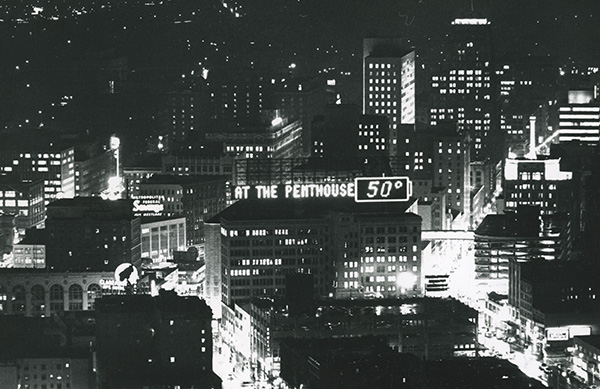
The Penthouse jazz club was on First and Cherry in Seattle. It had a seven-year run from 1962 to 1968 as one of the premier jazz venues on the West Coast. The site is a parking lot now. Yet the Penthouse lives. This is the story of why.
Great disc jockeys become like old friends. Jim Wilke's nationally syndicated public radio program "Jazz After Hours" began in 1984 and ran for 30 years. But long before Wilke's mellifluous, intelligent voice became reassuringly familiar to jazz fans across the United States and beyond, he worked for KING-FM in Seattle. In 1962, three years out of college, one of his jobs was to host a program every Thursday night that broadcast live jazz from the Penthouse.
The program contained the first 30 minutes of every first set on Thursdays. The musicians' union limited live broadcasts to 30 minutes. Wilke used two RCA 77-DX ribbon mikes, two Electro-Voice mikes, and a four-input monophonic RCA tube mixer. The mixer's output went to KING-FM over a phone line that was flat from 30Hz to 15kHz. From the radio station, live music from the Penthouse went out to the world—or at least to Seattle.
That would have been the end of it, except for a miraculous fact: The shows got taped. Wilke says, "There was an Ampex 350 single-channel tape recorder at the station, and it was also hooked up to the phone line. The tapes were initially for my reference. I wanted to be able to listen to what I had done in the club. I was a radio host, new to engineering." But while Wilke says the recordings were "initially" for his reference, the station kept taping the shows, until 1968. There is an archive of over 200 tapes. While the broadcasts were limited to 30 minutes, the tapes were not. Often the station let the tape keep rolling after the broadcast ended.
This huge hoard of tapes lay dormant at KING-FM for many years. At some point, the station considered reusing or disposing of them, but first asked Wilke if he wanted them. He did. The first commercial release of an album drawn from the tapes appeared in 1985, on half of a Joe Williams CD. Almost 30 years went by before there were more. Whenever producers contacted Wilke about his stash, he always insisted that clearances be obtained from artists or their estates. Starting in 2014, a slow but steady stream of albums drawn from the tapes began to appear, mostly on labels associated with producer Zev Feldman. As this article goes to press, there are 18.
Second, and most significantly, is the quality of the music. With names like those above, you expect strong stuff. But the Penthouse tapes exceed expectations. An example is Bill Evans's Portraits at the Penthouse. It is the most recent Penthouse release to date, from two Thursdays in 1966. The 1960s may have been Evans's finest period, musically if not personally. He looks thin and pale in the photos in the CD booklet. (Heroin will do that to you.) But at 36, at the piano, he basically could do no wrong. He must have played "'Round Midnight" a thousand times, but here it is a rarefied, hovering, perfectly poised suspension of tension and release. "Nardis" sounds like ecstasy, in continuous outbreaks of inspiration. Rapt ballads like "Detour Ahead" and "Time Remembered" will freeze you right in your chair.
 Third, these tapes contain rarities. Smokin' in Seattle is only the third known document of Wes Montgomery and Wynton Kelly playing together, and it is one of Montgomery's relatively few live recordings. The Horace Silver album is the only known recording by this great short-lived band. The Bill Evans album is his only one with Joe Hunt on drums, and his first recording with then–21-year-old Eddie Gómez on bass, who would stay with Evans for 11 years.
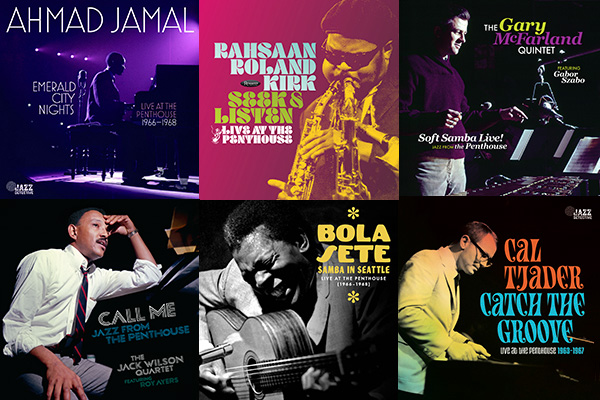
Some of the rarities are the artists themselves. Kristian St. Clair, in the two Penthouse albums he produced for his Century 67 label, chose to rescue two figures who were in danger of disappearing into the shadows of jazz history. Jack Wilson was a special pianist who never broke through. He recorded three albums for Blue Note in the late '60s that should have put him on the map. But health problems, including diabetes, a stroke, and a hand injury in a car accident, set him back. Wilson's Call Me, from the Penthouse in 1966, is a gem salvaged from the clutches of time. Tunes like "Here's That Rainy Day" and "The Shadow of Your Smile" reveal his natural, understated elegance. In 1966, vibraphonist Roy Ayers (who would go on to a big career in funk) had been with Wilson for three years. Together they create a unique, tightly woven, intricate piano/vibes interface, very different from the Modern Jazz Quartet paradigm. Another St. Clair production is Soft Samba Live by Gary McFarland. He was best known as a composer/arranger for large ensembles, but he was also a gifted vibraphonist. McFarland led a quietly captivating quintet at the Penthouse that included Sadao Watanabe on reeds, Gabor Szabo on guitar, and Eddie Gómez, who, six weeks earlier, had played the Penthouse with Bill Evans, on bass.
Third, these tapes contain rarities. Smokin' in Seattle is only the third known document of Wes Montgomery and Wynton Kelly playing together, and it is one of Montgomery's relatively few live recordings. The Horace Silver album is the only known recording by this great short-lived band. The Bill Evans album is his only one with Joe Hunt on drums, and his first recording with then–21-year-old Eddie Gómez on bass, who would stay with Evans for 11 years.
Some of the rarities are the artists themselves. Kristian St. Clair, in the two Penthouse albums he produced for his Century 67 label, chose to rescue two figures who were in danger of disappearing into the shadows of jazz history. Jack Wilson was a special pianist who never broke through. He recorded three albums for Blue Note in the late '60s that should have put him on the map. But health problems, including diabetes, a stroke, and a hand injury in a car accident, set him back. Wilson's Call Me, from the Penthouse in 1966, is a gem salvaged from the clutches of time. Tunes like "Here's That Rainy Day" and "The Shadow of Your Smile" reveal his natural, understated elegance. In 1966, vibraphonist Roy Ayers (who would go on to a big career in funk) had been with Wilson for three years. Together they create a unique, tightly woven, intricate piano/vibes interface, very different from the Modern Jazz Quartet paradigm. Another St. Clair production is Soft Samba Live by Gary McFarland. He was best known as a composer/arranger for large ensembles, but he was also a gifted vibraphonist. McFarland led a quietly captivating quintet at the Penthouse that included Sadao Watanabe on reeds, Gabor Szabo on guitar, and Eddie Gómez, who, six weeks earlier, had played the Penthouse with Bill Evans, on bass.
But even with the surprising quality of the original tapes, much sound restoration and mastering work has been necessary over the years. Several mastering engineers have had their hands on these tapes, including George Klabin, an engineer by trade who is also the founder of Resonance, the label on which most Penthouse albums have appeared. Lutthans and Turnidge both used iZotope RX to deal with issues such as tape hiss, wow, flutter, volume changes, and frequency imbalances. There were other occasional anomalies on the tapes that had to be dealt with. Lutthans says the pitch began to drag on some recordings, when the tape got close to the end. But the Penthouse albums have a visceral, in-the-moment immediacy. In the jazz canon, there is of course no shortage of live remote jazz recordings. But on those done professionally, there is a crew present, and the artists know, perhaps self-consciously, that they are being preserved for posterity. Jim Wilke was more like a fly on the wall. His recordings are raw artifacts, straight from the trenches of 1960s jazz.
 Looming over the Penthouse albums is Zev Feldman, who is renowned for his lavishly produced, comprehensively documented LP and CD packages. He is involved with no fewer than four historical labels, all of which have released and/or distributed Penthouse albums: Resonance, Reel to Real, Jazz Detective, and Elemental. Feldman says, "I wish Charlie Puzzo Sr. could be here to see how these recordings preserve and celebrate the legacy of his club. I am very grateful that Jim Wilke was there to capture the music. The artists who played the Penthouse are etched in history."
To date, only about 10% of Wilke's Penthouse archive has seen the light of day. We don't know how many other potential producers are out there, circling around these tapes.
As for Feldman, he says he is not done, but he won't talk about what he has got in the pipeline. He won't even give us a teaser. So stay tuned.
Looming over the Penthouse albums is Zev Feldman, who is renowned for his lavishly produced, comprehensively documented LP and CD packages. He is involved with no fewer than four historical labels, all of which have released and/or distributed Penthouse albums: Resonance, Reel to Real, Jazz Detective, and Elemental. Feldman says, "I wish Charlie Puzzo Sr. could be here to see how these recordings preserve and celebrate the legacy of his club. I am very grateful that Jim Wilke was there to capture the music. The artists who played the Penthouse are etched in history."
To date, only about 10% of Wilke's Penthouse archive has seen the light of day. We don't know how many other potential producers are out there, circling around these tapes.
As for Feldman, he says he is not done, but he won't talk about what he has got in the pipeline. He won't even give us a teaser. So stay tuned.
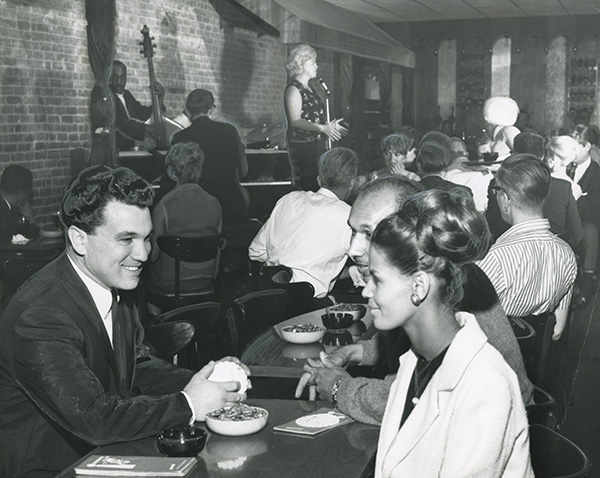
Penthouse founder/owner Charlie Puzzo, Sr, in the club.
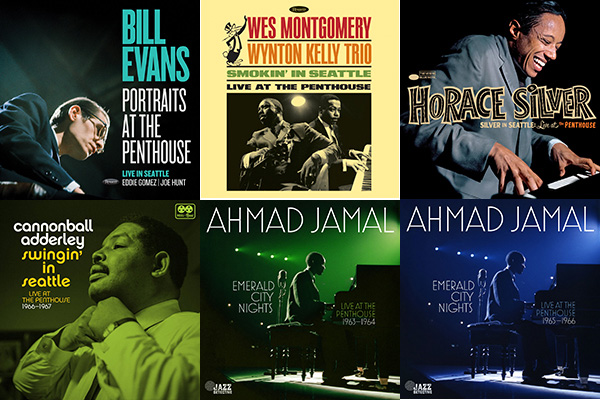
There are four primary reasons why the Penthouse tapes are unearthed buried treasure. First, world-class musicians are all over these tapes. In 1962, the year Charlie Puzzo Sr. (above, left) opened the Penthouse, the World's Fair took place in Seattle and put the city on the global map. A major jazz club coming on the scene was one example of Seattle's rising profile. Important bands on West Coast tours began to stop in Seattle. People on the order of Bill Evans, Wes Montgomery, Horace Silver, Cannonball Adderley, Ahmad Jamal, and Rahsaan Roland Kirk played the Penthouse.
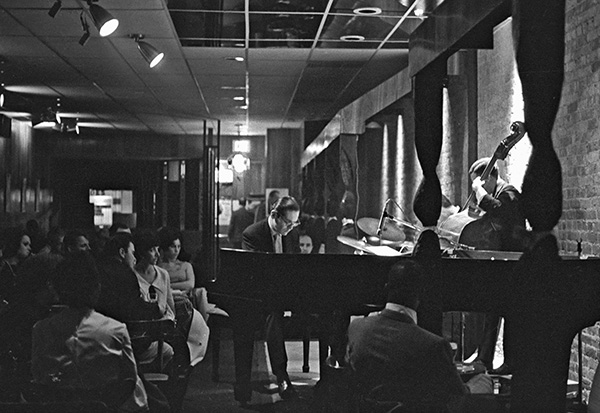
Bill Evans at the Penthouse. (Photo by David Azoze.)
You wonder what the people in the Penthouse were thinking and feeling, in May of 1966, to find themselves in such a place, at such a time, in the presence of such music. The Wes Montgomery album, Smokin' in Seattle, is co-led by Wynton Kelly. The two were magic together. In his personal, passionate liner note for this album, Pat Metheny points out the "micro-issues" of these two masters "creating harmony on the fly," a process of reconciliation that Metheny says frequently "hit code red." Horace Silver's band in 1965 contained his best front line ever. On Silver in Seattle, Joe Henderson kills and Woody Shaw, at 20, already sounds like Woody Shaw. The Cannonball Adderley album, Swingin' in Seattle, has his classic quintet with brother Nat Adderley and Joe Zawinul. This band was mostly together for 10 years and toured the world. Their engagement at the Penthouse had to have been just another gig. Yet they sound like they are playing for their lives.
Ahmad Jamal, in Emerald City Nights, gets three two-CD volumes, spanning 11 nights over five years and four different Jamal trios. It is a rich repository. (Jim Wilke says that Charlie Puzzo Sr. loved Jamal's music and also loved the fact that his fans spent money. Apparently expensive champagne flowed on Jamal nights, whereas less commercially successful artists had hardcore jazz fans who tended to nurse a beer all night. Budweisers at the Penthouse cost a dollar.) Rahsaan Roland Kirk's Penthouse album, Seek & Listen, contains unbridled full-throttle live versions of many of his signature songs.
Third, these tapes contain rarities. Smokin' in Seattle is only the third known document of Wes Montgomery and Wynton Kelly playing together, and it is one of Montgomery's relatively few live recordings. The Horace Silver album is the only known recording by this great short-lived band. The Bill Evans album is his only one with Joe Hunt on drums, and his first recording with then–21-year-old Eddie Gómez on bass, who would stay with Evans for 11 years.
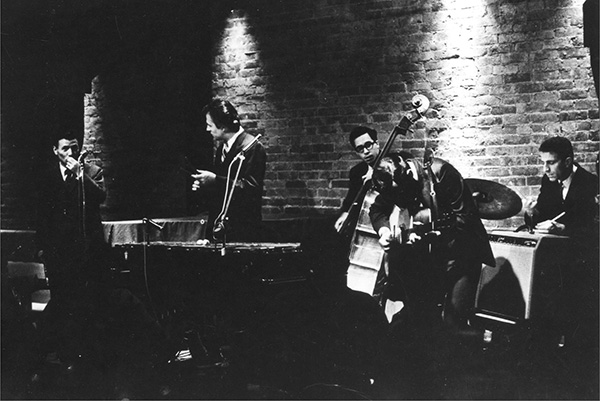
Some of the rarities are the artists themselves. Kristian St. Clair, in the two Penthouse albums he produced for his Century 67 label, chose to rescue two figures who were in danger of disappearing into the shadows of jazz history. Jack Wilson was a special pianist who never broke through. He recorded three albums for Blue Note in the late '60s that should have put him on the map. But health problems, including diabetes, a stroke, and a hand injury in a car accident, set him back. Wilson's Call Me, from the Penthouse in 1966, is a gem salvaged from the clutches of time. Tunes like "Here's That Rainy Day" and "The Shadow of Your Smile" reveal his natural, understated elegance. In 1966, vibraphonist Roy Ayers (who would go on to a big career in funk) had been with Wilson for three years. Together they create a unique, tightly woven, intricate piano/vibes interface, very different from the Modern Jazz Quartet paradigm. Another St. Clair production is Soft Samba Live by Gary McFarland. He was best known as a composer/arranger for large ensembles, but he was also a gifted vibraphonist. McFarland led a quietly captivating quintet at the Penthouse that included Sadao Watanabe on reeds, Gabor Szabo on guitar, and Eddie Gómez, who, six weeks earlier, had played the Penthouse with Bill Evans, on bass.
Gary McFarland at the Penthouse with his Quintet.
The fourth reason the Penthouse tapes are so valuable is sound. As a category, historical jazz recordings are not known for great sound. They are often found in strange places: audience tapes; soundboard cassettes; private collections of obscure provenance. Some are professionally sourced, but overall the sound of historical jazz material is a crapshoot. Wilke's tapes are way above average. Steve Turnidge, of UltraViolet Studios in Seattle, is a mastering engineer who worked on the Wilson and McFarland recordings. From conversations with him, it is clear that he is an exacting technician with very high standards. When he says, "The Wilke tapes fell within the range of being repairable and restorable," he is not damning with faint praise. He goes further: "Jim had a good ear." Matthew Lutthans, with The Mastering Lab in Salina, Kansas, worked on the Silver, Kirk, and Evans releases. He says, "Jim's recordings are so good they don't need to be doctored up much. They are conservative, tastefully done recordings that have good tone quality. For me, tone is the main thing." Kristian St. Clair says, "The fact that it was all mono makes Jim's on-the-fly mixing all the more impressive. His recordings sound balanced."
Looming over the Penthouse albums is Zev Feldman, who is renowned for his lavishly produced, comprehensively documented LP and CD packages. He is involved with no fewer than four historical labels, all of which have released and/or distributed Penthouse albums: Resonance, Reel to Real, Jazz Detective, and Elemental. Feldman says, "I wish Charlie Puzzo Sr. could be here to see how these recordings preserve and celebrate the legacy of his club. I am very grateful that Jim Wilke was there to capture the music. The artists who played the Penthouse are etched in history."
To date, only about 10% of Wilke's Penthouse archive has seen the light of day. We don't know how many other potential producers are out there, circling around these tapes.