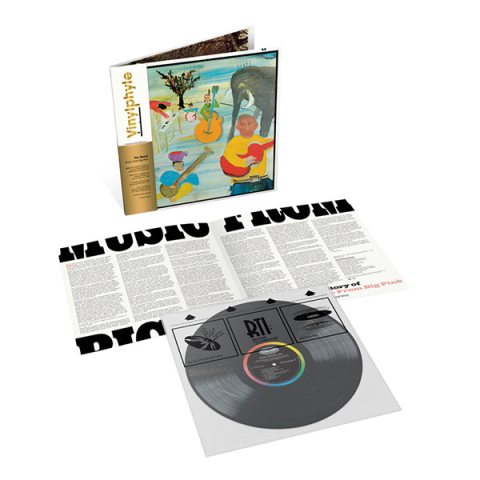
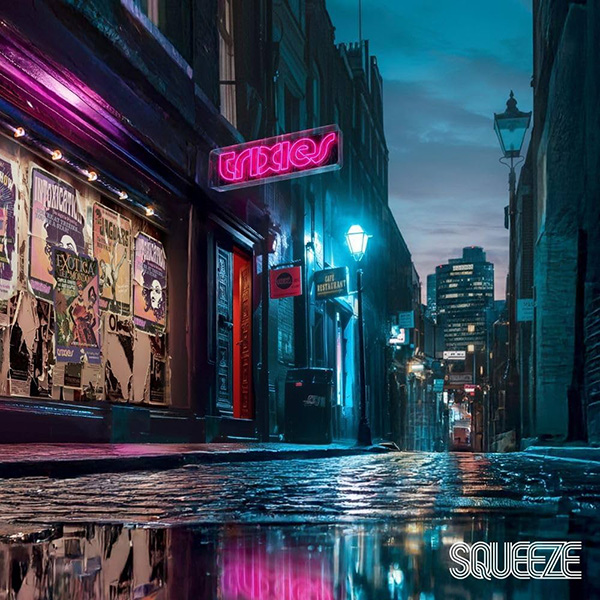
Each side of the one-sheet lyrics insert accompanying Squeeze's latest LP, Trixies (Love/BMG), has been divvied up into three equal columns that can be folded over to replicate a 4" × 11½" nightclub menu.
Subtitled "Trixies Concoctions Menu," the insert conjures the theme of the 13-track song cycle that comprises Trixies, whose storyline traces several scenes set in and around a fictional nightclub. The most telling line on the lyrics sheet reads, simply, "Difford & Tilbrook: The Mixologists / Since 1973."
Difford &Tilbrook are, of course, Chris Difford and Glenn Tilbrook, the songwriting partners and creative foils in Squeeze, the veteran British pop-rockers who have been making new waves and mixing new musical ideas on and off for the better part of six decades, producing indelible earworms such as "Pulling Mussels (From the Shell)," "Another Nail in My Heart," "Tempted," "Black Coffee in Bed," and "Cool for Cats." Trixies, the band's 16th studio album, is a modern-day update of a batch of demos committed to cassette in 1974, when D&T were teenagers and Squeeze was in its infancy, working to figure out where its talents actually laid.
"The guy who was managing us at the time had a posh reel-to-reel—a Grundig, I think it was," Tilbrook told me during a Zoom interview. "We set up two mikes and recorded the band in a rehearsal room, through a PA. The quality of what we recorded was very good, but the quality of our one cassette copy was not that great."
Even so, that crummy cassette captured the song cycle's building blocks, starting with keys. "The big thing in listening back to that tape was that it had the sound of the RMI piano," Tilbrook said. That's an RMI Electra, made by Rocky Mount Instruments in the '60s and '70s. "That was really important to Trixies because it was the first keyboard we had where we could actually hear what Jools was doing." "Jools" is Jools Holland, Squeeze's first keyboardist, who left the band in 1980 and went on to host Later... with Jools Holland on the BBC. "It's the backbone of the sound because those songs were written on it. For all the clunkiness, it has a charming sound—and so does the Wurlitzer, another keyboard of the time that appears on 'You Get the Feeling,'" the album's second track. "You would hear these kind of synth-string sounds on other songs, like The Rolling Stones's 'Fool to Cry.' It's a sound that's really tied to that point in time, because the technology got better, and those sounds got left behind." (footnote 1)
"My teachers were the songwriters I was listening to when I was growing up, and over and above everything else, it was Stevie Wonder," Tilbrook said. "When I started earning some of his songs, I learned 'You and I' on piano." (footnote 2) It was very different from writing on guitar, which would become his usual process. "Trixies is very definitely a product of those sorts of changes on piano that I would never have done on or even thought of doing on guitar."
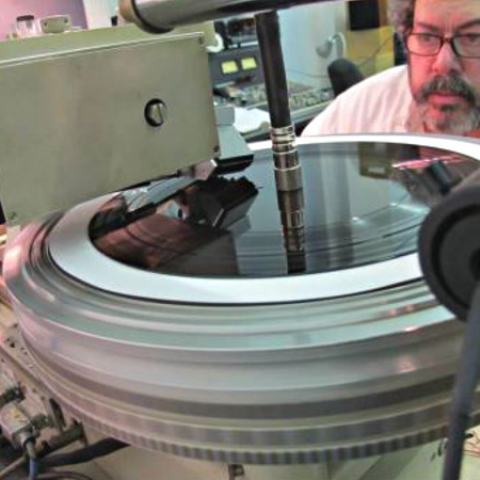
 Tilbrook and producer Owen Biddle, who doubles as bassist, mastered Trixies twice and went through three test pressings before signing off on the vinyl. "When I'm making a record, I'm really analytical about what I hear," Tilbrook said. "It turns me into a different beast, because I'm always picking everything apart. It's actually the opposite of listening to music for pleasure, which is something I do on the Technics DJ turntable at my studio quite a lot." His studio is 45RPM in Charlton, London. "Dropping the needle on an album and sitting down and listening to it is a great thing, but I often find myself going, 'What's going on here? Oh, I see what they're doing.' When I'm at the end of a recording period, I have to remember to go back to just listening to a record and appreciating it for what it is."
Tilbrook still appreciates the sound on "Tempted," the best-known song from Squeeze's 1981 LP East Side Story. "Tempted" features Paul Carrack on lead vocals instead of Tilbrook or Difford—a suggestion made by the album's co-producer, Elvis Costello. (My personal favorite lyric in "Tempted" forever remains, "I fumble for the clock / Alarmed by the seduction / I wish that it would stop.")
"Hearing Paul sing 'Tempted' in the version we all came up with sounded so good, but it also didn't sound like us in a way—and I love that," Tilbrook said. "I love how we sound on it. With that whole record, it really felt like we had finally made an adult record."
Trixies puts a 21st century spin on 20th century material—but as they worked on the old material, Squeeze was also cutting new material for an album to come. "To me, it was really important that we did both albums at the same time so that we were in the same mindset of both mining our past and creating our future," Tilbrook said, "and that's a lovely place to be."
Tilbrook and producer Owen Biddle, who doubles as bassist, mastered Trixies twice and went through three test pressings before signing off on the vinyl. "When I'm making a record, I'm really analytical about what I hear," Tilbrook said. "It turns me into a different beast, because I'm always picking everything apart. It's actually the opposite of listening to music for pleasure, which is something I do on the Technics DJ turntable at my studio quite a lot." His studio is 45RPM in Charlton, London. "Dropping the needle on an album and sitting down and listening to it is a great thing, but I often find myself going, 'What's going on here? Oh, I see what they're doing.' When I'm at the end of a recording period, I have to remember to go back to just listening to a record and appreciating it for what it is."
Tilbrook still appreciates the sound on "Tempted," the best-known song from Squeeze's 1981 LP East Side Story. "Tempted" features Paul Carrack on lead vocals instead of Tilbrook or Difford—a suggestion made by the album's co-producer, Elvis Costello. (My personal favorite lyric in "Tempted" forever remains, "I fumble for the clock / Alarmed by the seduction / I wish that it would stop.")
"Hearing Paul sing 'Tempted' in the version we all came up with sounded so good, but it also didn't sound like us in a way—and I love that," Tilbrook said. "I love how we sound on it. With that whole record, it really felt like we had finally made an adult record."
Trixies puts a 21st century spin on 20th century material—but as they worked on the old material, Squeeze was also cutting new material for an album to come. "To me, it was really important that we did both albums at the same time so that we were in the same mindset of both mining our past and creating our future," Tilbrook said, "and that's a lovely place to be."
Footnote 1: "Fool to Cry," which features Nicky Hopkins on piano and string synthesizer, appears on the Stones' 1976 LP, Black and Blue (Rolling Stones). See our review of the 2025 five-LP + Blu-ray Super Deluxe box set here. Footnote 2: "You and I (We Can Conquer the World)" is on Stevie Wonder's 1972 LP, Talking Book (Tamla). Wonder plays piano, T.O.N.T.O. synthesizer, and Moog bass.
Tilbrook and producer Owen Biddle, who doubles as bassist, mastered Trixies twice and went through three test pressings before signing off on the vinyl. "When I'm making a record, I'm really analytical about what I hear," Tilbrook said. "It turns me into a different beast, because I'm always picking everything apart. It's actually the opposite of listening to music for pleasure, which is something I do on the Technics DJ turntable at my studio quite a lot." His studio is 45RPM in Charlton, London. "Dropping the needle on an album and sitting down and listening to it is a great thing, but I often find myself going, 'What's going on here? Oh, I see what they're doing.' When I'm at the end of a recording period, I have to remember to go back to just listening to a record and appreciating it for what it is."
Tilbrook still appreciates the sound on "Tempted," the best-known song from Squeeze's 1981 LP East Side Story. "Tempted" features Paul Carrack on lead vocals instead of Tilbrook or Difford—a suggestion made by the album's co-producer, Elvis Costello. (My personal favorite lyric in "Tempted" forever remains, "I fumble for the clock / Alarmed by the seduction / I wish that it would stop.")
"Hearing Paul sing 'Tempted' in the version we all came up with sounded so good, but it also didn't sound like us in a way—and I love that," Tilbrook said. "I love how we sound on it. With that whole record, it really felt like we had finally made an adult record."
Footnote 1: "Fool to Cry," which features Nicky Hopkins on piano and string synthesizer, appears on the Stones' 1976 LP, Black and Blue (Rolling Stones). See our review of the 2025 five-LP + Blu-ray Super Deluxe box set here. Footnote 2: "You and I (We Can Conquer the World)" is on Stevie Wonder's 1972 LP, Talking Book (Tamla). Wonder plays piano, T.O.N.T.O. synthesizer, and Moog bass.