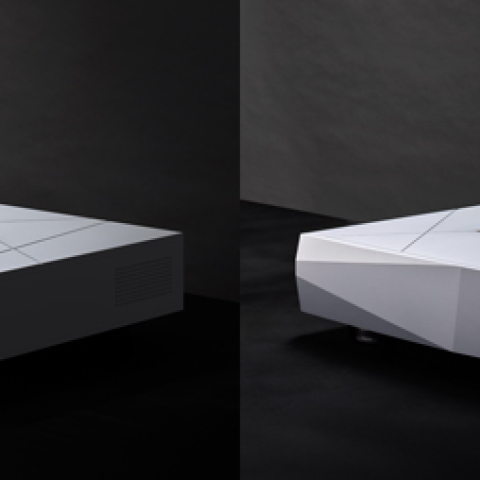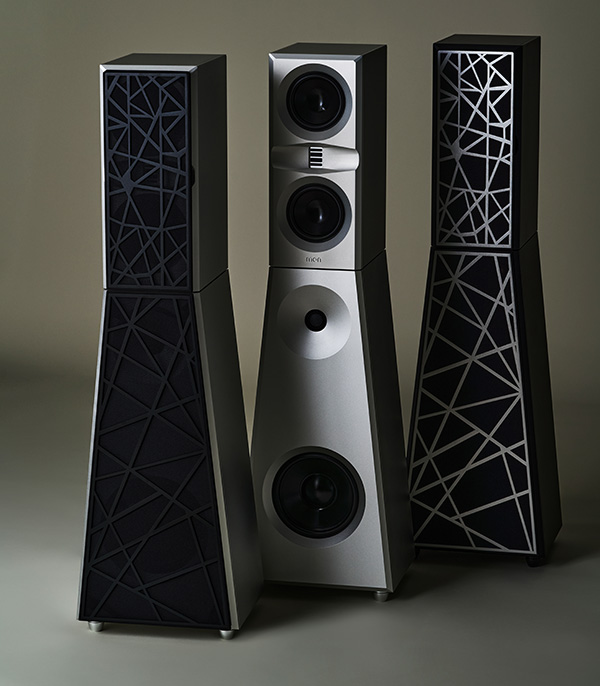
MonAcoustic, based in Daegu, Republic of Korea, is relatively new to the high-quality loudspeaker market. The company was established in 2020 by chief designer Jun Hyeog Seo and made its debut at the 2022 AXPONA. The company is taking a distinctively modular approach to its product lineup: The PlatiMon VC One MK2 is a two-way standmount ($9500/pair). It can be used independently or coupled with the PlatiMon VC Two ($12,100/pair), which adds two more "ways"—not just in the lows but also the highs (read on). Retailed as a four-way floorstanding stereo loudspeaker, the combination is priced at $21,600/pair.
Over time, I have found that high-end audio companies that appeal to me the most bear the strong personal stamp of their founding designer. MonAcoustic is in this category: They may not have been in business long, but already they're charting an independent path in their thinking and manufacture.
For years prior to founding MonAcoustic, designer Jun Seo was a noted mathematician, trained in topology, the study of properties preserved under deformation. Company CEO Young Byun explained to me that "Mon stands for 'More Natural'—our guiding principle of preserving musical continuity rather than exaggerating detail. The integration of Korean architectural proportion into the physical design reflects the same philosophy: balance, restraint, and structural clarity."
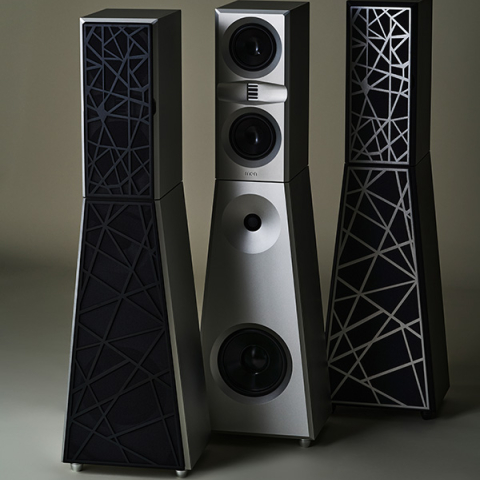
The MonAcoustic combo of their VC One and VC Two models offers up a creative twist to the most common configuration of multicabinet designs. The MonAcoustic PlatiMon VC Two extends the VC One's response in both directions, with a single 8" woofer plus a supertweeter with a 1" beryllium dome. With the two units working together, the VC One/Two combo's frequency response is specified as 20Hz–40kHz, ±3dB.
 Oemyeon (outside)
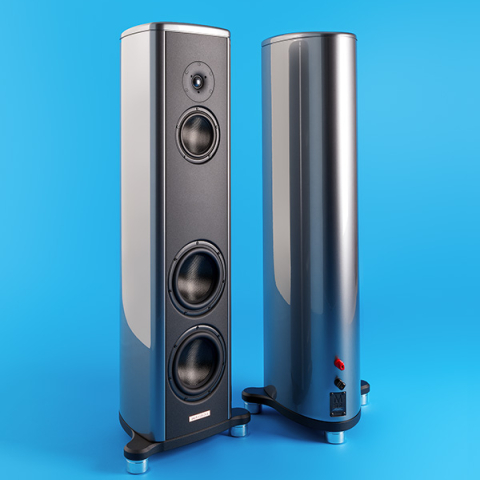
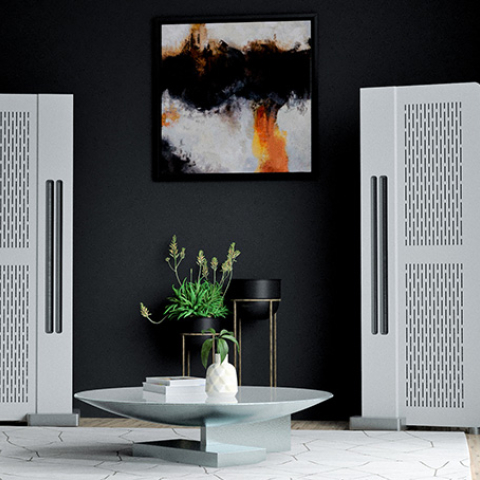
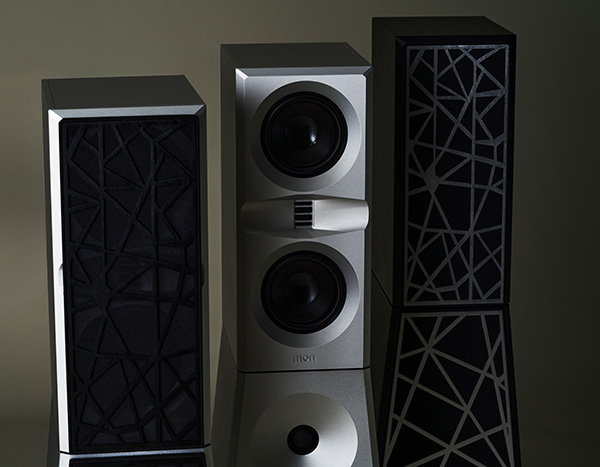
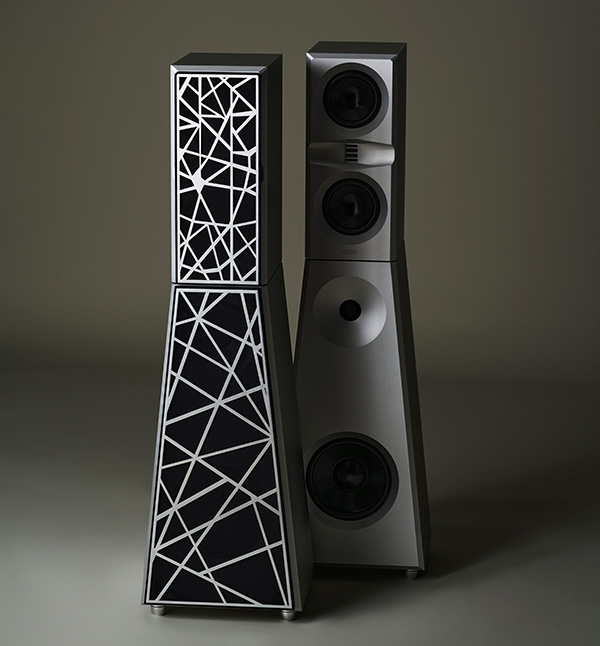
The exteriors of the PlatiMon VC One and VC Two cabinets are constructed from CNC-machined 6061-grade aluminum panels manufactured in Korea, bead blasted, and anodized. They are available in silver, black, or—for an upcharge—a custom navy finish. These aluminum panels vary in thickness. According to my measurements, both cabinets have a 3/4"-thick front baffle, and the panel at the bottom of the VC Two cabinet is about 5/8" thick. Edges and corners are handsomely beveled. The only screws visible are those on the rear access panels. The VC Two lower cabinet sits on rounded aluminum footers, avoiding the sharp spikes that put holes in my soft pine floors (although underneath a heavy speaker, a rounded footer can still leave dimples). The upper module, the VC One, is a classic rectangular box shape. Its interface with the obelisk-shaped VC Two employs three nested ball bearings; in addition to ensuring optimal alignment, this approach should provide some horizontal (but not vertical) compliance between the combined cabinets.
The visual/visceral impression of the PlatiMon VC speakers is of slimness and elegance. The VC One cabinet measures 17" high, and the VC Two is 26.4" tall—combined, the two units measure a modest 43.4" in height, plus the height of the footers. The VC One measures 7.5" wide; the VC Two matches that dimension at the top, widening to 13" at its bass. The speaker's overall depth is 10.5".
The VC One has two ports on the rear. The VC Two also employs two ports, one mounted high behind the supertweeter and one that exits through the bottom plate.
The VC One has one pair of high-quality binding posts; when used in combination with the VC Two, these posts allow the VC One and VC Two to be connected via a supplied external cable. The VC Two has two binding-post pairs that allow for either 3.5- or four-way operation. A five-position rotary knob allows selection of crossover options for the two tweeters.
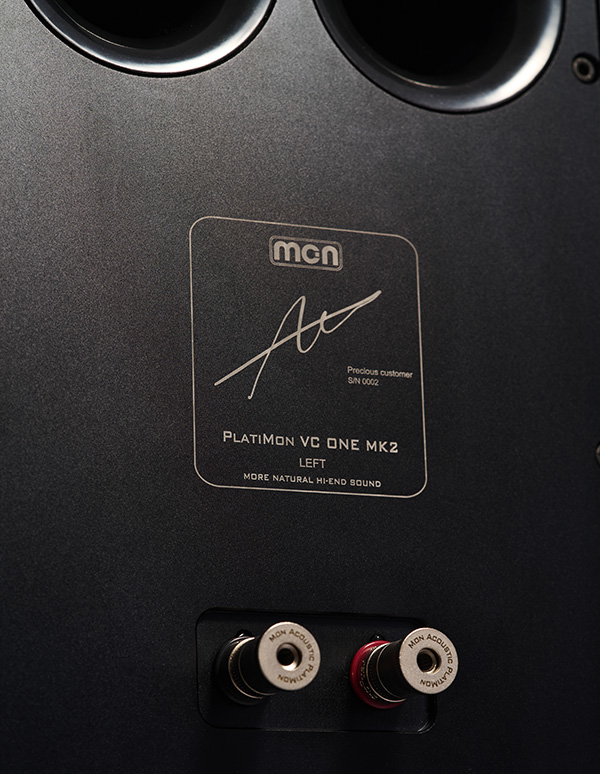 Provided documentation did not make clear the precise differences between the 3.5-way and four-way modes of operation—and indeed it seems they're not using the usual definitions. In the 3.5-way configuration, there is no connection to the top set of binding posts on the VC Two, suggesting (though it isn't certain) that the supertweeter is bypassed. In the four-way configuration, jumpers are used to connect all the binding posts together, likely engaging all the drivers via their respective crossover filters—although the supertweeter can be turned off (or adjusted) via the VC Two's back-panel switch.
Viewed from the front, the VC One cabinet shows twin German-made 5.5" midwoofers framing an AMT-type tweeter sourced from Dayton Audio, custom built to MonAcoustic's specifications. The VC Two deploys a single 8" front-firing woofer manufactured in-house in Korea, mounted toward the bottom of its cabinet. Toward the top is the supertweeter, with a 1" beryllium dome.
Partway through my auditions, grilles arrived. These unusual grilles have aluminum cutouts in abstract or near-abstract designs, backed by a lightweight speaker cloth. They attach to the cabinets with magnets. "The grille design is inspired by traditional Korean changho lattice architecture," Young Byun said. "We reinterpreted this concept using precision-cut metal rather than conventional fabric; they filter light while maintaining geometric balance. This was not intended as decoration but as a subtle expression of cultural identity."
The grilles look cool, but will they and their fairly thick "precision-cut metal" diffract the output of the drivers? They look like they might at certain frequencies, but I had no way of measuring.
Provided documentation did not make clear the precise differences between the 3.5-way and four-way modes of operation—and indeed it seems they're not using the usual definitions. In the 3.5-way configuration, there is no connection to the top set of binding posts on the VC Two, suggesting (though it isn't certain) that the supertweeter is bypassed. In the four-way configuration, jumpers are used to connect all the binding posts together, likely engaging all the drivers via their respective crossover filters—although the supertweeter can be turned off (or adjusted) via the VC Two's back-panel switch.
Viewed from the front, the VC One cabinet shows twin German-made 5.5" midwoofers framing an AMT-type tweeter sourced from Dayton Audio, custom built to MonAcoustic's specifications. The VC Two deploys a single 8" front-firing woofer manufactured in-house in Korea, mounted toward the bottom of its cabinet. Toward the top is the supertweeter, with a 1" beryllium dome.
Partway through my auditions, grilles arrived. These unusual grilles have aluminum cutouts in abstract or near-abstract designs, backed by a lightweight speaker cloth. They attach to the cabinets with magnets. "The grille design is inspired by traditional Korean changho lattice architecture," Young Byun said. "We reinterpreted this concept using precision-cut metal rather than conventional fabric; they filter light while maintaining geometric balance. This was not intended as decoration but as a subtle expression of cultural identity."
The grilles look cool, but will they and their fairly thick "precision-cut metal" diffract the output of the drivers? They look like they might at certain frequencies, but I had no way of measuring.
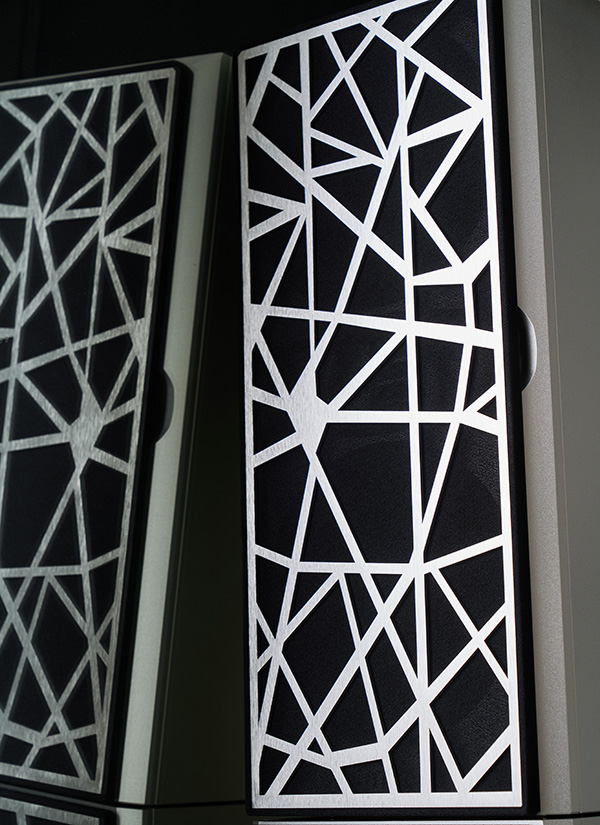 Diffraction was a moot point, however, because I could not get the grilles to stick. The magnets weren't strong enough, apparently. Obviously, I did my critical listening—all my listening in fact—with grilles off.
Naebu (inside)
Diffraction was a moot point, however, because I could not get the grilles to stick. The magnets weren't strong enough, apparently. Obviously, I did my critical listening—all my listening in fact—with grilles off.
Naebu (inside)
If you were to undo the dozens of screws that hold the back panels of the speakers in place, you would see that the internal design echoes the exterior. Inside the lower VC Two cabinet, an aluminum cross plate separates upper and lower chambers that house, respectively, the beryllium supertweeter and the 8" woofer. The upper chamber is lined with melamine acoustic foam. The lower chamber employs open-cell foam as a primary acoustic absorber for the rear-port assembly. MonAcoustic describes their approach as "selective damping to manage resonance without suppressing dynamic liveliness."
Similar braced-aluminum construction is employed in the VC One cabinet. The twin 5" midrange drivers function in a manner MonAcoustic terms "virtual coaxial"—hence "VC." This patented design uses two ports of different internal lengths. This asymmetrical tuning controls phase behavior and pressure release in the lower frequencies.
Based on my auditioning, I can report that the single 8" bass woofer in the VC Two speaker can produce an impressive amount of the lower frequency spectrum with fine detail and clarity. However, MonAcoustic encourages the use of port plugs for installation in rooms where the distance between the cabinets and the front wall is too short for fully open ports. I have more than adequate space behind loudspeakers, so it wasn't necessary to plug any ports—yet it is useful to know that this PlatiMon VC combo, with its slender profile and the pluggable ports, may work well in smaller rooms.
The VC pairing's internal wiring, and also the wires provided to connect the two modules, is custom-sourced by MonAcoustic. Two sets of crossover numbers are provided, one for 3.5-way operation (3.1kHz between the midwoofer and tweeter, 25kHz between the tweeter and supertweeter), the other for the four-way configuration (which adds a crossover with the woofers at 250Hz). Exactly what's happening in these different operating modes will be discussed in the following section.
Young Byun again: "These are two genuinely different design philosophies, not just two switch positions. Both connect amplifier cables to the bottom set of VC Two binding posts; the jumper position selects mode." In 3.5-way mode, the two speaker units operate in parallel. VC One runs full-range, and VC Two adds low-frequency reinforcement, with intentional overlap at the lower frequencies. "This produces some peaks and dips in the overlap region by design—a characteristic that we find adds liveliness and body to popular music. The structural reference here is the classic Wilson Audio WATT/Puppy approach, and the audible intent is similar."
In four-way mode, VC Two handles the lowest frequencies, crossing over to VC One at 250Hz. The PlatiMon becomes a more conventional beast, drivers turning on and off top to bottom, in an orderly way—especially when the knob is switched to the ST position. (See the discussion of the mode switch knob, below.) This mode, Young Byun says, is best for classical music and much jazz.
Moving from 3.5-way to four-way lowers the specified sensitivity by 1dB, from 91dB/2.83V/1m to 90dB/2.83V/1m. MonAcoustic recommends amplification of 40W or more; I used my McIntosh amplifier (see Associated Equipment).
 Tweaking tweeters
The most unusual and creative aspect of the PlatiMon VC One and VC Two combo is the use of two tweeters—rather, a tweeter and a supertweeter. As already mentioned, the two-way upper VC One speaker uses an AMT (Air Motion Transformer) transducer. The lower VC Two cabinet contains the beryllium-dome supertweeter. A rotary knob on the rear of the VC Two cabinet affects the supertweeter's network filters and so determines how it integrates with the AMT tweeter; MonAcoustic calls it a "mode switch knob." The knob's five positions are labeled: Off, H.T1, H.T2, H.T3, and ST. HT stands for "Harmonic Tweeter." Young Byun explained following a huddle with Jun Hyeog Seo. "In H.T1, H.T2, and H.T3 positions, the beryllium tweeter is fed through a fourth-order network whose component values place the network's effective region above the audible band. C1 in the network is 0.034µF; the variable element across the three positions is L2, the second inductor, stepped between 0.17mH and 0.19mH in fine increments. With these values, the audible-band response is unaffected; the network's phase manipulation occurs entirely above 20kHz. The design principle is the result of our own listening research: Subtle phase and harmonic variations in the ultrasonic region can meaningfully shape the overall atmosphere and character of the music a listener perceives, even though those frequencies are outside conscious hearing. The rotary knob makes those tuned variations user selectable. The network topology is performing harmonic shaping in the ultrasonic band—hence 'Harmonic Tweeter.'"
MonAcoustic employed subjective descriptions to explain the different settings. The H.T1 selection is described as a "warm and relaxed staging with rich overtones." The H.T2 choice is said to be "neutral and precise." H.T3 creates "modern, clear, and musical sound."
Off, as you'd expect, turns the supertweeter off. ST feeds the supertweeter "through a first-order network—the conventional simple high-pass topology associated with classical supertweeter applications. In this mode, the beryllium-dome tweeter extends the system to 40kHz without the harmonic-shaping function." It is, in other words, acting like a simple supertweeter.
Choices create quandaries. I asked Young Byun why anyone would pay for a high-quality beryllium-dome supertweeter and then turn it off. "System matching varies depending on room acoustics and listener preference," he responded. "We allow the listener to adjust the degree of supertweeter integration so the system can be optimized for individual spaces."
Music preferences also play a role. With the supertweeter fully engaged, in four-way operation, the VC One and VC Two combo is at its most linear, with the lowest distortion figures. Byun suggestd that someone like me, who listens mostly to acoustic jazz and classical, would probably prefer this setting. With one of the 3.5-way tunings, there will be more energy in the midbass region, so those who listen to electronic dance music can get the party going.
Swingin' four ways
I was surprised when UPS showed up in my driveway bearing four double-boxed containers; I was expecting a more exotic shipper. I was even more surprised when the UPS guy helped me carry the speakers into the house. There was two feet of snow on the ground, so I was also grateful. I always let things rest overnight before connecting and/or listening, especially things delivered on freezing freight trucks.
The PlatiMons' modularity made them relatively easy to handle. Once they had acclimated, I was able to move the four cabinets into position in my listening room on my own. The upper module, VC One, was said to couple to the lower module, VC Two, with ball bearings nesting in indentations. But where were the ball bearings? With an assist from MonAcoustic, I located them buried deep in a hole in the foam packaging, in a little white bag. It's the simple things that can throw you! If a chunk of Styrofoam seems heavier than it should be—don't throw it out!
Using supplied photos for guidance, I connected the upper and lower cabinets for four-way operation and cranked the mode switch knob to ST—I wanted to hear what these speakers could do with that supertweeter fully engaged. I set my McIntosh C12000 preamp to use its solid state outputs, which are more revealing than the tubed outputs: I wanted to hear everything there was to hear from my reference system.
MonAcoustic had told me the speakers were brand new and had not been played. I should run them in for at least 50 hours before evaluating them critically. So for the first week, I kept them running with internet radio at moderate levels. I didn't take notes.
I placed the PlatiMons in the positions normally occupied by my reference floorstanders, which worked great. I prefer most speakers in this space to be toed in but not all the way; this usually balances the dialectic of detail versus soundstage width. The VC Ones and Twos obliged. It was time to rock!
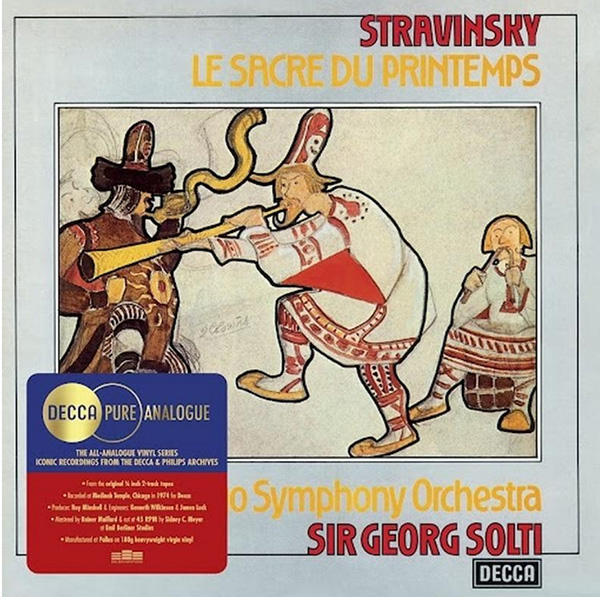 I had just gotten in a new LP, with George Solti and the Chicago Symphony burnin' down the house on a 45rpm reissue from earlier this year of Igor Stravinsky's Rite of Spring (Decca Pure Analogue 487 1496). The Emile Berliner remastering crew has turned its attention to the Decca catalog, and this one is a mind/ear-blower. I have heard this great 1974 recording many times over the years, but never like this. The experience took me back to my parents' living room, when I used to dance around to the Monteux/San Francisco Symphony version played on my dad's homemade mono hi-fi. Composer John Adams once said to me, "If Stravinsky had never written another note, he would still be viewed as one of the greatest of all composers." My dog Toby's ears were twitching as we neared the end of Part I/side 1. The CSO brass! The CSO percussion! The merciless rhythms that conclude Part I make me think of the triumph of the machine age or, updated, the "Dance of the Killer AI Robots."
Some conductors let Part II drag. There is academic debate about Stravinsky having changed tempo markings to make the work more playable. Solti knows instinctively how to get that 747 up off the runway.
I was impressed by the sound I was getting from the MonAcoustic speakers—by the subjective extension on both ends, by delicate detail in the moments of stillness, by how they deciphered the most complex orchestrations, like the running water of winds at the top of the work before the strings start pounding. When the timpani and bass drum did their thing, it was visceral—hair-raising!
I had just gotten in a new LP, with George Solti and the Chicago Symphony burnin' down the house on a 45rpm reissue from earlier this year of Igor Stravinsky's Rite of Spring (Decca Pure Analogue 487 1496). The Emile Berliner remastering crew has turned its attention to the Decca catalog, and this one is a mind/ear-blower. I have heard this great 1974 recording many times over the years, but never like this. The experience took me back to my parents' living room, when I used to dance around to the Monteux/San Francisco Symphony version played on my dad's homemade mono hi-fi. Composer John Adams once said to me, "If Stravinsky had never written another note, he would still be viewed as one of the greatest of all composers." My dog Toby's ears were twitching as we neared the end of Part I/side 1. The CSO brass! The CSO percussion! The merciless rhythms that conclude Part I make me think of the triumph of the machine age or, updated, the "Dance of the Killer AI Robots."
Some conductors let Part II drag. There is academic debate about Stravinsky having changed tempo markings to make the work more playable. Solti knows instinctively how to get that 747 up off the runway.
I was impressed by the sound I was getting from the MonAcoustic speakers—by the subjective extension on both ends, by delicate detail in the moments of stillness, by how they deciphered the most complex orchestrations, like the running water of winds at the top of the work before the strings start pounding. When the timpani and bass drum did their thing, it was visceral—hair-raising!
 Time to check out some vocals—and to experiment with the PlatiMon's tweeter-mode switch. I pulled up, on Qobuz, a 24/96 version of Ella Fitzgerald's Harold Arlen Song Book (Verve V6-4046-2, 1961). This is one of the great Ella/Norman Granz songbooks that was recorded in stereo. The icing on the cake are the arrangements, by Billy May.
I decided to split the difference, tweeter-wise, so I chose the H.T2 setting. "Blues in the Night" was lovely. Ella felt velvety and rich, which she does when the gear is good. When I focused on the band and switched back and forth from the H.T2 setting to the ST setting, with the former I heard slightly less sparkle from the cymbals and other percussion. With the supertweeter fully engaged, Ella struck me as more part of the room with the rest of the band—that sense of air. I also heard sharper, brighter attacks from the upper brass—and perhaps a hint more sibilance? With the ST setting, the inner details of Billy May's orchestrations were superfine.
My son Peter is trying to school me. For my birthday, he gave me an LP remastering on clear green vinyl of the 1972 album Ege Bamyasi from German experimental-rock band Can (Spoon Records 9378-1, 2014).
Time to check out some vocals—and to experiment with the PlatiMon's tweeter-mode switch. I pulled up, on Qobuz, a 24/96 version of Ella Fitzgerald's Harold Arlen Song Book (Verve V6-4046-2, 1961). This is one of the great Ella/Norman Granz songbooks that was recorded in stereo. The icing on the cake are the arrangements, by Billy May.
I decided to split the difference, tweeter-wise, so I chose the H.T2 setting. "Blues in the Night" was lovely. Ella felt velvety and rich, which she does when the gear is good. When I focused on the band and switched back and forth from the H.T2 setting to the ST setting, with the former I heard slightly less sparkle from the cymbals and other percussion. With the supertweeter fully engaged, Ella struck me as more part of the room with the rest of the band—that sense of air. I also heard sharper, brighter attacks from the upper brass—and perhaps a hint more sibilance? With the ST setting, the inner details of Billy May's orchestrations were superfine.
My son Peter is trying to school me. For my birthday, he gave me an LP remastering on clear green vinyl of the 1972 album Ege Bamyasi from German experimental-rock band Can (Spoon Records 9378-1, 2014).
 How did I miss this for all these years? Maybe because the record had little distribution in the States until recently. Can had serious art-music cred—two of the members studied with Stockhausen—but you can also think of them as a German Grateful Dead, capable of serious jamming, and driven by some really swinging funky drumming—in this case by Jaki Liebezeit. "One More Night," which ends the A-side, has more than a whiff of the Talking Heads funk that was to come. David Byrne must have been listening.
I swapped out my reference amplifier for the new Linn Klimax Solo 500 monoblocks that had recently arrived (review forthcoming). I wanted to hear what other powerful solid state amplification would pull from the PlatiMon VCs.
I heard clear differences immediately. The Linns excel in producing detailed textures, and so do the PlatiMons. Playing this track was like being dropped into a Berlin nightclub: No matter how hard I pushed the PlatiMon VC Ones and VC Twos, that kicking backbeat stayed locked in, punchy as all get-out but nonfatiguing.
Like distorted electric guitars? No problemo, you will hear that distortion loud and ... clear? If that's what floats your boat.
How did I miss this for all these years? Maybe because the record had little distribution in the States until recently. Can had serious art-music cred—two of the members studied with Stockhausen—but you can also think of them as a German Grateful Dead, capable of serious jamming, and driven by some really swinging funky drumming—in this case by Jaki Liebezeit. "One More Night," which ends the A-side, has more than a whiff of the Talking Heads funk that was to come. David Byrne must have been listening.
I swapped out my reference amplifier for the new Linn Klimax Solo 500 monoblocks that had recently arrived (review forthcoming). I wanted to hear what other powerful solid state amplification would pull from the PlatiMon VCs.
I heard clear differences immediately. The Linns excel in producing detailed textures, and so do the PlatiMons. Playing this track was like being dropped into a Berlin nightclub: No matter how hard I pushed the PlatiMon VC Ones and VC Twos, that kicking backbeat stayed locked in, punchy as all get-out but nonfatiguing.
Like distorted electric guitars? No problemo, you will hear that distortion loud and ... clear? If that's what floats your boat.
 While the PlatiMon VC Ones and Twos were here, I received the UHQR two-LP 45rpm stereo pressing of Jimi Hendrix's Axis: Bold as Love, remastered by Bernie Grundman for Analogue Productions (Analogue Productions UHQR 0001/Sony Music 19075812451). It had been back-ordered for months, and it finally came.
Axis: Bold as Love was never a long album—now spread it over four 45rpm sides, and you find yourself getting out of your listening chair often. Trust me—it's worth the effort. For those of you who don't listen to vinyl: You don't know what you're missing!
Jimi left the completed mix tapes for the A-side of the album in a cab. A frantic search ensued, then a remix, under a time gun. When they got to "If 6 Was 9," they had to resort to a 7½ips tape that was in the possession of Hendrix bassist Noel Redding.
This album is permanently embedded in my mental jukebox. I don't need to play it; I can just think about it, and I hear it in my head. But what a moving "experience" it was to hear it again after such a long time, sounding—literally—awesome via the MonAcoustics. So many things about this album are unique, even today, like all the crazy stereo panning: Why would anyone want to hear this in mono?
"Up From the Skies" had a killer swing groove going, with the bass subtly enhanced from the original release. "Little Wing" caused me to tear up, as did "Castles Made of Sand." Mitch Mitchell, the swingin'est drummer ever in rock! Boy, did those drums sound great! And Jimi's guitar solos were like firebirds streaking across the sky.
We live in Woodstock now, directly across the street from 1 Wiley Lane, the former home of Jimi's last manager, a sinister guy named Mike Jeffery. I can look out the window of my listening room and see the apartment over the garage where Jimi lived when he came to Woodstock, before he moved to a large ranch outside town. That's where he was living when Woodstock—the festival—occurred. I hear you talkin' to me, Jimi.
Auspicious starts
While the PlatiMon VC Ones and Twos were here, I received the UHQR two-LP 45rpm stereo pressing of Jimi Hendrix's Axis: Bold as Love, remastered by Bernie Grundman for Analogue Productions (Analogue Productions UHQR 0001/Sony Music 19075812451). It had been back-ordered for months, and it finally came.
Axis: Bold as Love was never a long album—now spread it over four 45rpm sides, and you find yourself getting out of your listening chair often. Trust me—it's worth the effort. For those of you who don't listen to vinyl: You don't know what you're missing!
Jimi left the completed mix tapes for the A-side of the album in a cab. A frantic search ensued, then a remix, under a time gun. When they got to "If 6 Was 9," they had to resort to a 7½ips tape that was in the possession of Hendrix bassist Noel Redding.
This album is permanently embedded in my mental jukebox. I don't need to play it; I can just think about it, and I hear it in my head. But what a moving "experience" it was to hear it again after such a long time, sounding—literally—awesome via the MonAcoustics. So many things about this album are unique, even today, like all the crazy stereo panning: Why would anyone want to hear this in mono?
"Up From the Skies" had a killer swing groove going, with the bass subtly enhanced from the original release. "Little Wing" caused me to tear up, as did "Castles Made of Sand." Mitch Mitchell, the swingin'est drummer ever in rock! Boy, did those drums sound great! And Jimi's guitar solos were like firebirds streaking across the sky.
We live in Woodstock now, directly across the street from 1 Wiley Lane, the former home of Jimi's last manager, a sinister guy named Mike Jeffery. I can look out the window of my listening room and see the apartment over the garage where Jimi lived when he came to Woodstock, before he moved to a large ranch outside town. That's where he was living when Woodstock—the festival—occurred. I hear you talkin' to me, Jimi.
Auspicious starts
MonAcoustic is starting strong out of the gate, with creative, substantive design work and fine manufacturing standards. With the MonAcoustics in my reference system, I experienced something new. The supertweeter in the VC Two cabinet was like an audio decongestant, opening up inner ear canals and making the music feel alive and present. You might think of these speakers as a sort of average of studio and consumer speakers; that is the ballpark they're playing in.
They've got some things to work on. Those prototype grilles need stronger magnets. They should start immediately, if they haven't already, working on a better owner's manual, with clear technical explanations of these complex speakers and how to extract the best from them.
Still, the PlatiMon VC One and VC Two loudspeakers rate very high in quality-for-cost ratio, which is important to me both as a reviewer and as a customer.
Hear the PlatiMon VC One and Two combo if you can and appreciate for yourself their unique music-making abilities.
Oemyeon (outside)The exteriors of the PlatiMon VC One and VC Two cabinets are constructed from CNC-machined 6061-grade aluminum panels manufactured in Korea, bead blasted, and anodized. They are available in silver, black, or—for an upcharge—a custom navy finish. These aluminum panels vary in thickness. According to my measurements, both cabinets have a 3/4"-thick front baffle, and the panel at the bottom of the VC Two cabinet is about 5/8" thick. Edges and corners are handsomely beveled. The only screws visible are those on the rear access panels. The VC Two lower cabinet sits on rounded aluminum footers, avoiding the sharp spikes that put holes in my soft pine floors (although underneath a heavy speaker, a rounded footer can still leave dimples). The upper module, the VC One, is a classic rectangular box shape. Its interface with the obelisk-shaped VC Two employs three nested ball bearings; in addition to ensuring optimal alignment, this approach should provide some horizontal (but not vertical) compliance between the combined cabinets.
Provided documentation did not make clear the precise differences between the 3.5-way and four-way modes of operation—and indeed it seems they're not using the usual definitions. In the 3.5-way configuration, there is no connection to the top set of binding posts on the VC Two, suggesting (though it isn't certain) that the supertweeter is bypassed. In the four-way configuration, jumpers are used to connect all the binding posts together, likely engaging all the drivers via their respective crossover filters—although the supertweeter can be turned off (or adjusted) via the VC Two's back-panel switch.
Viewed from the front, the VC One cabinet shows twin German-made 5.5" midwoofers framing an AMT-type tweeter sourced from Dayton Audio, custom built to MonAcoustic's specifications. The VC Two deploys a single 8" front-firing woofer manufactured in-house in Korea, mounted toward the bottom of its cabinet. Toward the top is the supertweeter, with a 1" beryllium dome.
Partway through my auditions, grilles arrived. These unusual grilles have aluminum cutouts in abstract or near-abstract designs, backed by a lightweight speaker cloth. They attach to the cabinets with magnets. "The grille design is inspired by traditional Korean changho lattice architecture," Young Byun said. "We reinterpreted this concept using precision-cut metal rather than conventional fabric; they filter light while maintaining geometric balance. This was not intended as decoration but as a subtle expression of cultural identity."
Diffraction was a moot point, however, because I could not get the grilles to stick. The magnets weren't strong enough, apparently. Obviously, I did my critical listening—all my listening in fact—with grilles off.
Naebu (inside)If you were to undo the dozens of screws that hold the back panels of the speakers in place, you would see that the internal design echoes the exterior. Inside the lower VC Two cabinet, an aluminum cross plate separates upper and lower chambers that house, respectively, the beryllium supertweeter and the 8" woofer. The upper chamber is lined with melamine acoustic foam. The lower chamber employs open-cell foam as a primary acoustic absorber for the rear-port assembly. MonAcoustic describes their approach as "selective damping to manage resonance without suppressing dynamic liveliness."
Tweaking tweetersThe most unusual and creative aspect of the PlatiMon VC One and VC Two combo is the use of two tweeters—rather, a tweeter and a supertweeter. As already mentioned, the two-way upper VC One speaker uses an AMT (Air Motion Transformer) transducer. The lower VC Two cabinet contains the beryllium-dome supertweeter. A rotary knob on the rear of the VC Two cabinet affects the supertweeter's network filters and so determines how it integrates with the AMT tweeter; MonAcoustic calls it a "mode switch knob." The knob's five positions are labeled: Off, H.T1, H.T2, H.T3, and ST. HT stands for "Harmonic Tweeter." Young Byun explained following a huddle with Jun Hyeog Seo. "In H.T1, H.T2, and H.T3 positions, the beryllium tweeter is fed through a fourth-order network whose component values place the network's effective region above the audible band. C1 in the network is 0.034µF; the variable element across the three positions is L2, the second inductor, stepped between 0.17mH and 0.19mH in fine increments. With these values, the audible-band response is unaffected; the network's phase manipulation occurs entirely above 20kHz. The design principle is the result of our own listening research: Subtle phase and harmonic variations in the ultrasonic region can meaningfully shape the overall atmosphere and character of the music a listener perceives, even though those frequencies are outside conscious hearing. The rotary knob makes those tuned variations user selectable. The network topology is performing harmonic shaping in the ultrasonic band—hence 'Harmonic Tweeter.'"
I was surprised when UPS showed up in my driveway bearing four double-boxed containers; I was expecting a more exotic shipper. I was even more surprised when the UPS guy helped me carry the speakers into the house. There was two feet of snow on the ground, so I was also grateful. I always let things rest overnight before connecting and/or listening, especially things delivered on freezing freight trucks.
I had just gotten in a new LP, with George Solti and the Chicago Symphony burnin' down the house on a 45rpm reissue from earlier this year of Igor Stravinsky's Rite of Spring (Decca Pure Analogue 487 1496). The Emile Berliner remastering crew has turned its attention to the Decca catalog, and this one is a mind/ear-blower. I have heard this great 1974 recording many times over the years, but never like this. The experience took me back to my parents' living room, when I used to dance around to the Monteux/San Francisco Symphony version played on my dad's homemade mono hi-fi. Composer John Adams once said to me, "If Stravinsky had never written another note, he would still be viewed as one of the greatest of all composers." My dog Toby's ears were twitching as we neared the end of Part I/side 1. The CSO brass! The CSO percussion! The merciless rhythms that conclude Part I make me think of the triumph of the machine age or, updated, the "Dance of the Killer AI Robots."
Some conductors let Part II drag. There is academic debate about Stravinsky having changed tempo markings to make the work more playable. Solti knows instinctively how to get that 747 up off the runway.
Time to check out some vocals—and to experiment with the PlatiMon's tweeter-mode switch. I pulled up, on Qobuz, a 24/96 version of Ella Fitzgerald's Harold Arlen Song Book (Verve V6-4046-2, 1961). This is one of the great Ella/Norman Granz songbooks that was recorded in stereo. The icing on the cake are the arrangements, by Billy May.
I decided to split the difference, tweeter-wise, so I chose the H.T2 setting. "Blues in the Night" was lovely. Ella felt velvety and rich, which she does when the gear is good. When I focused on the band and switched back and forth from the H.T2 setting to the ST setting, with the former I heard slightly less sparkle from the cymbals and other percussion. With the supertweeter fully engaged, Ella struck me as more part of the room with the rest of the band—that sense of air. I also heard sharper, brighter attacks from the upper brass—and perhaps a hint more sibilance? With the ST setting, the inner details of Billy May's orchestrations were superfine.
How did I miss this for all these years? Maybe because the record had little distribution in the States until recently. Can had serious art-music cred—two of the members studied with Stockhausen—but you can also think of them as a German Grateful Dead, capable of serious jamming, and driven by some really swinging funky drumming—in this case by Jaki Liebezeit. "One More Night," which ends the A-side, has more than a whiff of the Talking Heads funk that was to come. David Byrne must have been listening.
I swapped out my reference amplifier for the new Linn Klimax Solo 500 monoblocks that had recently arrived (review forthcoming). I wanted to hear what other powerful solid state amplification would pull from the PlatiMon VCs.
While the PlatiMon VC Ones and Twos were here, I received the UHQR two-LP 45rpm stereo pressing of Jimi Hendrix's Axis: Bold as Love, remastered by Bernie Grundman for Analogue Productions (Analogue Productions UHQR 0001/Sony Music 19075812451). It had been back-ordered for months, and it finally came.
MonAcoustic is starting strong out of the gate, with creative, substantive design work and fine manufacturing standards. With the MonAcoustics in my reference system, I experienced something new. The supertweeter in the VC Two cabinet was like an audio decongestant, opening up inner ear canals and making the music feel alive and present. You might think of these speakers as a sort of average of studio and consumer speakers; that is the ballpark they're playing in.