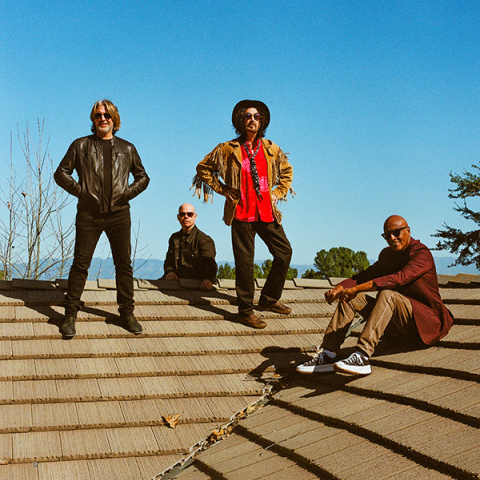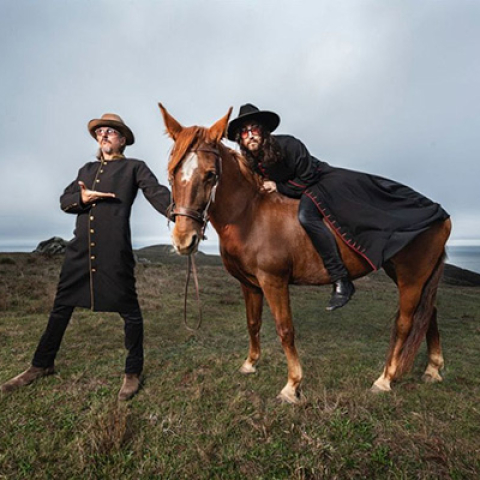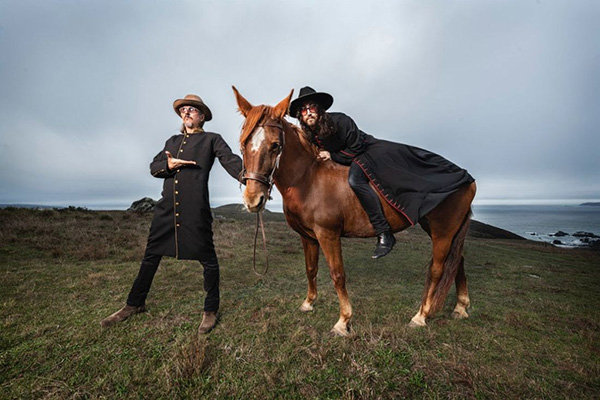
Photo by Jay Blakesberg
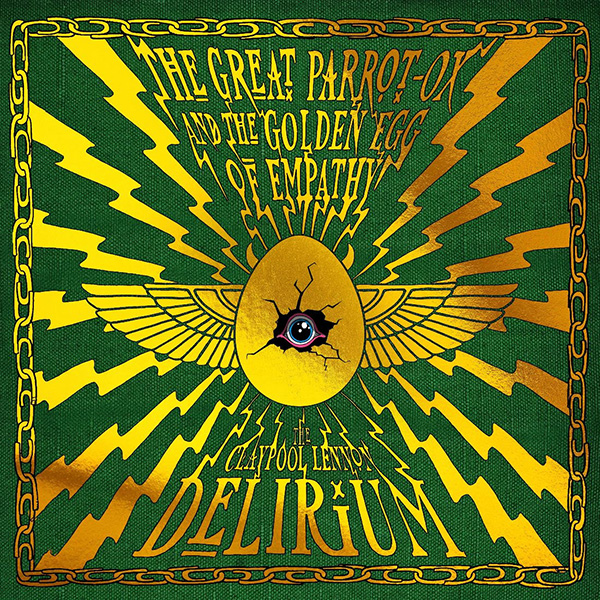
Few bands are as, shall we say, onomatopoetic as The Claypool Lennon Delirium. The Delirium is the umbrella under which bassist/vocalist Les Claypool (Primus, Fearless Flying Frog Brigade) and guitarist/vocalist Sean Ono Lennon (The Ghost of a Saber Tooth Tiger) gather occasionally and combine their creative forces to make some of the weirdest, wildest, wackiest soundscapes imaginable. Their latest—The Great Parrot-Ox and the Golden Egg of Empathy (Prawn Song/Chimera Music/ATO), a double album three-plus years in the making—includes 14 songs that hammer home the artists' preference for people-made sonics over AI-created glop. (A 24-page Parrot-Ox comic book included with the album illustrates their "humans aren't mere meat machines" beliefs quite literally.)
"We're not religious about it, but Les and I both come from a generation where playing actual instruments was the thing to do," Lennon said during a recent Zoom call with the two musicians. "Obviously I prefer playing instruments, but I don't want to come across that I'm against technology. I think it's interesting. Both Les and I dig weird shit made by drum machines, and I love a lot of electronic music. I mean, Aphex Twin is a total genius."
Claypool and Lennon both say it wasn't easy to get 62 minutes of Parrot-Ox soundfield exactly right. "I could remix it again," Claypool said. "And I geek hard on mixing. Some songs I've mixed 20, 30 times. But once we agree on it, and by 'we,' I mean me and Shiner"—that's Claypool's nickname for Lennon, who in turn calls Claypool Colonel if he doesn't call him Les—"it's pretty much done. But when I go back and listen, I always go, 'Ahh, I wish I'd have done this.' I can do that with every record—but once you feel it, it's done; it has to go out into the world." Then Lennon added, "I'm always surprised that a tiny little thing I didn't fix or change but wanted to is something I never forget for the rest of my life. It's happened on every record I've ever done. At the time you're doing it, a producer will say, 'Don't worry; you won't even remember this in a week.' But it's 30 years later, and I still remember."
 Vocal manipulation is another Parrot-Ox trait. "I learned this the hard way," Lennon explained. "On every record I've made where my voice is pretty dry, I just can't listen to it. Someone told me when I was working on one of my solo records, 'Don't double everything. You just got to do a single vocal'—and now I can't listen to my solo records because of that. So I definitely have to double it, or do something with it, to make it listenable to my ear." Here, Claypool interjected to amend the point. "Shiner, you never double anything! You triple and quadruple it." Lennon conceded, "Yeah, Colonel, it's more like sextuple," to which Claypool added, "Octuple."
"The record came out spectacular. I'm very proud of it," Claypool then volunteered. "You get to the point when you're mixing where you start chasing your tail, and then you go, 'Holy shit—it sounded better 10 mixes ago,' and you want to go back and rebuild it from there. That's what people like Stephen Marcussen (footnote 1) are there for, to keep that from happening."
Vocal manipulation is another Parrot-Ox trait. "I learned this the hard way," Lennon explained. "On every record I've made where my voice is pretty dry, I just can't listen to it. Someone told me when I was working on one of my solo records, 'Don't double everything. You just got to do a single vocal'—and now I can't listen to my solo records because of that. So I definitely have to double it, or do something with it, to make it listenable to my ear." Here, Claypool interjected to amend the point. "Shiner, you never double anything! You triple and quadruple it." Lennon conceded, "Yeah, Colonel, it's more like sextuple," to which Claypool added, "Octuple."
"The record came out spectacular. I'm very proud of it," Claypool then volunteered. "You get to the point when you're mixing where you start chasing your tail, and then you go, 'Holy shit—it sounded better 10 mixes ago,' and you want to go back and rebuild it from there. That's what people like Stephen Marcussen (footnote 1) are there for, to keep that from happening."
Footnote 1: Claypool and Matt Winegar mixed Parrot-Ox; Stephen Marcussen mastered it. Footnote 2: Waits turned in a signature guest vocal on "Tommy the Cat" on Primus's 1991 breakthrough Sailing the Seas of Cheese (Interscope). He also appeared on—and was one of the many producers of—Primus's 1999 release Antipop (Prawn Song/Interscope).