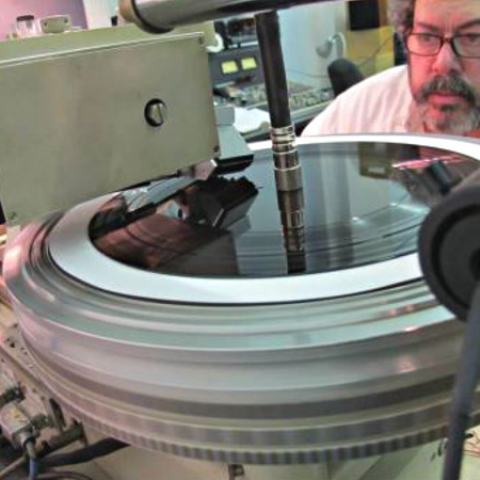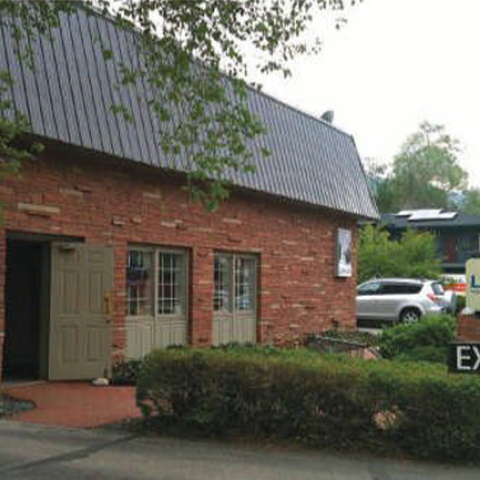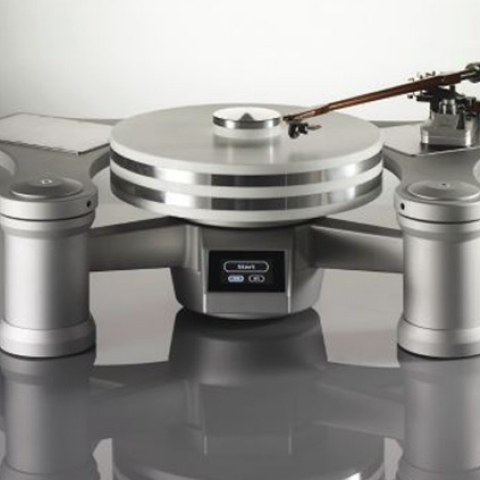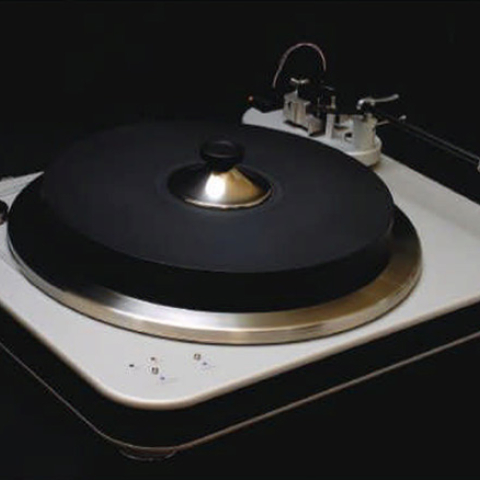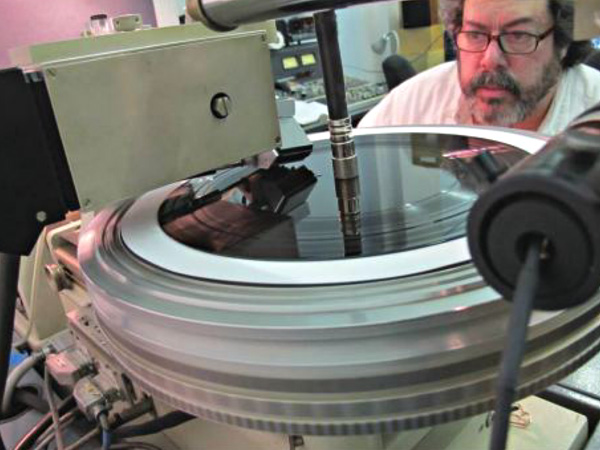
The Soundsmith's Peter Ledermann studies the first lacquer to be cut. (Photo by Michael Fremer)
Peter Ledermann's head rose from his Neumann SX-74 cutting lathe. He looked concerned. "The platter stopped turning the other day and I'm not exactly sure why," he said. "It started working again, but you know, these things are old..."
Normally, such a stoppage might mean only one lacquer lost during the transfer to disc of a tape or digital file, but on this day in late November, Ledermann was readying the lathe for a direct-to-disc recording session at the Soundsmith Corporation's headquarters in Peekskill, New York.
The musicians, led by classically trained, Cuban-born jazz pianist and composer Elio Villafranca, tinkered with the arrangements in the company's large showroom. In an adjacent room, Ledermann and his engineering team—Duke Markos, Mark Whitters, Craig Dick, and Rick Jacobsohn (whom Ledermann, in a Tim Tebow moment, told me the next day was sent at the last minute by God)—set about preparing the analog machinery and digital electronics that would capture the performances. Having all of this engineering power available was critical, Ledermann told me; it would allow him to focus on the lathe, which, he admitted, "could be more temperamental than me."
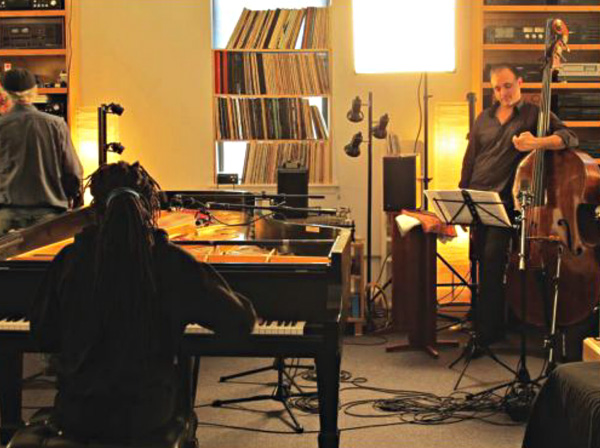
The musicians, pianist Elio Villafranca and bassist Gregg August, rehearse.
Meanwhile, the really important decisions—about the music—had been made about the arrangements and who would play them, and it was Villafranca's responsibility to work within Wyatt's generous production budget. Villafranca proposed, and Wyatt accepted, a sextet to accompany him on day one, and a quartet for day two. The musicians included veteran drummer Billy Hart, who's played with everyone from Otis Redding to Herbie Hancock; alto and soprano saxophonist Vincent Herring (Horace Silver, Roy Hargrove, Carla Bley, Wynton Marsalis, etc.); tenor saxophonist J.D. Allen III (Lester Bowie, Betty Carter, Jack DeJohnette, David Murray, etc.); bassist Gregg August (Ray Barretto, James Moody, etc.); trumpeter Bruce Harris; and percussionists Juango Gutierrez and Camilo Molina. Villafranca can be heard on his album Dynamic Resolution, with bassist Charles Flores, engineered by Markos and also cut by Ledermann, and available in mono and/or stereo vinyl through Acoustic Sounds (LP only, 16 Eyes A16E 001M/S/MS).
In short: a stellar team of musicians led by a remarkably creative, Grammy-nominated pianist, two great ensembles, and a topnotch engineering team, all making a direct-to-disc AAA recording. It was not to be missed.
 Ledermann ended up shipping seven lacquers to the RTI pressing plant, in California for plating and pressing. Four lacquers will make up the two-LP set; a single 45rpm lacquer will be reserved for the later release of a single one-sided disc. Of course, seven lacquers minus five leaves two lacquers unaccounted for. I'll leave it to Ledermann to explain the mystery discs, should he care to.
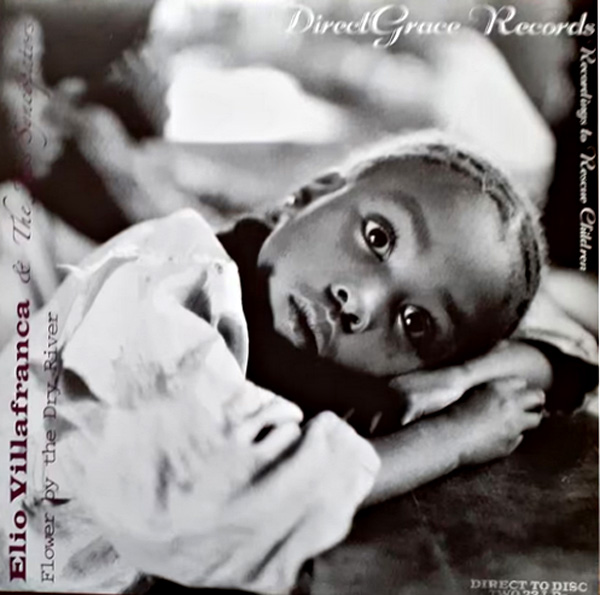
Robin Wyatt bankrolled these sessions, the musicians agreed to take considerable cuts in their normal session fees, and everyone else volunteered their time and equipment. Once production costs have been recouped, most of the profits from this release on DirectGrace Records—a label founded by Ledermann to make "Recordings to Rescue Children"—will go to the John Herrick Jackson Memorial Foundation, which distributes grants, gifts, and loans to qualified groups that help keep children from being forced into slave labor, which remains a horrendous problem worldwide.
There can only be winners here, and that includes you and me when we buy a copy of Flower by the Dry River. I'm not sure when it will be released; look for it at Music Direct, Elusive Disc, and Acoustic Sounds.
Ledermann ended up shipping seven lacquers to the RTI pressing plant, in California for plating and pressing. Four lacquers will make up the two-LP set; a single 45rpm lacquer will be reserved for the later release of a single one-sided disc. Of course, seven lacquers minus five leaves two lacquers unaccounted for. I'll leave it to Ledermann to explain the mystery discs, should he care to.
Robin Wyatt bankrolled these sessions, the musicians agreed to take considerable cuts in their normal session fees, and everyone else volunteered their time and equipment. Once production costs have been recouped, most of the profits from this release on DirectGrace Records—a label founded by Ledermann to make "Recordings to Rescue Children"—will go to the John Herrick Jackson Memorial Foundation, which distributes grants, gifts, and loans to qualified groups that help keep children from being forced into slave labor, which remains a horrendous problem worldwide.
There can only be winners here, and that includes you and me when we buy a copy of Flower by the Dry River. I'm not sure when it will be released; look for it at Music Direct, Elusive Disc, and Acoustic Sounds.
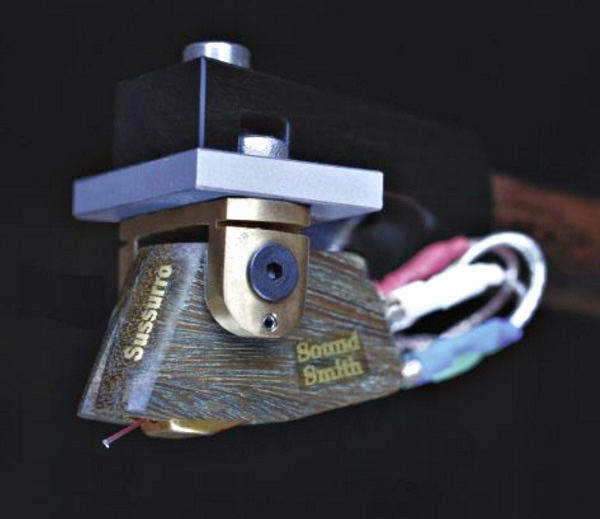 Soundsmith Sussurro low-output moving-iron cartridge
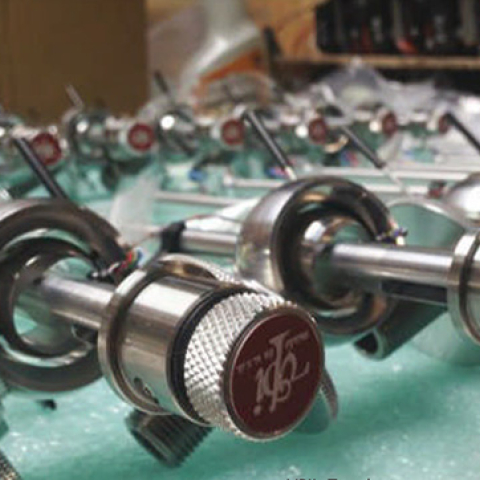
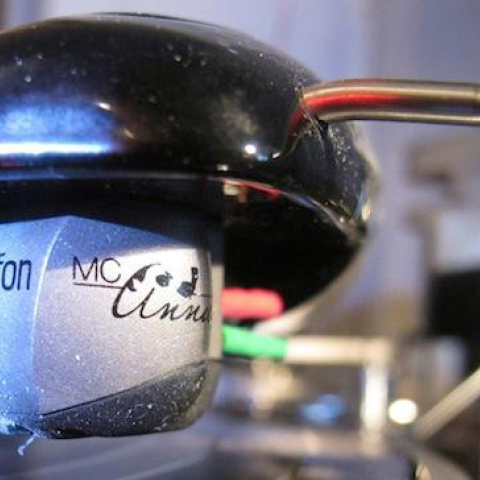
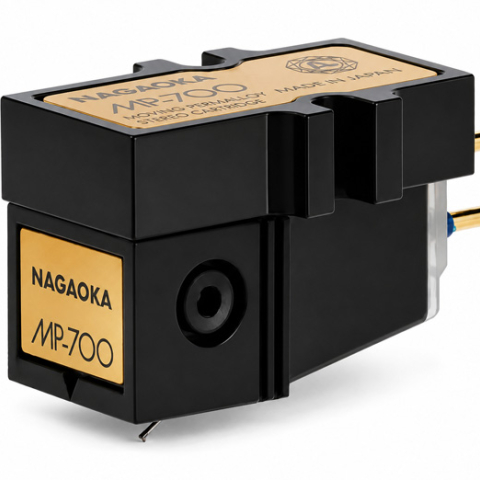
The inspiration for the Soundsmith Sussurro ($4499; footnote 2) grew from a discussion Peter Ledermann had a few years ago at a hi-fi show, with tonearm designer Frank Schröder. The result is a moving-iron design (footnote 3) of unusually low output (0.3mV) and very low effective moving mass. The low effective mass means that the cartridge's damping system can also be lower in mass, because it has less mass to support and control. The result should be more retrieval and resolution of microdetail, which is the main reason moving-coil cartridges have supplanted moving-magnet designs: Coils have lower mass than magnets. Ledermann says that each Sussurro is "critically tuned" to control all primary resonances. The generator system is then rigidly fixed within the magnetic structure, which is fully (six-sided) shielded. An unspecified system claimed to be "unique" then transfers the mechanical energy from the cantilever, through the cartridge's body, to the tonearm. The wooden-bodied Sussurro has a ruby cantilever to which is affixed a line-contact diamond stylus with an "optimized contour." The compliance is low, at 10µm/mN, and the recommended tracking force is a moderate 1.8–2.2gm. The entire cartridge has a mass of 8.79gm, and except for some parts sourced from overseas, it's made in America by Peter Ledermann himself.
 If you can afford an SME V, you can probably also afford a top-of-the-line cartridge built and tested to produce the correct results with the cantilever sitting perpendicular to the record surface. That's why I tell my seminar attendees that, even if they can't adjust azimuth, it's worth measuring crosstalk with a voltmeter (as described in my DVD 21st Century Vinyl). If you've spent thousands on the cartridge and the reading you get is very asymmetrical, you're entitled to a better-built sample, in my opinion.
The Sussurro lets you adjust azimuth, vertical tracking angle (VTA), and stylus rake angle (SRA), all from the cartridge body. This means that you can optimize its performance for any tonearm, even one that doesn't provide a way of adjusting these parameters. However, the Sussurro's instructions caution that only if your tonearm lacks such adjustability, should you use the cartridge's built-in azimuth and VTA/SRA adjustments. The adjustments involve loosening an Allen screw and some tiny setscrews. There's no need to get into the specifics here, other than to say that because the adjustment screws are made to be difficult to turn, it's best to remove the cartridge from the tonearm for the final tightening.
Be prepared to go through the setup routine at least twice. But even if it's a pain to use these adjustments, it's better than not having them, as long as there's no price paid in terms of structural rigidity. The Sussurro's design seems to meet that criterion.
If you can afford an SME V, you can probably also afford a top-of-the-line cartridge built and tested to produce the correct results with the cantilever sitting perpendicular to the record surface. That's why I tell my seminar attendees that, even if they can't adjust azimuth, it's worth measuring crosstalk with a voltmeter (as described in my DVD 21st Century Vinyl). If you've spent thousands on the cartridge and the reading you get is very asymmetrical, you're entitled to a better-built sample, in my opinion.
The Sussurro lets you adjust azimuth, vertical tracking angle (VTA), and stylus rake angle (SRA), all from the cartridge body. This means that you can optimize its performance for any tonearm, even one that doesn't provide a way of adjusting these parameters. However, the Sussurro's instructions caution that only if your tonearm lacks such adjustability, should you use the cartridge's built-in azimuth and VTA/SRA adjustments. The adjustments involve loosening an Allen screw and some tiny setscrews. There's no need to get into the specifics here, other than to say that because the adjustment screws are made to be difficult to turn, it's best to remove the cartridge from the tonearm for the final tightening.
Be prepared to go through the setup routine at least twice. But even if it's a pain to use these adjustments, it's better than not having them, as long as there's no price paid in terms of structural rigidity. The Sussurro's design seems to meet that criterion.
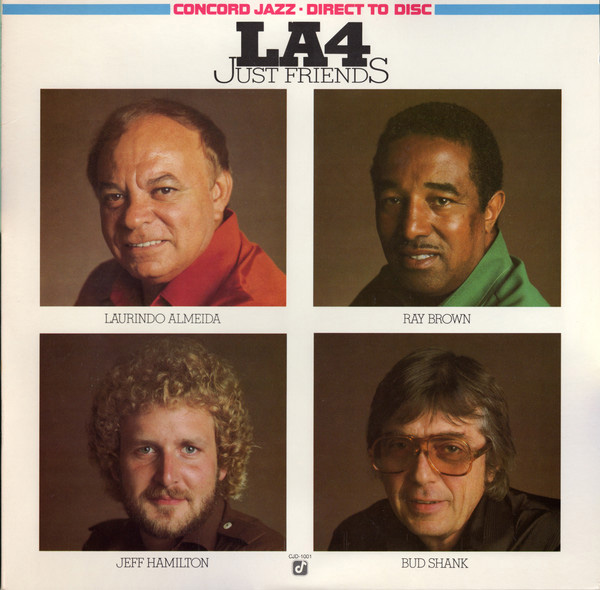 For instance, a few months ago I picked up, at the WFMU record convention, a copy of Just Friends, a fantastic direct-to-disc album by the L.A. 4: guitarist Laurindo Almeida, bassist Ray Brown, alto saxophonist Bud Shank, and drummer Jeff Hamilton (LP, Concord Jazz CJD-1001). Groove Note issued it from the backup tape a few years ago, but even at 45rpm it doesn't compare to the D2D. Through the Ortofon, the D2D was somewhat noisy, objectionably so at times—but almost miraculously, it sounded almost dead quiet through the Sussurro.
The Sussurro's balance of transients and texture was on the slightly lush, rich, soft side. Its harmonic palette was colorful and well saturated without being overripe, while its tonal balance was almost whatever I wanted it to be, depending on how carefully I trimmed its loading—as I could using the MCP2's variable loading control. I preferred to set this to 500 ohms; at 1 or 1.5k ohms, the Sussurru sounded too bright for my system and/or taste. Evidently the cartridge's top end was well extended and could be pulled down a bit—but if you like peaky and think that's "air," go for 47k ohms.
For instance, a few months ago I picked up, at the WFMU record convention, a copy of Just Friends, a fantastic direct-to-disc album by the L.A. 4: guitarist Laurindo Almeida, bassist Ray Brown, alto saxophonist Bud Shank, and drummer Jeff Hamilton (LP, Concord Jazz CJD-1001). Groove Note issued it from the backup tape a few years ago, but even at 45rpm it doesn't compare to the D2D. Through the Ortofon, the D2D was somewhat noisy, objectionably so at times—but almost miraculously, it sounded almost dead quiet through the Sussurro.
The Sussurro's balance of transients and texture was on the slightly lush, rich, soft side. Its harmonic palette was colorful and well saturated without being overripe, while its tonal balance was almost whatever I wanted it to be, depending on how carefully I trimmed its loading—as I could using the MCP2's variable loading control. I preferred to set this to 500 ohms; at 1 or 1.5k ohms, the Sussurru sounded too bright for my system and/or taste. Evidently the cartridge's top end was well extended and could be pulled down a bit—but if you like peaky and think that's "air," go for 47k ohms.
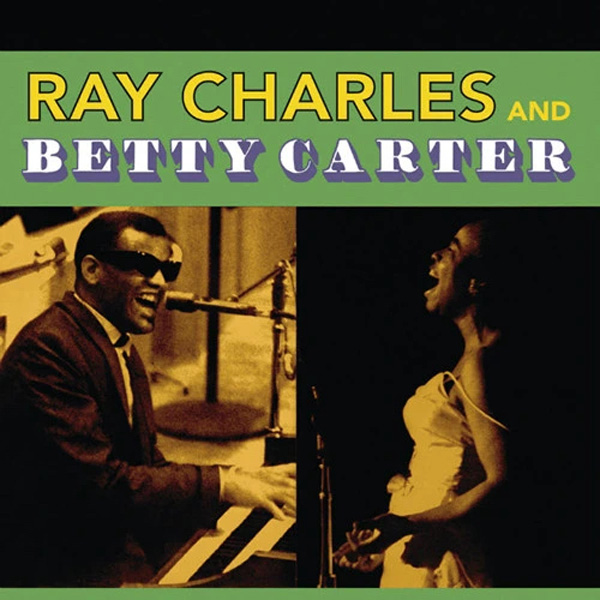 Where the Sussurro really excelled, and what made it so seductive, was in its fully fleshed out, opulent, but not overripe midrange. It had me just about sinking into a recent and stupendous-sounding reissue of Ray Charles and Betty Carter (ABC Paramount/Analogue Productions APP-385). The two voices sounded so fleshy and alive! You just have to learn to ignore the Jack Halloran Singers, who pop in to obtrusively—almost mockingly—repeat lines the duo have just finished singing. (Maybe they were there to reassure white folks in 1961, when this was first issued.) The downside of such midband richness was that it produced somewhat large and forward images that had a great deal of energy—where the human voice is. This will work better in some systems than in others, though the especially wide soundstages worked as an effective counterbalance.
 Unless you really like lushness, I recommend pairing the Sussurro with a somewhat lean solid-state rather than a tubed phono preamp. I'd be more inclined to recommend the Sussurro without reservation to lovers of jazz and classical music than to rockers, though its overall sound was far more all-purpose, and its tonal balance more neutral, than those of some other cartridges I could mention.
Even into Soundsmith's own MCP2, the Sussurro demonstrated that the transducer is the key. Carefully setting the loading eliminated a tendency toward brightness and a bit of hardness, though the imaging was less than precise, with a slight hollowness and metallic/electronic overlay to the overall sound when compared to a ridiculously expensive Ypsilon phono preamp. But if I had $5000 and change to play with, I'd spend $4499 of it on the Sussurro and $699.95 on the MCP2, rather than split the money evenly between a cartridge and a phono preamp, or put more into the electronics.
Unless you really like lushness, I recommend pairing the Sussurro with a somewhat lean solid-state rather than a tubed phono preamp. I'd be more inclined to recommend the Sussurro without reservation to lovers of jazz and classical music than to rockers, though its overall sound was far more all-purpose, and its tonal balance more neutral, than those of some other cartridges I could mention.
Even into Soundsmith's own MCP2, the Sussurro demonstrated that the transducer is the key. Carefully setting the loading eliminated a tendency toward brightness and a bit of hardness, though the imaging was less than precise, with a slight hollowness and metallic/electronic overlay to the overall sound when compared to a ridiculously expensive Ypsilon phono preamp. But if I had $5000 and change to play with, I'd spend $4499 of it on the Sussurro and $699.95 on the MCP2, rather than split the money evenly between a cartridge and a phono preamp, or put more into the electronics.
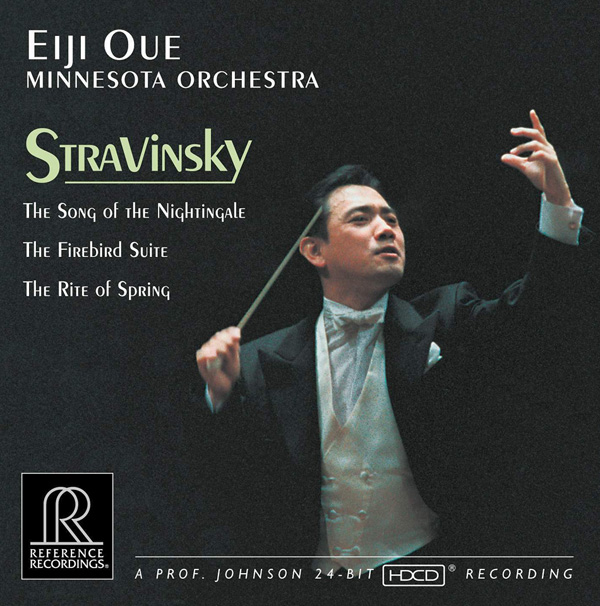
Sidebar: In Heavy Rotation 1) The Beach Boys, SMiLE, Capitol 180gm LPs (2) 2) Wayne Shorter, The Soothsayer, Blue Note/Music Matters 45rpm 180gm LPs (2) 3) Tony Joe White, Homemade Ice Cream, Warner Bros./Analogue Productions 180gm LP 4) Pink Floyd, Wish You Were Here, Harvest 180gm LP 5) Stravinsky, The Firebird Suite, The Song of the Nightingale (Eiji Oue, Minnesota Orchestra), Reference 180gm LP 6) The Black Keys, El Camino, Nonesuch 180gm LP 7) Brahms, Piano Concerto 1 (Clifford Curzon, George Szell, London Symphony Orchestra), London/Decca/ORG 45rpm 180gm LPs (2)
Footnote 1: Robyatt Audio. Web: www.robyattaudio.com. Footnote 2: Soundsmith, 2A John Walsh Boulevard, Site 1 Bldg., Peekskill, NY 10566. Tel: (914) 739-2885. Web: www.sound-smith.com Footnote 3: See my review of the Soundsmith SMMC1 phono cartridge in April 2008 for an explanation of what differentiates moving-iron cartridges from the more common moving-magnet and moving-coil designs.