
My wife and I are both very specific about how we take our coffee, to the amusement of everyone around us. She likes her coffee so black and violently strong that it has its own event horizon, while I swoon over ultralight roasts with fermented, fruity, and flowery notes. My wife makes her weapons-grade coffee in a moka pot that looks like a World War II hand grenade, while hipster dork me fights a losing battle against the urge to buy an umpteenth variation on expensive Japanese paper filters.
This descent into coffee-gear nerdery began a decade or so ago when I bought a gooseneck kettle. A gooseneck spout creates a more restrained flow for better control over water dosing and coffee-bed agitation. When, earlier this summer, its heating element began misbehaving, I replaced it with a different design that supposedly allows even more control over water flow. The reviews were right: I can effortlessly and with great precision pour at anything from 25gm/s to 1gm/s—and to my astonishment this does, somehow, allow me to achieve more consistent and better-tasting coffee. But $160 is a lot of money to set the temperature and pour some water.
You could argue that marginal differences in flow rate and coffee-bed agitation and turbulence shouldn't make a meaningful difference, as long as the temperature is right. To a bystander—and to my wife—that would be reasonable, but you'd be throwing hypotheticals at experience. Which brings us to preamplifiers.
Rogier van Bakel seemed to share my skepticism going into his review of the PS Audio PMG Signature preamplifier earlier this year. But assisted by PS Audio's Paul McGowan, he made a great technical case for why and how adding a preamplifier might be not just neutral but an actual improvement. I won't repeat it all here, but a common argument for preamps is that they can supply a low and unwavering output impedance. Otherwise, frequency response and distortion can vary.
For the past year I've delegated preamp duties to my Grimm MU2, which in John Atkinson's measurements showed an XLR output impedance of 94 ohms across the audioband.
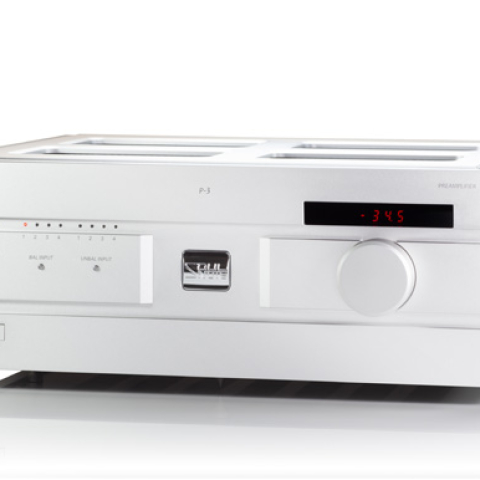
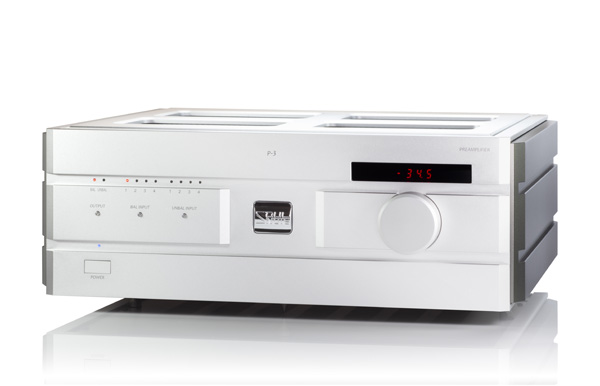
By almost any standard, that's as low as it needs to be, yet the Soulnote P-3—the component under review—has a specified output impedance of about one-fourteenth that, at 6.8 ohms; we'll see what the measurements say. It is also overbuilt to an almost comical degree, weighing 55 lb compared to the petite MU2's 10 lb—and the MU2 has a lot of other stuff inside the box. Sheer mass, surely, is not a reliable indicator of performance, but it can be a proxy for other things that are. The P-3 has dual monophonic construction, with two identical sets of I/O terminals, circuit boards, power supply circuits, power transformers, relay-drive circuits, and relay power supplies.
It also costs more, at $26,400. And it's a purist component. That price buys you just a line stage: no phono stage, no D/A processor, streaming or otherwise, no headphone amplifier, and no tone controls. That's a lot of money to select inputs and change the volume.
 The sum of its parts
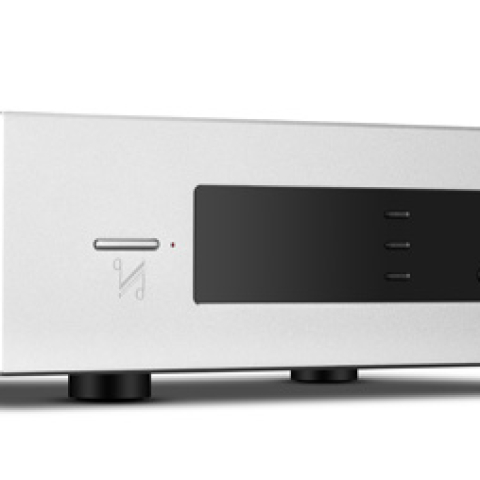
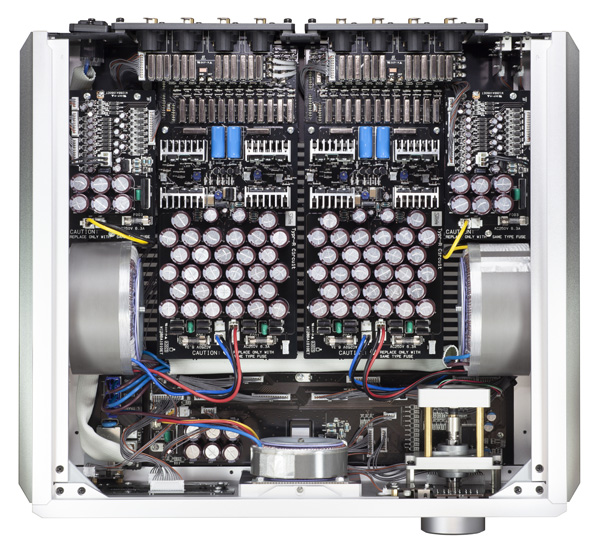
The P-3 is as physically imposing as many power amplifiers. It even electrically outspecifies many of them. Each channel has a 280VA toroidal transformer, and the control circuitry gets its own, separate transformer. That makes it more powerful than Soulnote's own A-2 integrated amplifier. That might seem excessive in a preamp, but Soulnote evidently believes it provides sonic advantages. The massive transformers aren't potted—not encased in epoxy resin. That yields better thermal dissipation and makes mechanical decoupling from the chassis slightly easier. The extra rigidity of a potted transformer means it can vibrate more forcefully—and as discussed in my Soulnote A-3 Core review in the October issue, Soulnote obsesses over vibration control.
For switching, the P-3 uses a proprietary component Soulnote calls the RSR-2-12D, described as an "ultra-low loss glass tube sealed reed relay." Relays provide galvanic isolation in the sense that the control signal that switches them on and off never touches the signal the relay transmits. Apparently nothing else on the market was good enough for Soulnote Chief Sound Manager Hideki Kato, so he made it himself.
The P-3's design uses custom naked foil resistors, which are made by bonding a thin metal film directly to a ceramic substrate and etching a pattern into the foil to achieve the desired resistance. As the name implies, the foil isn't given any sort of coating, which, if present, would reduce and delay heat dissipation. Since heat affects performance, in an ideal implementation, the thermal expansion of the substrate mechanically counteracts the thermal resistance changes of the foil, making its resistance stable across transients in a way regular resistors can't achieve. The dizzying rabbit hole that is naked foil resistor design goes deeper than this, but the point is simple enough: Soulnote not only uses them but has designed its own.
Each P-3 uses 94 RSR-2-12D relays and 156 naked foil resistors. Looking up the prices for high-end versions of these component types starts to make the price of this preamplifier justifiable—even before you hear it.
 Input, output, stay put
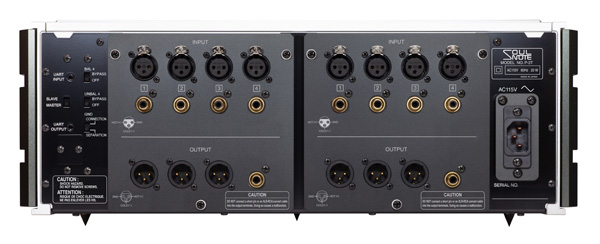
The P-3 shares several idiosyncratic design choices with the A-3 Core—choices that, if you didn't hear the explanation, you might assume are superstitious. The top cover rests loosely on three spikes and rings conspicuously when wobbled. Its AC inlet is loose and wiggles when touched. However, on the P-3—in contrast to the A-3 Core—the dual input/output boards aren't loose. The P-3 offers eight inputs, four each on balanced XLR and single-ended RCA. Each input has an optional source bypass setting that fixes output to a zero-gain setting, a feature typically used in home-theater setups. There are three XLR outputs, for triamping, or for biamping plus a headphone amp, or what have you. The single RCA output can't be run in parallel with the XLRs. The P-3 sits atop a custom wood plinth on three sliding footers or spikes—your choice. Soulnote says both footer and plinth-material choice affect the sound. I think I heard the effects their website describes, but it was so subtle I won't grant it more space on the page than this.
As in the A-3 Core, there is no overall negative feedback, and grounding is taken extremely seriously. The two channels and the control system—volume and input selection—have ceramically insulated chassis and use optocouplers to completely separate the left and right channels and control ground. To avoid the detrimental effects of ground loops and noise propagation when connecting multiple sound sources, the P-3 switches unselected devices to a state where their connectors are completely unplugged. A switch on the rear lets you turn on a more conventional grounding scheme if a hum problem occurs, but that was never necessary in my system. Here, the P-3 was dead quiet.
 Interface
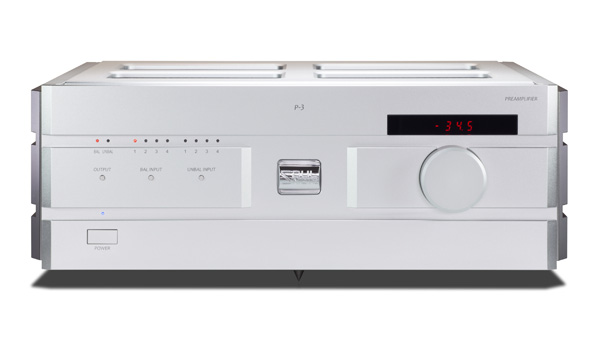
The user-friendliness of a preamplifier's interfaces is crucially important in daily use. The P-3's front has only four buttons: a power button, a toggle between balanced and unbalanced outputs, and one button each to cycle through balanced and unbalanced inputs. Input cycling via the remote goes through all eight, so it's unclear why the front panel needs two buttons for the same task. The volume is adjustable in half-dB steps and is shown numerically on an easy-to-read red segment display. Such old-school displays are more reliable and less likely to emit RFI than fancier technologies; that judgment comes from me and not Soulnote. You can turn the display off, leaving only the blue power LED. If you opt to do so, the volume readout lights up for a couple of seconds when you change volume with the remote or the very pleasant-feeling knob. The latter uses an optocoupler to set the volume via those RSR-2-12D relays. The volume is remembered even when the unit is powered off, but it is—sensibly—limited so that it never initiates above –20dB when switched on.
The old-school display means that some P-3 features are instead communicated via the color of various LEDs: Invert the phase, and a yellow light shows. The P-3 remembers your choices even when it's been turned off.
When the P-3 launched, it had a different remote than the one it ships with now. The new one is long and slender, and like the old one, it's designed for far more features than the P-3 has. For a full Soulnote system that involves a CD player, this remote makes sense, but at this price I will argue that the remote control provided should not have 25 unnecessary buttons. That said, the input selection and volume up and down buttons are easy enough to find by touch alone. All in all, I found the P-3's remote—indeed the P-3 itself—frustration-free.
 Listening
I received the P-3 alongside the A-3 Core stereo power amplifier, but I didn't want to change two things at once, so the preamp was sidelined for weeks as I evaluated the A-3. The amplifier was so impressive on its own that I felt no rush to add the P-3. I eventually did—but first I played Eivind Aarset's kaleidoscopic rock-prog-psych-jazz-ambient Strange Hands (24/96 FLAC, Jazzland Recordings/Tidal). Then, after putting the P-3 into the system, I played the whole album again. The most noticeable change was in the precision, depth, and textural refinement of the bass. That reinforced foundation in turn gave upper frequencies a greater sense of physicality, turning the sonic picture from aquarelle toward impasto. I was so captivated I played the album a third time in a row.
Beyond the bass, and particularly when partnered with the A-3 Core, the P-3 filled out sonic crevices only perceived by their absence. This fairing of the sonic hull provided a sense of ease, a naturalness, a rightness that exceeded what the system achieved without it. With the other power amplifiers I had available—the AGD Forte, AGD The Audion MkIII, and Mola Mola Ossetra (footnote 1)—I heard much the same improvements, but they were less marked. I suppose a downstream power amp can impede some of the sonic qualities of a preamp, whereas a power amplifier is in itself the final stretch of signal path before the speakers. There is also the question of synergy.
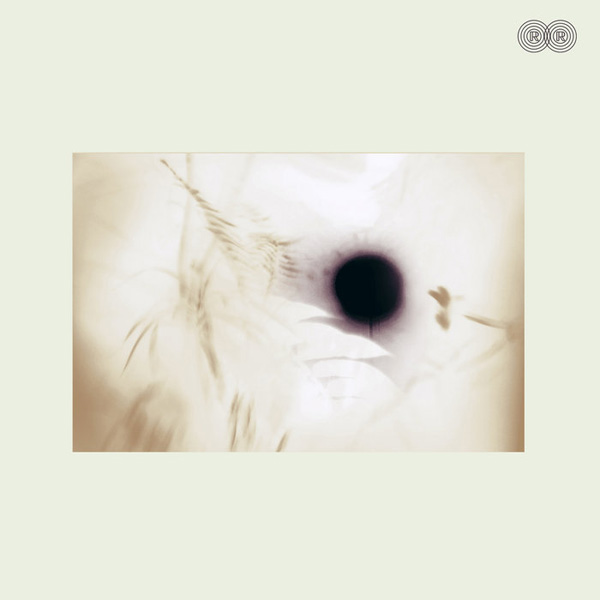
Svarte Greiner, Norwegian for "black branches," is the often somber solo project of Erik K. Skodvin, who is also half of personal favorite Deaf Center. "Syringa," the opening track on Five Hundred Fink Experience (24/44.1 FLAC, Rrose Sélavy/Tidal), combines a high-pitched droning sound with an astonishing treble shimmer, like time-stretched cicadas. I find it intoxicating. With the P-3 this sound billowed out to vaster proportions, engulfing me more fully than I've heard it do before. When something sounds strikingly open and clear, it's customarily due to a heightened upper midrange or treble. But at no point did the P-3 feel spectrally tilted in the slightest, even with harsh metal or noisy electronica. This preamplifier's sense of unveiled presence is of a fundamentally different kind.
 In common with the A-3 Core, the P-3 benefited from being powered on for a long time. What it brought to the Svarte Greiner track was less evident in the morning than in the afternoon. I left it turned on for most of the review period.
I lack the imagination and experience to say with any certainty what the P-3 does not do. Could bass, dynamics, fluidity, or any other parameter of your choosing be improved further? Hypothetically, perhaps. What I know is that I had to force myself to even think about such things, because its conveyance of musical rightness, sincerity, and authenticity sounded so complete. Soulnote says the P-3's elaborate grounding scheme offers "an incredible expansive three-dimensional soundfield with expressive, natural sound." On its own, that sounds like advertising hyperbole, but it takes only a few minutes of listening to realize that it is undeniable truth.
Through a different lens
After having the P-3 in the system for a couple of weeks, going back to the MU2 feeding the A-3 Core was, metaphorically, like going from a photo with infinite depth of field to a tilt-shift lens. Everything was still there, but it was somewhat miniaturized, intimate, petite, and at times adorable. It was a fundamentally pleasant and appealing perspective, and much as with a tilt-shift lens, the sense of space and depth was intensely present. The P-3 added vastness to the sonic vista, lifelike scale, grandeur. It grabbed my brain like a vise and made it impossible for my attention to slither away. Everything was in focus, at the expense of no other part of the experience. In one session, just before I reluctantly returned the A-3 Core, I played varying combinations of the Grimm MU2 feeding the A-3 Core, the Mola Mola Ossetra monoblocks, or the AGD Forte, with close attention to level matching. When getting up every two minutes to switch cables and play the same track over, it is natural to start listening for differences rather than listening with your heart, which is why I often distrust the conclusions drawn from rapid switching. Yet these exercises are not without merit: After maybe half an hour of hopping between power amps, I plugged the P-3 back in and my body surprised me with a hearty chuckle that tackled my brain out of analytical mode. It sounded so right, so lush, so inviting.
When someone talks in your direction but not directly and intentionally to you, you can sense their intent—that what they say is not meant for you. That makes it easier not to listen, or not to listen closely. The P-3 speaks directly to you.
 Balanced or not
Balanced differential signals can cancel unwanted distortion, but that also means they might cancel wanted distortion, distortion perceived as harmonic richness. To see if the loveliness of the P-3's sound would be enhanced further in single-ended mode, I employed my Grimm MU2, which has both XLR and RCA outputs. Supposedly the MU2 performs best when only one output is connected, so I played it safe and removed the unused cable from the MU2 each time I switched. This made the comparison less instant and more laborious, but it seemed the more scientifically rigorous approach. To my relief, both input types on the P-3 yielded exactly the same volume, so level matching was taken care of. My distaste for the chore of quick-switching A/B comparison was at least temporarily derailed by an interesting phenomenon: Every single time I switched, it sounded better. Or I thought it did. I thought that surely this phenomenon had to stop at some point, but it continued. "Oh yes!" I wanted to blurt out the fifth and sixth and seventh time I restarted John Surman's "On Staddon Heights" from Saltash Bells (24/96 FLAC, ECM Records/Qobuz).
This tells me several things: First, that the P-3 sounds addictively and bewitchingly good. Second, that neither input format is at a disadvantage to the other, at least with my source and cables. Third, that A/B comparisons, despite their inherent dullness, can yield interesting results—just not (or not necessarily) the results their proponents claim.
My Manley Steelhead phono preamp has only unbalanced RCA outputs, and while it has a volume control, I normally handle that through the MU2. On raison d'être & Troum's XIBIPIIO. In and Out of Experience (LP, Cyclic Law 49thCycleLP), the droning vespertine murk was rendered subtly but meaningfully more palpable and intentful with the P-3, as if the sound was at once more focused and vast, attributes that ought to be at odds but were married in this preamplifier. This sense of infinite focus stayed consistent across other LPs, ranging from scraggly indie pop to jazz and techno.
 An ambient album in heavy rotation this year is Alio Die & Lingua Fungi's Lento (16/44.1 FLAC, Hic Sunt Leones/Tidal). It meanders through sonic garden paths devoid of narrative tension or release, instead rewarding listeners with deliciously intimate sonic scents and colors. That I hadn't yet found a place for this album in other reviews is perhaps for the best, because the P-3's conveying of space and flow rendered this more evocatively than any other signal path I've tried. At times this is barely music at all, which highlights a core ability of the P-3: All signals that travel through it, music or whatever else, are infused with animistic meaning. Soulnote, indeed.
To see if I could poke any sort of hole in this characteristic, I pulled up an old favorite playlist I've called "current drift," which is made up of ambient-esque music with electronic-sounding textures. Could tracks that are deliberately electrical—even sterile-sounding—be granted life, too?
The short answer is yes, but what struck me the most was something else. The P-3's voluminousness was not applied to everything equally. The P-3 vividly rendered space in recordings, but it did not artificially inflate recordings that are inherently flat. Consequently, this playlist sounded more scattered and disjointed than
I'd heard it before. Tracks with less spatial information were not presented in an unflattering or unpleasant way, but their technical shortcomings were laid bare by the track-to-track contrasts.
Conclusion
Part of me remains uncomfortable with the fact that adding another device in the signal chain yields particular kinds of improvements. If a superfluous signal detour adds some color or flavor, I can understand that. But what I felt the P-3 added was a sense of authenticity. Maybe it doesn't add anything but instead removes something I couldn't detect that had veiled and suppressed certain qualities. That explanation better fits the evidence. Even so, I find it baffling how it boosts corporeality, timbral verisimilitude, temporal liquidity, and vastness. Beyond all that, it also glues everything together into a unified whole. It is best with its partner the A-3 Core, but with every amplifier I had on hand, the improvements it wrought were not offset by a single downside. These improvements are readily detectable and unequivocally desirable, but they are modest. Those who can't look unflinchingly at the price tag might rightfully wonder if spending this kind of money on nuance can ever be reasonable. Salt is a tiny ingredient in practically any recipe, but its omission can ruin most of them. Even minute improvements to one's daily indulgences, be they coffee or music, are difficult to let go of once you've tasted them.
Footnote 1: It is coincidental that all these alternatives are class-D. They're what I happened to have on hand at the time.
The sum of its partsThe P-3 is as physically imposing as many power amplifiers. It even electrically outspecifies many of them. Each channel has a 280VA toroidal transformer, and the control circuitry gets its own, separate transformer. That makes it more powerful than Soulnote's own A-2 integrated amplifier. That might seem excessive in a preamp, but Soulnote evidently believes it provides sonic advantages. The massive transformers aren't potted—not encased in epoxy resin. That yields better thermal dissipation and makes mechanical decoupling from the chassis slightly easier. The extra rigidity of a potted transformer means it can vibrate more forcefully—and as discussed in my Soulnote A-3 Core review in the October issue, Soulnote obsesses over vibration control.
Input, output, stay putThe P-3 shares several idiosyncratic design choices with the A-3 Core—choices that, if you didn't hear the explanation, you might assume are superstitious. The top cover rests loosely on three spikes and rings conspicuously when wobbled. Its AC inlet is loose and wiggles when touched. However, on the P-3—in contrast to the A-3 Core—the dual input/output boards aren't loose. The P-3 offers eight inputs, four each on balanced XLR and single-ended RCA. Each input has an optional source bypass setting that fixes output to a zero-gain setting, a feature typically used in home-theater setups. There are three XLR outputs, for triamping, or for biamping plus a headphone amp, or what have you. The single RCA output can't be run in parallel with the XLRs. The P-3 sits atop a custom wood plinth on three sliding footers or spikes—your choice. Soulnote says both footer and plinth-material choice affect the sound. I think I heard the effects their website describes, but it was so subtle I won't grant it more space on the page than this.
InterfaceThe user-friendliness of a preamplifier's interfaces is crucially important in daily use. The P-3's front has only four buttons: a power button, a toggle between balanced and unbalanced outputs, and one button each to cycle through balanced and unbalanced inputs. Input cycling via the remote goes through all eight, so it's unclear why the front panel needs two buttons for the same task. The volume is adjustable in half-dB steps and is shown numerically on an easy-to-read red segment display. Such old-school displays are more reliable and less likely to emit RFI than fancier technologies; that judgment comes from me and not Soulnote. You can turn the display off, leaving only the blue power LED. If you opt to do so, the volume readout lights up for a couple of seconds when you change volume with the remote or the very pleasant-feeling knob. The latter uses an optocoupler to set the volume via those RSR-2-12D relays. The volume is remembered even when the unit is powered off, but it is—sensibly—limited so that it never initiates above –20dB when switched on.
ListeningI received the P-3 alongside the A-3 Core stereo power amplifier, but I didn't want to change two things at once, so the preamp was sidelined for weeks as I evaluated the A-3. The amplifier was so impressive on its own that I felt no rush to add the P-3. I eventually did—but first I played Eivind Aarset's kaleidoscopic rock-prog-psych-jazz-ambient Strange Hands (24/96 FLAC, Jazzland Recordings/Tidal). Then, after putting the P-3 into the system, I played the whole album again. The most noticeable change was in the precision, depth, and textural refinement of the bass. That reinforced foundation in turn gave upper frequencies a greater sense of physicality, turning the sonic picture from aquarelle toward impasto. I was so captivated I played the album a third time in a row.
In common with the A-3 Core, the P-3 benefited from being powered on for a long time. What it brought to the Svarte Greiner track was less evident in the morning than in the afternoon. I left it turned on for most of the review period.
After having the P-3 in the system for a couple of weeks, going back to the MU2 feeding the A-3 Core was, metaphorically, like going from a photo with infinite depth of field to a tilt-shift lens. Everything was still there, but it was somewhat miniaturized, intimate, petite, and at times adorable. It was a fundamentally pleasant and appealing perspective, and much as with a tilt-shift lens, the sense of space and depth was intensely present. The P-3 added vastness to the sonic vista, lifelike scale, grandeur. It grabbed my brain like a vise and made it impossible for my attention to slither away. Everything was in focus, at the expense of no other part of the experience. In one session, just before I reluctantly returned the A-3 Core, I played varying combinations of the Grimm MU2 feeding the A-3 Core, the Mola Mola Ossetra monoblocks, or the AGD Forte, with close attention to level matching. When getting up every two minutes to switch cables and play the same track over, it is natural to start listening for differences rather than listening with your heart, which is why I often distrust the conclusions drawn from rapid switching. Yet these exercises are not without merit: After maybe half an hour of hopping between power amps, I plugged the P-3 back in and my body surprised me with a hearty chuckle that tackled my brain out of analytical mode. It sounded so right, so lush, so inviting.
Balanced or notBalanced differential signals can cancel unwanted distortion, but that also means they might cancel wanted distortion, distortion perceived as harmonic richness. To see if the loveliness of the P-3's sound would be enhanced further in single-ended mode, I employed my Grimm MU2, which has both XLR and RCA outputs. Supposedly the MU2 performs best when only one output is connected, so I played it safe and removed the unused cable from the MU2 each time I switched. This made the comparison less instant and more laborious, but it seemed the more scientifically rigorous approach. To my relief, both input types on the P-3 yielded exactly the same volume, so level matching was taken care of. My distaste for the chore of quick-switching A/B comparison was at least temporarily derailed by an interesting phenomenon: Every single time I switched, it sounded better. Or I thought it did. I thought that surely this phenomenon had to stop at some point, but it continued. "Oh yes!" I wanted to blurt out the fifth and sixth and seventh time I restarted John Surman's "On Staddon Heights" from Saltash Bells (24/96 FLAC, ECM Records/Qobuz).
An ambient album in heavy rotation this year is Alio Die & Lingua Fungi's Lento (16/44.1 FLAC, Hic Sunt Leones/Tidal). It meanders through sonic garden paths devoid of narrative tension or release, instead rewarding listeners with deliciously intimate sonic scents and colors. That I hadn't yet found a place for this album in other reviews is perhaps for the best, because the P-3's conveying of space and flow rendered this more evocatively than any other signal path I've tried. At times this is barely music at all, which highlights a core ability of the P-3: All signals that travel through it, music or whatever else, are infused with animistic meaning. Soulnote, indeed.
Part of me remains uncomfortable with the fact that adding another device in the signal chain yields particular kinds of improvements. If a superfluous signal detour adds some color or flavor, I can understand that. But what I felt the P-3 added was a sense of authenticity. Maybe it doesn't add anything but instead removes something I couldn't detect that had veiled and suppressed certain qualities. That explanation better fits the evidence. Even so, I find it baffling how it boosts corporeality, timbral verisimilitude, temporal liquidity, and vastness. Beyond all that, it also glues everything together into a unified whole. It is best with its partner the A-3 Core, but with every amplifier I had on hand, the improvements it wrought were not offset by a single downside. These improvements are readily detectable and unequivocally desirable, but they are modest. Those who can't look unflinchingly at the price tag might rightfully wonder if spending this kind of money on nuance can ever be reasonable. Salt is a tiny ingredient in practically any recipe, but its omission can ruin most of them. Even minute improvements to one's daily indulgences, be they coffee or music, are difficult to let go of once you've tasted them.
Footnote 1: It is coincidental that all these alternatives are class-D. They're what I happened to have on hand at the time.