"I'm a supervising social worker by day, helping individuals on parole get their mental health needs met," Weber explained via text message. "Concurrent to that, I have a private practice doing teletherapy, and I moonlight in a hospital emergency room."
Weber's Zen-master tranquility—perhaps learned at the feet of his mother, a molecular biologist and cancer cell researcher at USC, and father, an organic chemist at DARPA and NSF—is in curious opposition to the amplifiers and speakers bearing the Ampsandsound name. These brute-force–looking machines mirror Weber's muscled physique more than they do the aura he projects.
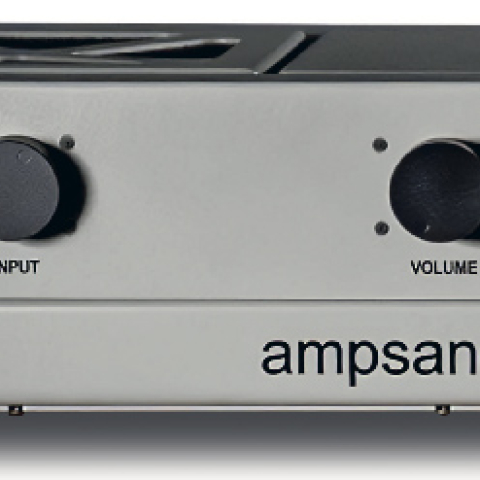
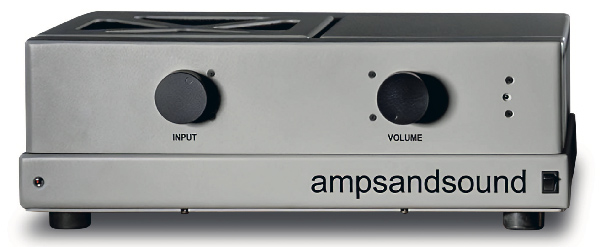
The Yellowstone preamplifier ($25,000) dominates the room it's in, defying you not to press the power switch. Military corners. Ten-gauge steel-plate construction. Minimalist, stripped-down fascia. Pick it up and your arms, assuming they're like my arms, will cry for relief. The Yellowstone preamplifier means business.
Building on Ampsandsound's Yosemite preamplifier, the Yellowstone design "verges on the excessive," the website states. "New in-house power transformers were designed from the ground up, using Tectronix Analog Oscilloscope transformers as a model." Those transformers are considered "among the most highly executed pieces of audio equipment ever made, and their transformers contribute in large part to their special characteristics," the website says.
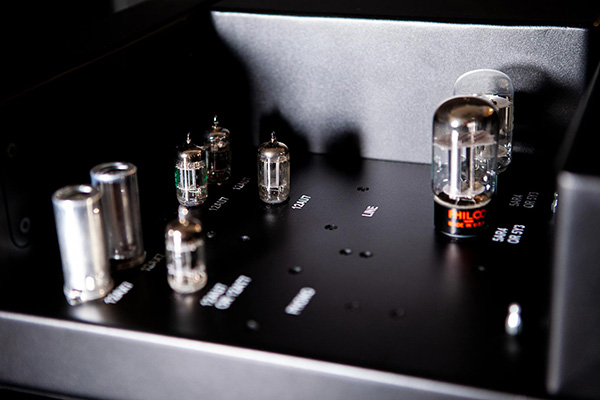
The 19½" wide, 7" high, and 15" deep Yellowstone is outfitted with "copper and beeswax capacitors throughout the entire unit. The results are a vanishingly quiet linestage and phono stage," it continues. The preamp also carries a bevy of NOS tubes, dictated by user choice. My review sample carried Sylvania/CBS/Baldwin 12AU7 and 12AX7 tubes in the line and phono stages and two Russian-made Tung-Sol 5AR4s as rectifiers.
The "nature of this pre was to give all the sonic dividends of the Marantz 7 but in a more robust/serviceable package. Though heavy, it's meant to be lab grade."
Weber has owned preamps from Harman/Kardon, Dynaco, RCA, and Heathkit, and all of them have influenced his builds. Yet the Marantz Model 7C holds a revered status.
"The two most widely sought-after preamps are the McIntosh C22 and the Marantz 7C," Weber wrote. "Both had schematics where the tone control compensation had been removed and/or power supply cleaned up, but the 7C is more widely favored. It was a question of market interest."
"The goal of the Yellowstone was to give a modern take on vintage American tube preamplifier circuits," Weber said. "I was trying to honor that circuit tone and character with a modern take on industrial design and ergonomics. I wanted to give all the sonic dividends of the Marantz 7C but in a more robust/serviceable package."
It isn't just the Marantz, though. Weber took cues from myriad 1940s and '50s industrial audio designs to create his modular machines.
"The 1940s and 50s designs were about tonal purity," he wrote. "There was less goosing of tone, a more even harmonic distribution versus the 1960s sound. For a preamplifier, trying not to overtly produce tone with the circuit seems right. Tube choices can be the spice of the client. I think so many of the very best ideas can be found in the RCA tube manual—the rest is implementation. Earlier designs are always our starting point, which is distilled and changed to suit our needs at the time."
Chassis control
As already stated, the Yellowstone weighs 60lb, but somehow it feels heavier. There's lots of iron inside—multiple transformers and heavy chokes—and a whole chassis made of 10-gauge steel, including its removable vented cover. It's a beast to move.
"This is a physically large chassis," Weber explained. "I wanted to feel there would never be any deflection, bending, or warping. I wanted the chassis to convey an industrial orientation of quiet strength. The weight and material strength reduced oscillation/ vibration and made for a quieter product."
Weber also employs turret-board construction, a build principle I hadn't encountered before, though it was standard practice among hi-fi brands of the '50s and '60s, including Fisher, Harman/Kardon Citation, HH Scott, Dynaco, EICO, and Marantz.
"Turret-board construction is about durability, serviceability, and tone flexibility," Weber explained. "The boards hold the components physically in place while you run the wires between to connect the circuit. It's more durable, it requires more preplanning, but it's super-flexible with optimizing grounds for the lowest noisefloor. It's too labor intensive to be done widely, but Air Tight also follows this practice. McIntosh from the '60s as well. I call it 'mission critical wiring.'"
"We chose turret-board construction because it's easier to repair and modify; you can swap parts without lifting traces or damaging a board," he continued. "It's excellent for long-term ownership. It's more robust under heat and vibration, which is especially relevant in tube amps where heat cycles matter. It enables custom layout control. The designers can physically separate components to reduce noise or tweak performance. And it offers a boutique, hand-built feel to the unit."
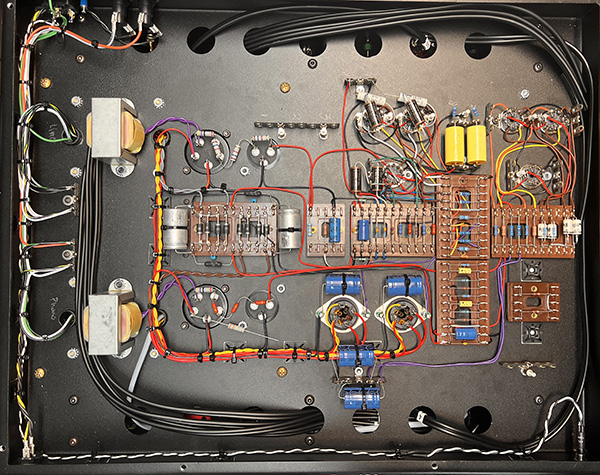
Weber makes a big deal out of the Yellowstone's internal layout, each circuit secluded in its own section.
"We separate all sections of the preamplifier," Weber said. "The analog components and wiring occur below the chassis; the transformers are above the chassis in their own shielded and insulated 10-gauge steel covers to reduce EMI/RFI bleedout. The inputs and outputs have their own shielded subassembly. The line and the phono are completely separate, having their own power transformer, choke, and power supplies. The input selector/volume control is in its own shielded subassembly. The I/O is separated; the digital controller for the ultrasophisticated 64-step volume control is separated; the three power supplies are separated. Each is built separately and then tied in."
Weber constructs the chassis as four bolted-together boxes, with the steel transformer covers creating a solid transition: Their installation turns the top of the primary chassis into the floor of the transformer enclosure above it. Below, the line stage and phono sections share the main chassis space, their wiring, capacitors, and resistors running together yet kept on separate circuits. The only thing threading through the whole assembly is the wiring itself.
"If you pulled the rectifier for the phono stage," Weber wrote, "the line stage would function independently—same for the phono stage. In short, each subassembly is in its own chassis/box, walled off with 10-gauge steel plate. It's overbuilt and seems silly, but brutalist and understandable."
Separate transformers for phono and line?
"We developed the line and phono circuits separately," Weber responded. "Combining them with the power supplies would be a step backward. We were trying to lower the noisefloor of each required power transformer; each had slightly different specs. It needed to be an all-out assault on the idea, with no compromises." Ampsandsound's modular construction is down to Weber's training: "I'm a therapist by training and a designer by choice and passion. By focusing on grouping tasks/choices for a specific module, we reduce complications. We try to not add features. Our clients reward us for restraint. Only as many features as needed to make it work right."
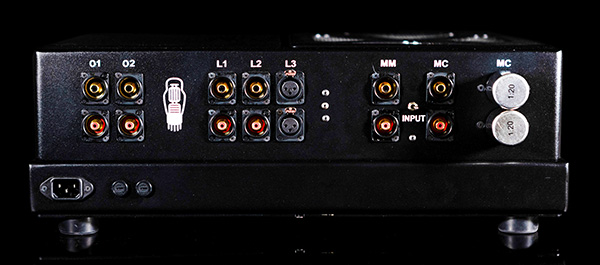
Further components in the Yellowstone's Brutalist build include OFC pure-copper wire taken from spare ends of the custom EI Transcendar transformer leads and enclosed in Teflon shielding. Cinemag XLR-to-RCA line transformers ("big, beefy monsters with huge core sizes," Weber says). Grayhill switches ("stupid expensive but worth every penny"). Neutrik panel-mount RCAs and XLRs. Heavy-duty McMaster-Carr feet ("I love the industrial vibe"), tube-rectified power supplies, and chokes and DC filaments for quiet operation. Oddly, the Yellowstone's knobs are from eBay.
"The 64-step attenuator volume control is by Khozmo," Weber boasted. "It's an insane relay latch control using an optical encoder with a microprocessor switching the relays in and out. It has its own dedicated linear power supply, separate from the preamp, and is shielded."
I found the Yellowstone's phono stage to be exceptional, easily on par with the internal phono stage of my reference Shindo Allegro preamplifier.
"We started with the Marantz 7C circuit but wanted it for MC carts only," Weber described. "It's always meant to be paired with a SUT and an MC cart. The phono, like all phono stages, is a compromise, with its passive RIAA. We modeled in SPICE and measured six different options for where we applied the feedback and how much gain in what stages. It's tricky to get it to sound right with so few tubes. It's a great compromise that leans toward simplicity and the absolute need for a SUT, but if you like SUTs, ours is killing. And our MM stage does not overdrive and distort, which is all too common."
Weber brings humanity to his Ampsandsound products as he does to his other work, imbuing each unit with the care and support he might bring to a patient. He also brings other things. "I grew up in my parents' research labs at USC," Weber recalled. "They had industrial equipment, nuclear magnetic resonance (NMR) instruments, centrifuges, autoclaves that never stopped. If malfunctioning, they were serviced on site. Similarly, Ampsandsound equipment is meant for long-term installation. We build our equipment with the goal that they can't break, can't come home, and they won't need to be serviced indefinitely."
Setup and listening
I managed to squeeze the Yellowstone into my Salamander rack—barely. I attached one of two custom Cinemag step-up transformers (SUTs) to its rear panel, adjacent to the MM/MC RCA inputs. Weber supplies two SUT ratios—1:9 and 1:18—and I opted for the 1:9, nearly matching the loading of the internal SUT of my reference Shindo Allegro preamp.
I used a pair of Triode Wire Labs Spirit interconnects to connect the Yellowstone to the Air Tight ATM-1 2024 Edition amplifier, followed by the Rogue Audio Stereo 100 amplifier.

Listening
Choosing records to appraise hi-fi gear is always a challenge. Wide dynamic range and natural production are my goalposts, but I'll gladly veer toward records I love and new ones itching for a spin. Contenders this time: the Krautrock collection Deutsche Elektronische Musik, Volume One (Soul Jazz SJR LP213), The Jazz Trio of Hank Jones (Savoy MG 12023), the fusion adventure of John Abercrombie, Dave Holland, and Jack DeJohnette on Gateway 2 (ECM 1105), bassist Richard Davis's Fancy Free (Galaxy GXY-5102), and Source Direct's "Stars" (Odysee Records ODYR006).
Recorded in the late 1970s, Richard Davis's Fancy Free fields a serious cast: drummer Billy Cobham, pianist Stanley Cowell, and tenor master Joe Henderson, among others. Session opener "The Wine of May" is a samba/funk-to-swing romp, Cobham charging through the performance like his pants and hands are on fire. Via the Yellowstone (and its internal phono stage) and the rest of this system, each instrumental sound arrived at my ears well defined, amply layered, and finely separated, with real speed and punch. It was immediately apparent that this preamp is among the most neutral and transparent amplification machines I've heard in-house. It adds just a touch of warmth, giving music a sweet liquidity and natural sonic flow I never grew tired of.
That sonic personality was subtle but real, yet the Yellowstone was transparent to records and associated components. Albums I'd long considered excellent, like Tower of Power's In the Slot, were exposed as notably thin despite that touch of warmth, while TOP's Urban Renewal held every bit of its sunny Californian glow and flow.
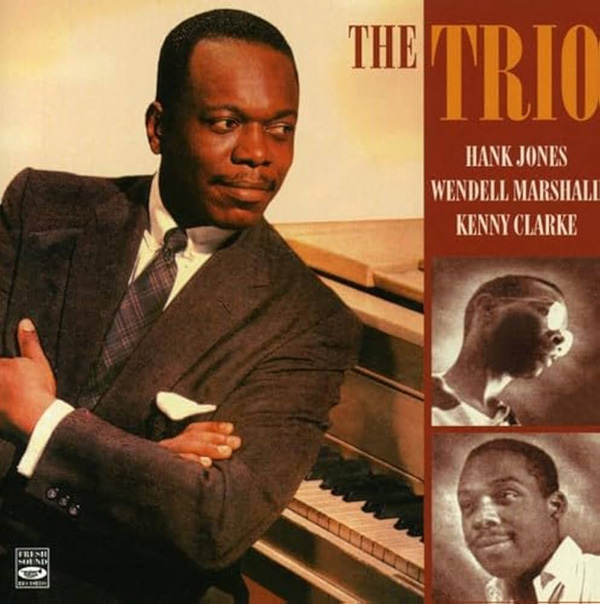
The Yellowstone delivered a physical, sprinter-grade power and purpose. The Jazz Trio of Hank Jones hit with authority, especially Kenny Clarke's single-stroke snare drum solo on "We're All Together." On that song, the Yellowstone (plus the rest of the system) threw a gladiator-scaled stage, and the performance landed at warp speed and without a cushion.
Ampsandsound's penthouse piece excelled at layering and definition, placing musicians naturally into studio space, even when no traditional studio existed at the recording's genesis. A remix of Source Direct's "Stars," assembled on early samplers and computers in the 1990s, proved the point. A wall of unidentifiable atmospheric elements built a soundfield of enormous scale, rich bass textures moving through the room like massive dollops of liquid chocolate, the classic "Amen Brother" drum loop arriving like Giger's Alien crushing astronauts between its metal teeth. Through the electronic rampage, the Yellowstone showed its hand: a confident, sure-footed master of soundstage logistics that finds its fullest expression, and this thing genuinely loves volume, in head-on physical impact.

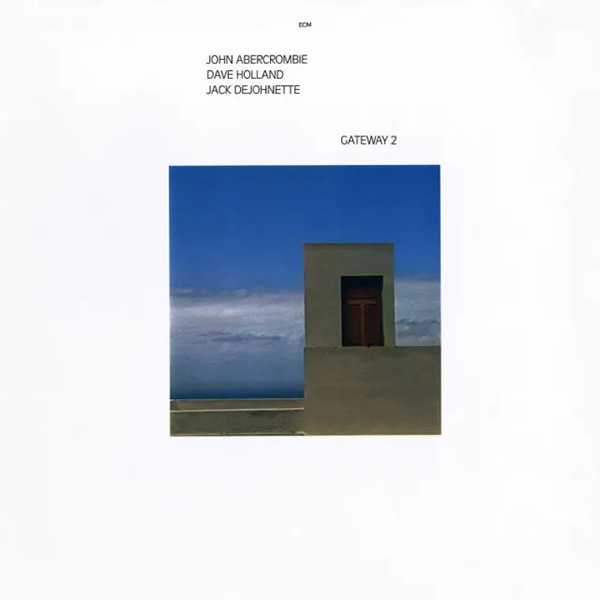
Tonally, the Yellowstone played remarkably uniform—nothing tweaked, no frequency pushed, no agenda declared. It never called attention to itself; it let the music breathe and move. Pinning down its sonic character beyond that touch of warmth proved genuinely difficult. Its next most prominent characteristic: speed. After that: intense dynamics. Notes flew out with easy authority. My North Carolina grandma would holler, "Land o'Goshen, Kenny!" The textures and images it produced were consistently physical. It was an even-handed companion across Krautrock and electronica, '70s jazz and funk, pop, and classical. Gateway 2's heated improvisations landed with force and dimension. Tower of Power's "Only So Much Oil in the Ground" hit warmly and clearly, with a well-focused punch of midrange. Aphrodite's electronic textures spread across a generous soundfield, subbass reaching deep enough to make my stomach churn.
Exchanging the Air Tight ATM-1 SE (35Wpc, $14,795) for the Elekit TU-8888 monoblocks (60Wpc, $4461/pair) provided contrast.
The Elekit monos' footprint was slightly lighter, with a more delicate sound. This combination was moderately less powerful and deep but just as fast and with more inner detail. Billy Cobham's gale-force drumming lacked a little weight (in relative terms), but the snare gained focus. I now heard Kenny Clarke stomping his foot in 4/4 time; Neu!'s "Hallogallo" was less substantial but no less driving and head-thumping. Bass detail improved; midrange lost some creaminess. The Yellowstone paired well with the Elekits. This was a different sound but equally compelling, engaging, filled with drama.
Staying with the Elekits, I swapped the Yellowstone for my reference Shindo Allegro pre, connecting it to the amplifier via Auditorium 23 XLR-to-RCA interconnects inherited from Art Dudley and using the Shindo's onboard phono stage. While it couldn't match the absolute weight and density of the Ampsandsound-Elekit combination, the Shindo brought more urgency to the music, plus marginally (further) improved inner detail and a bit more flow. Now I could trace every ripping, snorting line of Richard Davis's acoustic bass and follow the hyperactive conversation between Billy Cobham's toms and bass drum. The Shindo had a lighter touch, less low-end weight. It was a shade leaner, but it returned delicacy, resolution, and a sense of music breathing freely.
Where the Ampsandsound conjured a deep ocean of sonic density, the Shindo offered marked internal focus, a cleaner/lighter footprint, and a sense of flesh-and-blood humanity.
One further thought about the Ampsandsound–Shindo comparison. The Shindo is lovely, but it's delicate, physically. The Yellowstone, in contrast, is an impervious beast.
Returning to the Yellowstone, I brought in the Manley Labs Chinook phono stage to compare with the Yellowstone's internal MM/MC functionality. The Chinook offered a gossamer shimmer all its own, but it couldn't match the Yellowstone's SUT-aided weight, force, silence, layering, integration, or that deeply organic liquidity and body. Against the Yellowstone's meaty, commanding presentation and its wide and finely delineated soundstage, the Chinook sounded thin and uninvolving.
The Yellowstone's use of high-quality SUTs is no small thing. It's a game changer for anyone serious about getting the most from a turntable and cartridge with a full-function preamplifier.
Conclusion
Ampsandsound's Justin Weber is a rare breed, a Zen master of audio design whose components somehow carry the DNA of the man himself: humane, fair, quietly extraordinary. Heavy words to hang on a preamplifier, I know, but my time with the Yellowstone earned every one of them. It may be the finest preamplifier I have ever had the privilege of living with. Its onboard phono stage alone justifies serious attention. You can stack that on top of a tonal palette of impressive beauty, a soundstage the size of a small continent, dynamics that snap and breathe like live music, and a rightness and wholeness that makes you forget the gear and listen.