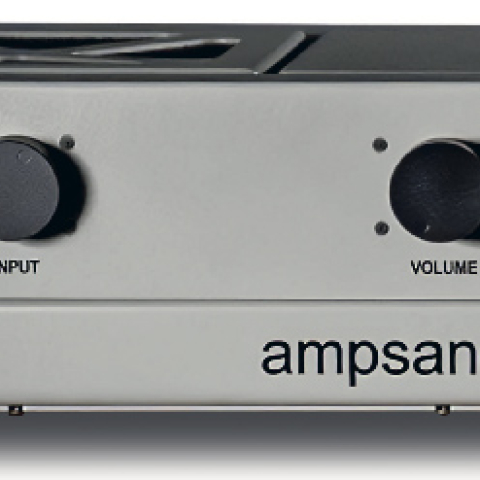
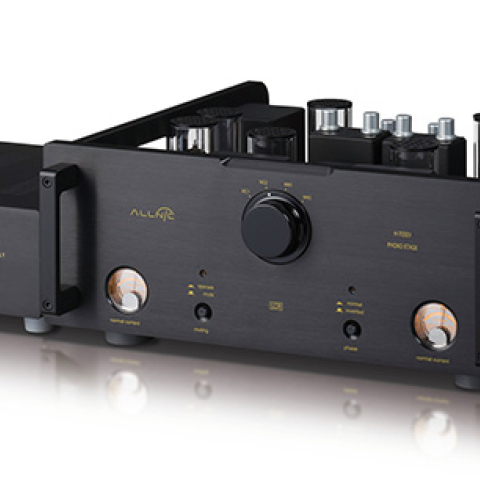
I used the Audio Precision APx555 analyzer to measure the Ampsandsound Yellowstone. To minimize noise, I connected the grounding terminal on the preamplifier's rear panel to the analyzer's ground. Over four hours of testing, the Yellowstone stabilized at 89°F, measured on the top panel. Many of the measurements below were made several times at different operating temperatures with no meaningful change in performance.
The Yellowstone has three line inputs—two single-ended and one balanced—alongside dedicated single-ended inputs for moving magnet and moving coil phono. There is one single-ended L/R pair of outputs. Absolute polarity was preserved via all inputs—ie, the preamp circuit is noninverting. The maximum gain was 14.6dB via the single-ended inputs and a near-identical 14.55dB via the balanced inputs.
The Yellowstone's unbalanced input impedance is specified as 600 ohms via the XLR inputs and 50k ohms via the single-ended inputs. Via the single-ended inputs, with the volume set at 100%, I measured 275k ohms at 20Hz, 390k ohms at 1kHz, and 65k ohms at 20kHz. Via the balanced inputs, I measured 175k ohms at 20Hz, 249k ohms at 1kHz, and 266k ohms at 20kHz. The output impedance is specified as 300 ohms. I measured 335 ohms above 200Hz rising to 16k ohms at low frequencies.
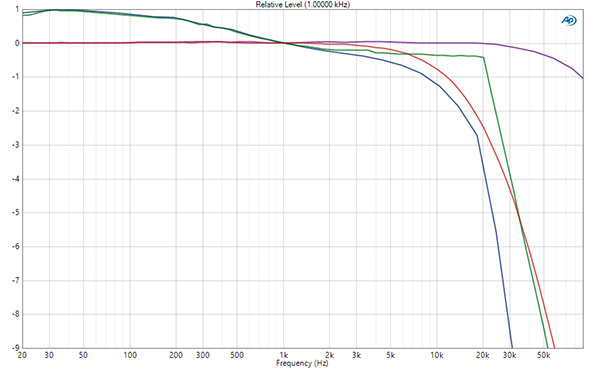
I measured some high-end rolloff, the amount depending importantly on the volume-knob position. In fig.1, the purple trace is a measurement of the preamplifier line inputs at 2V RMS with the volume set for unity gain; at this setting the rolloff is just 1dB at 100kHz. The red trace in fig.1 is the same 2V RMS output level taken with the volume at 100%; here, the rolloff is 2.2dB at 20kHz. Similar behavior is visible in the blue and green traces; these are equivalent measurements taken via the MM phono input.
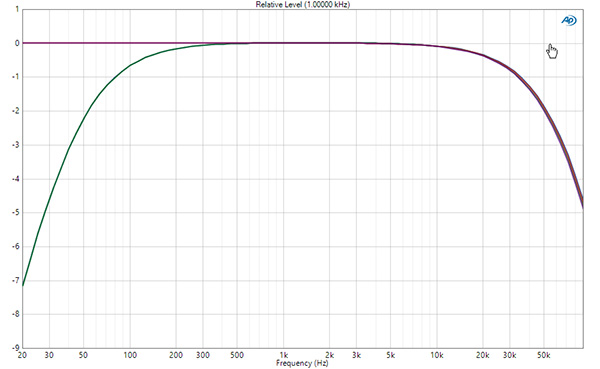
The Yellowstone's response into 600 ohms (fig.2, green and gray traces) was the same as that into high impedance over most of the audible range, but there was some low-frequency rolloff due to the rising output impedance. A conversation with the manufacturer suggested that the early production sample we tested may have a capacitor out of spec.
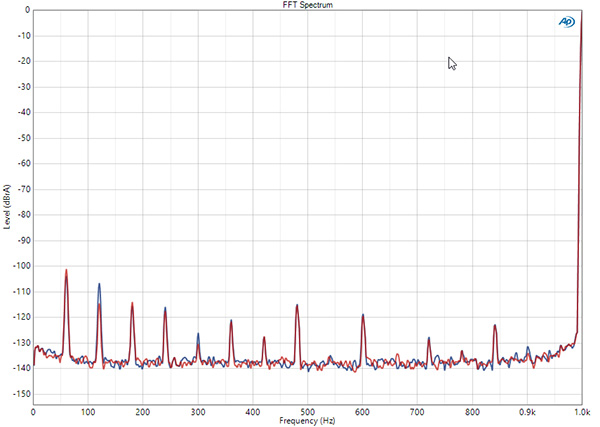
The Ampsandsound preamplifier's channel separation (not shown) was 80dB in both directions below 1kHz, falling to 43dB at the top of the audioband. The Yellowstone offered extremely low noise from all its outputs, with impressively low levels of power supply–related spuriae, especially considering that the power supply is unregulated (fig.3). The wideband, unweighted signal/noise ratio, measured with the unbalanced input shorted to ground and the volume control set to "100%," was a very good 80.2dB ref. 1V. Restricting the measurement bandwidth to the audioband increased these ratios by 13dB, while switching an A-weighting filter into the circuit further improved the ratios by 4dB.
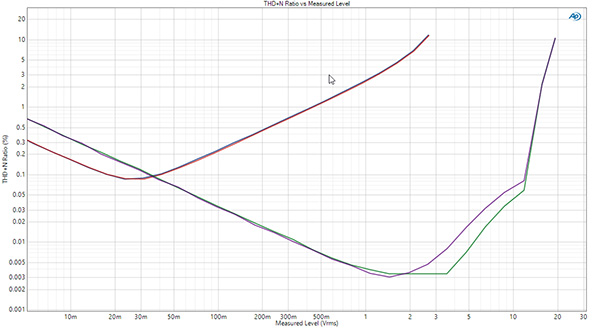
Fig.4 plots the percentage of THD+noise in the Yellowstone's output against the output voltage into both 100k and 600 ohms, with the volume control set to unity gain. The actual distortion lies beneath the noisefloor below an output of 2V RMS into 100k ohms (purple and green traces), though with the 600 ohm load, the Yellowstone appears to be saturating (red and blue traces). We specify a preamplifier's clipping voltage as when the THD+N reaches 1%, which occurs at 14V RMS into 100k ohms. The clipping voltage into the current-hungry 600 ohm load was just 453mV RMS.
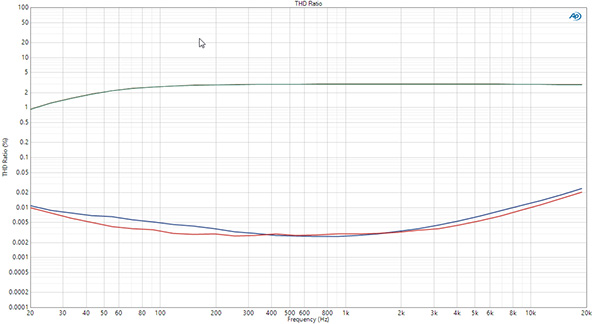
To ensure that the THD+N reading on the 600 ohm load was not simply due to excessive noise, I measured how the Yellowstone's distortion changed with frequency at an output level of 2V at the unity gain setting. The THD ratio into 100k ohms was superbly low throughout the audioband (fig.5, blue and red traces); the measured ratio into 600 ohms (green, gray traces) confirmed that the source of the saturation in fig.4 was not extraneous noise. This preamplifier should be used with an amplifier with a high input impedance.
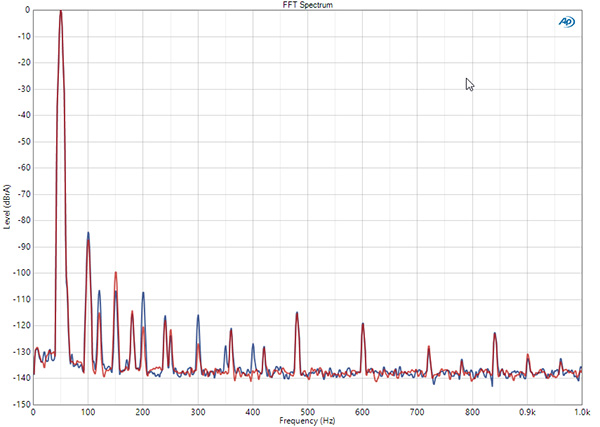
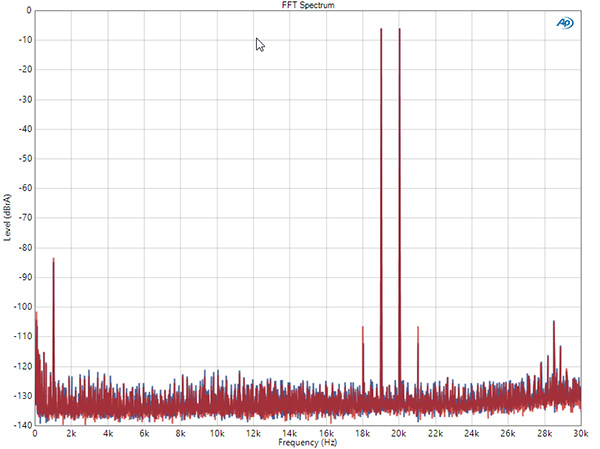
Fig.6 shows the preamplifier's spectrum with a 50Hz input into a 100k ohm load, at unity gain and 2V RMS input. The highest-level harmonic is the second, at –85dB. Spuriae from the 60Hz AC supply are visible but low at –105dB. With an equal mix of 19 and 20kHz tones at the same peak voltage level, intermodulation products were exceptionally low, below –107dB (fig.7).
In preparation to use the preamplifier's phono inputs, I connected a wire from one of the ground terminals on the preamplifier chassis's back panel to a grounding post on the Audio Precision analyzer to minimize hum. The two phono inputs can be selected for moving coil or moving magnet cartridges, and the gain for moving coil connections can be adjusted via easily configurable step-up transformers on the MC. The phono inputs preserved absolute polarity at the preamplifier's outputs. In MM mode, the gain at the outputs with a 1kHz signal was 51.5dB.
The input impedance to the MM stage was relatively uniform compared to the line level inputs; I measured 48k ohms at 20Hz, 49.7k ohms at 1kHz, and 43k ohms at 20kHz. Channel separation for the MM input was close to 65dB in both directions below 1kHz and fell with rising frequency to 34.15dB at 20kHz.
The phono input's unweighted, wideband S/N ratio, measured with the input shorted to ground, depended on the gain setting. With volume set to unity gain, the noise was a very good –76.5dBV (average of both channels). Restricting the measurement bandwidth to 22Hz–22kHz improved the floor to –81.2dBV in both channels; inserting an A-weighting filter improved this modestly, to –83.9dBV.
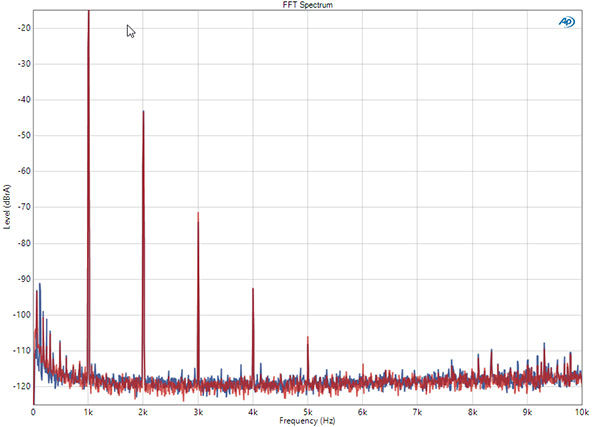
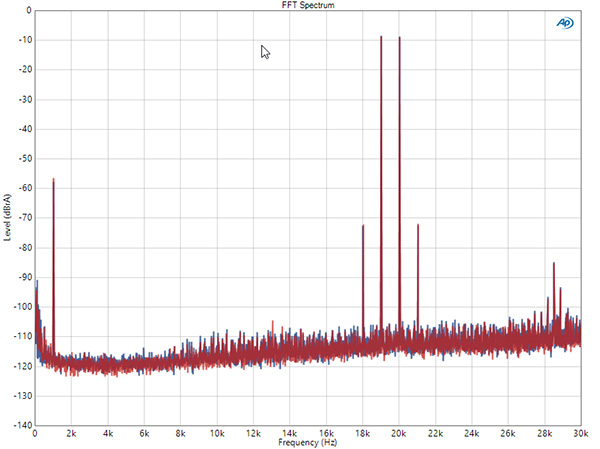
The Ampsandsound's phono inputs present the harmonic distortion expected from a tube preamplifier. Fig.8 shows the spectrum of the preamplifier's output with an input signal of 1kHz at 5mV and the volume set to unity gain; the harmonics decline with increasing order in an orderly way. The phono inputs offered admirable levels of intermodulation distortion: Even with the level of an equal mix of 19kHz and 20kHz tones lying just 3dB below clipping, the second-order difference product lay at –57.4dB; higher-order products were 15dB lower in level (fig.9).
Via both its line and phono inputs, the Ampsandsound Yellowstone's measured performance was very good, and typical of a purist tubed preamplifier.
A special thanks to Dylan Wahl for assistance in tracking down a tricky ground loop, without which these measurements would not have been possible.—James Grinalds