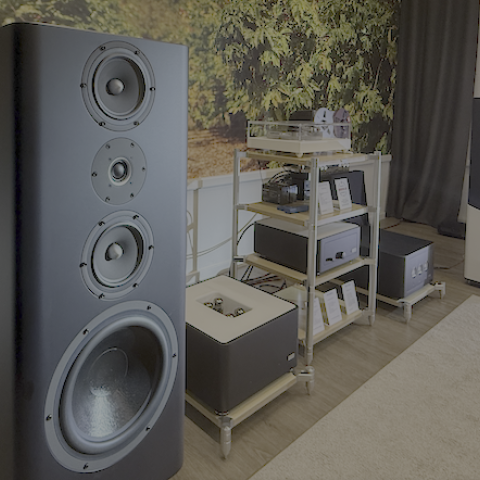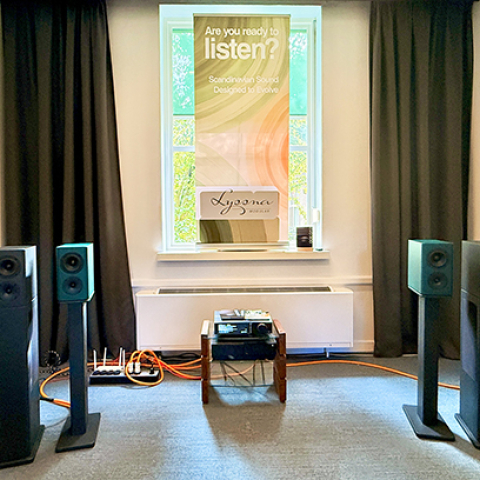

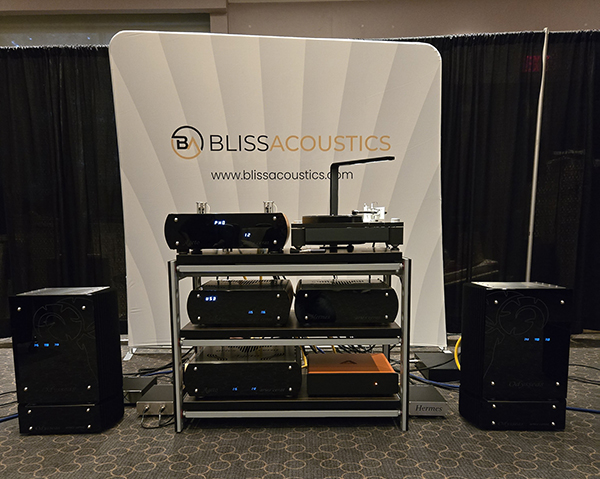
Like I said in my show intro last week, the three days I spent at Toronto Audiofest (October 16–18, 2026) delivered on the promise of a wonderful mix of collective cheer and musical bliss, with a dollop of very unusual-looking gear. Here' s the first of three T.O. show reports to prove my points.
Note: All provided SRPs are in Canadian dollars.
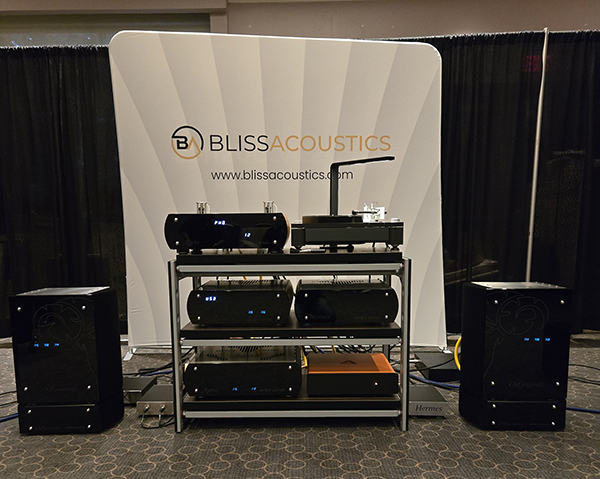
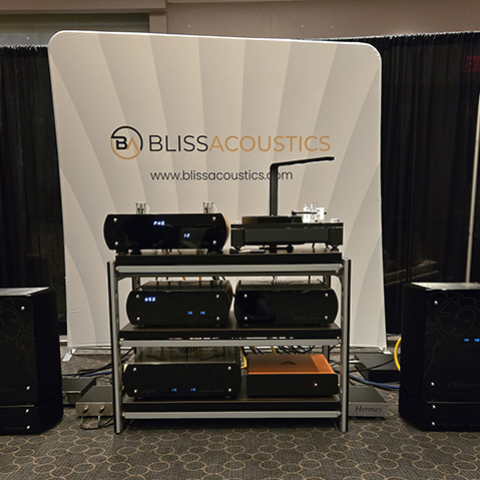
Blissed out with Bliss Acoustics
Can you guess the first words out of my mouth as I entered the Bliss Acoustics room and immediately laid eyes on the giant pair of elevated cubic structures, one on either side of the room?
That was a trick question. I had no words—more like a gasp or a gurgle. That was all I could muster while I tried to process what I was seeing. Finally, out came, "whoa," followed by, "what kind of speakers are those?"
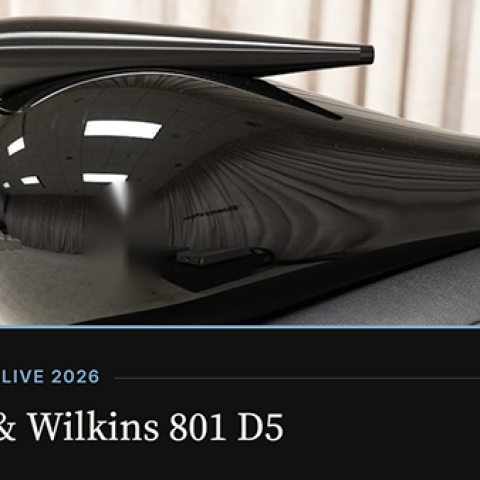
Those were the Aries Cerat Aurora horn loudspeakers ($250,000/pair), a unique design combining hybrid open-baffle/aperiodic bass loading with a horn-loaded midrange. According to designer Stavros Danos, a former aeronautical robotics engineer, the midrange horn's distinctive, swirl-shaped geometry was deemed the best solution for minimizing diffraction at the horn's mouth and, consequently, bringing the "horn" or "cupped hands" coloration to inaudible levels.
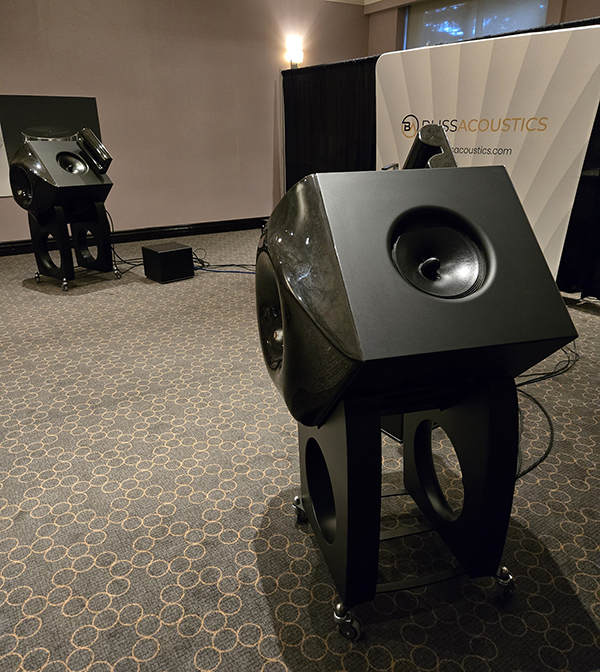
See that black component protruding off the side of the speaker? That's a horn-loaded dipole ribbon tweeter, which may be, at least according to designer Danos, the first of its kind.
Believe me when I say these speakers are impressive to behold in person, physically and sonically. Upstream components featured more from the Aries Cerat line, including the company's Ageto preamplifier ($100,000), Odysseas monoblocks ($175,000/pair), and a Hermes phono preamp ($36,000).
Other Aries Cerat products showcased (but not active) during my room visit included an Ithaka Minor DAC ($92,000) and a Hronos digital interface ($16,000), the latter designed to upgrade the digital stream ahead of the DAC. I also didn't get to hear the Lucas Audio Lab REF ONE server ($45,000), nor the digital and ethernet cables by David Laboga.
Other "silent" products used in the Bliss room setup included Graphite Audio isolation products, RD Acoustics panels, Ictra Design component racks, and an Uberlight. The latter didn't make a sound—but it did make light that spotlit something I did hear: the Thiele IWD01 idler drive turntable ($88,300), which was fitted with a Thiel TA-01 tonearm ($21,700) and a Tedeska Tielke MC cartridge ($10,375).
Using Hemingway Audio Z-Core cables throughout, the system's presentation across a couple of jazz tracks was imbued with earthy tones, rich instrumental texture, and holographic imaging, not to mention warm, breath-infused vocals, and sensuously fleshed-out sound.
Vinyl sound, digital dreams
Despite its name, Ontario retailer Vinyl Sound doesn't deal exclusively in vinyl playback—it also offers digital options—but the company name might suggest a particular sonic aesthetic, regardless of format. I say that because the digital demo I heard in Vinyl Sound’s room was not what I expected—but I'm getting ahead of myself.
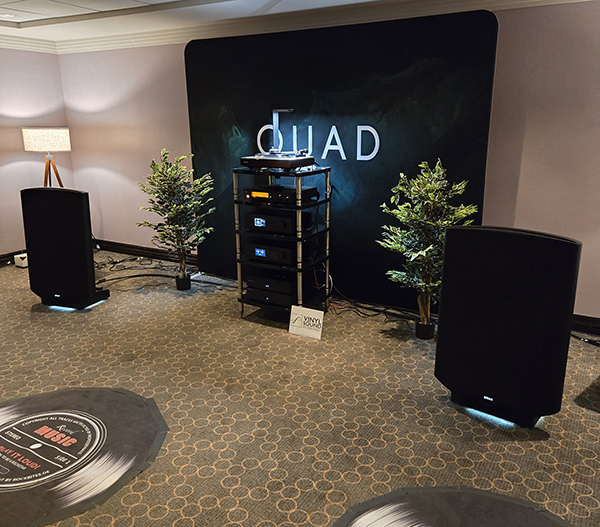
As I anticipated, the system's front end—consisting of a Technics TD-404DD turntable ($9,495) fitted with a MoFi MC UltraGold cartridge ($1,995) feeding a MoFi MasterPhono phono stage ($8,995) and a 200Wpc Quad Platina dual-mono Class AB stereo integrated amp/DAC ($7,995)—delivered very good vinyl playback.
Playing a Chuck Mangione LP through a pair of Quad ESL 2812X electrostatic speakers ($21,995/pair), this system sounded transparent and texturally refined. It offered a meaty, deliberate flow, an exquisite sense of touch, and strong low-end presence. Everything was in place for a rewardingly musical experience—and it certainly was.
Then the 'table was switched off and the Quad Platina Stream network streamer ($6495) was switched on, and a FLAC file of George Michael singing The Police's “Roxanne” began to pour forth. I was… befuddled? bewildered? "Whoa, wait—this is digital? Since when?"
The sound was so lush, full, effortless, organic, and thick-toned that it seemed every pore of the musical presentation was accounted for, each one brimming with sumptuous vitality. But digital? Times have definitely changed.
Rounding out the system were AudioQuest cabling, IsoTek power conditioning, and a Solidsteel rack.
Eversolo, ever so good
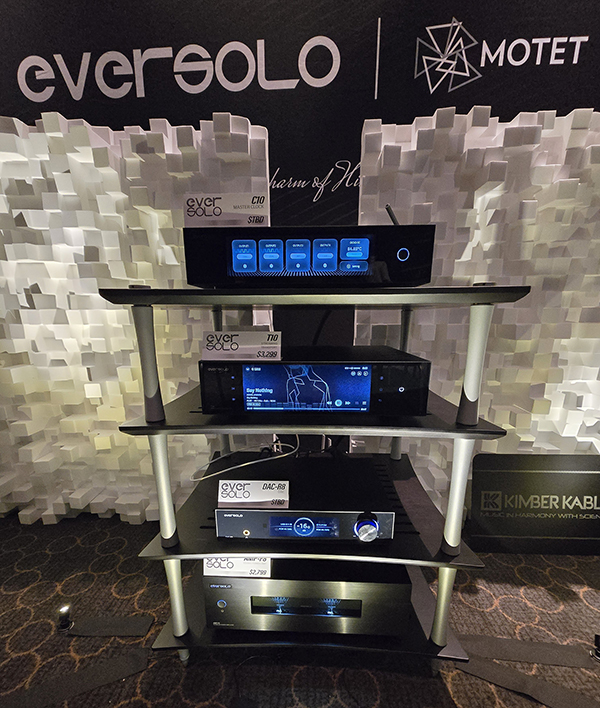
The Toronto show was ground zero for Eversolo products that are so new they don't even have SRPs yet. They do, however, have names: the DAC R8, which employs the company's proprietary 24-bit R2R ladder architecture, and the C10 master clock.
But even though neither product is on the market yet, both are very much real. I know because I heard them in the Motet room in a system that also included Eversolo's MF8 power amp ($2799), T10 streaming transport ($3299), and a gorgeous pair of silver-finished, three-way KEF R11 Meta speakers ($8500/pair), all connected with Kimber Kable cables.
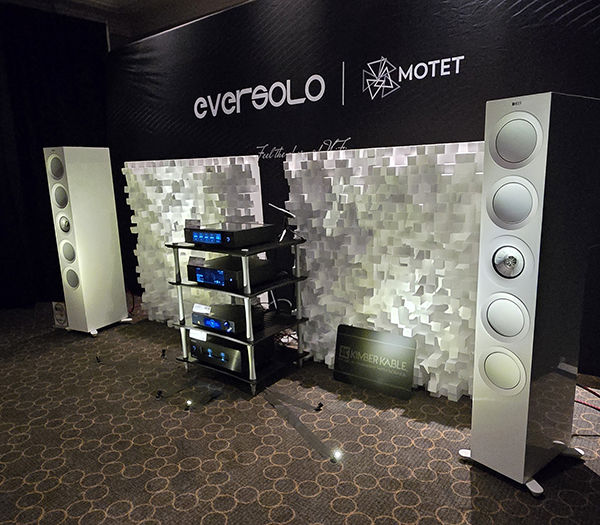
The amount of sound—and quality sound—produced by this Eversolo quartet reminded me why the company has been on a tear ever since its 2023-launched DMP-A6 made streaming cool for audiophiles, and why KEF remains a brand to be reckoned with 65 years after its founding.
They delivered an electronic track with such air-displacing energy, dynamic thrills, solid imaging, and natural detail, I found myself thinking, "this sound is absurd for the price." Then I remembered that two of the components didn't have prices yet. (But still.)
And it wasn't just about power. I then listened to Allan Rayman's "Tennessee," a rap-inflected pop song he'd released in 2015, and I heard a presentation that was clear, expansive, and layered, with a lit-from-within vitality and presence. My fearless prediction? These new Eversolo products are going to be a hit!
mono/stéréo, très jolie
Danny Labrecque knows good sound. He also knows the retail side of the audio business, having worked for years at some of Montreal's most iconic stores. Over that time, his knowledge of and passion for audio grew, but what he enjoyed most, as he told me recently, was interacting with people and bringing them joy through audio.
That combination of expertise and a love of sharing his enthusiasm for audio prompted him to establish Luna Cables in 2015 with his friend Erik Forter, who has since struck out on his own to found the audio importer Phonographe. Labrecque now owns Luna Cables outright and continues to serve as its chief designer.
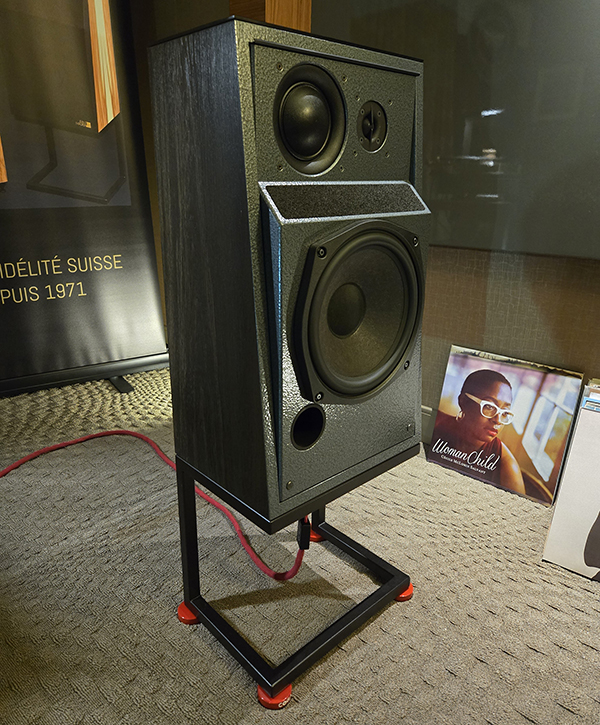
It was, by all accounts, a good call. Luna Cables proved so successful that it allowed Danny to fulfill another dream: opening his own retail store, which he did in 2025. That store, mono/stéréo, featured a system at the show comprising a string-drive (technically belt-drive, but with a string!) CS Port LFT1M2 turntable ($48,100), fitted with an André Thériault Black Beauty tonearm ($15,000) and Aidas Cartridges Tru-Stone Violet Gold cartridge ($12,000), a step-up transformer, and various Luna Cables cabling, a CS Port C3EQM2 phono preamp ($19,100), a 30Wpc Riviera Audio Laboratories Levante integrated amplifier ($35,000), and a pair Jean Maurer JM 320E speakers ($35,000/pair), whose woofers protrude from the baffles to help achieve time coherence. The system also included Box Furniture Heritage HD3S component stands ($8750) and Coga Audio vibration-control accessories.
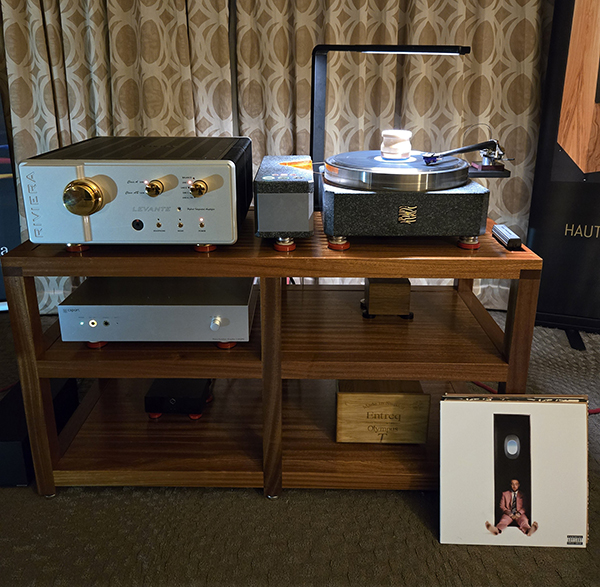
Regarding that CS Port 'table, Danny explained that a string drive is said to create less friction and transfers less energy than a belt drive, resulting in lower noise. He also said that its platter rotates with greater speed accuracy than any other turntable he has measured.
On a recent reissue of Sonny Rollins's classic 1956 Prestige LP Saxophone Colossus, Sonny's sax sounded ample and thick-toned, conveying a sense of air propulsion and an almost viscous continuity from note to note that felt lifelike. Double-bass notes sounded acutely finger-propelled, with marvelous dynamic contrasts and richly rendered string textures, while drum hits delivered impact and a vivid sense of the materials being struck.
There was also a remarkable sense of tonal rightness, as if every note across the frequency range were ideally balanced and perfectly pitched.
It was wonderful.
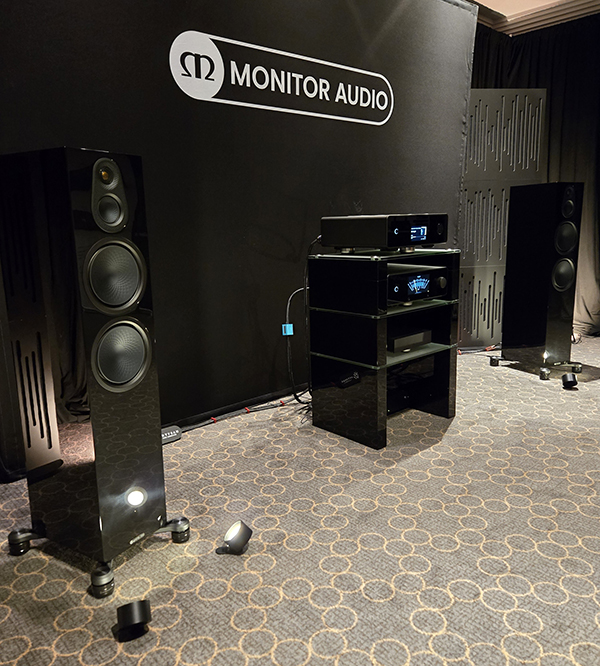
Kevro synergy, for the masses
The Kevro/Monitor Audio/Rotel room was one of those rooms at the T.O. show—and there were a few—that exemplified to me what's become so fantastic about our favorite hobby. And it's this: the amount of quality sound you can get from a system that's both ergonomically simple and priced in such a way that it would make many people happy forever for having obtained it.
That's not to say you can’t get better sound, or that some people don't enjoy upgrading their equipment in pursuit of ever-greater sonic heights. But neither pursuit is necessarily necessary to enjoy great sound. I come from an era when it wasn’t as easy as it is now to find synergy among components, especially those from different brands. Inevitably, something sounded a little askew, or not quite right. It was a fundamental reason we kept wanting to upgrade: to fix what we felt was off.
I don't believe it’s nearly as much the case anymore. Today's audiophile gear is generally so well designed and sonically balanced that achieving synergy among components is easier. The result is that more systems are capable of reaching a plateau of goodness and musicality without the extra fuss to allow us to worry less—or at least think less—about the gear and simply enjoy the music.
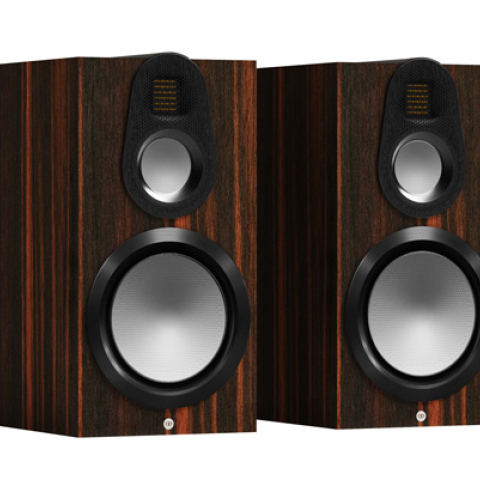
A case in point was the system Canadian importer Kevro set up in this room, which featured a Roon Nucleus (now discontinued), brand-new Monitor Audio Silver Series 8G speakers ($5000/pair), a Rotel Michi Prestige X430 integrated amplifier ($6500), a Michi Q430 CD player ($5500), and cabling by Artysan.
Irrespective of price, this system delivered bodacious sound. It was full-bodied and unveiled, and full of life and vim, with pinpoint imaging, lifelike vocals, a richly layered soundstage, and unfettered dynamics and bountiful bass.
On a FLAC stream of "A Million Dreams," from the 2017 soundtrack for The Greatest Showman, the sound was so invigorating and emotionally charged I was almost tempted to stand and raise my arms in celebration, swept up in the music's joyous spirit.
For some listeners, this may be all they ever need.
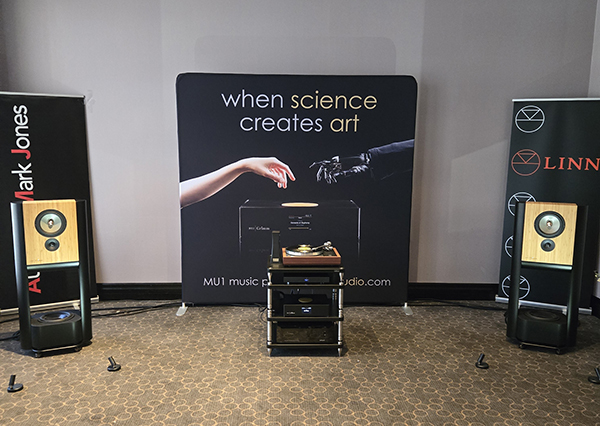
Jonesing for Audio by Mark Jones
At audio shows, retailer Audio by Mark Jones usually demos systems comprising a variety of components. This time, though, Jones went simpler—at least in terms of component count—with a setup centered around a pair of Grimm LS1c active speakers (starting at $37,400/pair). The Grimms are almost complete systems in themselves, incorporating DSP and a DAC; all they need is a streaming source to play music. By their very nature, the LS1c speakers are digital products.
But here's the thing: for as long as I've know him, Jones has always been an LP guy, so perhaps I shouldn't have been even mildly surprised when I visited his room that he was using a Linn LP12 turntable ($47,730) with an Etsuro Urushi Bordeaux cartridge ($8725) as the source componentry, whose signal the LS1c digitizes before processing it for playback.
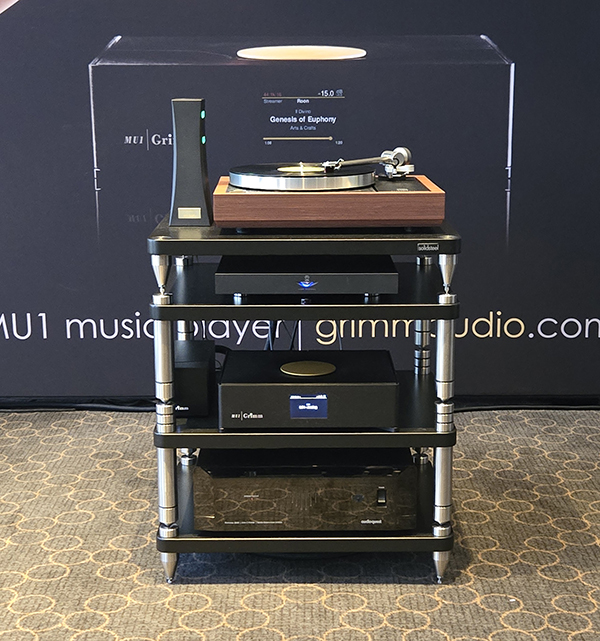
If digitizing an analog signal sounds slightly blasphemous to you, or at least potentially degrading, all I can vouch for is what I heard. The system also included a Grimm MU1 music player ($18,550), which was in standby mode while I was there; a pair of Grimm SB1 subwoofers ($18,900/pair), one integrated into each speaker stand and firing upward; AudioQuest cabling and power conditioning; and a Solidsteel component rack.
The sound was, in a word, glorious. Jimmy Page's acoustic guitar on Led Zeppelin's "Bron-Y-Aur Stomp," from 1970's Led Zeppelin III, sounded thick-toned and pellucidly springy. John Bonham's bass drum had grip and power and Robert Plant's vocals were explicit and sturdy, while the handclaps that popped in and out of the mix materialized way off to the sides, seemingly reaching toward me.
"Stomp" was a chunky feast for the ears—but perhaps not as much of one as the next track, Frankie Goes to Hollywood's mid-1980s international hit "Relax," which was cued up in its 12" version. With its flood of percussion and swirling sound effects, "Relax" sounds were clearly defined, solidly anchored, and cohesively integrated into the whole.
And what a whole it was: spacious, big, room-filling, projecting here and there, near and far—and not once, no matter how loud the music got, did it become fatiguing. When the music called for it, such as with vocals and synthesizer parts mixed this way, the sound delivered a great combination of body and presence, light and color, and excitement and satisfaction.
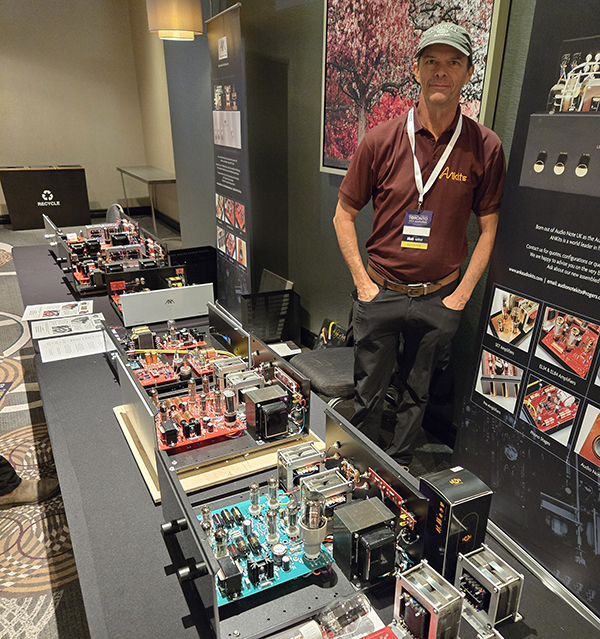
Anchored in ANK
I rarely report on room/gear demos that are entirely static, but this one caught my fancy, along with a sense of curiosity verging on carnal. In this room, laid out side by side in a long line on tables covered in black tablecloths, were several tube-based components with their tops off, beckoning me to admire their meticulously mapped out circuitry and tube types. At the end of the display, and equally eye-catching, stood a handful of custom-made transformers.
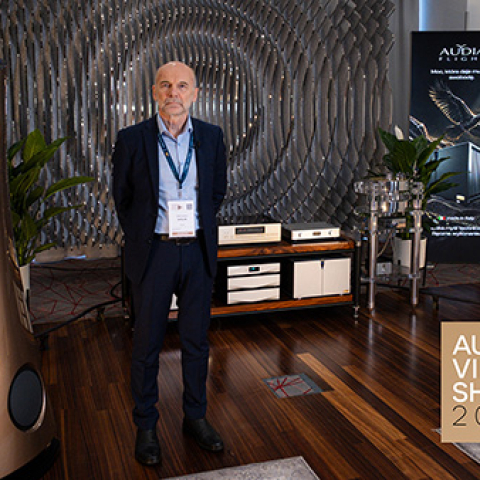
The company hosting the display was ANK, based in Ontario. According to the company's literature and its affable owner Brian Smith (seen above, manning the display), ANK was established in 2004 under the name audionotekits.com as a DIY extension of Audio Note UK, offering its products in kit form.
Initially, the company offered two products: the Kit1 300B amplifier and the DAC1.1. It now boasts more than 25 products, including 300B-, EL34-, and EL84-based amplifiers, as well as preamps, DACs, and phono stages—all tube-based and derived from Audio Note UK designs.
Products are available either as kits or fully assembled. When I asked Smith about the proportion sold in each form, he estimated that "about 80% [are sold] in kit form, and 20% preassembled." Individual products are also available in different quality tiers, depending on the components used and the type of build selected.
Audionation aux deux
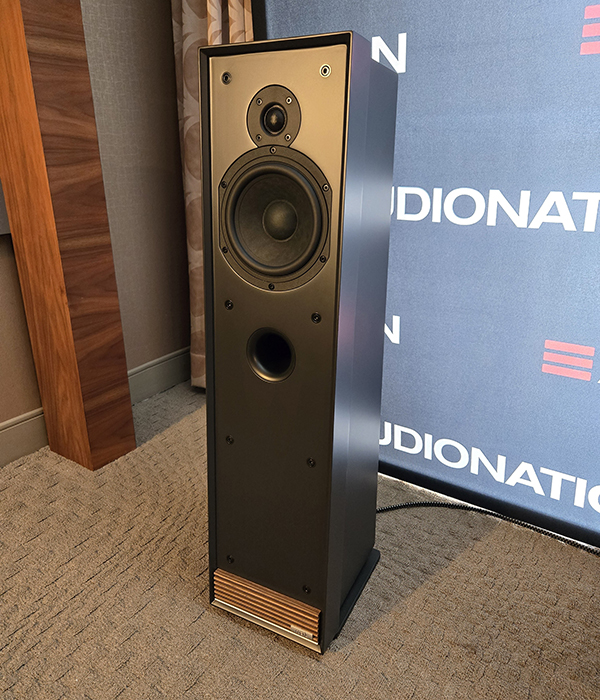
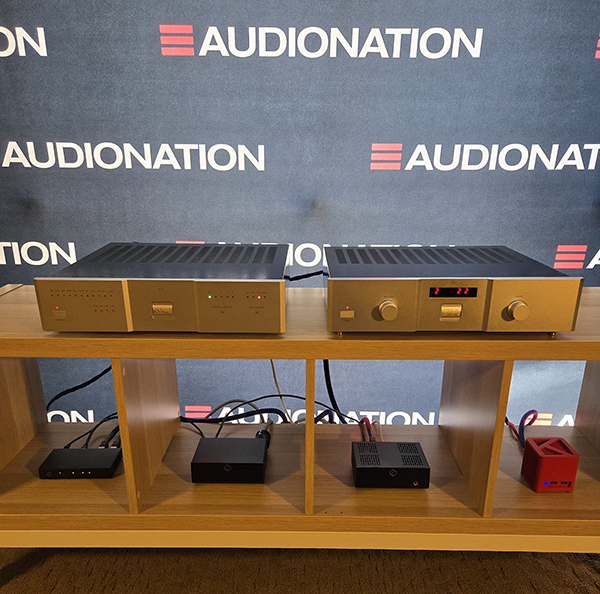
Audionation had two rooms. Both sounded exceptional. The first one I went to included a pair of horizontally rectangular Guru Q10 monitors ($3999/pair) perched on Standpoint Q10 wood stands ($999/pair), a Soulnote D-1N V2 DAC ($5990), an 80Wpc Soulnote A-1 V2 solid state integrated amp ($5990), and Luna Cables throughout. But wait—there’s more.
I heard this system twice. The first time, I thought it sounded very good. High class, even. The second time, when I returned to the room on importer Erik Fortier's urging, it sounded remarkably better, to the point of phenomenal.
What changed? The addition of a pair of Acustica Applicata DAAD acoustic panels (starting at about $650 each)—called "sound harmonizers" on the Italian company's website—that weren't there first time. Placed centrally behind the speakers against the curtains, they, well, harmonized things significantly further. And despite instantly hearing the improvement in sound, I did not realize until later that those harmonizers had been added.
On streamed Cream and Black Sabbath covers by electronic music duo Yookie, along with Martin Costaz's 2023 single "Disparate Youth," the music sounded more holographically solid, deep colored, and spatially layered with solid, luxuriantly vivid imaging.
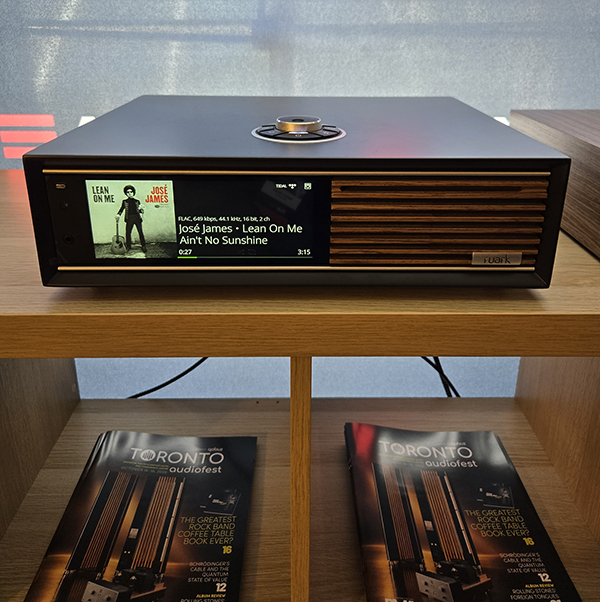
The second Audionation room showcased an all-in-one class-D-based Ruark R710 CD Hi-Fi Console ($4499) and a pair of Talisman-R speakers ($2999/pair), a modern redesign and fourth-generation evolution of the original Talisman launched in 1990. That's it—only three pieces, unless you count the cables that come included. But what pieces they were!
After learning how much that combo cost, I was stunned. Its sound-quality-to-price ratio was off the charts. On a streamed live jazz track, double bass notes brimmed with texture, cymbals shimmered with fine detail, and the sax sounded like the real thing and scaled the way it should be; the jazz club was in the house! It was palpable—the energy, the atmosphere, the crowd's presence, and the kinetic physicality of the music.
While both of these Audionation systems may have initially appeared diminutive, they sure didn't sound it. In fact, they sounded impressive and grand, regardless of cost or size. They may even be Giant Killers.