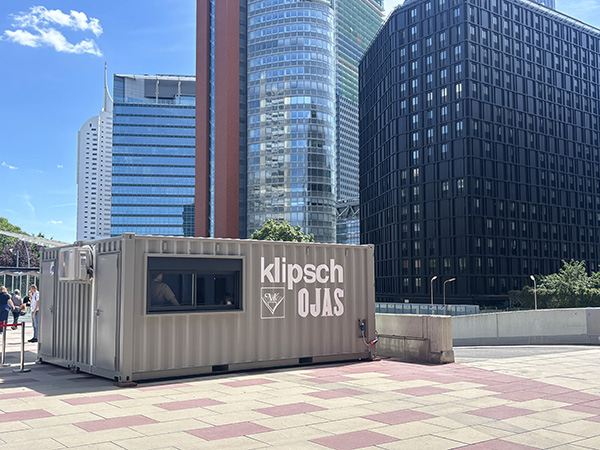
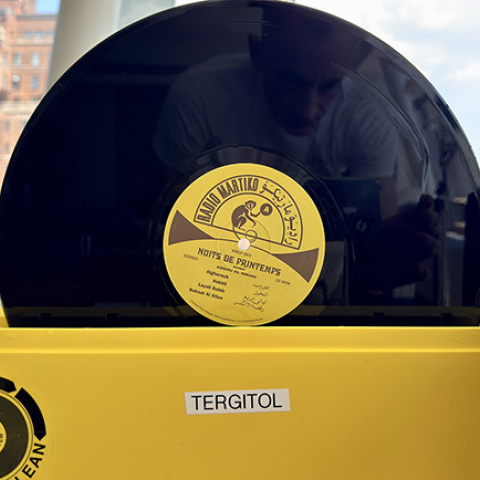
The Klipsch-OJAS storage container outside the High End Vienna venue.
Whenever I spend time in Vienna, I never think I'm going to eat schnitzel every day, but somehow it happens anyway. The truth is that when done right, schnitzel is a scientifically perfect dish: unexpectedly light, texturally complete, and oddly comforting. The trick is something called the three-pan method, which refers not to frying but to the assembly, which goes as follows.
Tenderize a cutlet of veal or pork until it's about 1/8" to 1/4" thick and season it generously with salt and pepper. (Veal is traditional in Vienna but pork has a devoted following, of which I'm a member.) In a large pan, slowly heat about 1/8" of peanut oil with a little unsalted butter (for flavor). While this is happening, line up three large plates or pans on your counter. In the first plate, dredge the meat in all-purpose flour. In the second, coat it in egg, making sure to leave no dry spots. In the third, cover it in fine bread crumbs, though many cooks prefer panko for added crunch.
When the oil and butter mixture is sizzling (for the objectivists, that's around 350°F), cook the schnitzel for about 2–3 minutes per side, making sure to swirl the pan, which creates air pockets. When the breading is golden brown, rest the schnitzel on a rack for a few minutes. The result should be lightly crispy on the outside and juicy on the inside, with a thin crust that undulates over the meat like the ocean at low tide. Serve with a simple green salad and, if you wish, some vinegary German-style potatoes. No matter what some recipes say, please don't drown this masterpiece in sauce or gravy, which in some parts of the German-speaking world is punishable by 48 hours in jail.
Many guides to Vienna's best schnitzel will point you to the comically giant breaded UFO at Figlmüller, a small chain that bills itself as the Home of the Original Wiener Schnitzel. Ignore this: Any place purporting to be the birthplace or home of anything is a tourist trap. My favorite version in Vienna is found at Cafe Anzengruber, an unglamorous tavern near the Karlsplatz overseen by two Croatian brothers who don't seem all that fond of each other. Open until 1am, the place is a delight for watching locals in various states of inebriation, and the pork schnitzel that arrives alongside a salad of fresh greens is basically unimprovable. Before a long, boozy dinner at Anzengruber, you can take a stroll to see the Klimts at the Belvedere or the magnificent Bruegels at the Art Historical Museum, and if classical music is your thing, the Musikverein and the acoustical marvel that is the State Opera are even closer.
These are some of the reasons I rejoiced when I heard that the High End show was moving from sleepy, manicured Munich to Vienna. This June, the inaugural edition took place at the Austria Center Vienna, a Brutalist convention hall situated on Kaisermühlen, an island in the Danube that's home to the gloriously green Donaupark and decidedly less glorious architecture. Well before I arrived, the scuttlebutt was that many regular exhibitors had been turned away because the new venue turned out to be smaller than Munich's MOC event center. So High End Vienna opened its doors alongside no fewer than four satellite minishows popping up in its vicinity like mushrooms after the rain.
In what must be the canniest piece of marketing I've experienced in our hobby, the throng of visitors to the ACV had to pass a shipping container plunked down in a small plaza and festooned with the logos of Klipsch and OJAS (top). Inside was a listening room built around the new kO-R2 speakers, the second collaboration between the venerable company from Hope, Arkansas, and artist/designer/impresario Devon Turnbull. No frontal photo of the ACV could be taken without the shipping container showing up in the foreground, but perhaps its most stealth feature is that you could get inside without buying a ticket to High End Vienna. Well played, fellas!
The kO-R2 is a large two-way with a sand-cast sectional horn perched atop a nearly cubic front-ported cabinet containing a 15" woofer. I found these new speakers, clad in hammertone paint and resembling a 1950s Altec Voice of the Theater system, to be lovely. Limited to 600 pairs and retailing for $12,000/pair, they also struck me as keenly priced.
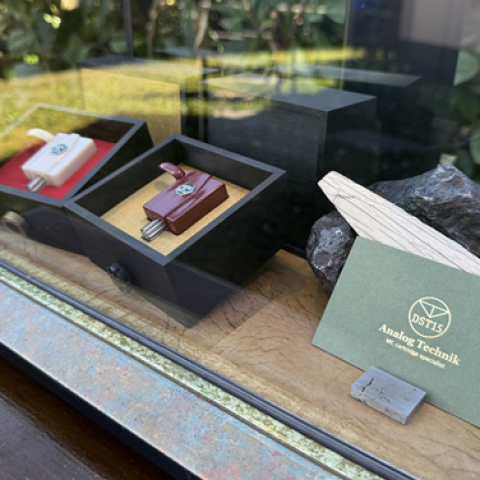
As ever, Turnbull folded various collaborators into his enterprise, and the shipping-container system sounded excellent driven by a hybrid Silbatone amplifier, with a front end anchored by the superb Garrard 301–based record player from L'Art du Son's Martina Schoener with a DST-style stereo cartridge from Daniel Kim of Analogtechnik. During my visits to the container, I heard Brazilian pop, classic jazz, and, best of all, Kraftwerk played from analog tape on an Ampex reel-to-reel. I've now had a chance to hear the kO-R2s in two distinct spaces, and what impressed me is their easygoing yet tonally evenhanded voicing, quite unlike the rather bass-forward sound of the kO-R1s.
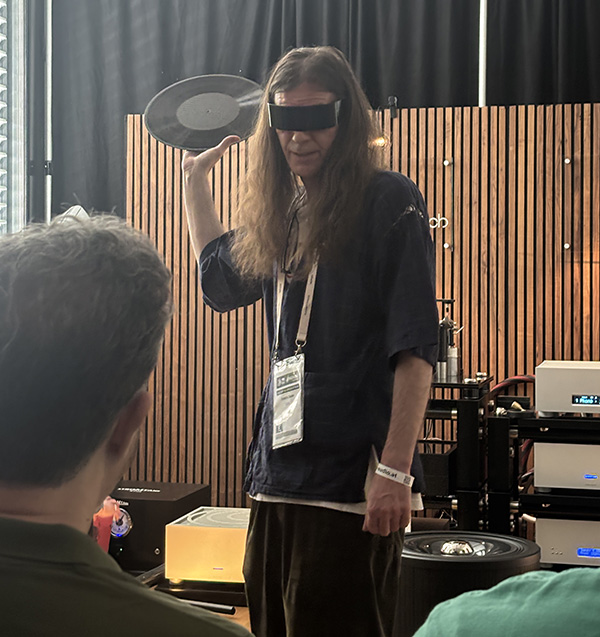
Frederic Stader in action.
A handful of cafe tables outside the shipping container served as a hangout for assorted Turnbull stans, DIY-adjacent weirdos, and a fair number of music industry people. Perhaps the strangest looking among them was Frederic Stader, a mastering engineer from Cologne who complemented his mid-back-length Rasputinesque locks with a cyclopic piece of eyewear that made him look like a down-on-his-luck Robocop.
Up in the Wilson Benesch room, Stader gave what for me was the most memorable presentation at the Vienna show. He played acetates of tracks by Miles Davis (from the soundtrack to
Elevator to the Gallows) and John Coltrane (from
Blue Train) which he reportedly mastered from the original Fontana tape and a Blue Note French production master. Stader's mastering job was exquisite, rendering the music easy to listen to—he did an especially impressive job of banishing the hard edge the saxophone has on most versions of that Coltrane record—while giving up none of the reverberant cues or musical excitement.
The room's focal point was Wilson Benesch's new, wedding-cake–like Greenwich turntable, which features a direct-drive motor that's 15" in diameter and, according to the company, the largest ever produced for this application. The company's GMT System One turntable retails for $302,000 without tonearm or stand; comparatively, the $130,000 Greenwich is an impulse buy. Playing through the company's stand-mounted Endeavour 3Zero speakers and a subwoofer that looked only a little like a bidet, it held down one of the best sounding rooms I heard in Vienna.
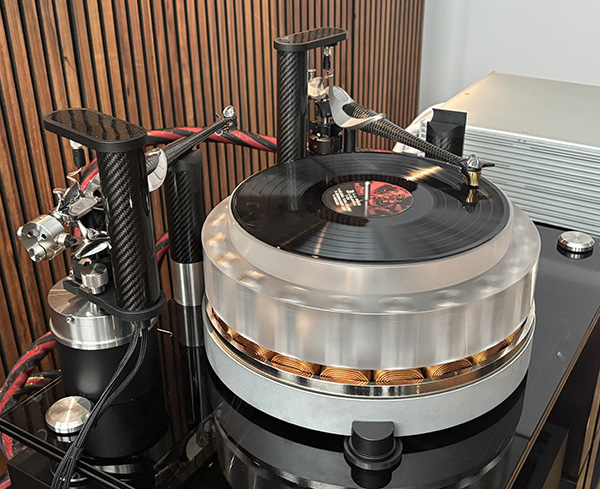
Wilson Benesch's new Greenwich turntable.
The odd, cinnamon-bun–shaped layout of the ACV combined oddly empty public spaces with some unpleasantly crowded rooms, but eventually I found my bearings (sorry). Among many product introductions, the one that excited me the most was the return of the Verdier line of turntables, which has lain pretty much dormant since founder Jean-Constant Verdier's death in 2014. The resurrected Verdiers sat in the titanic Pro-Ject Audio Systems room (since Pro-Ject owner Audio Tuning now owns Verdier and manufactures their products), which had enough turntables on view to play every Nana Mouskouri record simultaneously.
The reintroduced line includes the original La Platine (€11,900), which features the famous magnetic bearing, the Nouvelle Platine (€9000), with its only slightly more conventional hydraulic oil–filled bearing system, and a new, smaller model called the Petite Platine, about which, shamefully, I learned next to nothing. The larger turntables look and reportedly operate just like the originals, something Pro-Ject says they have gone to some pains to accomplish. With their metal-shop aesthetic, and sporting massive platters rotated by a thread connected to a motor stationed alarmingly far from said platters, the Verdiers are clearly not intended for every home. But given their near-mythical reputation for making LPs engaging, I can't wait to hear one in my home. If you see this, Heinz Lichtenegger, drop me a line.
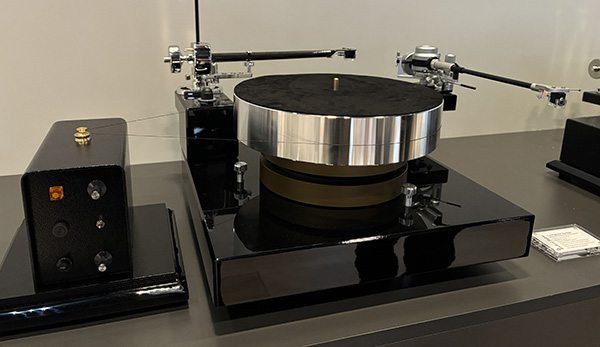
The J.C. Verdier La Platine turntable.
For me, one of the things that make audio shows challenging are the many, many rooms in which very large speakers are playing music very loudly. What makes this worse is that these speakers tend to emit a
lot of treble and a
lot of bass, when what I'm generally listening for is more midrange played at a volume that's safe for the elderly and small animals. Fortunately, there were more than a few rooms fitting that description.
In a happily unmobbed corner of the ACV, I sat listening to a relatively petite, beautiful-sounding hi-fi that featured two battery-powered turntables from Thales, an amplifier from Stellavox, a phono stage made jointly by both companies, and the enigmatic-looking Manger P2 speakers. This gear was new to me, but it played music with so much delicacy, balance, and inner detail that I wanted to set up a lawn chair and a sleeping bag and call it a day. The Thales gear—especially the Reference turntable driven by an ingenious centrifugal governor and eddy current break—struck me as beautiful in a jewel-like, Swiss way (alas, it's also priced at a very Swiss $38,000). That governor looked as precisely machined as the balance wheel in a Breguet wristwatch.
One of those satellite shows was taking place a few minutes away at the Arcotel Kaiserwasser, the façade of which is covered with the names of Austria's cultural luminaries: On my way in, I passed Adolf Loos, Arnold Schoenberg, and Falco. Upstairs, Audio Note UK was playing a system consisting of the TT-Three/PSU4 turntable, the Meishu Phono Tonmeister integrated amplifier, and the AN-E/SOGON LTD Field Coil loudspeakers.
Writing out those model names was no fun. Listening to several classical records on this rich-sounding hi-fi was
a lot of fun. The company's SORO SE Signature integrated amp recently arrived here in Brooklyn, and I'm eager to find out how it will play my favorite Little Jimmy Dickens records.
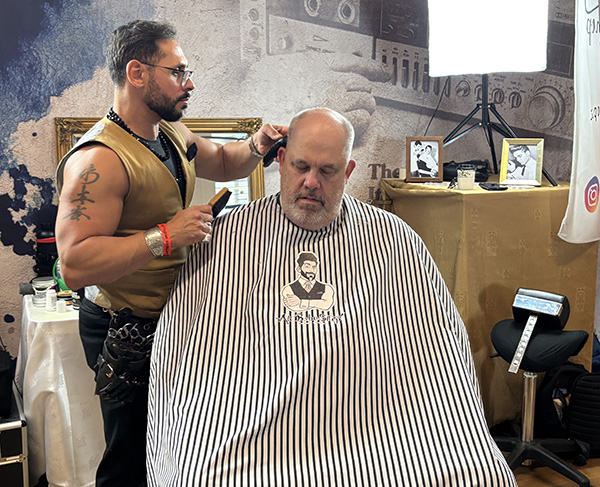
Beau getting his hair trimmed.
Back at the ACV, I ran into my friend and Brooklyn neighbor Beau, who was getting a haircut under a mural of a vintage Onkyo cassette deck. This was surprising because barbers don't usually set up chairs at audio shows, and also because Beau is basically bald. It turned out that the barber was part of the Klipsch-Onkyo exhibit. I guess the company was channeling an old-timey rec room vibe meant to communicate something about cassettes and barbers and America and masculinity? Did I get it?
Inside one of the company's listening rooms, I was happy to take a listen to the new, 80th Anniversary, limited-edition Klipschorns; with brass inlaid across their dark wood veneer, they struck me as gorgeous. They sounded gorgeous, too, with that enormous sense of scale I recognized from the
La Scalas but more and deeper bass. Of course these speakers aren't really Klipschorns, being two-ways with DSP-based crossovers and newly designed sandcast horns covering much of the highs and mids. I heard a bit of the textural homogenization I associate with crossovers that utilize DSP—but
just a bit.
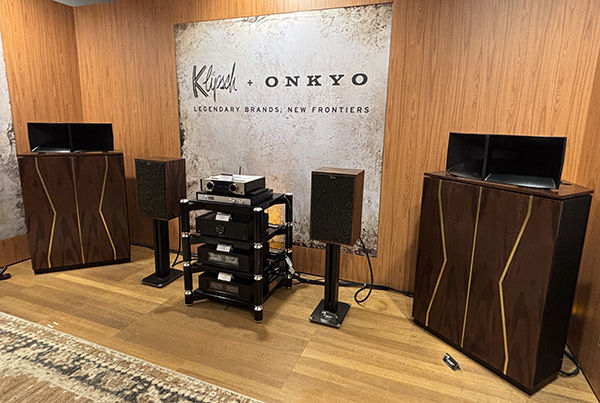
The 80th Anniversary, limited-edition Klipschorns.
I wondered how much better the speakers might have sounded driven by a good tube amp rather than the solid state Onkyos in the listening room. Every time I speak to chief engineer Roy Delgado, I try to convince him to pair the Heritage series speakers with tube amplifiers at audio shows, but Klipsch is a real company run by real businesspeople, and Roy just laughs at my retro foolishness in his easygoing, affable way.
Of course I looked in on the wizardly nerds, er, artisans, whose wares and spiritual-aesthetic pursuits are close to my own personal heart. Transformer guru Michael Ulbrich was manning a tiny room—or was it an alcove?—containing a static display of his new
dual-mono SUTs, which incorporate a "new development" that he was keeping to himself. Did I want to hear them, perhaps, Ulbrich wondered aloud in his unhurried Germanic cadences. I said yes faster than a duck running for a bowl of frozen peas.
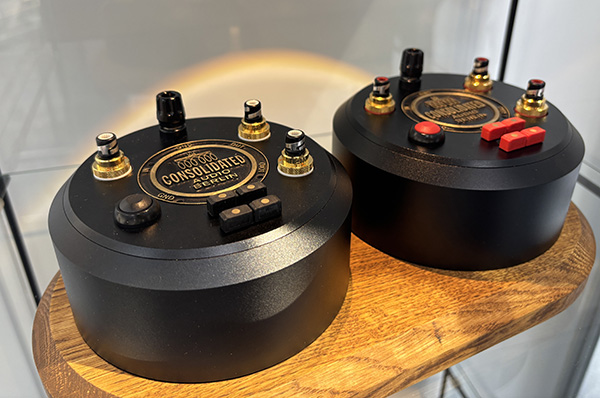
Michael Ulbrich's Consolidated Audio dual-mono SUTs.
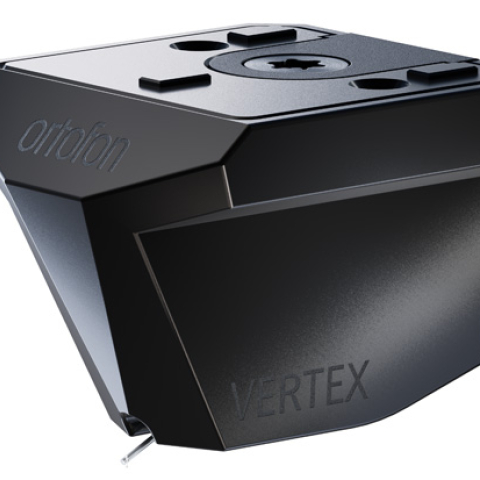
Sharing Ulbrich's purgatorial cubicle were fellow Berliners Hyun and Francesca Lee of Tedeska cartridges. I'd been trying to obtain a Tedeska review sample for, well, a substantial span, and my eyes must have widened with greed when Hyun produced a small wooden box containing a Tedeska Torres moving coil. More even than the cartridge's beauty—with its mother-of-pearl inlay and intricate woodwork, it resembles the work of a master luthier—I was charmed by the barely visible spiderweb pencil script outlining the specs covering the inside of the box. More on that cartridge soon.
What else did I see at High End Vienna? Well, there was Rick Rubin, looking like the world's oldest and most hirsute skater. At the Clearaudio exhibit I stood gaping in disbelief at a turntable emblazoned with the backlit, blood-red name of the German metal band Rammstein. I was mid–panic attack when a friend pulled me away from this frankly terrifying display.
And I was utterly charmed by the Little Fwend, an automatic tonearm lifter that must be one of the best-thought-out and cutest audio accessories I've seen. It was dreamed up by bearded Norwegian Lasse Gretland, who hosts a dinner he calls Friends of Fwend and was kind enough to help me find my way around the satellite shows. Thank you, Lasse.
Unsurprisingly, the seminar, party, and mobile museum that is the Silbatone room was in full effect at the ACV. As ever, presiding over the goings on was the always loquacious and mostly sober audio sage
Joe Roberts, while tonearm mavens Frank Schröder and Thomas Schick manned the turntables, and company chief and Audeum founder M.J. Chung conducted the presentations to the somewhat agog audiences. The century-old Western Electric speakers were just as eye- and ear-popping as in previous years—they sounded breathtaking—but for me the highlight took place outside the ACV, in a biergarten in Vienna's 9th district.
Before I tell you about it, I have a confession to make. I arrived in Vienna with my audio fuel tank running low. Writing is a solitary activity, and anyone who covers audio will tell you that some subjects are more inspiring than others. And then there's the pesky question of meaning: In a world that sometimes seems to be on the verge of splintering from rapid change, is it all that important that one speaker's soundstage is a little larger than another's? In other words, in 2026, where does writing about high-end consumer electronics fit into the job of being an informed, responsible human being?
I was marinating in these thoughts when I sat down with around 70 assorted audiophiles at the large dinner that my friend Christian Bayer, a journalist from Munich, hosts every year during the High End show. Around me were visitors from Korea, Germany, the Netherlands, Japan, the US, and who knows where else. Journalist Michael Vrzal was telling me about a group of hi-fi fanatics that meets every Thursday in Berlin. "We go to a restaurant or one of our homes," he told me. "It's not just about audio. We're good friends." He recalled how during a personally difficult time, the members of the audio group took care of him.
Many of the people he mentioned were sitting around us, engrossed in conversations and washing down the better-than-serviceable schnitzel with Czech-style pilsner. My friend Christian Bayer, a journalist from Munich, was talking to Frank Schröder. Across the table, a retired NATO official from Portugal who might not appreciate being named was asking me about something I'd written. Silbatone designer Dr. Stefano Bae was laughing with M.J. Chung. J.C. Morrison walked over to say hi. At the end of the table, Michael Ulbrich was contentedly puffing on a cigarette with his eyes closed, the smoke wafting into the darkening sky.
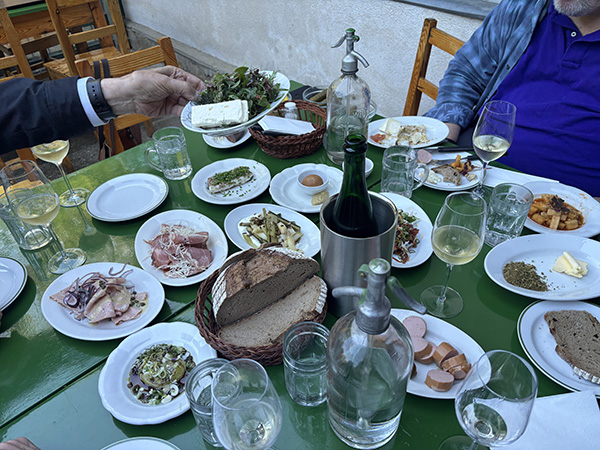
Cold supper at Jutta Ambrositsch's tavern in the Grinzing neighborhood of north Vienna.
The following night, some of us found ourselves at a heuriger—a kind of seasonal wine tavern—run by my friends Jutta and Marco. One of the best winemakers in Vienna, which has been a source of good wine since Roman times, Jutta Ambrositsch doesn't allow hired workers or other strangers to touch her grapes. She believes that they should be handled with love, so she only invites friends to work the harvest alongside her. At her tavern, in the Grinzing neighborhood in north Vienna, we sat on a terrace under a row of gnarled grapevines as the sun was setting and drank her brisk, precise field blends late into the night. A local law mandates that heurigers are allowed to serve only cold food, and we ate a salad of foraged herbs that tasted like they had been gathered earlier that day, perfectly smoked trout, a crusty loaf of rye, and mortadella so fragrant that I could smell it from across the courtyard.
Everyone was feeling so unlaced that when Jutta and Marco learned that my friend, Brooklyn saxophonist
Jerome Sabbagh, would be playing a concert with Vienna-based jazz pianist and composer Danny Grissett, they donated several cases of wine for the occasion. That concert took place in an event space above a piano showroom, and seemingly everyone I knew in Vienna showed up. Someone brought plastic cups because there were none at the space, and given that there was no staff, either, I worked the wine station, pouring several cases of Jutta's cold wine for the hot, thirsty attendees. The sound in the space was stupendous, and the loud applause reminded everyone that live music can make us feel things that no hi-fi can.
Afterwards, people milled around outside in the mild nighttime weather, not wanting to go back to their hotels. Sabbagh and I found a recycling bin for the empty wine bottles and sat down on a bench, a little wrung out. It occurred to me then that the point of being here had been under my nose all along. The reason why making, or selling, or writing about hi-fi gear matters, if it matters at all, is that it lets us feel less alone. Given that occasionally it amuses or briefly makes someone happy, you could say we do it for each other. Feeling relieved to have remembered this, I walked the long way back to my room.