I'm far too disorganized to have kept an accurate count, but I'm pretty sure that at this point in my life I have installed or adjusted well over 5000 phono cartridges. These days I work on three or four turntables in a typical week and have been doing that consistently for the last 40 years.
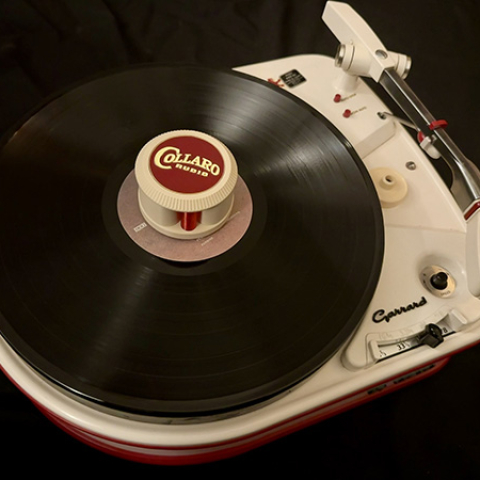
While many of those setups are now kind of a blur, I still clearly remember my very first cartridge installation job back in 1973, when I was 11. A new cartridge wasn't something my dad and I had planned on, but when we decided it was time to upgrade from our ancient Monacor SMX-50A tube receiver to a snazzy new Sony one, we were both blissfully unaware that the old Garrard Autoslim/P record changer's ceramic cartridge was incompatible with the Sony. We needed a magnetic cartridge, and as I was already showing a keen interest in audio, my dad left it up to me to figure it out.
I campaigned for a Shure cartridge, having read about the new and amazing V15 Type III, but my dad, ever the pragmatist, stuck with the guidance from his purchasing bible, Consumer Reports, and went for a cartridge from a British company called Goldring. I'd never heard of Goldring at the time, but I soon learned that it made its first electric phono pickup in 1935 and was manufacturing steel needles at least 19 years before Shure was founded.
With the Goldring G850 at hand, I went to work installing it in the Garrard's detachable headshell, and somehow managed to complete the task without breaking one of the clips or damaging the stylus. Available adjustments on the inexpensive Autoslim were essentially zero, with only a little thumb wheel that altered the tension in the spring that applied the downforce. I had no way to measure it, so I just twiddled the thumb wheel until it felt about right.
Despite its humble position near the bottom of Garrard's 1963 lineup, that old Autoslim was central to my childhood and adolescent musical explorations. The Autoslim was purchased by my dad when I was about two, and by age three I had figured out how to work the whole system and was starting to play records by myself. To prevent this, my parents moved everything to a shelf about four feet above the floor, at which point I learned to climb up on the bookcase so I could keep on spinning. Apparently my relationship with records and turntables started very early.
These days, I can't seem to get a straight answer as to whether Ortofon or Audio-Technica makes the most phono cartridges. Audio-Technica is the bigger company, certainly, but that's because in addition to cartridges, it makes headphones, micrphones, and turntables. Ortofon (footnote 1), on the other hand, is almost exclusively a cartridge company, catering to a very broad range of vinyl enthusiasts with the widest range of offerings. I counted 52 different basic models in its lineup including the variations available for some models and the club cartridges, which cater to the deejay and turntablist market.
In Ortofon's bread-and-butter ranges—the moving magnet 2M Series, the entry-level moving coil X Series, and the midpriced moving coil Cadenza Series—the pecking order is clearly laid out, with more exotic materials and stylus shapes as you move up each range. But once you get to the top-of-the-line Exclusive Series, it becomes more a mix of models that stand individually as unrelated designs, appealing to different kinds of listeners.
Before the new MC Vertex arrived as Ortofon's most ambitious cartridge to date, the top model was a cartridge called the MC Diamond, which itself was developed from a cartridge called the MC Anna first launched back in 2012. The MC Anna was named in tribute to Russian operatic soprano Anna Netrebko, and featured a drawing of her eyes peering back at you from the side of the cartridge body. A few years later, the MC Anna was upgraded with a diamond cantilever to become the MC Anna Diamond, but then Netrebko became a bit of a PR liability following the 2022 Russian invasion of Ukraine, due to her relationship with Russian President Vladimir Putin, and various statements she made, landing her on a lot of boycott lists in the West. Later in 2022, Ortofon introduced a second revision of the cartridge, and from that point it has been called the MC Diamond, with Anna's eyes no longer there peeking back at you.
 A new flagship
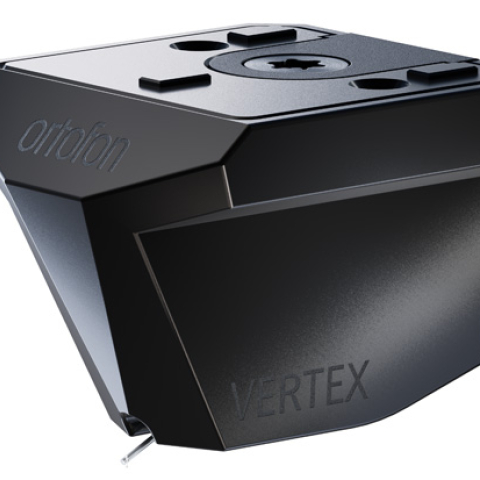
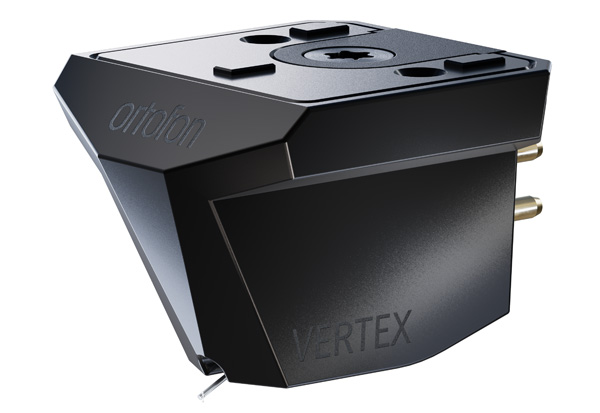
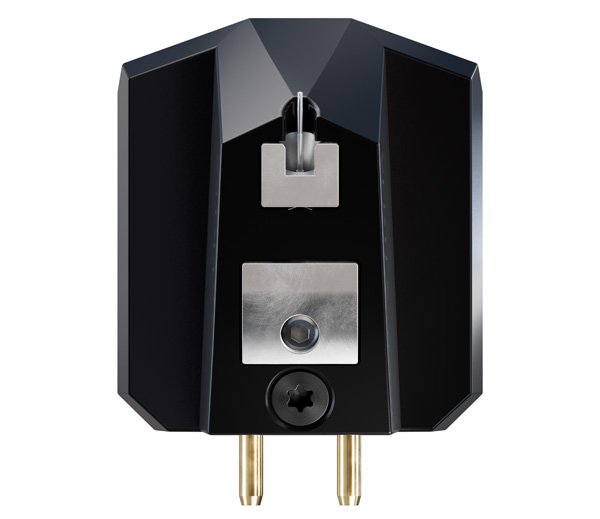
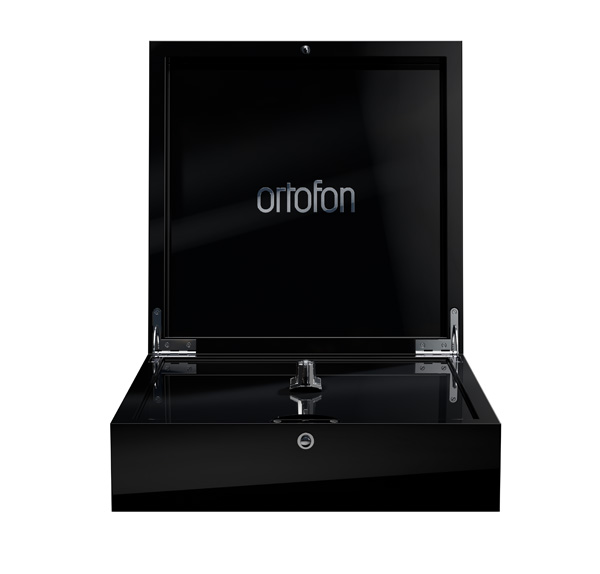
In June of this year at High End Vienna, the MC Vertex was launched as Ortofon's latest flagship model, taking all the experience gained over the years with the Anna and other top models (the Verismo, MC 90X), and rolling it all together along with some new tricks developed for this model. As with the MC Diamond, the cantilever is a solid lab-grown diamond, but while the MC Diamond uses a more traditional cemented nude mounting to attach the stylus to the cantilever, the Vertex stylus is inserted through a laser-cut hole in the cantilever. This ensures perfect and repeatable alignment both with respect to zenith and stylus rake angle.
This level of precision is especially important in light of the new stylus profile Ortofon has developed for the cartridge, which is also called Vertex. Ortofon's longstanding Replicant stylus has an extreme line contact profile, but the Vertex takes things up a notch by increasing the major radius to 110µm while reducing the minor radius to just 4µm. The result is a super tall and narrow contact area with the groove walls, promising intense levels of detail, but also increasing the importance of precise setup. For comparison, a typical elliptical stylus has radii of 18µm and 8µm. As with the Replicant stylus Ortofon continues to use on several models, the Vertex stylus's contact area is at the leading edge of the diamond, with a specified 23° VTA. This means the cartridge should be set level as a starting point before fine-tuning for any sample-to-sample variations. The review sample was spot on and needed neither SRA nor azimuth correction.
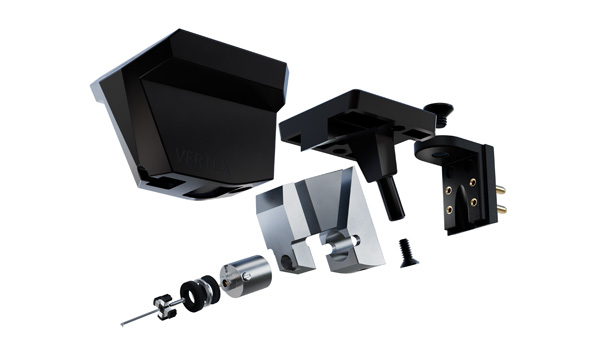 Internally, the Vertex uses pure silver wire in its coils, which are wound to provide a 0.3mV output, with an internal impedance of 19 ohms. That puts it right near the limit for compatibility with transimpedance phono stages, though I don't currently have one on hand to check. Using the more conventional voltage-drive Musical Fidelity Nu-Vista Vinyl S, I found that loading the Vertex at 400 ohms delivered the best results. The Vertex is a little heavy at 15gm, but its compliance is low at 9µm/mN, so a higher-mass arm is recommended. I used it in both the high-mass Esoteric TA-9D arm on the Esoteric Grandioso T1 turntable and in the medium-mass Brinkmann 10.5 arm on my Brinkmann La Grange turntable without encountering any problems. Ortofon makes special note of the Vertex's newly patented Wide Range Damping system, which uses new damping materials developed in-house. No doubt this helps with compatibility over a wider range of tonearms.
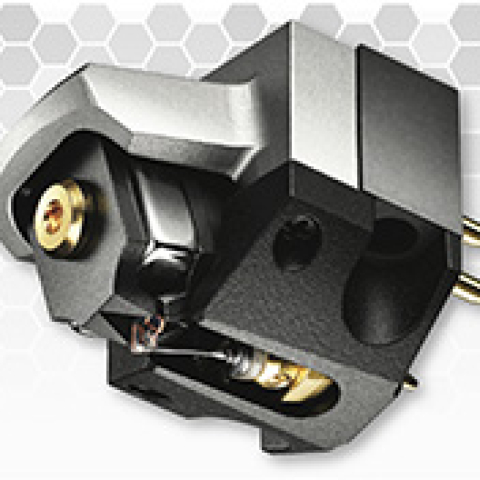
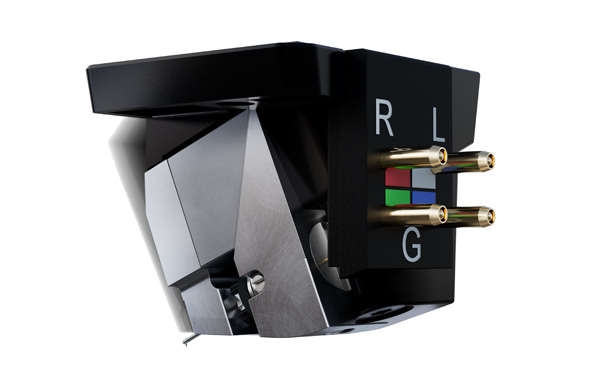 Moving away from the N-shaped structure Ortofon used for cartridges like the Verismo and MC 90X, the Vertex's body is actually somewhat reminiscent of the budget 2M models, mimicking the facets of a cut diamond. It is built from titanium using Ortofon's selective laser melting process and finished with a coating called DLC (diamond-like carbon), which has a satin, dark gray or black appearance that's very tough to photograph.
The Vertex costs just a penny less than $17,000, so protecting that fancy stylus from accidental damage is paramount. One day I plan to write about what I call housekeeper syndrome, and how stylus protector design can play a critical role in how long your cartridge lasts. Ortofon has a checkered history when it comes to stylus protection: I still cringe whenever I have to install the crazy protector the company came up with for the MC A90 cartridge, in 2009. The good news is that the Vertex's cover is Ortofon's best ever, with a clear plastic shell that gets pulled into position and held in place by a magnet, with little risk of an accident during installation.
Moving away from the N-shaped structure Ortofon used for cartridges like the Verismo and MC 90X, the Vertex's body is actually somewhat reminiscent of the budget 2M models, mimicking the facets of a cut diamond. It is built from titanium using Ortofon's selective laser melting process and finished with a coating called DLC (diamond-like carbon), which has a satin, dark gray or black appearance that's very tough to photograph.
The Vertex costs just a penny less than $17,000, so protecting that fancy stylus from accidental damage is paramount. One day I plan to write about what I call housekeeper syndrome, and how stylus protector design can play a critical role in how long your cartridge lasts. Ortofon has a checkered history when it comes to stylus protection: I still cringe whenever I have to install the crazy protector the company came up with for the MC A90 cartridge, in 2009. The good news is that the Vertex's cover is Ortofon's best ever, with a clear plastic shell that gets pulled into position and held in place by a magnet, with little risk of an accident during installation.
 But how does it sound? All this technology would be a waste if the Vertex failed to deliver the goods sonically. Thankfully that was never a concern. Tonally the Vertex is effectively neutral and through that neutrality it offers an illuminating level of insight into the recording being played. It's not an enveloping blanket of sound that makes you feel all warm and fuzzy inside, nor is it something that tosses tons of detail at you without context. It simply passes along the sound of the recording with exceptional clarity and focus.
A good demonstration of this can be heard on the track "Mishima/Opening" from Philip Glass's score for the movie Mishima (LP, Nonesuch 79113). Starting off with the quietest possible tinkling of some wind chimes, the track builds quickly, adding glockenspiel, strings, tubular bells, harp, bass drum, and eventually timpani until you're hearing a triple-forte blast that makes you feel like Maxell's Blown-Away Guy in the 1980s TV commercial. What's remarkable is not just how the Vertex can deliver the massive dynamic swings without breaking a sweat but also how natural and clear all the percussion instruments sounded. Those bells and chimes sounded real! The one strike against Mishima, an early digital recording, is that the strings can sound a bit threadbare. Played with the Vertex, I never found the record irritating, as the Vertex also allowed me to hear more of the texture and detail within the instruments than I'm accustomed to.
The Comsat Angels were one of the great post-punk bands of the early 1980s—think Joy Division meets U2—yet few people have even heard of them. Licensing disputes that have kept most of their music away from the popular streaming services haven't helped, nor has the name change to CS Angels, forced by a lawsuit from the Comsat Corporation. Their 1980 debut album, Waiting for a Miracle (LP, Polydor 2383-578), was a truly audacious starting point and one of the albums that seemed glued to my turntable's platter when I was at college. It was recorded in just 10 days, which seems to be the right amount of time to capture great sound but not enough time to muck it up too much. Despite the hasty recording process, Peter Wilson's production work is exceptional, and with the Vertex's ability to dig deeper into the low-level information, the subtleties of those little production details are laid bare. On "Total War," you hear not only the growl of bassist Kevin Bacon's (not THAT Kevin Bacon) bass, but also the lucidity of tone from each string. The Vertex truly lets you hear deep into the recording, but in a highly digestible way that's always coherent and eminently listenable.
But how does it sound? All this technology would be a waste if the Vertex failed to deliver the goods sonically. Thankfully that was never a concern. Tonally the Vertex is effectively neutral and through that neutrality it offers an illuminating level of insight into the recording being played. It's not an enveloping blanket of sound that makes you feel all warm and fuzzy inside, nor is it something that tosses tons of detail at you without context. It simply passes along the sound of the recording with exceptional clarity and focus.
A good demonstration of this can be heard on the track "Mishima/Opening" from Philip Glass's score for the movie Mishima (LP, Nonesuch 79113). Starting off with the quietest possible tinkling of some wind chimes, the track builds quickly, adding glockenspiel, strings, tubular bells, harp, bass drum, and eventually timpani until you're hearing a triple-forte blast that makes you feel like Maxell's Blown-Away Guy in the 1980s TV commercial. What's remarkable is not just how the Vertex can deliver the massive dynamic swings without breaking a sweat but also how natural and clear all the percussion instruments sounded. Those bells and chimes sounded real! The one strike against Mishima, an early digital recording, is that the strings can sound a bit threadbare. Played with the Vertex, I never found the record irritating, as the Vertex also allowed me to hear more of the texture and detail within the instruments than I'm accustomed to.
The Comsat Angels were one of the great post-punk bands of the early 1980s—think Joy Division meets U2—yet few people have even heard of them. Licensing disputes that have kept most of their music away from the popular streaming services haven't helped, nor has the name change to CS Angels, forced by a lawsuit from the Comsat Corporation. Their 1980 debut album, Waiting for a Miracle (LP, Polydor 2383-578), was a truly audacious starting point and one of the albums that seemed glued to my turntable's platter when I was at college. It was recorded in just 10 days, which seems to be the right amount of time to capture great sound but not enough time to muck it up too much. Despite the hasty recording process, Peter Wilson's production work is exceptional, and with the Vertex's ability to dig deeper into the low-level information, the subtleties of those little production details are laid bare. On "Total War," you hear not only the growl of bassist Kevin Bacon's (not THAT Kevin Bacon) bass, but also the lucidity of tone from each string. The Vertex truly lets you hear deep into the recording, but in a highly digestible way that's always coherent and eminently listenable.
 Just a few years ago, the mere idea of a cartridge with a five-figure price tag would have made us gasp, but now it seems all the major players at the top end of the cartridge market offer at least one. Ortofon has rolled a lot of its latest thinking into the Vertex, and the results are remarkable. I've always found the Danes a straightforward bunch, and the Vertex, made by Danes in Denmark, follows that thinking. It shows no favoritism. It just tells you more about what's embedded in the grooves of your records. If you can swing just a penny shy of $17,000 to go there, I'm certain you won't be disappointed.
 How to break in a cartridge
And now for something completely different. One question I am often asked when installing a new cartridge is how long it will take to break in. My usual answer is that break-in happens on a logarithmic curve. A new cartridge will sound excellent right out of the box, let's say 90% of its potential performance, and it will settle in quickly at first, getting to 95% after the first hour, and 99% after five hours. It's that last 1% that takes the longest, and it could be 50 hours before you finally reach its full performance potential. This has never bothered me during my own listening at home, and
I enjoy listening to how the sound of a new cartridge changes over time. But now that I'm reviewing more cartridges, I find I need a way to speed up that process, so I don't have to play 60 albums before I'm ready to sit down and listen critically.
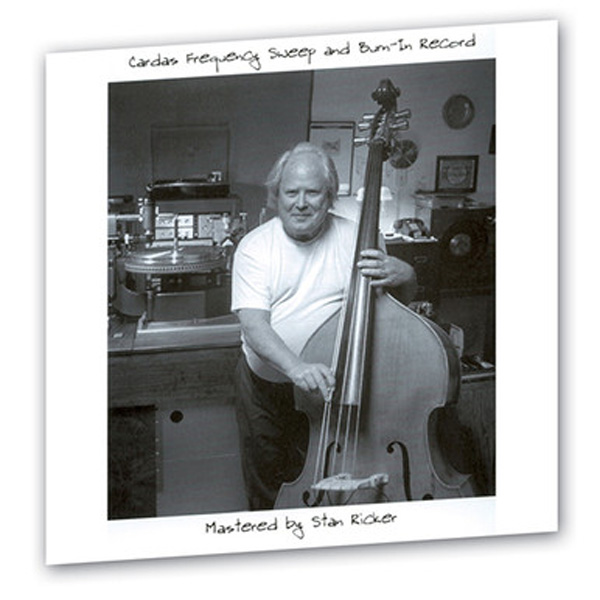 Over the years, I have used the locked pink noise grooves on the Cardas Frequency Sweep and Burn-in Record to speed up the process. You can just leave the cartridge playing a locked groove for a couple of hours to move the break-in process along, but I feel that using actual music with varying groove modulation and pitch is preferable. The problem is that almost all high end turntables are completely manual, so you have to remember to go and start the side over every 20 minutes or so, or you'll be listening to the repeated shlumpf ... shlumpf ... shlumpf as the unattended stylus rides repeatedly through the lead-out groove.
Arm lifters have been around for at least a half-century, but in the past I have rejected them as fiddly to adjust, prone to lifting early, and ultimately unnecessary. Back in the 1970s, I tried using one made by a company called Bib on the Autoslim, but I soon gave up after it triggered itself in the middle of Led Zeppelin's "Going to California" one too many times.
Most of the current crop of lifters seem to be based on the Audio-Technica AT6006 Safety Raiser, a design that dates back to the 1970s. A lifting bar similar to the cueing arm on the tonearm rises vertically on a hydraulic piston once the tonearm hits a vertical tripwire as it nears the record's lead-out groove. The tricky part is getting it positioned and adjusted so that it trips at exactly the right point, not so early that it lifts before the music ends on a long side cut close to the record label, and not too late.
Over the years, I have used the locked pink noise grooves on the Cardas Frequency Sweep and Burn-in Record to speed up the process. You can just leave the cartridge playing a locked groove for a couple of hours to move the break-in process along, but I feel that using actual music with varying groove modulation and pitch is preferable. The problem is that almost all high end turntables are completely manual, so you have to remember to go and start the side over every 20 minutes or so, or you'll be listening to the repeated shlumpf ... shlumpf ... shlumpf as the unattended stylus rides repeatedly through the lead-out groove.
Arm lifters have been around for at least a half-century, but in the past I have rejected them as fiddly to adjust, prone to lifting early, and ultimately unnecessary. Back in the 1970s, I tried using one made by a company called Bib on the Autoslim, but I soon gave up after it triggered itself in the middle of Led Zeppelin's "Going to California" one too many times.
Most of the current crop of lifters seem to be based on the Audio-Technica AT6006 Safety Raiser, a design that dates back to the 1970s. A lifting bar similar to the cueing arm on the tonearm rises vertically on a hydraulic piston once the tonearm hits a vertical tripwire as it nears the record's lead-out groove. The tricky part is getting it positioned and adjusted so that it trips at exactly the right point, not so early that it lifts before the music ends on a long side cut close to the record label, and not too late.
 Say hello to my Little Fwend
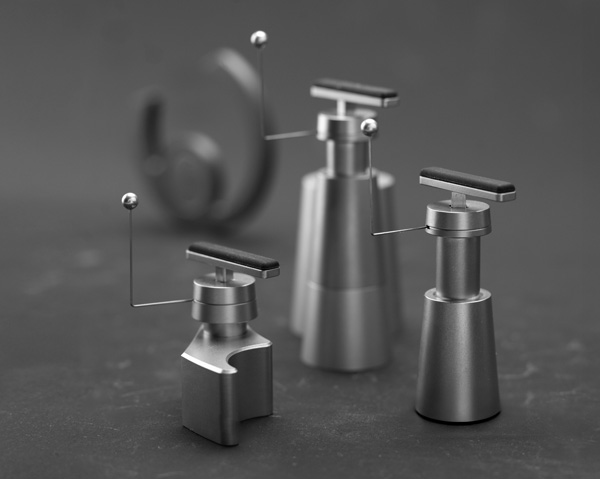
Lasse Gretland, owner of the lifter company with the somewhat silly name Little Fwend (footnote 2), offered me a couple of his lifters to try out. The High Mk2 has the correct range of adjustment for my Brinkmann La Grange turntable, while the Disco Mk3 is made for use with the Technics SL-1200 Series turntables. While the Disco has a base that's preshaped to fit in the perfect spot on a Technics, I found that the universal model required a little experimentation to determine the perfect location, rotation, and height. The difference in lifter-bar height between the play setting with the bar locked down and the raised position is small, so the setup needs some finesse. One feature I really liked is how once you've determined the perfect spot, you can attach a small steel disc to your plinth that the lifter sticks to using a magnet in its base. That makes it easy to remove the lifter and set it aside when you just want to play records, and then snap it back into the correct position when needed. I found the Little Fwend to be very nicely made, easy to adjust, and best of all it didn't lift once in the middle of a record side. The Little Fwend sells for between $249 and $279 depending on which version you need, which seems like a fair price for added peace of mind.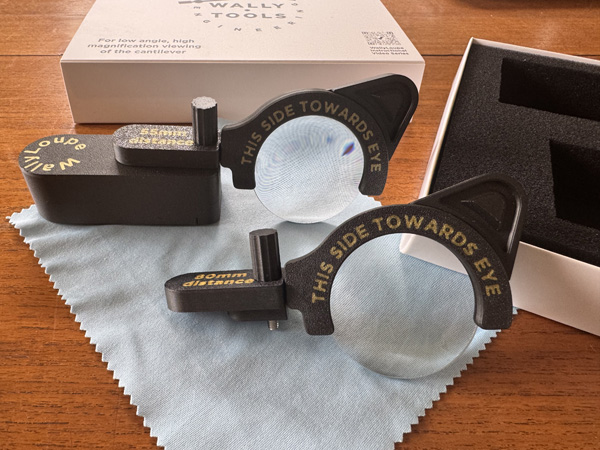 The WAM Engineering WallyLoupe
I'm always on the lookout for new and better tools to help with my installations, and over the years WAM Engineering, aka WallyTools, has made some of the most innovative aids to help nail the setup (footnote 3).
One of the most important things when you're aligning a cartridge is the ability to see everything clearly, and that means using a magnifier to clarify the tiny stylus and cantilever against the protractor you are using.
About 10 years ago, I was asked to set up a VPI turntable with a Soundsmith cartridge for one of the fancy demonstration rooms at the AXPONA show, and I was kind of surprised when I arrived to find both Soundsmith's head honcho Peter Ledermann and VPI President Mat Weisfeld already sitting in the room. I'm thinking, why would they hire me to do the install when they have the men who built the equipment sitting right there? Anyway, I proceeded with my normal setup methods and tools, and when I pulled out my folding linen-tester magnifier, Ledermann became curious. Linen testers were originally used to warp and weft in linen fabric. I invited Ledermann over to take a look, and when he saw how clear everything was, he remarked, "Where has this thing been all my life?"
I have been using linen testers for more than 30 years, and I figured everyone already knew about them. The Acoustical Systems SMARTractor comes with one as part of its kit, so they're out there. But we are audiophiles, so it seemed inevitable that someone would make an audiophile linen tester, which is essentially what the WallyLoupe is.
Housed in a plastic storage box about the size of a brick, the $195 WallyLoupe kit includes two magnifying lenses, a base to support them, and a cleaning cloth. The standard lens has a focal length of a little over 2", which is perfect for most cartridges where the cantilever is openly visible from the front. The second lens sits farther away at around 3½", with the idea that this makes it easier to see under the bodies of cartridges where the stylus tip is set farther back. The wood-body Grado cartridges are notoriously difficult, although a recent revision has raised the lower edge of the body at the front.
WAM Engineering's JR Boisclair points out that cheap linen testers can suffer from a lot of spherical lens aberration, causing the grid lines on the protractor to appear bent as you get toward the edge of the lens, and this is certainly true. The WallyLoupe's lenses suffer far less from this problem, but are not immune. My main difficulty with the WallyLoupe is its larger physical size. With a linen tester, I can move it to the side of the protractor to help set the overhang using my favored tool, the Feickert NG protractor, but the WallyLoupe is simply too large to fit along the edge of the platter. Using it for the front view to line up the cantilever to the grid was definitely its best role, with a clearer and less distorted view than the linen tester. The WallyLoupe is clearly a step forward in precision for setting zenith angle perfectly, but I'm still going to hang on to my linen tester to get that side-on overhang view.
Footnote 1: Ortofon A/S, Stavangervej 9, DK-4900 Nakskov, Denmark. Web: ortofon.com. US distributor: Ortofon Inc., 500 Executive Blvd., Suite 102, Ossining, NY 10562. Tel: (914) 762-8646. Email: support@ortofon.us.
Footnote 2: Little Fwend, Jens Bjelkesgate 47B, 0578 Oslo, Norway. Email: info@littlefwend.com. Web: littlefwend.com. US distributor: MoFi Distribution, 1811 W. Bryn Mawr Ave., Chicago, IL 60660, USA. Email: sales@mofidistribution.com. Web: mofidistribution.com.
Footnote 3: WAM Engineering, Santa Rosa, CA. Tel: (707) 210-6345. Web: wallyanalog.com.
A new flagshipIn June of this year at High End Vienna, the MC Vertex was launched as Ortofon's latest flagship model, taking all the experience gained over the years with the Anna and other top models (the Verismo, MC 90X), and rolling it all together along with some new tricks developed for this model. As with the MC Diamond, the cantilever is a solid lab-grown diamond, but while the MC Diamond uses a more traditional cemented nude mounting to attach the stylus to the cantilever, the Vertex stylus is inserted through a laser-cut hole in the cantilever. This ensures perfect and repeatable alignment both with respect to zenith and stylus rake angle.
Internally, the Vertex uses pure silver wire in its coils, which are wound to provide a 0.3mV output, with an internal impedance of 19 ohms. That puts it right near the limit for compatibility with transimpedance phono stages, though I don't currently have one on hand to check. Using the more conventional voltage-drive Musical Fidelity Nu-Vista Vinyl S, I found that loading the Vertex at 400 ohms delivered the best results. The Vertex is a little heavy at 15gm, but its compliance is low at 9µm/mN, so a higher-mass arm is recommended. I used it in both the high-mass Esoteric TA-9D arm on the Esoteric Grandioso T1 turntable and in the medium-mass Brinkmann 10.5 arm on my Brinkmann La Grange turntable without encountering any problems. Ortofon makes special note of the Vertex's newly patented Wide Range Damping system, which uses new damping materials developed in-house. No doubt this helps with compatibility over a wider range of tonearms.
Moving away from the N-shaped structure Ortofon used for cartridges like the Verismo and MC 90X, the Vertex's body is actually somewhat reminiscent of the budget 2M models, mimicking the facets of a cut diamond. It is built from titanium using Ortofon's selective laser melting process and finished with a coating called DLC (diamond-like carbon), which has a satin, dark gray or black appearance that's very tough to photograph.
But how does it sound? All this technology would be a waste if the Vertex failed to deliver the goods sonically. Thankfully that was never a concern. Tonally the Vertex is effectively neutral and through that neutrality it offers an illuminating level of insight into the recording being played. It's not an enveloping blanket of sound that makes you feel all warm and fuzzy inside, nor is it something that tosses tons of detail at you without context. It simply passes along the sound of the recording with exceptional clarity and focus.
A good demonstration of this can be heard on the track "Mishima/Opening" from Philip Glass's score for the movie Mishima (LP, Nonesuch 79113). Starting off with the quietest possible tinkling of some wind chimes, the track builds quickly, adding glockenspiel, strings, tubular bells, harp, bass drum, and eventually timpani until you're hearing a triple-forte blast that makes you feel like Maxell's Blown-Away Guy in the 1980s TV commercial. What's remarkable is not just how the Vertex can deliver the massive dynamic swings without breaking a sweat but also how natural and clear all the percussion instruments sounded. Those bells and chimes sounded real! The one strike against Mishima, an early digital recording, is that the strings can sound a bit threadbare. Played with the Vertex, I never found the record irritating, as the Vertex also allowed me to hear more of the texture and detail within the instruments than I'm accustomed to.
Just a few years ago, the mere idea of a cartridge with a five-figure price tag would have made us gasp, but now it seems all the major players at the top end of the cartridge market offer at least one. Ortofon has rolled a lot of its latest thinking into the Vertex, and the results are remarkable. I've always found the Danes a straightforward bunch, and the Vertex, made by Danes in Denmark, follows that thinking. It shows no favoritism. It just tells you more about what's embedded in the grooves of your records. If you can swing just a penny shy of $17,000 to go there, I'm certain you won't be disappointed.
How to break in a cartridgeAnd now for something completely different. One question I am often asked when installing a new cartridge is how long it will take to break in. My usual answer is that break-in happens on a logarithmic curve. A new cartridge will sound excellent right out of the box, let's say 90% of its potential performance, and it will settle in quickly at first, getting to 95% after the first hour, and 99% after five hours. It's that last 1% that takes the longest, and it could be 50 hours before you finally reach its full performance potential. This has never bothered me during my own listening at home, and
Over the years, I have used the locked pink noise grooves on the Cardas Frequency Sweep and Burn-in Record to speed up the process. You can just leave the cartridge playing a locked groove for a couple of hours to move the break-in process along, but I feel that using actual music with varying groove modulation and pitch is preferable. The problem is that almost all high end turntables are completely manual, so you have to remember to go and start the side over every 20 minutes or so, or you'll be listening to the repeated shlumpf ... shlumpf ... shlumpf as the unattended stylus rides repeatedly through the lead-out groove.
Arm lifters have been around for at least a half-century, but in the past I have rejected them as fiddly to adjust, prone to lifting early, and ultimately unnecessary. Back in the 1970s, I tried using one made by a company called Bib on the Autoslim, but I soon gave up after it triggered itself in the middle of Led Zeppelin's "Going to California" one too many times.
Say hello to my Little FwendLasse Gretland, owner of the lifter company with the somewhat silly name Little Fwend (footnote 2), offered me a couple of his lifters to try out. The High Mk2 has the correct range of adjustment for my Brinkmann La Grange turntable, while the Disco Mk3 is made for use with the Technics SL-1200 Series turntables. While the Disco has a base that's preshaped to fit in the perfect spot on a Technics, I found that the universal model required a little experimentation to determine the perfect location, rotation, and height. The difference in lifter-bar height between the play setting with the bar locked down and the raised position is small, so the setup needs some finesse. One feature I really liked is how once you've determined the perfect spot, you can attach a small steel disc to your plinth that the lifter sticks to using a magnet in its base. That makes it easy to remove the lifter and set it aside when you just want to play records, and then snap it back into the correct position when needed. I found the Little Fwend to be very nicely made, easy to adjust, and best of all it didn't lift once in the middle of a record side. The Little Fwend sells for between $249 and $279 depending on which version you need, which seems like a fair price for added peace of mind.
The WAM Engineering WallyLoupeI'm always on the lookout for new and better tools to help with my installations, and over the years WAM Engineering, aka WallyTools, has made some of the most innovative aids to help nail the setup (footnote 3).
Footnote 1: Ortofon A/S, Stavangervej 9, DK-4900 Nakskov, Denmark. Web: ortofon.com. US distributor: Ortofon Inc., 500 Executive Blvd., Suite 102, Ossining, NY 10562. Tel: (914) 762-8646. Email: support@ortofon.us.