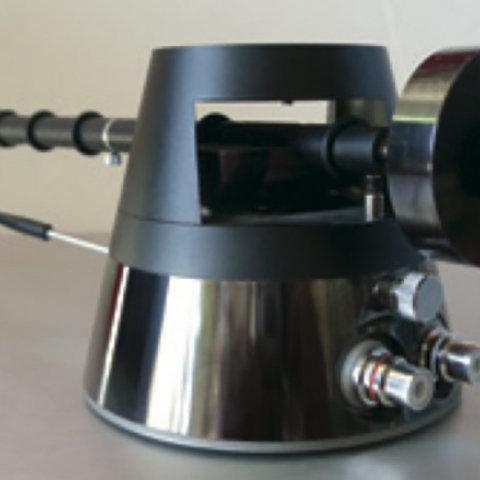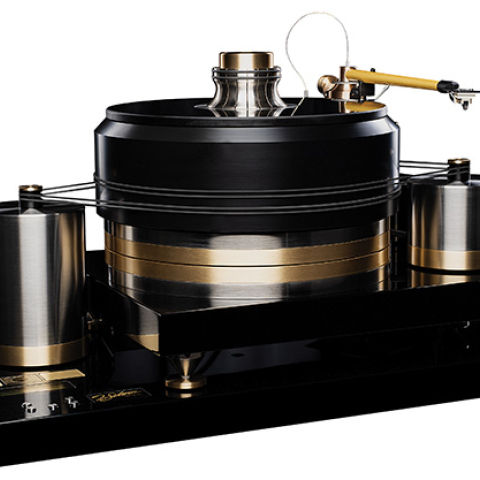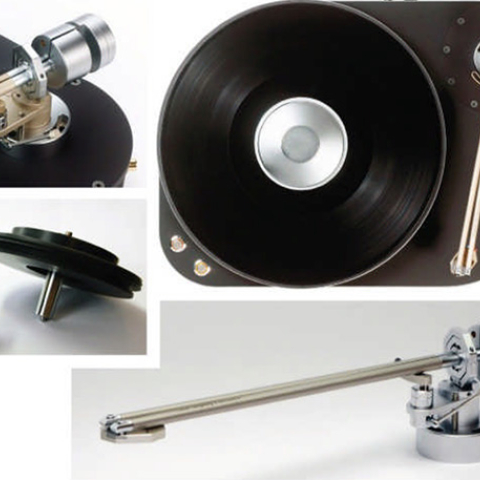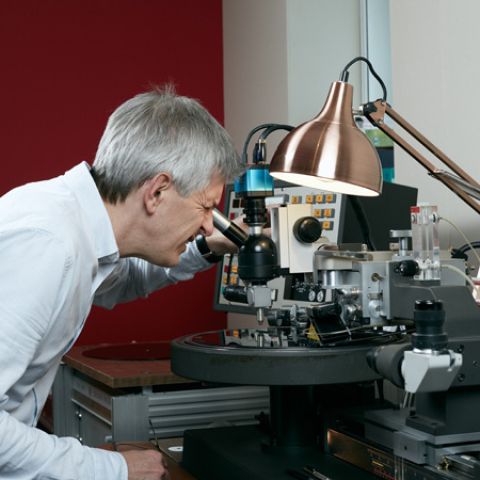

Clearaudio's origin story dates from the depths of the Cold War, in Czechoslovakia. It was 1968, and the Prague Spring uprising against the Soviet Union had collapsed (footnote 1). A young man escaped the carnage on a motorcycle, crossing the Iron Curtain into West Germany. That young man, Peter Suchy, went on to found Clearaudio, maker of turntables, tonearms, phono cartridges, preamps, and associated equipment, in 1978. His children, Robert, Patrick, and Veronika, run it today.
Back in Czechoslovakia, a manufacturing plant of the state-owned electronics conglomerate Tesla, located in the town of Litovel, produced hi-fi gear including turntables from the 1950s until after the fall of the Iron Curtain. In 1986, the Tesla NC 500 belt-drive turntable premiered (footnote 2). Its design was simple but effective: a wooden plinth with an AC motor isolated by rubber mounting washers, a straight tonearm with an SME-like bearing design and string-hung antiskate weight, a light alloy platter and subplatter. It was unadorned and compact to the point that it looked sleek and modern. To change rotation speeds from 33 1/3 to 45, it was necessary to lift the platter off and move the drive belt from one pulley to another. This was record-playing stripped to its bare essentials.
By 1990, following Czechoslovakia's Velvet Revolution and the collapse of the Soviet bloc, demand for traditional consumer electronics had plummeted, and the Tesla enterprise faced bankruptcy. Heinz Lichtenegger, founder and owner of Austria's Pro-Ject Audio, visited the Litovel plant, SEV Litovel, recognized the value of its skilled workforce and the institutional memory formed over decades of turntable manufacturing, and persuaded the factory's management to stay open and keep making turntables. He partnered with the factory to launch the Pro-Ject 1, which was similar to the Tesla NC 500 but with improvements and modernizations. Former Tesla management, led by Jiří Mencl, bought the plant.
Today, SEV Litovel manufactures turntables and electronics for Pro-Ject and serves as an OEM manufacturer for other turntable makers, including Clearaudio.
Entry-level record-playing, Clearaudio style
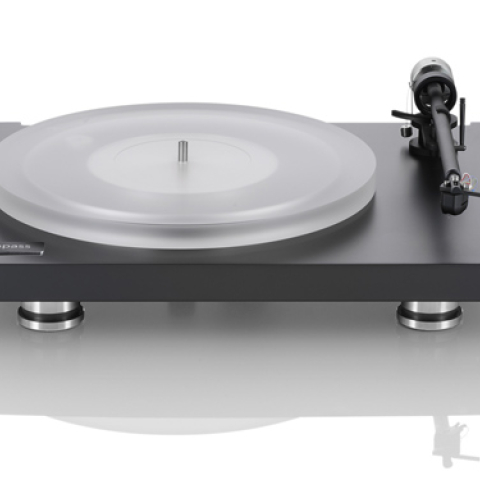
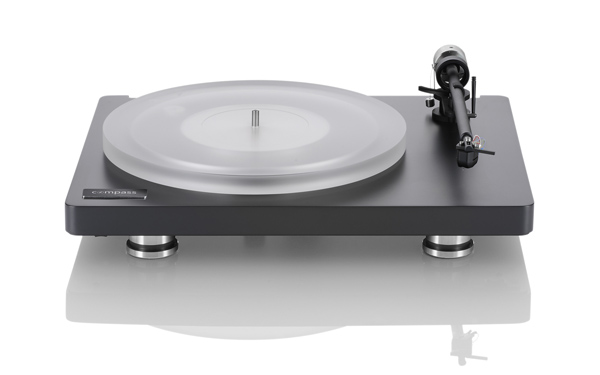
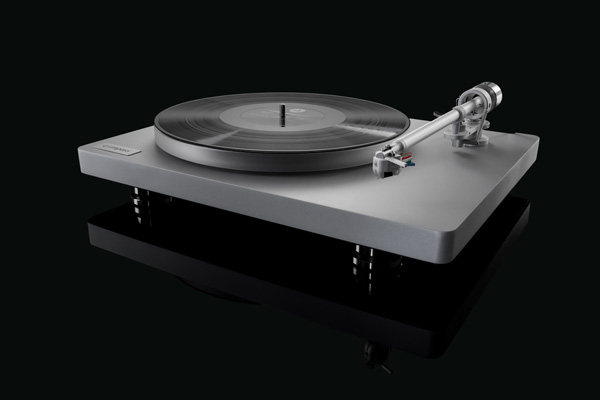
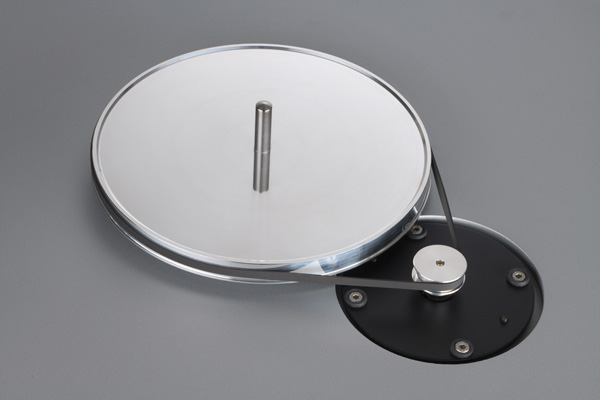
The Compass is Clearaudio's entry-level audiophile record player (footnote 3). Its medium-density fiberboard plinth, DC motor and drive electronics, aluminum subplatter, acrylic platter, flat rubber belt, and hinged dustcover are made at SEV Litovel. Its platter bearing, described by Clearaudio as a "polished and hardened steel spindle in a bronze bushing, running on a Teflon thrust pad," the included T1 tonearm, and N1 moving magnet cartridge are made at Clearaudio's factory in Erlangen, Bavaria, Germany. Final assembly takes place in Erlangen. The Compass could be considered a direct descendant of the Tesla NC 500: belt drive; simple, compact one-piece plinth, start-stop switch on its underside; straight tonearm. The Compass's design is more refined, its motor system more precise, its resonance damping more effective, its tonearm more Clearaudio than vintage SME; its platter and subplatter are machined to modern, exacting tolerances. It's a good idea taken forward through several generations of improvement and modernization.
The Compass's 12V DC motor is powered by a globally compatible wall-wart power supply, which plugs in to the back of the plinth. A rocker switch under the plinth's front left pivots left for 33 1/3rpm, center for OFF, and right for 45rpm. On the Compass, you don't need to remove the platter to change the speed. Clearaudio added a steel plate under the MDF plinth for added stiffness and resonance control. The four height-adjustable vibration-isolation feet are made by Clearaudio.
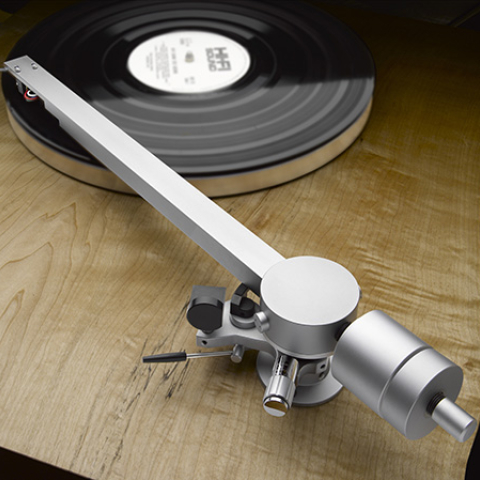
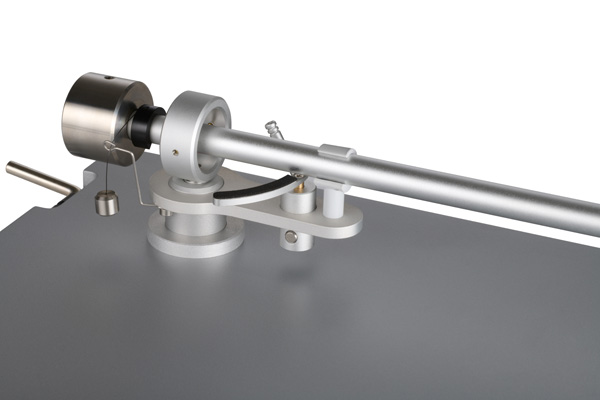 The T1 tonearm and N1 cartridge were designed for the Compass. The company describes the T1 as "a compact version of our proven Satisfy tonearm"; it's a radial-bearing design using precision sapphire bearings. Whereas the Satisfy uses a magnetic antiskate system, the T1 uses the traditional string-and-weight system—simple but effective, which is why it is widely used. The bearing housing, counterweight, and tonearm tube are aluminum. Clearaudio's own Direct Wire PLUS wire runs 1.1m (about 3' 7") from the cartridge connectors to the RCA output plugs.
Garth Leerer, president of Musical Surroundings, Clearaudio's US importer, elaborated on the tonearm differences: "The T1 bearing housing is a smaller size, but the bearing is the same as used in the Satisfy: a three-point bearing with two tungsten carbide points into ruby thrust pads for the vertical axis and one tungsten carbide point into a ruby thrust pad for horizontal." The T1 has a "slightly shorter overall length—301mm for T1 and 305mm for Satisfy—but the same pivot-to-spindle [distance] of 222mm and the same offset angle."
The supplied N1 moving magnet cartridge features a bonded elliptical stylus on an aluminum cantilever, housed in an aluminum body. The stylus assembly is replaceable. Its output—2.9mV—is somewhat low for an entry-level MM cartridge compared, for example, to the Ortofon 2M Red, included on several Technics turntables including the entry-level SL-50C, which has an output level of 5.5mV. Connected to several preamps in my systems, I found that I turned the listening volume up more with the N1 than with most of my other MM cartridges, but it did not present any problems. In contrast to many (but not all) of today's entry-level audiophile turntables, the Compass lacks an onboard phono preamp. That's a reasonable judgment, since I've found the phono preamp to be a particularly weak point in entry-level turntables that have one.
 Regarding the N1, Clearaudio Managing Director Robert Suchy told me: "The MM generator, cantilever, and stylus are based on our ... MM cartridges, including the Virtuoso, Maestro, and Charisma. Most cartridges in the price range of the N1 [US retail about $175] use a plastic body, which does very little to control vibrational energy. ... We designed the CNC-machined aluminum body of the N1 cartridge for dynamics and clarity that complement the Compass's performance. The N1 is created with precision assembly in our German factory." (footnote 4)
Leerer said the N1's lower output level reflects its design goal of "lowering moving mass and controlling magnetic saturation of the generator." He added that most modern MM preamps provide 40dB gain; older designs had around 34dB of gain. "This gain structure works well with this output level. All Clearaudio MM cartridges are typically 3.6mV or less."
Suchy told me in an email, "There are a lot of turntables in this price region, including models made in the UK and Asia. With the proven platter and tonearm-bearing designs used in the Compass, it should set a new standard for musicality, dynamics, and imaging in this class." That's an ambitious goal.
 Setup and first spins
The Compass I reviewed was black—it is also available in silver, and there's now a multicolored "GT" version aimed at gamers (footnote 5). It arrived double-boxed in sturdy cardboard. Nested in layers of protective cardboard in a logical order, it was not too complicated to unpack. As is often the case today, there wasn't a printed manual in the box but rather a QR code that links to the manual online. I downloaded and printed the PDF because I wanted to get it set up exactly as intended; having an ink-on-paper checklist at hand helped with that.
The box held 10 things: the basic turntable (plinth, subplatter, tonearm, premounted cartridge), the platter, a simple "seesaw" tracking-weight scale, a set of three small Allen wrenches (for tonearm adjustments, should the user choose to swap in a different cartridge), a small Phillips screwdriver, the clear plastic dustcover, the flat rubber belt, the wall-wart power supply, the clip-on anti-skate string and weight, and the stainless steel counterweight.
One of the advantages of the Tesla NC 500's progeny, from Clearaudio, Pro-Ject, and others, is that they're easy to set up. In the case of the Compass, all that's needed is to place the basic turntable on a flat, stable surface; install the belt; lower the platter onto the subplatter; install the antiskate weight and feed the string through a bracket hanging off the tonearm tube; install the counterweight; use the seesaw tracking weight gauge to adjust the counterweight to 2.2gm tracking force and tighten the Allen screw on the counterweight to hold it in place; connect the power supply; and spin records. Clearaudio recommends playing recordings with the dustcover removed. It's easy to lift the dustcover off the hinged stainless steel pegs connecting it to the turntable and easy to put it back on when not playing records.
 I first connected the Compass to my office system (McIntosh MA6500 integrated amplifier with built-in phono preamp feeding Amphion One18 speakers set up nearfield to my desk) and spun some familiar records. Over a few days of listening, I found that this belt-drive turntable didn't sound sluggish or dull, meaning that the motor is up to the job, the turntable bearing isn't producing enough friction to matter, and the system is designed to move the grooves past the stylus steadily and accurately. I couldn't hear any "haze"—a nice accomplishment for the inexpensive cartridge in particular—or anything else interfering with the beat and pacing. I had to turn the volume up quite a bit for the low-output cartridge, but I heard no hum or hiss even at the higher amplification level.
I was impressed by how carefully Clearaudio thought this system out: The cartridge tracking weight was exactly aligned with the preset antiskate system, and setup was the only time anything needed to be adjusted. Play records and enjoy. The factory settings were fine with several records I know are challenging to track—for instance, the long-duration, loudly cut sides on Bob Ludwig's original cut of the Rolling Stones' Tattoo You (Rolling Stones Records COC 16052, 1981). I heard no midrange rattle or treble buzz at the end of "Neighbours" (side A) or "Waiting on a Friend" (side B).
With some records, I was reminded of the punchy, fun sound of the Technics SL-50C, a lower-priced, entry-level audiophile record player of totally different design, with a different bonded-elliptical MM cartridge (the aforementioned Ortofon 2M Red). I thought, it's great that two companies with good engineers approached the idea of a high-quality starter turntable in different ways, and both got results that are fun and lively, and will no doubt bring some people who already know what good hi-fi sounds like into the vinyl fold. There are many ways to skin a cat. (Just to be clear, this dog lover would never skin or otherwise hurt a cat!)
In the reference system
When I connected the Compass to my full-range reference system—Pro-Ject Phono Box RS2 phono preamp, Benchmark LA-4 preamp, Benchmark AHB2 power amp, Bowers & Wilkins 808 speakers—I had two goals in mind. The first, obviously, was to listen to Clearaudio's record player in a highly revealing, full-range environment. The second was to compare its speed accuracy, consistency, and drive to two more expensive direct-drive turntables: the Technics SL-1200GME and Thorens TD 404 DD. My audio buddies—Mike, Dave, and Farrukh—joined me for an afternoon of record spinning.
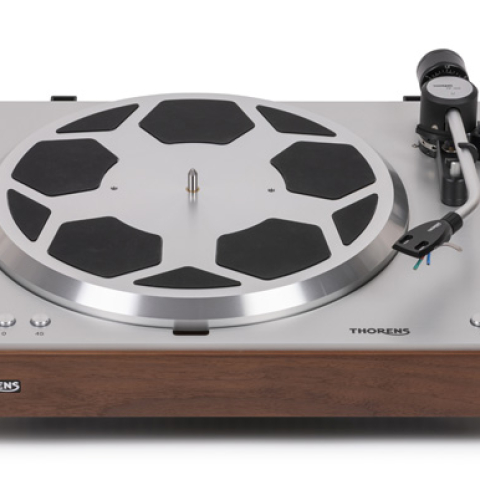
We were all pleasantly surprised by how well the Clearaudio Compass brought PRaT (pacing, rhythm, and timing) excitement to anything we played. It was not quite as punchy and precise as the Technics, but it was better in this respect than the Thorens with its standard wall-wart DC power supply. In fact, the superior peppiness of the Compass led me to quickly swap in Thorens's optional linear power supply, which greatly improved that turntable's snap and punch. All that was detailed in my review of the TD 404 DD.
 One of our baseline reference tracks for cartridges and turntables is "The Hawk Talks" on Duke's Big 4 (Pablo-Analogue Productions 2310 703). If Louis Bellson's drums don't sound like they are in the room—if the bass drum sound doesn't include both the pop of impact and the ringing of the drum body—then the record isn't being played well. The Compass brought forth those details perfectly, and the snap of Bellson's snare was quick and meaty. This confirmed my earlier impressions that Clearaudio thought through how much motor power, belt tension, and other mechanical tolerances would be needed for unsluggish playback and brought it all to the party.
I found that the Clearaudio's feet provided adequate isolation from floor vibrations, but if I knocked with some but not much force on my Butcher Block Acoustics rack, the sound transmitted through the feet and to the record-playing parts. Similarly, the top of the plinth was lively; a gentle finger tap was easy to hear. So you probably should place this turntable well away from speakers, and if your floor is soft, give some thought to the best ways to isolate it from footfalls. It may well benefit from a wall-mounted turntable shelf, an isolation platform, or Michael Trei's trick of wedging something between the top of the rack and the wall behind it.
In the junior system
For most of my listening time with the Compass, it was connected to my junior system: Onkyo Icon A-50 streaming integrated amplifier with its built-in phono preamp feeding KEF LS50 Meta speakers and a KRK Rokit 10s subwoofer. This level of system—not super-expensive but of high quality and able to fill a moderate-size room with full-frequency, dynamic sound—is perfect for testing a starter-level audiophile record player. In this system, seated in my comfortable recliner, I enjoyed many hours of vinyl bliss. Here are some highlights: The folks at Universal Music were kind enough to send me a test pressing of the Definitive Sound Series all-analog one-step reissue of Hole's Live Through This (LP, DGC 7924). This reissue was cut by Chris Bellman at Bernie Grundman Mastering and pressed at RTI in California, from a master tape recently rediscovered in a storage locker by the group's cofounder and original lead guitarist, Eric Erlandson. This is a foundational grunge album, also a great rock album, with frontwoman Courtney Love's performance in league with peak-era Joan Jett and Chrissie Hynde. Her musical expression of highly distilled feminine rage is unsettling but exciting, similar in effect to the first time I heard Alanis Morissette's Jagged Little Pill. Soundwise, this LP bests the original CD by a mile.
Muddy Waters—Brass and the Blues (LP, Chess-Analogue Productions LPS 1507). I had my doubts. The concept—pairing OG electric bluesman Muddy with brass sections and arrangements by Gene Barge and Charles Stepney—seemed forced. Contrived. I should have known that the folks at Chess Records wouldn't let the blues go too far astray. Recorded in June 1966 at the company's Ter Mar Studios, the sound isn't hi-fi, exactly, but it's plenty lively. Musically, it's more South Side than 52nd Street, more bite than swing. Matt Lutthans's mastering sounded great, and QRP's pressing was flawless.
Howlin' Wolf—(LP, Chess-Analogue Productions 1469, the album with the rocking chair on the cover). This collection of Wolf 's 1959–'62 singles is the most intense 30:26 of blues ever waxed. Another sonic and manufacturing victory for Lutthans and QRP. The Compass/N1 cartridge combo brought Wolf's menacing self to life in front of me.
 Skip James—Devil Got My Woman (LP, Vanguard-Bluesville CR00982). This album is a favorite of my colleague Herb Reichert. Sparse and intense, it conjures the atmosphere of a dark night on the Mississippi Delta inside a rickety shack, James playing an acoustic guitar and stirring the air with images of cheating, violence, hate, death, and love-intense stuff, and James still had plenty of vocal power at age 66 when the album was recorded. Another good Lutthans cut.
Roberto Roena y su Apollo—Lucky 7 (LP, Fania-Craft CR01038). This was a big salsa album of the mid-'70s, but it was new to my ears. Cut by Dave Polster and Clint Holley at Well Made Music, its sound is bright and sassy, just like the music. The N1 cartridge didn't turn the sass into spittle; loud horns sounded like loud horns. I became a fan after my first listen.
The Velvet Underground & Nico (LP, Verve Vinylphyle 6024787699702). Purposely lo-fi but so much fun! This new cut by Joe Nino-Hernes at Sterling Sound Nashville is higher-fi than prior LPs. For me, each listen to this LP is a new trip. The beautiful reproduction of the original graphics, with the peelable banana sticker on the front, includes the amusing quotes lifted from contemporary (1966) reviews of Andy Warhol's "Exploding Plastic Inevitable" event (happening), for which the VU provided music. Variety magazine called this "A three-ring psychosis." A long-gone publication called the East Village Other said, "The Velvet Underground ... has a sound hard to describe, even harder to duplicate, but haunting in its uniqueness."
My final spin with the Clearaudio Compass was Frampton Comes Alive! (LP, A&M-Vinylphyle 602478982873). This is another great Nino-Hernes cut. The new, informative liner notes say there were no overdubs except when the recording microphones failed. Side 4, which climaxes with "Do You Feel Like We Do," was all live. The record sounds like a 1970s concert record—midrange-dominant, somewhat fuzzy—but better than most. The Clearaudio N1 cartridge emphasized the growl of Frampton's guitar and the punchy sparkle of Bob Mayo's Fender Rhodes keyboard. John Siomos's drums and Stanley Sheldon's bass were present and accounted for, and they glued the monster hit together.
I've likely heard that song hundreds of times in my life, and I still love it, cheesy talk box and all. This kind of rocking fun is why I dig the vinyl renaissance, and the Compass/N1 combo brought it all home in my cozy basement lair on my junior system.
 Conclusions
The Compass is a fine record player, with a precision tonearm and good-sounding cartridge premounted. It seems designed for a long and hassle-free life. Soundwise, it is a step above the Technics SL-50C/Ortofon 2M Red system, with all the pep of the lower-cost direct-drive record player but more sharp-focus detail and sparkle. At a price more than twice that of the SL-50C, it should be. The build quality and fit'n'finish are in line with Clearaudio's higher-priced turntables, and the T1 tonearm is a cut above the 'arm on many similar-looking turntables. Everything about the user experience was easy and pleasing. The Compass feels as high-quality as it looks. At the entry level of audiophile-grade record players, there are lower-priced options that also include built-in phono preamps, which means they can plug into a wider range of systems and smart speakers and make music right away. (Then again, those built-in phono preamplifiers tend to be a weak link.) A prospective buyer will have to decide if the solid German engineering and flawless European manufacturing—plus a cartridge that sounds cleaner, fuller-bodied, and more detailed than other entry-level MMs—are worth the extra dollars.
The Clearaudio Compass is one of the finest-sounding belt-drive turntables I've heard. Hats off to the designers for mating a motor, belt, bearing, subplatter, and platter into a system that spins records with no hesitation and plenty of energy. Clearaudio has taken the old Tesla NC 500 concept to new heights.
Footnote 1: History of the Prague Spring: en.wikipedia.org/wiki/Prague_Spring. Footnote 2: Here's a video of a man and his bird describing the Tesla NC 500: youtu.be/VaCdHaY-9G9M. Footnote 3: In Stereophile, a turntable is the thing that spins the record, unadorned. If it is sold with a tonearm and cartridge, and maybe also a built-in phono preamp, we call it a record player.
Footnote 4: A company-sponsored video tour of the Clearaudio cartridge plant by former Stereophile videographer Jana Dagdagan (Jana Loves Hi-Fi) is at youtu.be/UlU-BdSgi-I.
Footnote 5: See clearaudio.de/en/compassgt/.
The Compass is Clearaudio's entry-level audiophile record player (footnote 3). Its medium-density fiberboard plinth, DC motor and drive electronics, aluminum subplatter, acrylic platter, flat rubber belt, and hinged dustcover are made at SEV Litovel. Its platter bearing, described by Clearaudio as a "polished and hardened steel spindle in a bronze bushing, running on a Teflon thrust pad," the included T1 tonearm, and N1 moving magnet cartridge are made at Clearaudio's factory in Erlangen, Bavaria, Germany. Final assembly takes place in Erlangen. The Compass could be considered a direct descendant of the Tesla NC 500: belt drive; simple, compact one-piece plinth, start-stop switch on its underside; straight tonearm. The Compass's design is more refined, its motor system more precise, its resonance damping more effective, its tonearm more Clearaudio than vintage SME; its platter and subplatter are machined to modern, exacting tolerances. It's a good idea taken forward through several generations of improvement and modernization.
The T1 tonearm and N1 cartridge were designed for the Compass. The company describes the T1 as "a compact version of our proven Satisfy tonearm"; it's a radial-bearing design using precision sapphire bearings. Whereas the Satisfy uses a magnetic antiskate system, the T1 uses the traditional string-and-weight system—simple but effective, which is why it is widely used. The bearing housing, counterweight, and tonearm tube are aluminum. Clearaudio's own Direct Wire PLUS wire runs 1.1m (about 3' 7") from the cartridge connectors to the RCA output plugs.
Garth Leerer, president of Musical Surroundings, Clearaudio's US importer, elaborated on the tonearm differences: "The T1 bearing housing is a smaller size, but the bearing is the same as used in the Satisfy: a three-point bearing with two tungsten carbide points into ruby thrust pads for the vertical axis and one tungsten carbide point into a ruby thrust pad for horizontal." The T1 has a "slightly shorter overall length—301mm for T1 and 305mm for Satisfy—but the same pivot-to-spindle [distance] of 222mm and the same offset angle."
Regarding the N1, Clearaudio Managing Director Robert Suchy told me: "The MM generator, cantilever, and stylus are based on our ... MM cartridges, including the Virtuoso, Maestro, and Charisma. Most cartridges in the price range of the N1 [US retail about $175] use a plastic body, which does very little to control vibrational energy. ... We designed the CNC-machined aluminum body of the N1 cartridge for dynamics and clarity that complement the Compass's performance. The N1 is created with precision assembly in our German factory." (footnote 4)
Leerer said the N1's lower output level reflects its design goal of "lowering moving mass and controlling magnetic saturation of the generator." He added that most modern MM preamps provide 40dB gain; older designs had around 34dB of gain. "This gain structure works well with this output level. All Clearaudio MM cartridges are typically 3.6mV or less."
Setup and first spinsThe Compass I reviewed was black—it is also available in silver, and there's now a multicolored "GT" version aimed at gamers (footnote 5). It arrived double-boxed in sturdy cardboard. Nested in layers of protective cardboard in a logical order, it was not too complicated to unpack. As is often the case today, there wasn't a printed manual in the box but rather a QR code that links to the manual online. I downloaded and printed the PDF because I wanted to get it set up exactly as intended; having an ink-on-paper checklist at hand helped with that.
I first connected the Compass to my office system (McIntosh MA6500 integrated amplifier with built-in phono preamp feeding Amphion One18 speakers set up nearfield to my desk) and spun some familiar records. Over a few days of listening, I found that this belt-drive turntable didn't sound sluggish or dull, meaning that the motor is up to the job, the turntable bearing isn't producing enough friction to matter, and the system is designed to move the grooves past the stylus steadily and accurately. I couldn't hear any "haze"—a nice accomplishment for the inexpensive cartridge in particular—or anything else interfering with the beat and pacing. I had to turn the volume up quite a bit for the low-output cartridge, but I heard no hum or hiss even at the higher amplification level.
When I connected the Compass to my full-range reference system—Pro-Ject Phono Box RS2 phono preamp, Benchmark LA-4 preamp, Benchmark AHB2 power amp, Bowers & Wilkins 808 speakers—I had two goals in mind. The first, obviously, was to listen to Clearaudio's record player in a highly revealing, full-range environment. The second was to compare its speed accuracy, consistency, and drive to two more expensive direct-drive turntables: the Technics SL-1200GME and Thorens TD 404 DD. My audio buddies—Mike, Dave, and Farrukh—joined me for an afternoon of record spinning.
One of our baseline reference tracks for cartridges and turntables is "The Hawk Talks" on Duke's Big 4 (Pablo-Analogue Productions 2310 703). If Louis Bellson's drums don't sound like they are in the room—if the bass drum sound doesn't include both the pop of impact and the ringing of the drum body—then the record isn't being played well. The Compass brought forth those details perfectly, and the snap of Bellson's snare was quick and meaty. This confirmed my earlier impressions that Clearaudio thought through how much motor power, belt tension, and other mechanical tolerances would be needed for unsluggish playback and brought it all to the party.
I found that the Clearaudio's feet provided adequate isolation from floor vibrations, but if I knocked with some but not much force on my Butcher Block Acoustics rack, the sound transmitted through the feet and to the record-playing parts. Similarly, the top of the plinth was lively; a gentle finger tap was easy to hear. So you probably should place this turntable well away from speakers, and if your floor is soft, give some thought to the best ways to isolate it from footfalls. It may well benefit from a wall-mounted turntable shelf, an isolation platform, or Michael Trei's trick of wedging something between the top of the rack and the wall behind it.
For most of my listening time with the Compass, it was connected to my junior system: Onkyo Icon A-50 streaming integrated amplifier with its built-in phono preamp feeding KEF LS50 Meta speakers and a KRK Rokit 10s subwoofer. This level of system—not super-expensive but of high quality and able to fill a moderate-size room with full-frequency, dynamic sound—is perfect for testing a starter-level audiophile record player. In this system, seated in my comfortable recliner, I enjoyed many hours of vinyl bliss. Here are some highlights:
The folks at Universal Music were kind enough to send me a test pressing of the Definitive Sound Series all-analog one-step reissue of Hole's Live Through This (LP, DGC 7924). This reissue was cut by Chris Bellman at Bernie Grundman Mastering and pressed at RTI in California, from a master tape recently rediscovered in a storage locker by the group's cofounder and original lead guitarist, Eric Erlandson. This is a foundational grunge album, also a great rock album, with frontwoman Courtney Love's performance in league with peak-era Joan Jett and Chrissie Hynde. Her musical expression of highly distilled feminine rage is unsettling but exciting, similar in effect to the first time I heard Alanis Morissette's Jagged Little Pill. Soundwise, this LP bests the original CD by a mile.
Muddy Waters—Brass and the Blues (LP, Chess-Analogue Productions LPS 1507). I had my doubts. The concept—pairing OG electric bluesman Muddy with brass sections and arrangements by Gene Barge and Charles Stepney—seemed forced. Contrived. I should have known that the folks at Chess Records wouldn't let the blues go too far astray. Recorded in June 1966 at the company's Ter Mar Studios, the sound isn't hi-fi, exactly, but it's plenty lively. Musically, it's more South Side than 52nd Street, more bite than swing. Matt Lutthans's mastering sounded great, and QRP's pressing was flawless.
Skip James—Devil Got My Woman (LP, Vanguard-Bluesville CR00982). This album is a favorite of my colleague Herb Reichert. Sparse and intense, it conjures the atmosphere of a dark night on the Mississippi Delta inside a rickety shack, James playing an acoustic guitar and stirring the air with images of cheating, violence, hate, death, and love-intense stuff, and James still had plenty of vocal power at age 66 when the album was recorded. Another good Lutthans cut.
Roberto Roena y su Apollo—Lucky 7 (LP, Fania-Craft CR01038). This was a big salsa album of the mid-'70s, but it was new to my ears. Cut by Dave Polster and Clint Holley at Well Made Music, its sound is bright and sassy, just like the music. The N1 cartridge didn't turn the sass into spittle; loud horns sounded like loud horns. I became a fan after my first listen.
ConclusionsThe Compass is a fine record player, with a precision tonearm and good-sounding cartridge premounted. It seems designed for a long and hassle-free life. Soundwise, it is a step above the Technics SL-50C/Ortofon 2M Red system, with all the pep of the lower-cost direct-drive record player but more sharp-focus detail and sparkle. At a price more than twice that of the SL-50C, it should be. The build quality and fit'n'finish are in line with Clearaudio's higher-priced turntables, and the T1 tonearm is a cut above the 'arm on many similar-looking turntables. Everything about the user experience was easy and pleasing. The Compass feels as high-quality as it looks. At the entry level of audiophile-grade record players, there are lower-priced options that also include built-in phono preamps, which means they can plug into a wider range of systems and smart speakers and make music right away. (Then again, those built-in phono preamplifiers tend to be a weak link.) A prospective buyer will have to decide if the solid German engineering and flawless European manufacturing—plus a cartridge that sounds cleaner, fuller-bodied, and more detailed than other entry-level MMs—are worth the extra dollars.
Footnote 1: History of the Prague Spring: en.wikipedia.org/wiki/Prague_Spring. Footnote 2: Here's a video of a man and his bird describing the Tesla NC 500: youtu.be/VaCdHaY-9G9M. Footnote 3: In Stereophile, a turntable is the thing that spins the record, unadorned. If it is sold with a tonearm and cartridge, and maybe also a built-in phono preamp, we call it a record player.