Since you're reading Stereophile, it's likely that you and music have an intense and (hopefully) steadfast relationship. Perhaps it dates from your formative years, or perhaps you and music found each other during a difficult or transitional life phase. Whatever the case, you found music—or music found you—and you've held on tight ever since. We all have that in common!
There's a constant tension in the audiophile hobby, on full display in magazines. Is the raison d'être, the core of the hobby, the gear or the music? Which warrants front-of-mind discussion and spilt ink?
Here's my take, one man's opinion: The gear is a toolkit, a way to get me into my favorite music and the music into my soul. The right equipment is a transmission system for the creative and life-affirming aspects of the musical art. My favorite music played through a great hi-fi system is elevated, and it resonates with the core of my being.
That's a heavy notion, but it's true: Our favorite music played through great gear elevates and enriches us. It's plenty damn fun!
Back to more pedantic matters. Many music lovers live double lives. There's so much of it around us, so available and so convenient—not necessarily in hi-fi quality, but ever-present. We don't have to slow down and concentrate to become enveloped in our favorite tunes. It can happen in a car via lossy-compressed satellite radio. It can happen in the kitchen (or the shower) via a Bluetooth smart speaker. It can happen on the street via the phone and a pair of decent (or not) earbuds. It can even happen in your living room with a first-rate wired headphone system (footnote 1).
But I think the most intense and rewarding way to engage with music is listening intently over a relatively large-scale hi-fi system. Only in that setting can we experience the full frequency and dynamic range of most recordings. Only a full-sized system can excite enough air to engage our skin (and deeper tissue) in the listening experience.
Which leads to vinyl: Why does it hang on, and why is it so important in audiophile circles? I think the interaction with physical media—and the notion of owning our favorite albums rather than paying a subscription fee to stream out of thin air—was long underappreciated. Until streaming came along and became the mass medium for recorded music and mostly subsumed the Compact Disc, we didn't know how much we'd miss cover art, liner notes, and the acts and exertions involved with playing physical media. When high-quality music streaming started, the vinyl revival was well underway, but streaming gave it a major push.
Speaking of those record-playing exertions: I think the very fact that vinyl is a bit of a pain in the ass—the PITA factor—is part of its attraction. Like a complicated friend or lover, vinyl demands attention and engagement. And there is a long road on which there is more reward (in the form of better and more detailed sound) the more attention and engagement given.
Now back to the delicate balance: When is it more about the equipment than the music? That's for each vinyl-loving audiophile to decide. For me it comes in the middle of the market, where the equipment is more refined and capable of bringing forth more music and less noise from the grooves but the act of playing a record is still simple: Select the appropriate speed, start the motor, lift the tonearm, and gently place the needle in the groove. From that point on, the music is the focus.
 Flexible, precision phonography from Germany and Taiwan
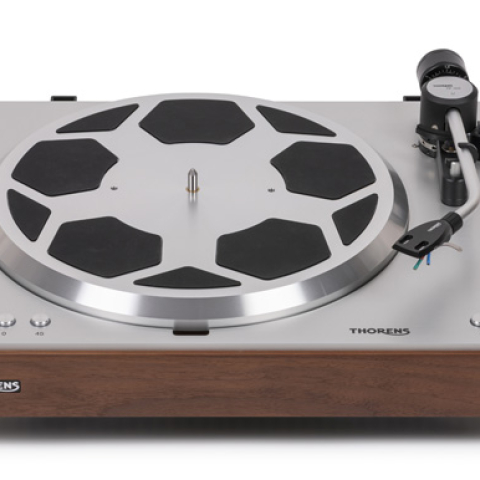
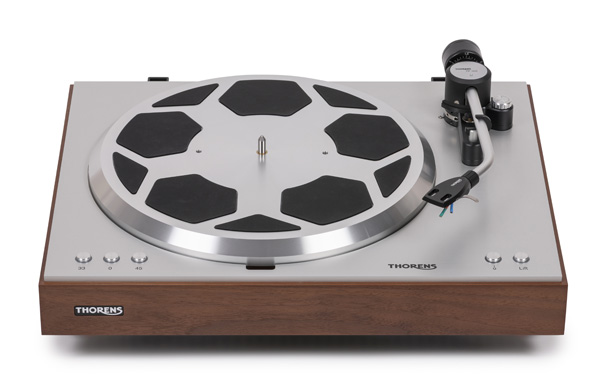
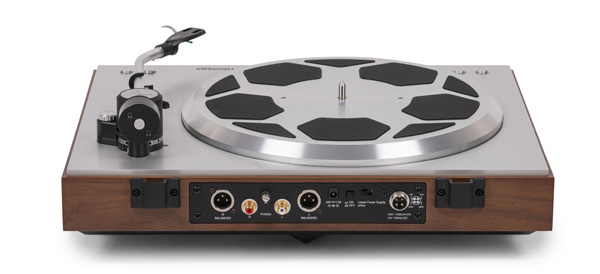
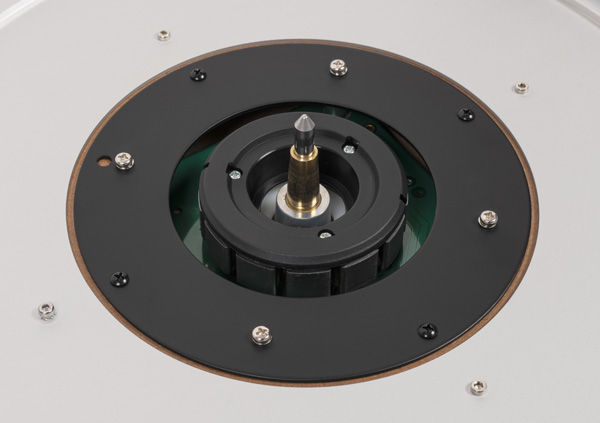
The Thorens TD 404 DD is a mid-priced ($6750) direct-drive turntable that includes the Thorens TP 160 tonearm. Just add a cartridge, plug it into a phono preamp (via either single-ended RCA or balanced XLR connectors), and play records. Included in the box is a wall-wart switching DC power supply; for $750 extra, you can get an external precision linear supply. More on all that later. The TD 404 DD was designed in Germany by a team led by Thorens owner Gunter Kürten. Helmut Thiele handled the mechanical design, Walter Fuchs the electrical. This Thorens is manufactured in Taiwan, probably by Yahorng (footnote 2). The TD 404 DD features Thorens's "High Precision Direct Drive Motor," with a 12-pole laminated-silicon steel core, a high-resolution optical sensor, and a sinewave motor-drive system designed to "deliver smooth, low-vibration rotation." The 8.4 lb CNC-machined aluminum platter has a 5mm rubber damping ring attached to the bottom and a group of rubber damping pads integrated into the top. Thorens doesn't recommend using a third-party platter mat. The chassis has three layers: high-density fiberboard on bottom, a medium-density fiberboard core (available in three finishes: "black high gloss," "walnut high gloss," and "oak matt"), and a 5mm, 3.3 lb aluminum plate on top. The turntable sits on three height-adjustable, upside-down conical rubber damping feet, which are spring-loaded.
Looks-wise, the TD 404 DD is different from other Thorens direct-drive turntables, which (not counting the TD 124 DD) look and operate somewhat like classic Dual models. It is reminiscent of the 1970s Bang & Olufsen Beogram 1200 (footnote 3), but with a modern heavy-duty vibe. Control is via machined aluminum pushbuttons rather than the levers used on the lesser TD 403DD and TD 402DD.
The TD 404 DD features refined, modern looks plus a modern take on semiautomatic operation: At the end of an LP or 45-single side, a silky-smooth electronic cue lift engages, the needle rises above the groove, and the platter motor shuts off. There's no arm-return mechanism like there was on so many semiautomatics common in vinyl's heyday, with their failure-prone gears and belts. The fact that they were failure-prone is why they're not common on modern turntables marketed to audiophiles.
That motorized cue mechanism—Thorens calls it "e-lift"—keeps the cartridge above the record by default. Plus there's no cueing lever: You put a record on the TD 404 DD, move the needle over the lead-in groove, start the platter motor by pushing either the 33 1/3 or 45rpm speed button, and then push the CUE button, which very gently lowers the stylus onto the record. When the cue position goes from up to down, the LED light surrounding the CUE button turns from green to red. The tonearm rest's snap-in bracket provides good security for cartridge and stylus when the turntable isn't playing records.
 On the knife's edge
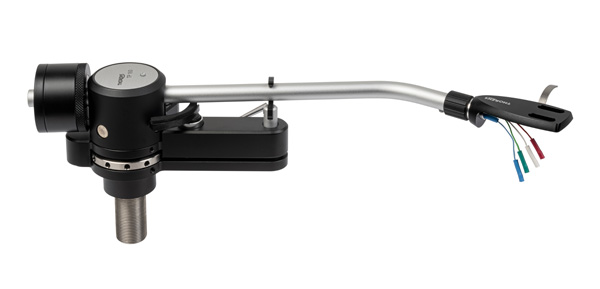
The TP 160 tonearm—a new design—features two different bearing designs: a traditional thrust bearing for horizontal rotation and a newly designed knife-edge bearing for vertical movement. Kürten explained it in an email: "The knife-edge bearing is a classic of analog engineering, made legendary by brands like SME. However, Thorens has significantly refined this principle for the TP 160 tonearm to eliminate historical weaknesses. Unlike conventional ball bearings [for up and down movement], where multiple balls roll in a race, a knife-edge bearing rests on an extremely sharp edge within a V-shaped block. ... The contact area is theoretically infinitely small. ... There is virtually no breakaway torque (stiction). The tonearm can react with extreme sensitivity to vertical irregularities in the record." However, Kürten said, "Classic knife-edge bearings often suffer from being 'loose.' As the needle tracks the groove, vibrations can cause the 'knife' to chatter or shift slightly within the block. ... In the TP 160, Thorens utilizes magnetic stabilization. Powerful magnets pull the edge firmly and consistently into its bearing seat. [This design] combines the friction-free nature of an open bearing with the stability and lack of play found in a closed ball bearing. This results in a calmer soundstage and more precise bass response. "The direct, hard contact between the metal edge and the bearing block allows resonances—traveling from the cartridge through the arm tube—to be efficiently channeled into the heavy bearing base. ... The tonearm accumulates less internal energy. This leads to greater clarity and fewer colorations in the midrange and treble." Another benefit: "A knife-edge bearing is mechanically much simpler. Since there are no balls to stick or wear down unevenly, the performance remains consistent over decades."
At the back end of the tonearm is a flexible, two-piece counterweight with several back-end metal plates of progressively heavier weight included, to accommodate a wide range of cartridges. Tonearm height is adjustable via an Allen screw. The spring-loaded antiskate mechanism is adjusted with a knob.
The business end of the TP 160 features Thorens's modern take on the classic SME-style headshell (compatible with Technics, SME, and other current-production tonearms). Like higher-end headshells from DS Audio and others, it includes an azimuth adjustment screw.
Thorens specs the TP 160's effective mass at 18gm. That's 50% higher than the effective mass of the Technics SL-1200 tonearm and twice that of some versions of the SME 3009 tonearm. Kürten said the more-massive arm accommodates a wide range of cartridges: "We have [had] good experience with Audio-Technica and EMT cartridges. We also have our own MC cartridge, the TAS 1600, which is designed for our turntables." Kürten told me it's made in Japan by Audio-Technica. In my reviewing time with the TD 404 DD, I used Ortofon 2M Blue and Hana SL MK II cartridges.
 Unpacking and setup
The TD 404 DD arrived double-boxed and sturdily packed with a logical arrangement of pieces inside the box. On top was the plastic dustcover and the user manual in German and English. Under the dustcover's layer of foam forms was the turntable, itself embedded in sturdy foam. Under that was a sheet of heavy cardboard, then a layer of foam containing the platter, the wall-wart power supply, the headshell, and accessories. The manual presents a logical step-by-step process to assemble the turntable, similar to the Technics direct-drive turntables I'm accustomed to. To install the heavy platter, there are plastic finger handles that must be screwed temporarily into tapped holes, which make it easy to lower the platter straight onto the spindle. The manual warns: "The platter must slide over the axle without tilting. No pressure should be exerted on the axle." The dustcover hinges were embedded in the accessories-layer foam. They slide into slots on the back of the dustcover and then fit into T-shaped brackets on the back of the turntable. The hinges provided ample spring-back to keep the lid raised with confidence. The manual said installation of the dustcover was optional and offered no guidance about operating the turntable with the dustcover open or closed. I chose to install it, then often operated the TD 404 DD with the dustcover removed, but occasionally I kept it attached and raised while a record played. I didn't hear a difference with or without the dustcover.
The counterweight arrived from the factory with the heavier of two plates attached to the back with two Phillips screws. This plate made the counterweight too heavy for almost all my cartridge/headshell combos. I replaced it with a slimmer, lighter plate included in the accessories foam.
For my first spins, I used an Ortofon 2M Blue (once owned by the late Art Dudley) in an Ortofon headshell. I was happy to discover that the Technics alignment tool provides a setup that also lines up in the Thorens tonearm. Setting tracking weight was a little fussier than with a Technics because the counterweight's screw-on travel wasn't quite as subtle on the Thorens, and the dial indicating the tracking weight was unusually stiff; setting it to "0" while the arm was at neutral balance caused the counterweight to change position and the balance to change. Using my digital scale, I was eventually able to dial in exactly 1.8gm tracking force. Satisfied this was a good start, I began spinning black circles.
Footnote 1: And it's not merely possible but easy to get immersed in a country song broadcast on an AM radio station while sitting late at night in an old pickup truck. Except that old pickups with AM radios, and AM radio stations playing country music, are a lot rarer than they used to be.—Jim Austin
Footnote 2: See yahorng.com/index.php?lang=english. Although Kürten wouldn't confirm that Yahorng is the manufacturer of the TD 404 DD, he confirmed that the company's retro-luxury turntable, the TD 124 DD, which uses a similar direct-drive motor, is made there: tinyurl. com/mry5t38k.
Footnote 3: See beocentral.com/beogram1200.
Flexible, precision phonography from Germany and TaiwanThe Thorens TD 404 DD is a mid-priced ($6750) direct-drive turntable that includes the Thorens TP 160 tonearm. Just add a cartridge, plug it into a phono preamp (via either single-ended RCA or balanced XLR connectors), and play records. Included in the box is a wall-wart switching DC power supply; for $750 extra, you can get an external precision linear supply. More on all that later. The TD 404 DD was designed in Germany by a team led by Thorens owner Gunter Kürten. Helmut Thiele handled the mechanical design, Walter Fuchs the electrical. This Thorens is manufactured in Taiwan, probably by Yahorng (footnote 2). The TD 404 DD features Thorens's "High Precision Direct Drive Motor," with a 12-pole laminated-silicon steel core, a high-resolution optical sensor, and a sinewave motor-drive system designed to "deliver smooth, low-vibration rotation." The 8.4 lb CNC-machined aluminum platter has a 5mm rubber damping ring attached to the bottom and a group of rubber damping pads integrated into the top. Thorens doesn't recommend using a third-party platter mat. The chassis has three layers: high-density fiberboard on bottom, a medium-density fiberboard core (available in three finishes: "black high gloss," "walnut high gloss," and "oak matt"), and a 5mm, 3.3 lb aluminum plate on top. The turntable sits on three height-adjustable, upside-down conical rubber damping feet, which are spring-loaded.
On the knife's edgeThe TP 160 tonearm—a new design—features two different bearing designs: a traditional thrust bearing for horizontal rotation and a newly designed knife-edge bearing for vertical movement. Kürten explained it in an email: "The knife-edge bearing is a classic of analog engineering, made legendary by brands like SME. However, Thorens has significantly refined this principle for the TP 160 tonearm to eliminate historical weaknesses. Unlike conventional ball bearings [for up and down movement], where multiple balls roll in a race, a knife-edge bearing rests on an extremely sharp edge within a V-shaped block. ... The contact area is theoretically infinitely small. ... There is virtually no breakaway torque (stiction). The tonearm can react with extreme sensitivity to vertical irregularities in the record." However, Kürten said, "Classic knife-edge bearings often suffer from being 'loose.' As the needle tracks the groove, vibrations can cause the 'knife' to chatter or shift slightly within the block. ... In the TP 160, Thorens utilizes magnetic stabilization. Powerful magnets pull the edge firmly and consistently into its bearing seat. [This design] combines the friction-free nature of an open bearing with the stability and lack of play found in a closed ball bearing. This results in a calmer soundstage and more precise bass response. "The direct, hard contact between the metal edge and the bearing block allows resonances—traveling from the cartridge through the arm tube—to be efficiently channeled into the heavy bearing base. ... The tonearm accumulates less internal energy. This leads to greater clarity and fewer colorations in the midrange and treble." Another benefit: "A knife-edge bearing is mechanically much simpler. Since there are no balls to stick or wear down unevenly, the performance remains consistent over decades."
Unpacking and setupThe TD 404 DD arrived double-boxed and sturdily packed with a logical arrangement of pieces inside the box. On top was the plastic dustcover and the user manual in German and English. Under the dustcover's layer of foam forms was the turntable, itself embedded in sturdy foam. Under that was a sheet of heavy cardboard, then a layer of foam containing the platter, the wall-wart power supply, the headshell, and accessories. The manual presents a logical step-by-step process to assemble the turntable, similar to the Technics direct-drive turntables I'm accustomed to. To install the heavy platter, there are plastic finger handles that must be screwed temporarily into tapped holes, which make it easy to lower the platter straight onto the spindle. The manual warns: "The platter must slide over the axle without tilting. No pressure should be exerted on the axle." The dustcover hinges were embedded in the accessories-layer foam. They slide into slots on the back of the dustcover and then fit into T-shaped brackets on the back of the turntable. The hinges provided ample spring-back to keep the lid raised with confidence. The manual said installation of the dustcover was optional and offered no guidance about operating the turntable with the dustcover open or closed. I chose to install it, then often operated the TD 404 DD with the dustcover removed, but occasionally I kept it attached and raised while a record played. I didn't hear a difference with or without the dustcover.
Footnote 1: And it's not merely possible but easy to get immersed in a country song broadcast on an AM radio station while sitting late at night in an old pickup truck. Except that old pickups with AM radios, and AM radio stations playing country music, are a lot rarer than they used to be.—Jim Austin