 First spins, and a power play
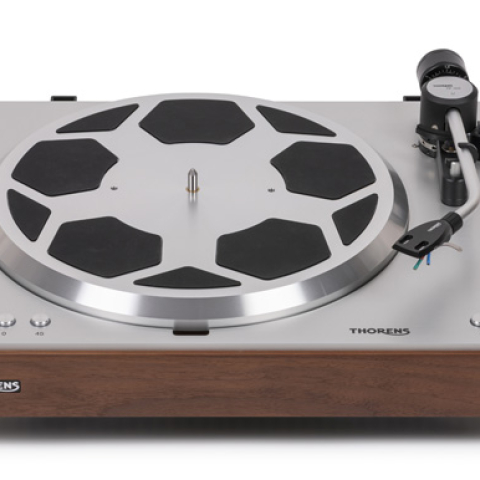
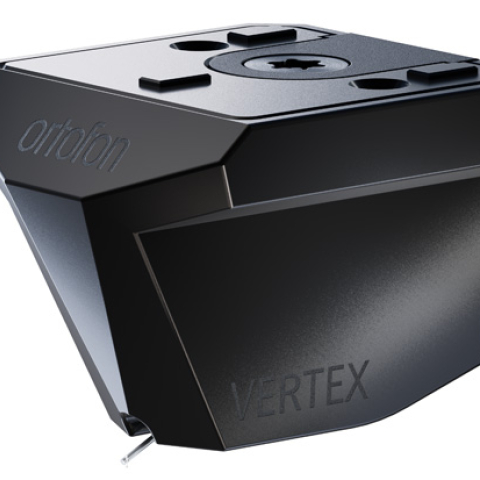
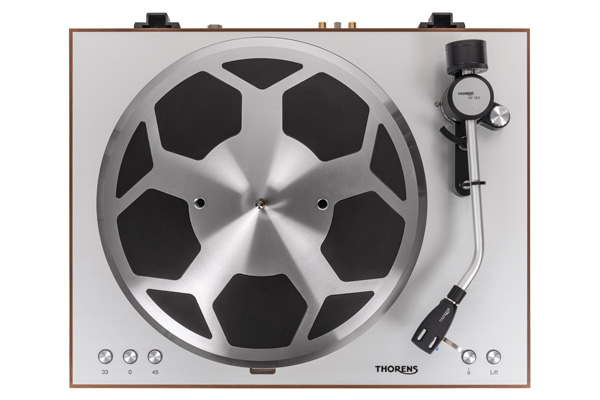
For a few days, I used the TD 404 DD in my office system, connected directly to my McIntosh MA6500 integrated amplifier, driving small but mighty Amphion One18 speakers nearfield to my desk. I listened mainly while doing background work, with the Ortofon cartridge installed. Things sounded fine. The turntable is well-grounded and shielded, so there wasn't any hum or RFI hash. I immediately liked the electronic cue lifter. It lowered the needle into the groove precisely and gently. The semiautomatic feature was a little slow to lift at the end of a side, so on many records, the needle traveled all the way to the end of the groove's runout before it lifted. The payoff was a gentle uplift, after which the motor shut off. This is a very useful feature: If I was engrossed in work, I didn't have to get up and rush across the room to lift the stylus to avoid the ka-chunk, ka-chunk of the runout end stop (which surely isn't good for the needle or cantilever). This version of semiautomation is the best I've encountered. It's well engineered by Thorens. The next week, I had Audio Buddies Mike, Farrukh, and Dave over for an afternoon of listening. We set up shop in the living room with my reference system: Pro-Ject Phono Box RS2, Benchmark LA4, Benchmark AHB2, Bowers & Wilkins 808 speakers. One of our projects was to compare how records sounded played on the TD 404 DD with the same records played with the same cartridge on a Technics SL-1200GME. At $6600, the Technics is in the Thorens's price range, and it's also direct-drive (though with very different motor and electronic drive designs), with a heavy aluminum platter. The tonearm designs are quite different, but both conveniently accept SME-type headshells. We noticed right away that the Thorens isolation feet are, well, meh. Heavy footfalls on the synthetic wood floor transmitted up through the Butcher Block Acoustics rack (which itself isn't great at isolating heavy vibrations from the floor); these footfalls were audible through the turntable, stylus, and cartridge. That said, it wasn't like the needle was flying out of the groove. Tapping gently on the turntable top plate was very audible, as was tapping less gently on the rack surface near the turntable. In contrast, the Technics was well isolated, with only gentle tapping on its top plate audible as a record played. I recommend paying attention to mechanically isolating the rack or platform on which a TD 404 DD sits.
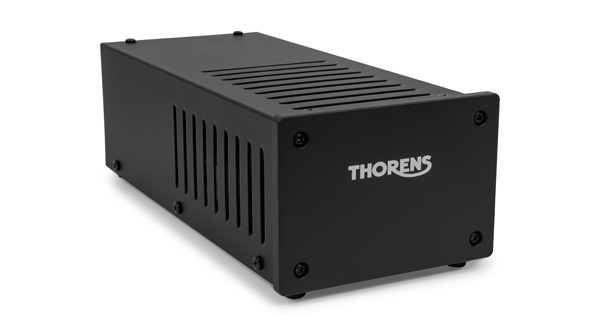 Then we spun some familiar tracks, first on the Thorens then on the Technics and then again on the Thorens. We all noticed that, played on the Thorens, they seemed less percussive and forward-moving, a bit dulled-down. It wasn't a problem with pitch, and there wasn't any wow we could hear, yet things just didn't sound as snappy. We heard a big difference in the quickness of dynamics and general "excitement" of the music. Previously, Thorens's US rep, MoFi Distribution, sent a TPN 124 outboard linear power supply (a $750 extra option for the TD 404 DD), with a strong recommendation to try it out. The fellas and I decided to put it to the test.
Swapping in the TPN 124 was simple: Disconnect the wall-wart power supply from both the AC outlet and the turntable's rear panel; move the slider switch to Linear Power Supply—ON; connect the four-wire line from the linear power supply (24VDC+, 24VDC–, 5VDC+, 5VDC–), connect the standard IEC power cord from the linear power supply to the AC outlet; then power on the linear power supply. Everything on the turntable worked as expected. We put a record on and waited to hear if the answer was in the DC power source. Indeed it was!
Immediately the sluggish beat and dulled percussiveness were in the past. The music burst out into the room the same as when the same records were played on the Technics.
Then we spun some familiar tracks, first on the Thorens then on the Technics and then again on the Thorens. We all noticed that, played on the Thorens, they seemed less percussive and forward-moving, a bit dulled-down. It wasn't a problem with pitch, and there wasn't any wow we could hear, yet things just didn't sound as snappy. We heard a big difference in the quickness of dynamics and general "excitement" of the music. Previously, Thorens's US rep, MoFi Distribution, sent a TPN 124 outboard linear power supply (a $750 extra option for the TD 404 DD), with a strong recommendation to try it out. The fellas and I decided to put it to the test.
Swapping in the TPN 124 was simple: Disconnect the wall-wart power supply from both the AC outlet and the turntable's rear panel; move the slider switch to Linear Power Supply—ON; connect the four-wire line from the linear power supply (24VDC+, 24VDC–, 5VDC+, 5VDC–), connect the standard IEC power cord from the linear power supply to the AC outlet; then power on the linear power supply. Everything on the turntable worked as expected. We put a record on and waited to hear if the answer was in the DC power source. Indeed it was!
Immediately the sluggish beat and dulled percussiveness were in the past. The music burst out into the room the same as when the same records were played on the Technics.
 Deep listening
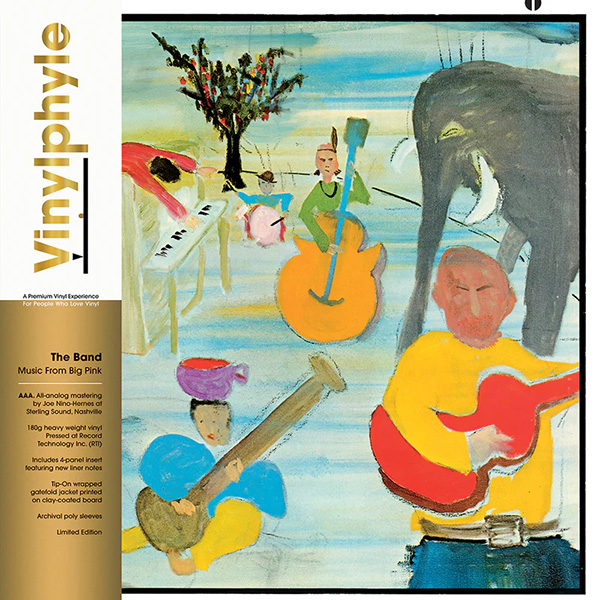
It was time to concentrate on the heart of the matter: music. Having found the ideal setup for the Thorens TD 404 DD in my system, I set about a series of concentrated listening sessions. I wanted to know how it played some of my favorite platters and check out some new releases. For this phase of the review, I swapped in my Hana SL MKII low-output moving coil cartridge. The Hana proved to be a good match for the TP160 tonearm and the Thorens headshell, based on how well it tracked challenging sides and how familiar it sounded and behaved. Some highlights: Two records from Universal Music's VinylPhyle series, The Band's classic Music from Big Pink (LP, Capitol 199957336406) and Mama's Gun by Erykah Badu (LP, Motown 602478946547), provided great entertainment. These two albums come from different times, in different musical styles, and feature different qualities of sound. But they share a punchy beat and forward momentum—though it's more restrained in The Band's unfolding tales of timeless human drama and wilder in Badu's urban setting of fast-developing word-pictures. The mastering work on both albums by Joe Nino-Hernes at Sterling Sound Nashville was exceptional; I've never heard better-sounding music from The Band's debut, and the effects of cutting and playing grooved media benefit Badu's work by deepening and thickening the low end. The four-page bonus liner notes add context and understanding to both albums.
 I'll Play the Blues for You by Albert King (LP, Stax CR00979), an early 1970s blues classic reissued in Analogue Productions/Craft Recordings' Bluesville series, sounded heavier, stronger, and more naturally human and of its time than its CD reissues sound. Hats off to Matt Lutthans at The Mastering Lab, part of Chad Kassem's vinyl-centric empire. He captured all of Albert King's massive life force in those grooves.
 The last disc I spun on the TD 404 DD was Duke's Big 4 (LP, Pablo–Analogue Productions 2310 703), one of my current reference records. It sounded as punchy, swinging, and alive as played on any turntable I've had in the system, but I noticed a touch more background vinyl noise than I'm used to. It could well be that I had the volume cranked up a few notches louder than usual, but that whoosh and rumble was a little distracting. Still, as always when the playback is right, that album got me snapping fingers and tapping feet. Ellington, Joe Pass, Ray Brown, and Louie Bellson laid down one for the ages back in 1973, and Lutthans cut it all into those grooves.
Conclusions
The last disc I spun on the TD 404 DD was Duke's Big 4 (LP, Pablo–Analogue Productions 2310 703), one of my current reference records. It sounded as punchy, swinging, and alive as played on any turntable I've had in the system, but I noticed a touch more background vinyl noise than I'm used to. It could well be that I had the volume cranked up a few notches louder than usual, but that whoosh and rumble was a little distracting. Still, as always when the playback is right, that album got me snapping fingers and tapping feet. Ellington, Joe Pass, Ray Brown, and Louie Bellson laid down one for the ages back in 1973, and Lutthans cut it all into those grooves.
ConclusionsThe TD 404 DD is obviously the result of a fresh look at direct-drive turntables from Thorens. It looks sleeker and more modern than any other turntable in the Thorens lineup. The new approach to semiautomatic operation and the silky-smooth electronic cue lift are great innovations. The fit and finish are worthy of the price. Its platter, with the integrated raised rubber "zones," eliminates the need for a mat. The substantial platter and heavy motor seem designed to spin any record truly and reliably, no matter the cartridge or tracking weight. The TP 160 tonearm features two types of bearings optimized for horizontal and vertical motion, and its extra mass may be ideal for cartridges that fuss with lighter tonearms. In my system and house, the accessory TPN 124 linear power supply proved essential. The turntable simply didn't play records as well with the included wall-wart switching supply. You may have a different experience, but my house has no special electrical issues, so I see no reason to think so.