
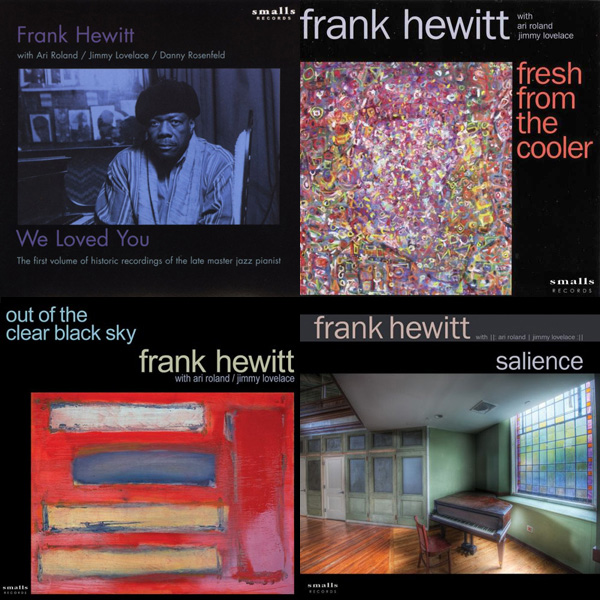
Jazz critics tend to live in the now. Just-released records. Tonight's concert. New breakout talents. One of the few things I dislike about being a jazz critic is that I rarely go back and dig out old albums I loved and listen to them again just for pleasure. This week, I did.
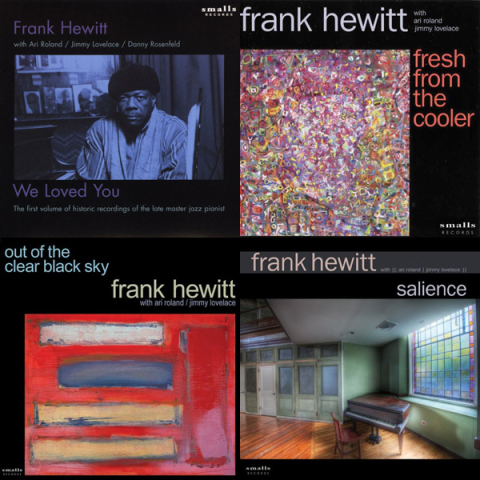
Twenty years ago, I went through a Frank Hewitt period. I own five of the six CDs that exist under his name, and this week I have been buried in them. After not hearing him for years, it was a rush to learn he was as great as I remembered. He was a pianist, conservative in repertoire (he played standards) but radical in style. The first song I listened to was "Ghost of a Chance," the first track on the first Hewitt album ever released, We Loved You. The tune does not have a verse. But Hewitt, as he often did, improvises his own introductory verse in the moment and invents intriguing thematic elements that he then carries into the melody. Hewitt's touch on the keys reminds you of Monk: It was hard. He also reminds you of Monk in his fondness for dissonance, his ferocious ringing tremolos, and the way he broods at the piano, often briefly pausing as he ponders his next move. To say he was not a composer is an oversimplification. Hewitt wildly, aggressively, beautifully recomposed every standard he ever played. In his unique, heavily arpeggiated piano language, he added fascinating new content to old songs.
He was a romantic, but he was all about tough love. His lyricism was deep but utterly unsentimental. As I re-immersed myself in his music, I dwelt longest on the ballads. Emotionally devastating ballads are spread throughout the five albums. "What's New?" is epic. So is "The Nearness of You." Hewitt's free, lush embellishments derive new nuances of feeling even as he consumes the song in his creative fire, leaving only ash.
He sometimes made surprising choices. You would not expect him to play "The Girl from Ipanema." I have never gotten tired of Antônio Carlos Jobim's most covered song, though many versions trivialize it. I have never heard a version like Frank's. The samba throb is there, but stronger and darker, and he rethinks this bossa nova hit, audaciously, for 11 minutes.
So, you ask, "Who the hell was Frank Hewitt?" If you have never heard of him, you are forgiven. His story, even by jazz standards, is extraordinary. In the 1990s, he was effectively the house pianist at Smalls, the tiny basement club at 183 West 10th Street in Greenwich Village. Smalls was more a cult than a club. It had no liquor license, and admission was $10. Shows started at 10pm and went to 2am, followed by jam sessions that went all night. Smalls was its own underground scene and a haven for young musicians who pushed the envelope. Many of them became famous later: Mark Turner, Kurt Rosenwinkel, Peter Bernstein, Chris Potter—even Brad Mehldau, an early Smalls participant. Hewitt was older and was revered as a master by the musicians and their followers who hung out at Smalls. Hewitt played there two or three nights a week for nine years. But when he died of pancreatic cancer in 2002, at 66, he was almost entirely unknown to the outside world, and no recordings under his name had been issued. He was also, in practical terms, homeless. In his final years, he often slept in a stripped-out walk-in refrigerator in the back of Smalls.
In his youth, Byars was a charter member of the Smalls scene. I reached out to him for this article. His memories of Hewitt are heartfelt and vivid. He said, "I have never known anyone faster on any instrument. In jazz, 400 beats a minute is fast. One night at Smalls, Frank was playing 'Lover,' and we timed him at 580." A 10-minute speed-freak workout on "Lover" appears on Out of the Clear Black Sky. Ballads were not Hewitt's only gift.
The Smalls Records label shut down about 15 years ago. The original Smalls—the club itself—is long gone. There is still a venue called Smalls, at 183 West 10th, but it is under different ownership and is somewhat more corporate. (To be fair, every jazz joint in New York is more "corporate" than the original Smalls.) The current Smalls has its own label, SmallsLIVE, which is better funded than Smalls Records ever was and probably gets confused with Kaven's imprint by some consumers.
Looking back, what Kaven accomplished was remarkable. On a shoestring budget, doing everything himself from engineering to liner notes to graphics, he sustained respectable production values. The sound of his Hewitt recordings is good enough to feed my recent Hewitt obsession. Without Luke Kaven, Frank Hewitt would have left nothing behind.
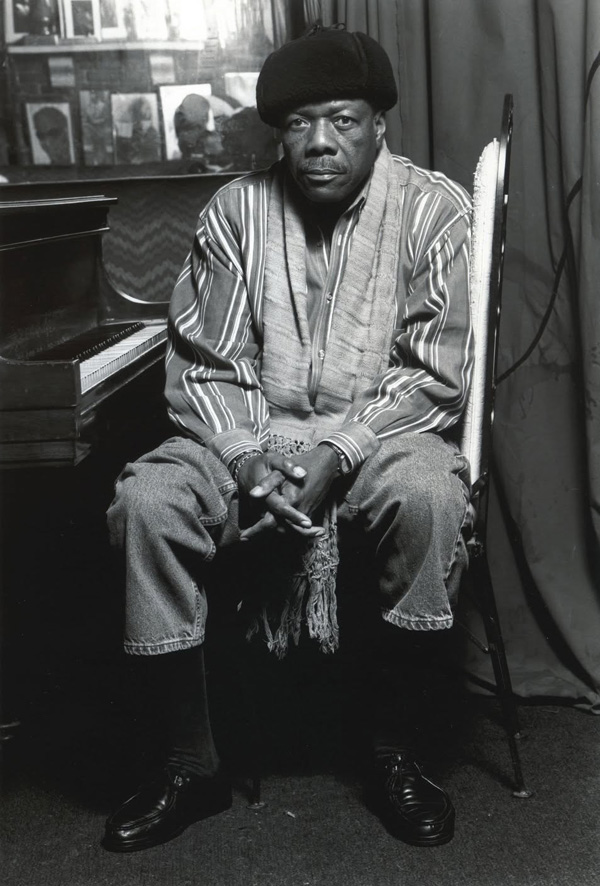
Frank Hewitt: Photo by Barney Kulok
The only reason Hewitt's name did not entirely disappear into the shadows of history is someone named Luke Kaven. Kaven was a fan embedded in the Smalls community, and around 1996 he began recording Smalls artists, usually live in the club, sometimes in a small nearby studio. In 2004, Kaven started a label, Smalls Records, and began putting out CDs. He eventually released six posthumous Hewitt albums. The five I own are We Loved You, Not Afraid to Live, Four Hundred Saturdays, Fresh from the Cooler, and Out of the Clear Black Sky. All are trio recordings except Four Hundred Saturdays, which is a quintet date featuring the excellent tenor saxophonist Chris Byars.