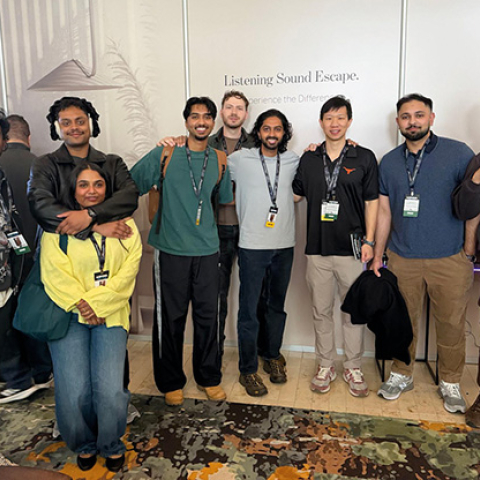

It's trite to observe that we're doomed to fail to understand the generations that come after us, yet it's true. We are also, apparently, doomed to forget we're doomed. "We have to get a younger generation into hi-fi, or the industry is dead," lament aging men, unable to imagine a traversable path other than their own. Meanwhile, Apple sells 100 million pairs of AirPods every year. That's a guess: Apple doesn't share the exact numbers, but have you been outside lately?
We have three kids. The eldest goes to a renowned choir school with music lessons every day, but the active speakers I gave him for his room haven't made sound in months. The middle one is obsessed with Billie Eilish, but her active speakers are inactive, too. The youngest, who is five, loves Kraftwerk as served by the living room's Dutch & Dutch 8c speakers, but despite my best efforts still can't spell "cardioid dispersion."
In his 1884 novella Flatland: A Romance of Many Dimensions, Edwin Abbott Abbott tells about a square living in a two-dimensional world, visited by a sphere, which it sees as a point growing into a circle then back again to a point before vanishing. The square can't fathom what a sphere even is. In episode 10 of Cosmos, broadcast on PBS in 1980, Carl Sagan referenced and extended this to explain how a four-dimensional entity would appear to us when passing through our three-dimensional reality. I'm convinced that one such unfathomable dimension is added with each generation.
Today's indecipherable tesseract children still seem to enjoy music, though. They won't do it like we did, but zoom out a little: What was a stereo like in 2000? No streamers. 1980? Nothing digital. 1960? Nothing portable. 1940? 1920? Soon enough we reach the dawn of recorded sound. Before the phonograph, if you wanted to enjoy music in the home, you had to play and sing or get the kids to do it. Change keeps changing.
My maternal grandmother's piano was moved to our house when I was a kid. I never learned to play properly, but I was obsessed with sound, and the piano made sounds. I invented stories of adventure, peril, battle, and mystery as clumsily pressed keys and sustain pedal gave rise to varying flavors of dissonance and (rarely) harmony. It must have been torture for everyone else, but I remember how it felt letting my imagination flow with the sounds, and I can still recall fragments of the stories I made up. I didn't acquire these powerful connections to tone, texture, and timbre from some school of audiophilia.
I was wired this way by evolution and chance—the same way every member of every generation gets wired.
Most of you reading Stereophile presumably grew up in a home where a stereo system was a prominent feature. You might attribute your current pursuits to your upbringing. I'm sure it did help that my dad was (and still is) very much into music and, by extension, hi-fi. That by extension is what many worry about: that kids today don't care about reproduction quality and will never learn. When all they know is a voice-assist speaker in the kitchen, how can they know what they're missing?
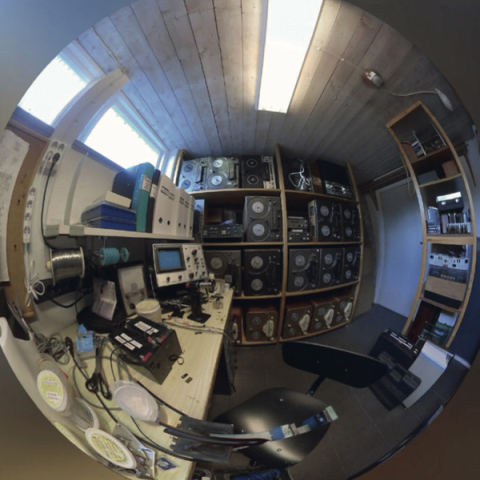
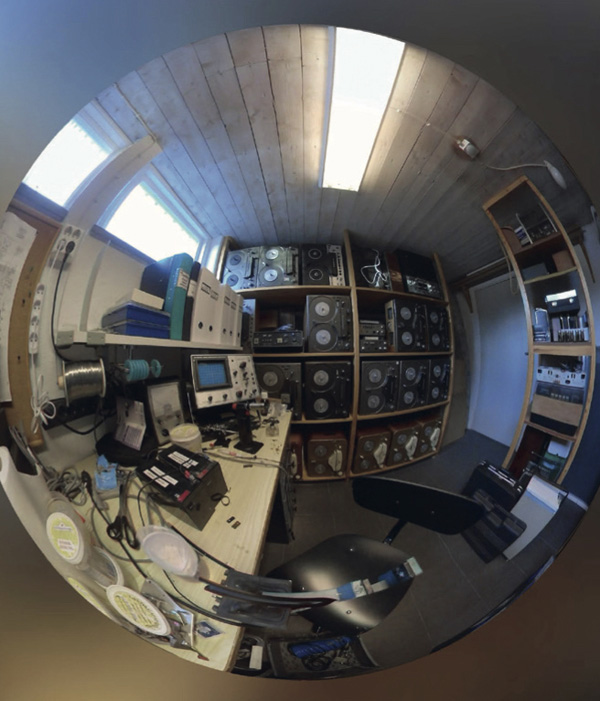
My dad has 59 reel-to-reel decks—plus five cassette decks. He's granted me permission to reveal this fact about him in this column but said he didn't want to be depicted as a nerd; I'll let you decide if those two things can be reconciled. Anyway, his immense interest in tape decks didn't rub off on me: I bought a CD player when I was 12, years before he got his first one.
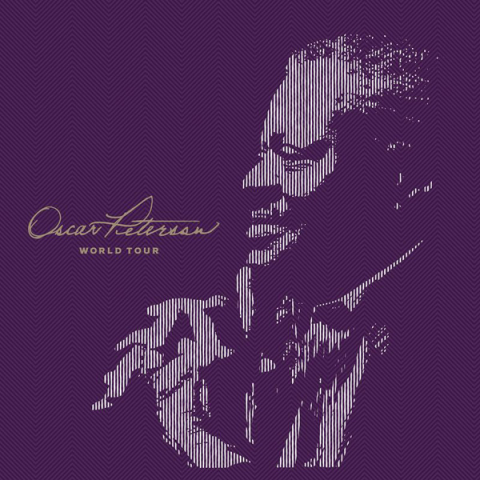
Dad is deep into the musical greats: Cannonball Adderley, John Coltrane, Keith Jarrett, Jan Johansson (footnote 1). Apparently determined to add a maximally perplexing new dimension to my dad's example, I sought out jazz's diametrical opposite: electronic music, unnatural and inhuman. Instead of going to concerts, I arranged rave parties. I don't think I was deliberately contrarian, but my passion for music and sound was entirely detached from his.
With time, a bridge has formed between my father's dimension and mine. I'm slowly getting to know the music he loves; I cite some in my reviews. The last time I visited him, he was playing Oneohtrix Point Never using a WiiM DAC, tape decks dormant.
I don't expect the next generation to find their way to our hobby the same way we did, and that's fine. It's better than fine—it's essential. Change is the enemy of stagnation. Headphone listening, ambient slumber parties, hi-fi as art, the vinyl revival, listening bars—these are encouraging signs. Music and sound will be an obsession for future generations, albeit in an unpredictable, new-spatial-dimension kind of way.
There is, however, one thing I worry about: that too many will be alienated early on. If they seek advice about sound on YouTube and Reddit, as many do, they'll encounter many confident assertions, among them that everything's a scam. They'll hear self-anointed priests of ABX orthodoxy preach that ears are not to be trusted. But let's not get too comfortable on that high horse: We, too, can alienate the young. Being made to sit at our knee, absorb our wisdom, and do things the way we did can disillusion newcomers and send them fleeing toward some other pursuit.
We can't transform the incentive structures of social media, but we can acknowledge that the modest influx of newcomers needed for the audiophile pursuit to survive likely won't find their way in the way we did. Our task is to share our passion, stay humble, and stay out of the way.
Footnote 1: The name on that list that may not be familiar to every reader is Jan Johansson. Pianist and composer Johansson is widely regarded as Sweden's greatest jazz musician; he's certainly the one who inspires the most national pride. Like so many jazz greats, he died much too soon, at age 37, in a car crash.
Footnote 1: The name on that list that may not be familiar to every reader is Jan Johansson. Pianist and composer Johansson is widely regarded as Sweden's greatest jazz musician; he's certainly the one who inspires the most national pride. Like so many jazz greats, he died much too soon, at age 37, in a car crash.