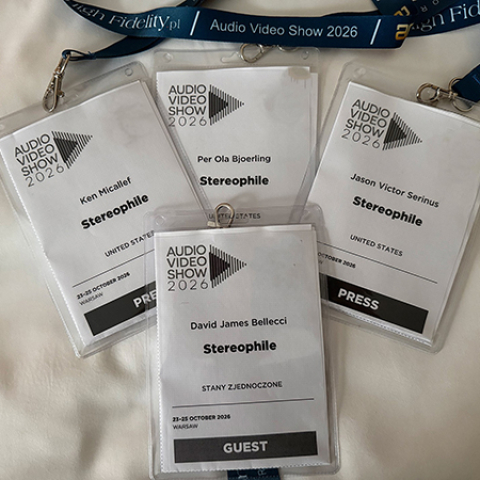

In the first installment of his non-video Audio Video Show Warsaw 2026 reports, Jason Victor Serinus relays his experiences with new and current gear from D'Agostino, dCS, Wilson, VTL, Nordost, AudioVector, REL, and Moon by Simaudio.
D'Agostino / dCS / Wilson: A familiar pairing with a new twist
Given how many times we have covered the uncommon synergy of these superb-sounding brands, why cover them again? Because Audio Video Show Warsaw 2026 was my first opportunity to hear a Dan D'Agostino Master Audio System Relentless Z amplifier and evaluate the Z upgrade's impact on the Relentless amp's performance. What added spice to the mix was that, rather than the customary mix of Transparent and Shunyata cabling, HRS racks, and a Stromtank battery power source, this system was completely wired, grounded, and power treated by Shunyata, with Artesania racks.
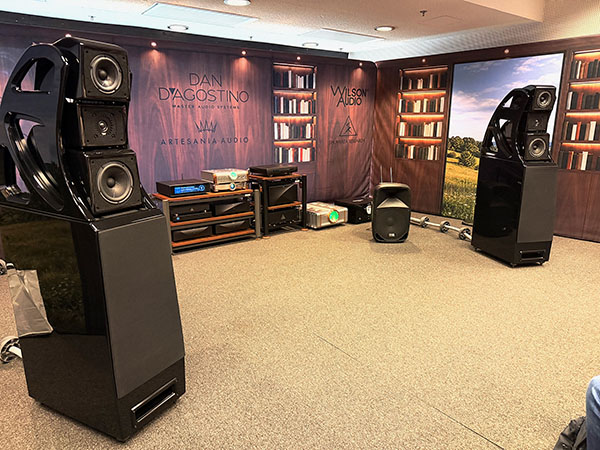
In my upcoming review of the D'Agostino Momentum Z monoblocks, I point out that Z technology employs a 300-ohm JFET input stage that's extremely low noise, along with a regulated output stage. When a Z amplifier is paired with a high-current preamp such as the Momentum C2Z (review also forthcoming) Z technology promises to deliver authoritative, demonstration-level bass and an exceptionally quiet, smooth presentation. The Momentum Z/Momentum C2Z combo currently in my reference system continues to blow the mind of everyone who visits.
This and more are what I expected from a system that included D'Agostino Relentless Z monoblocks and Momentum C2Z preamp, five-piece dCS Varèse DAC, Aurender NH10 network switch, Oladra Presence music server from Antipodes, Wilson Alexx Vfx speakers, Shunyata Everest X power/Omega cables/Altaria X grounding, and an Artesania rack. On most levels, it delivered in spades.
On Sophie B. Hawkins's 1992 breakthrough hit single "Damn, I Wish I Was Your Lover," the soundstage was huge and the presentation the epitome of openness and clarity. But then the system took one noticeable leap forward.
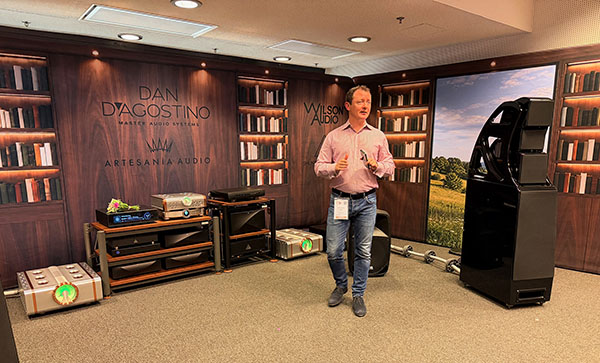
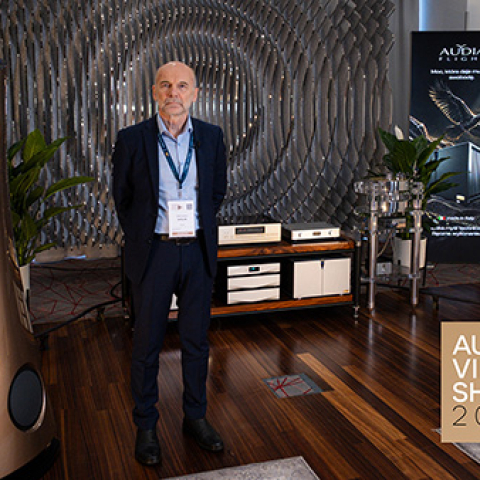
After I asked dCS's Alasdair McDonald (seen above) to remove the grilles on the Wilson's tweeter and midrange drivers, we listened to Azaleh's "Transcendence" in 24-bit/44.1kHz. This track, which reminded me of the opening of the overplayed Hedegaard track "Ratchets," proved that removing the grilles rendered the presentation more alive and vibrant.
The system's authority was remarkable, the control matchless. What I did not hear, however, was the huge bass response I'd expected. Since I know that Relentless's bass is superb, even without the Z upgrade, intuition points to the room as the MIA bass culprit.
VTL Lohengrin, takes 1 and 2
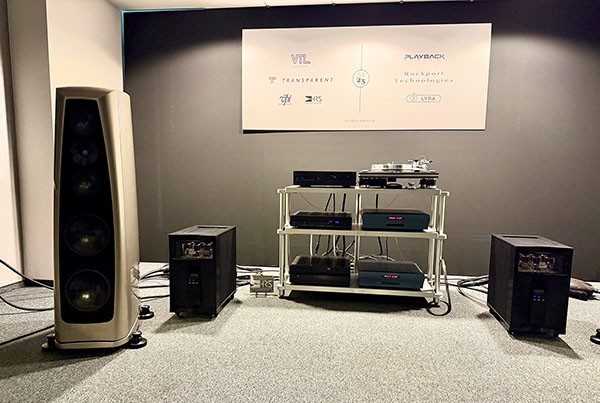
I may have delivered glowing reports of prototypes of VTL's new Lohengrin monoblocks (498,500 PLN) on previous occasions, but Warsaw was my first opportunity to hear the actual production model. Although I was quite familiar with the sound of the VTL TP-6.5 Series II phono preamp (84,500 PLN), TL-75 Series III line preamp (199,500 PLN), Rockport Lyra loudspeakers (1,160,000/pair PLN), HRS stands, and Transparent cabling, the Playback Designs MPS-8 CD/SACD/streamer/DAC (133,500 PLN) was new not only to me, but also to VTL's Luke Manley and Bea Lam. (PLN is the Polish złoty, the country’s official currency; one złoty is worth about as much as one US quarter.)
This wasn't the first time I returned to a VTL room after receiving an email explaining that the speakers had been repositioned, resulting in improved sound. In this case, however, I'd already decided to revisit the room because something was definitely off the first time around. I knew that the VTL trio could sound very smooth, a bit warm, and luscious, but that's not what I heard on that first visit. Thankfully, my second visit revealed highs and midrange sounding gorgeous on Gustavo Dudamel's recording of Leonard Bernstein's West Side Story with the L.A. Philharmonic.
Auditioning a bit of a DSD file of the London Symphony Orchestra's recording of Shostakovich Symphony 5 confirmed how wonderful and fully saturated colors can sound through the VTL/Rockport/Playback Designs pairing. Bass, however, was MIA. Since I know that Lohengrin's bass is quite substantial, the finger (again) points at the room.
Premieres from Nordost, AudioVector, and REL join the virtually new from Moon by Simaudio
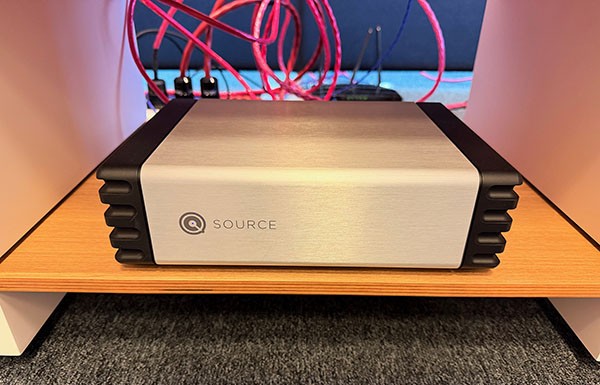
Lots of news and new-to-me in this shared room at the PGE Narodowy Stadium. For Nordost, the reconfigured and repackaged QSource MK II ($4500), whose completely different, rack-friendly encasing mirrors the casing of some other recent Nordost Q products. With much more internal space, the QSource MK II ups the original QSource's internal transformers from one to two and takes advantage of dedicated black-finned end caps that dissipate heat and result in cool operation. The payoffs, according to Nordost's Alex Brady, include less heat, far less transmitted noise, and a more fluid and organic soundstage.
"When the switch is fully populated, with both its 5/9/12V A port and 12/19/24 B ports engaged, the sonic differences are even more audible," Brady said. "The original QSource was optimized for 19V, regardless of which port was used. Here, the A port is optimized for 9V, and the B port for 19V. The unit is far more stable, promises constant ultra-low noise, and is 2.5 times more powerful than the original QSource."
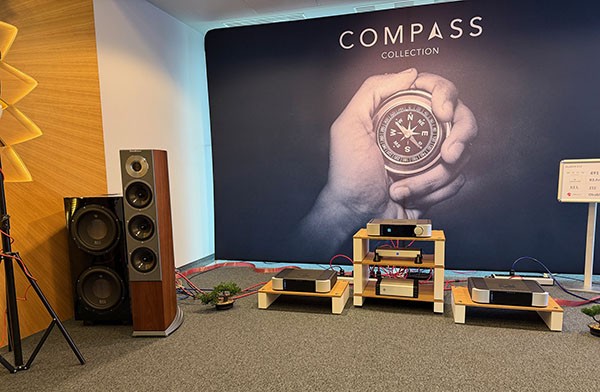
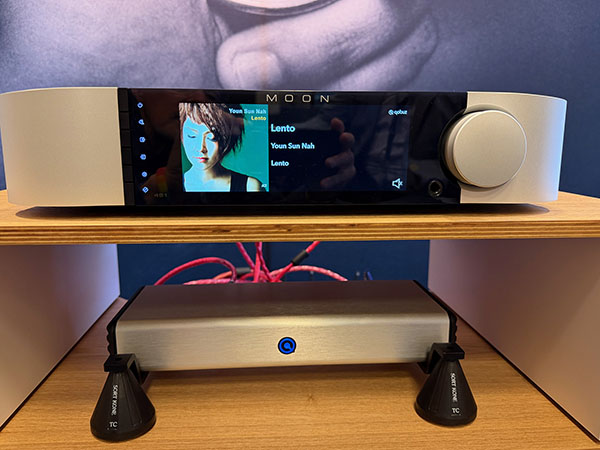
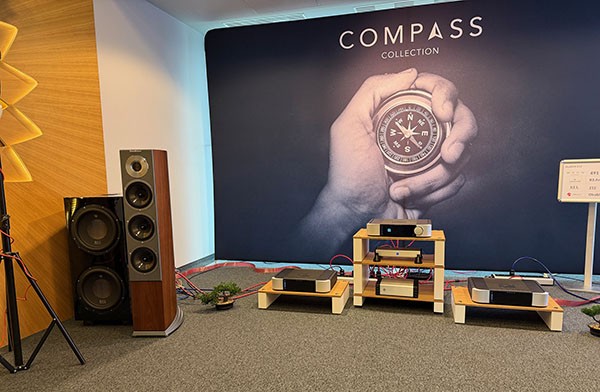
Having missed the first Vienna High End show earlier this year, where Moon by Simaudio's 461 power amplifier ($5000) and 491 network player/DAC/preamp ($6500) had their initial public showing, I was glad to encounter them here. As with all Moon products, the 461 and 491 are manufactured in Canada and sold with a 10-year warranty. Incorporating technology developed for the excellent Moon 861 and 891 (both of which I reviewed), the amps include the new MHP Moon hybrid power supply, which combines the strengths of switch mode and linear technology, and special Moon distortion canceling technology.
The 861 outputs 150W into 8 ohms (doubling into 4) in stereo mode, and 450W into 8 ohms (doubling into 4) in mono configuration. The 491 includes the Moon MiND streaming platform and one ESS9039Q2M DAC per channel. With an advanced volume control, it's fully balanced.
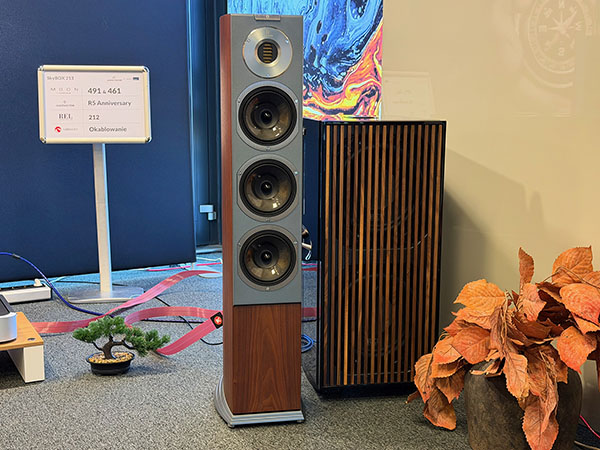
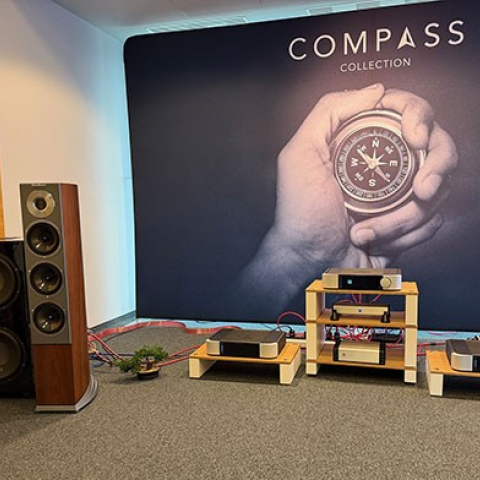
AudioVector's new R5Anniversary speaker ($24,500-$30,000/pair, depending upon finish) paired with REL212 carbon special subwoofers ($6000). Described as the "first step into the REL line array concept," the 212 includes linear reinforcement designed to fundamentally enhance all frequencies of the main speaker. The 212 boasts a rear-firing driver designed to reinforce the upper midrange and tweeter of the main speaker and an optional premium wooden grill said to be totally transparent.
The system also included Nordost's Red Dawn III cabling and QNet7 network switch with Sort Kone equipment supports.
The sound? On Woong Sun's "I Can't Stand the Rain," it was extremely smooth and warm. Bass was nicely articulated and fairly fast. The system truly shined when volume was raised for the title track of The Sonny Clark Memorial Quartet's 1986 Black Saint LP, Voodoo.
Look for reviews of some of these products in the coming year.