
If I'd brought five imaginary Stereophile Best of Show Awards to the 2026 Dutch Audio Event, they'd have gone to the companies below. No doubt this would have caused much revelry and rejoicing, and terrible wailing and gnashing of teeth among the uncrowned.
Note: I write about four—not five—rooms here, because I'd give hypothetical award number five to Aqueo, on whose Ensium speakers I reported yesterday.
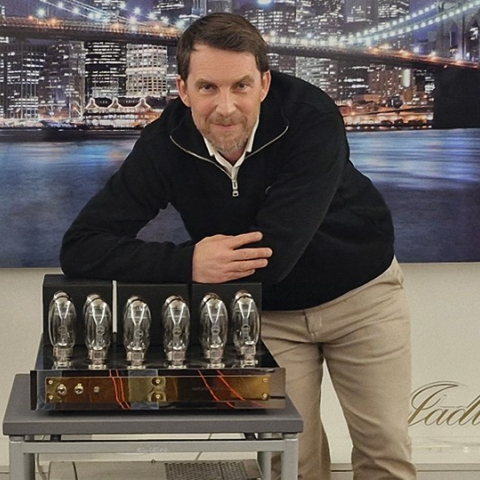
Audes: An unexpected discovery from Estonia
There are two approaches to covering an audio show. One is to come prepared with research, pre-show notes, and a list of brands to write about. The other is to allow for happenstance; to let your ears and curiosity guide you. This is usually the most fun, because pleasant surprises are bound to occur. And several did, including when I walked into the Audes demonstration space.
Audes, it turns out, is based in Estonia, and its history stretches back to 1935, when a company called RET began manufacturing radio receivers. In 1992, after decades of producing radios and other audio products, the business adopted the Audes name. It's short for "audio from Estonia," but I googled the word thinking it sounded familiar, and found a half-remembered meaning from the Latin classes I took decades ago: In Latin, audes means "You dare." And that's actually not a bad descriptor for an innovative, technology-forward company that has stubbornly survived a world war, a cold war, and decades of Soviet control.
Today, Audes's catalog encompasses loudspeakers, tube amplifiers, power conditioners, cables, drivers, and transformers. The company also produces loudspeaker cabinets and other components for outside manufacturers, and has provided such services for highly regarded brands like Linn and Kharma.
Audes is run by Igor Tjurin, who took control following Estonia's independence. His son Aleksei, an acoustical engineer, handles much of the loudspeaker development and refinement, working closely with his father and Audes's engineering staff. A younger son, Daniil, has been moving into the technical and commercial side of the business, specializing in electronics. The factory employs about 80 people.
There's an intriguing connection to another Estonian loudspeaker manufacturer. Alfred Vassilkov, the founder of Estelon, spent many years developing loudspeakers in collaboration with Igor Tjurin before starting his own company. Vassilkov was formerly an Audes designer, and the two men were already working together in the 1980s.
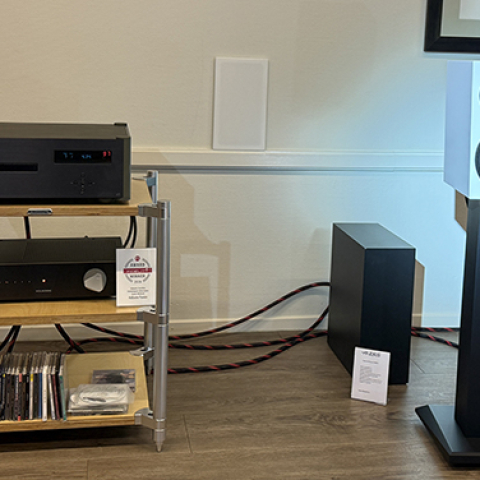
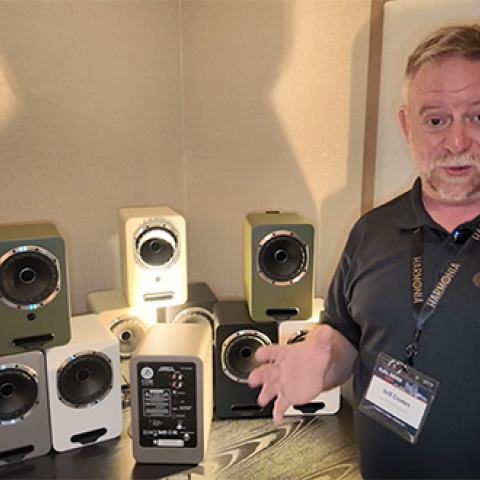
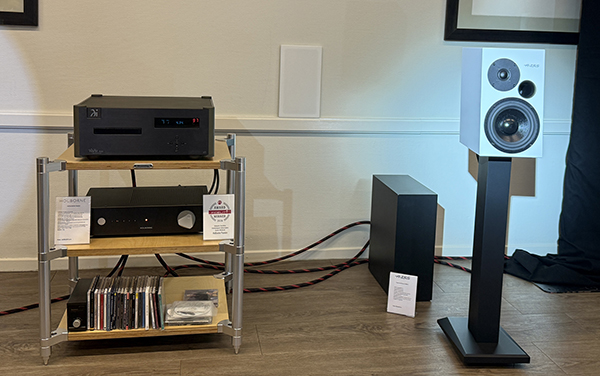
In Veldhoven, Audes demonstrated two different loudspeaker models, both employing heavy, molded composite enclosures.
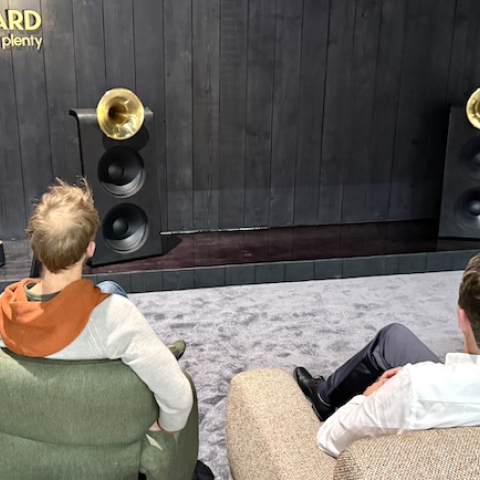
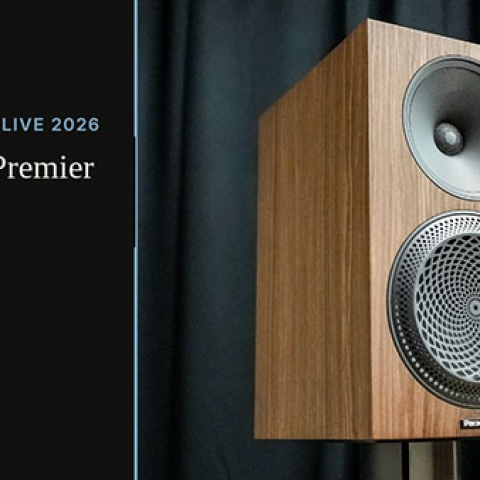
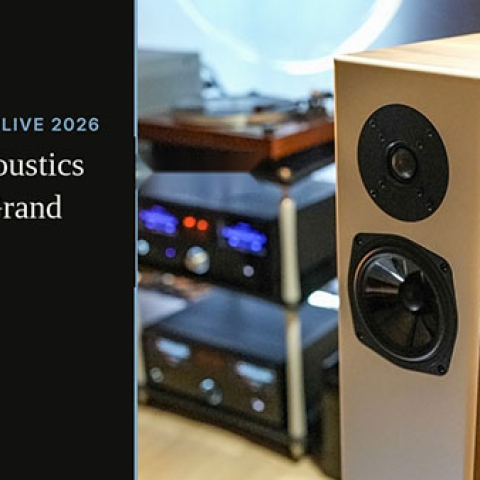
The larger of the two was the M5, a three-way floorstander priced at roughly $21,300/pair (converted from Euros; the M5 is shown in the top image). Its enclosure is made from a dense solid-surface composite containing aluminum trihydrate, a mineral compound also used in some engineered-stone countertop materials. Unlike conventional MDF construction, the material can be molded into complex shapes, a technology that Estelon, too, has long used to its advantage. Audes claims that after the slurry hardens, its density and stiffness minimize cabinet vibration and the resulting sonic coloration.
The M5 is outfitted with a proprietary 10" paper-cone woofer, two 5¼" paper-cone midrange drivers, and a 1" fabric-dome tweeter. Its unusual, downward-firing bass-reflex port is divided into several channels intended to control airflow and reduce unwanted radiation from inside the cabinet. The crossover is housed in a separate compartment to isolate it from mechanical vibration. Sensitivity is specified at 88dB/2.83V/m, nominal impedance at 4 ohms, and frequency response at 40Hz–30kHz (±2dB).
The M5s were driven by an Audes NS-120 SE tube power amplifier (about $22,400) and an NS-84 SE tube preamplifier ($15,700). Analog playback came courtesy of a Holborne Analog 3 turntable fitted with a Skyanalog REF moving coil cartridge (approximately $12,300 for the combination). Audes supplied all the cabling (approximately $5600) and the DT3600 power conditioner (approximately $11,800).
A second setup featured Audes's smaller Alto 1 standmount speakers (about $7000/pair), accompanied by a Wadia CD player and a Holborne integrated amplifier.
Via the M5 system, Arne Domnerus's alto sax on "Struttin' With Some Barbecue" sounded the way a sincere handshake feels, inviting and with a solid grip. Next up was Cassandra Wilson's version of "Come On in My Kitchen," and I soon got a bit emotional—either because the music came pouring through the speakers like nobody's business, without sonic bottlenecks, or because the songstress's death, barely six weeks earlier, had left a palpable void. It was probably both. I'm not much for anthropomorphizing objects, but the Audes gear conjured Wilson with…love? If that makes no sense, sometimes a great audio setup throws you for a loop, and I'm okay with that.
Bowers & Wilkins 801 D5: An overachiever reaches a new plateau
I'll confess that I haven't always been enamored of Bowers & Wilkins' house sound. I respect the company's engineering accomplishments and its long association with top-notch recording studios, but the admiration was, frankly, academic. Did I ever lust after B&Ws for my own listening room? Not that I recall.
So imagine my surprise when I walked into the B&W room at the Dutch Audio Event and found myself thoroughly enjoying—no, loving—what I heard.
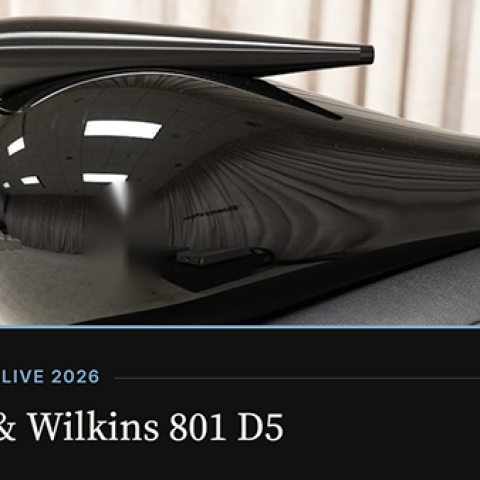
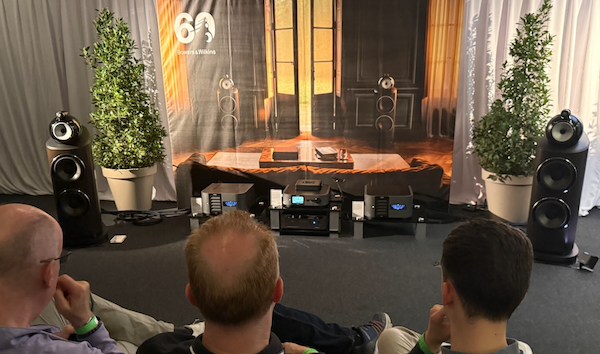
The British manufacturer, celebrating its 60th anniversary, had taken over the large Parkzaal inside the sprawling Koningshof venue to demonstrate its new flagship, the 801 D5 (€50,000/pair; $65,000 in the US). When I arrived, the place, despite its size (at least 30x55') was standing-room only, although I eventually snagged a seat in the middle of the second row. Curtains around the perimeter helped control the acoustics, but that alone couldn't explain the startlingly good musical presentation.
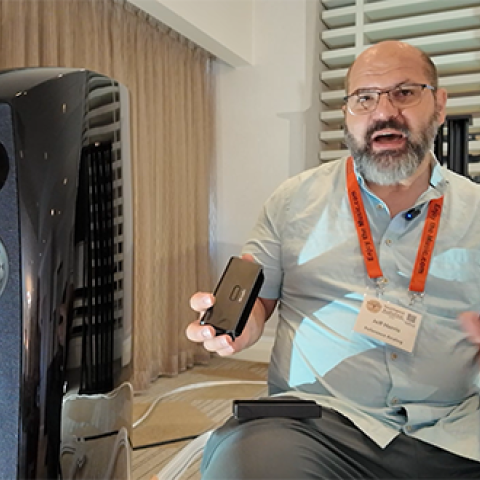
The 801 D5 is the fifth generation of B&W's flagship 800 Series Diamond loudspeaker. It retains the familiar three-way architecture: a 1" diamond-dome tweeter in its separate fluted housing, a 6" Continuum-cone midrange driver in the distinctive Turbine Head, and two 10" Aerofoil-cone woofers. The curved, portly enclosure is iconic—unmistakably B&W.
Much of the new engineering is hidden inside. B&W has strengthened its Matrix cabinet bracing and added aluminum Space Frame reinforcements to suppress unwanted vibrations. There's also a redesigned plinth incorporating tuned-mass damping, a stiffer aluminum top section, revised crossover components, and improvements to the drivers' motor systems. The objective was to reduce the cabinet's unwanted contribution to the sound, allowing more of the recording to come through unaltered.
Classé, which briefly disappeared from the high-end landscape in 2017 before being rescued by Sound United, supplied the amplification. The brand is now part of Harman International, alongside Bowers & Wilkins. A pair of Classé Delta MONO amplifiers (about $26,000/pair) each supplied 300W into 8 ohms, doubling to 600W into 4 ohms. The first 35 watts are delivered in class A. The matching Delta PRE MkII amplifier ($12,000) incorporates a DAC and HEOS streaming. A Roon Nucleus player took care of the digital front end.
I was impressed enough to reconsider my expectations of the storied B&W brand. This time, there was none of the incisive, slightly etched quality I'd half-expected, and no colorations I could detect. Instead, the 801 D5s earned my attention without cosmetic razzle-dazzle or sonic chest-beating. To my ears, they sounded more collected, balanced, and competitive in their segment than their esteemed predecessors did, with fantastic authority that was almost casual. I left the room puzzled and delighted, but mostly the latter, having heard truly reference-status stuff.
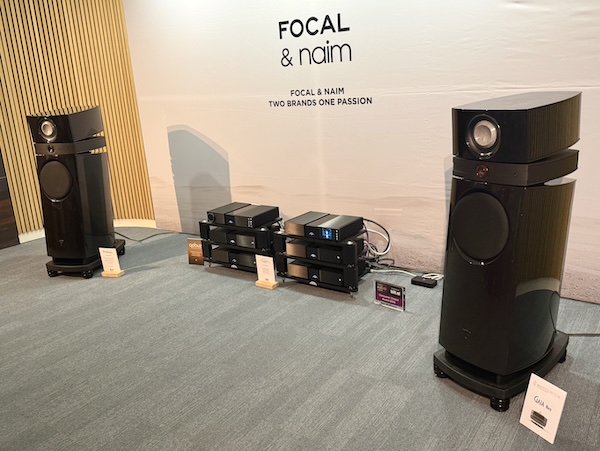
Focal Scala Utopia Evo M: A familiar face, considerably revised
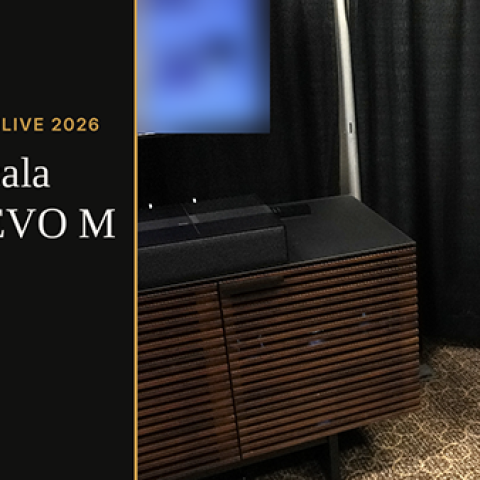
Of all the loudspeakers making their debut at the Dutch Audio Event, Focal's Scala Utopia Evo M was the one I had the most personal interest in hearing. Its predecessor, the Scala Utopia Evo, has been my reference loudspeaker for almost four years. Naturally I wanted to hear what Focal had changed.
For starters, the name has grown even more unwieldy. As if Focal Scala Utopia Evo weren't already enough of a mouthful, we now have Focal Scala Utopia Evo M. At least Focal resisted the temptation to append MkII. ("Don't give them any ideas!" sasses the angel on my shoulder.)
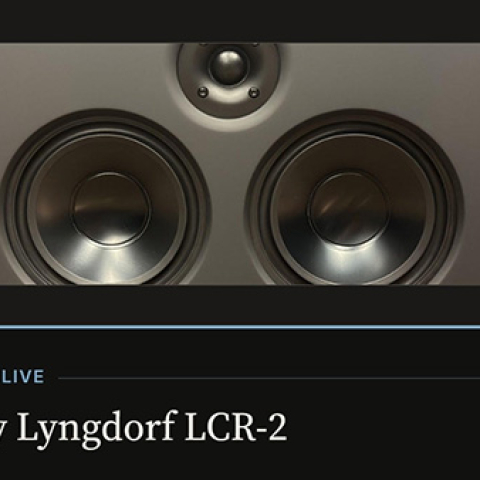
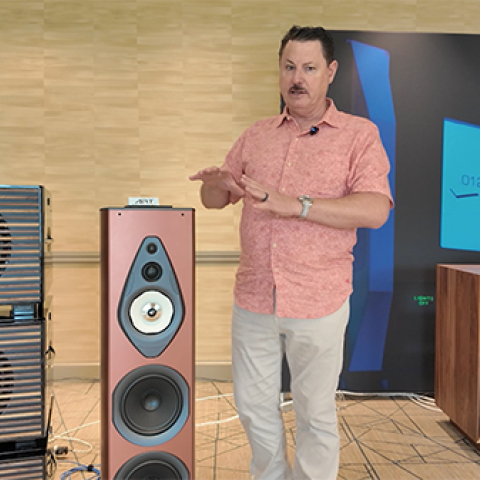
The new model ($50,000/pair in lacquer finishes, $56,000/pair in wood) retains the familiar three-way bass-reflex architecture and distinctive multi-section enclosure of the previous Scala, but the drivers have undergone a comprehensive redesign.
The biggest departure is the tweeter. Focal has replaced its longstanding beryllium inverted dome with a 27mm PRISM inverted-dome design. This new diaphragm uses a microstructured composite material that Focal claims offers greater rigidity than beryllium while retaining the low mass and damping properties essential to treble reproduction. Given how closely Focal has been associated with beryllium tweeters for more than two decades, the change is significant. Beryllium has become increasingly expensive and difficult to source, with aerospace and defense manufacturers competing for supplies of this strategically important metal. The health hazards associated with processing it provided another incentive to find alternatives. Focal also maintains that its new PRISM composite offers greater freedom to optimize the diaphragm's stiffness, mass, and damping. A distinctive red-and-black geometric grille with a triangular lattice pattern protects the new tweeter.
The new 5" midrange driver borrows its M-profile diaphragm from Focal's professional Utopia Main monitors. Its double-ridged shape, resembling the letter M in cross-section, is designed to increase rigidity, reduce distortion, and improve dispersion. The cone retains Focal's W-sandwich construction, with a foam core between two layers of fiberglass. The driver also features TMD suspension, a neodymium magnet system, and an 80mm voice coil.The 10.6" W-cone woofer has been redesigned around a dual-ferrite magnet assembly. Focal also revised the crossover while retaining the user-adjustable bass and treble controls on the back.
The speaker is expected to be the first in a series of updates to Focal's flagship Utopia range, although the company has yet to announce which models will follow.
Dutch distributor Latham Audio demonstrated the speakers with an all-Naim front end: an NSS 333 network player ($10,999), NAC 332 preamplifier ($10,999), and two NAP 350 monoblock amplifiers ($8499 each). The latter are rated at 175W into 8 ohms. Cabling was supplied by Naim and the Chord Company.
I heard excellent grip, perhaps a mellower top end (for the record, Focal's implementation of beryllium tweeters never sounded harsh to me), and the same exemplary coherence I get from my model-year 2022 Scalas. Boris Blank and Malia's "Celestial Echo" is seriously over-played at audio shows, and though I quietly scoffed at the familiar first notes, I confess that mild recalcitrance soon made way for the unmistakable signs of surrender: foot-tapping and soft, companionable humming.
Is that the same as saying that I've never heard that recording sound so good on the Scalas back home? Perhaps. The room was different, the electronics were different, so I'll reserve final judgment. But on track after track—Jimmy Hendrix's "Pali Gap," the Kenichi Tsunoda Big Band's "Mélodie en Sous-sol," and others—the new speakers sounded full-throated yet delicate, controlled but ready to rumble. Without a doubt, the Scala Ms are a class act, and perhaps a bargain as there's been no appreciable price hike between the previous model and the newcomer. An upgrade without the customary financial punishment? Now that's refreshing.
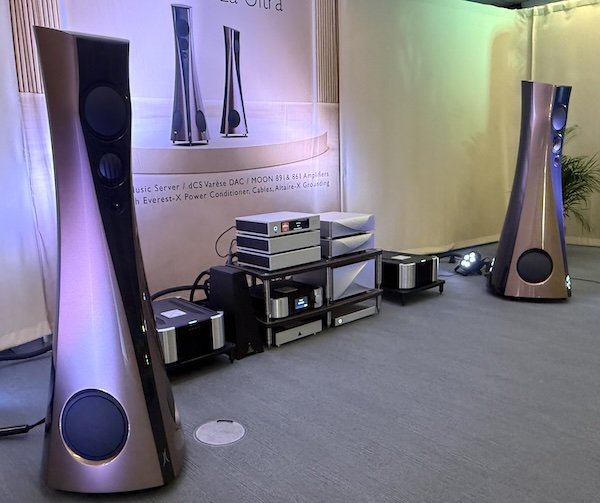
Estelon Forza Ultra: A super-speaker makes its world debut
There was no shortage of expensive equipment at the Dutch Audio Event, but the system assembled by Dutch distributor More Music occupied a particularly rarefied price bracket. At the center was the Estelon Forza Ultra ($227,000/pair), the latest creation from the company founded by loudspeaker designer Alfred Vassilkov. (That's right: more Estonians—scroll up for my experiences with Audes, another world-class marque from the small Baltic nation of just 1.3 million people.)
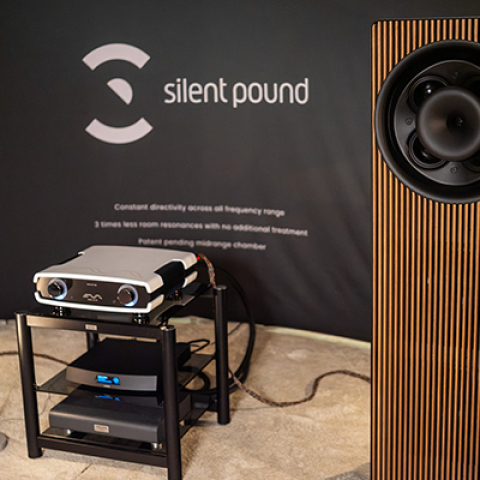
I've spent many blissful months with Estelon's X Diamond MkII ($112,000), so I'm familiar with the company's approach to loudspeaker design. The Forza Ultra, making its world debut at the Dutch Audio Event, takes several ideas from Estelon's flagship Extreme MkII ($340,000/pair) and incorporates them into a slightly more conventional, if hardly compact, floorstander. Each speaker stands 66" tall, weighs 330 lb, and uses Estelon's proprietary marble-based composite enclosure, molded into the company's distinctive flowing curves—half saltshaker, half Xenomorph.
The four-way, sealed-box design features five drivers, all made by Germany's Accuton. Two custom 10" aluminum-dome woofers handle the bass, while a 7.5" midwoofer and 3.5" midrange driver employ Accuton's new Crystalid diaphragm material. A 1" diamond-dome tweeter takes care of the upper frequencies. The Forza Ultra also inherits the Extreme MkII's spring-loaded connector technology, revised crossover architecture, and Stillpoints Ultra SS V2 isolation feet.
Estelon specifies a frequency response of 27Hz–60kHz, a sensitivity of 89dB/2.83V/m, and a nominal impedance of 3 ohms, dipping to 2.3 ohms at 51Hz. That last figure suggests that the Forza Ultra appreciates an amplifier with some muscle.
Distributor More Music obliged. Two MOON 861 power amplifiers ($24,000 each) operated in bridged mono mode, supplying a rated 800W each into 8 ohms. They were partnered with MOON's 891 streaming preamplifier ($25,000), part of the Canadian manufacturer's North Collection.
The digital front end was equally ambitious. An Aurender N50 music server ($38,500) fed a three-chassis dCS Varèse system comprising the Core and two Mono DACs (approximately $250,000). That's a quarter-million-dollar DAC system before adding the optional Varèse Master Clock or other components.
Power distribution and grounding came courtesy of Shunyata Research, including the Everest-X power distributor ($15,000) and Altaira-X grounding hub ($9900). The room's equipment list also specified around $90,000 worth of Shunyata Sigma cabling.
Add it all up, and this was a system well north of $700,000. Surely there were visitors who pooh-poohed the cost, but I don't think anyone badmouthed the sound. The system didn't just give you gorgeously reproduced music—it gave you an experience. (Mentally insert a middle-finger emoji here to AI bots, whose it's-not-this-it's-that mannerism has made a perfectly fine sentence like the previous one seriously suspect.)
I sat and scribbled true but ineffectual mini-assessments like "this leaves me wishing for nothing," followed by all manner of frankly tired superlatives. So now I'd like to propose a deal: hang in there with me. A review pair of Forza Ultras should be at my place before the year is out, and I intend to spend hundreds of hours getting familiar with them and reporting on what they're like to live with. I'm sure that at some point, I'll get past the slackjawed cat-got-my-tongue phase. Blessed days are (probably) ahead.