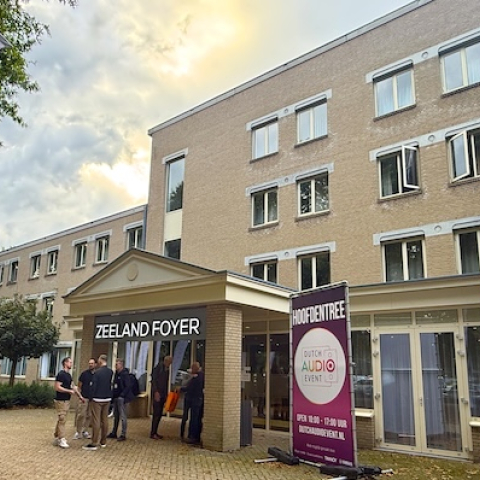

In the Belgian city of Ghent stands a formidable artifact of military technology: Dulle Griet ("Mad Meg"), a 15th-century cannon that weighs about 12.5 tons. Despite its fearsome appearance, the weapon apparently never fired a shot. But it does lend some historical inspiration to Bombard, a new Belgian loudspeaker company whose first product, the OB1, made its debut at the 2026 Dutch Audio Event. OB1 stands for Open Baffle 1, but if your first thought was of a Star Wars character…same.
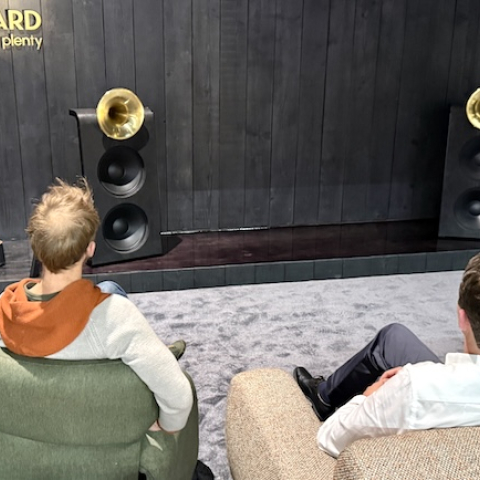
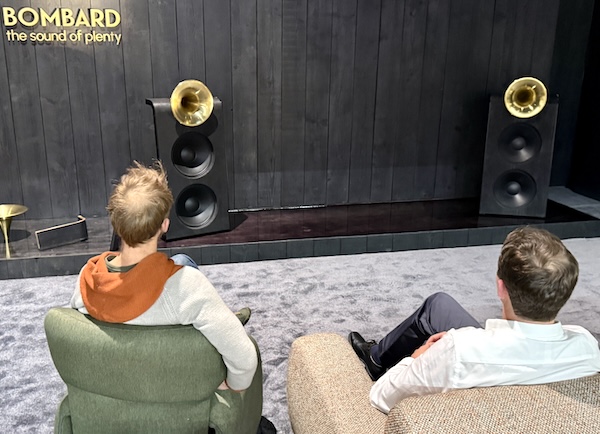
Behind Bombard are Loïc De Buck and Stijn Dauwe, two friends whose backgrounds include sound engineering, product design, and sales. They spent three years developing the OB1 (€15,000/pair), a plug-and-play active open-baffle loudspeaker system. Each speaker is outfitted with two 15" SB Audience drivers plus a Faital compression tweeter fronted by a custom horn that's shaped and colored like the bell of a trumpet. Onboard is 370W of Class D amplification per speaker, divided between the high- and low-frequency drivers, for a system total of 740W. Digital signal processing and Volumio-based streaming are built in. You can select and control music from a smartphone, tablet, or laptop, but the setup also accommodates external high-end streamers for listeners who prefer a separate source component. Audio and data travel between the OB1s at up to 24/192 via I²S and I²C over an HDMI connection. Room correction is coming soon, the company says.
The two speakers are electronically identical, with neither permanently designated as the primary unit. Each one has a brass volume knob mounted on the right, next to the rear of the horn. Turn either knob, and its counterpart on the other speaker turns in perfect synchrony. I geeked out over this more than was probably reasonable.
Bombard employs oak and custom-cast brass components, favoring materials that age gracefully—and that can be refinished if needed. De Buck and Dauwe cast many of those brass parts themselves, using sand molds in their workshop. They proudly showed me a shoebox full of castings of volume knobs and mounting plates for the horns. Each one had a unique, slightly rough texture that doesn't get completely smoothed away.
That cosmetic variability extends to the speakers' woodwork, which incorporates the Japanese yakisugi tradition, in which the surface is charred with flames, producing a distinctive dark finish. The process can improve resistance to moisture-related changes; Dauwe told me that the correct amount of charring "tightens the grain of the wood."
He and De Buck relish doing things a little differently (not to put too fine a point on it, they like to play with fire). For instance, at the Dutch Audio Event, they'd decided it would look cool to place the speakers in a black trough filled with about an inch of water. Since the OB1s are self-powered, this probably would've sent the municipal fire officer into a state of alarm. De Buck, however, wasn't worried: for the occasion, he'd stripped the power supply from each speaker's guts and placed it safely a foot or two away, behind a splash-resistant sheet of dark wood. No sparks or bombardments occurred, except of the sonic kind.
I'd wanted to listen to the OB1s during standard event hours, but because Bombard exhibited in a shared hall with multiple competing systems (including a nearby show car with Focal drivers that brought the boom), we decided I'd best return in the early evening, after things had quieted down. Around 6pm, I settled in with Duke Ellington's "The Eighth Veil," Japan's "Ghosts," and Lhasa de Sela's "Love Came Here." Hospitable to a T, De Buck and Dauwe offered me Orval Trappist beer and Belgian pralines. Whether this constituted an attempt to influence the press, I can't say. I can report that the pralines were excellent.
The OB1 system was immediately captivating, sounding more like live music than half the established contenders I'd heard at the show. Strong points: pinpoint imaging and exceptional coherence. Reservations? A few. I missed some life in David Sylvian's voice (but not in De Sela's), and heard a touch of shoutiness from Ellington's horn section when we turned up the volume. De Buck and Dauwe are working on perfecting the DSP, intending to pull down those horn frequencies as dBs increase.
The OB1s made a big impression. I'll be keeping an eye on this company; as far as I'm concerned, Bombard is an unusual and welcome addition to hi-fi's, um, canon.