We interrupt our regularly scheduled analog programming for this important message: Shunyata Research's proprietary DTCD Analyzer (footnote 1) finally proves that power cords, power conditioners, circuit breakers, even fuses measure differently, and that perhaps these measured differences are what audio enthusiasts hear when they swap out these elements in their systems.
DTCD stands for Dynamic Transient Current Analyzer. Too simply stated, its bedrock purpose is to simulate the power grid that supplies electricity to your home, but in a predictable, repeatable way that's not dependent on the varying current and line voltage, which can affect measured results. The grid's goal is to maintain 117V while providing sufficient current. The grid can deliver a lot of current. It can melt your wiring, which is why you have circuit breakers to prevent that, should the impedance of the load drop to short-circuit conditions.
The DTCD is a low-impedance power source with a constant voltage that simulates the power grid. It measures, in the context of a pulsed current draw, the instantaneous current delivery in amperes, and voltage drop across the AC input of device being measured. The DTCD also measures the stored residual noise component and rate of dissipation after the conduction period.
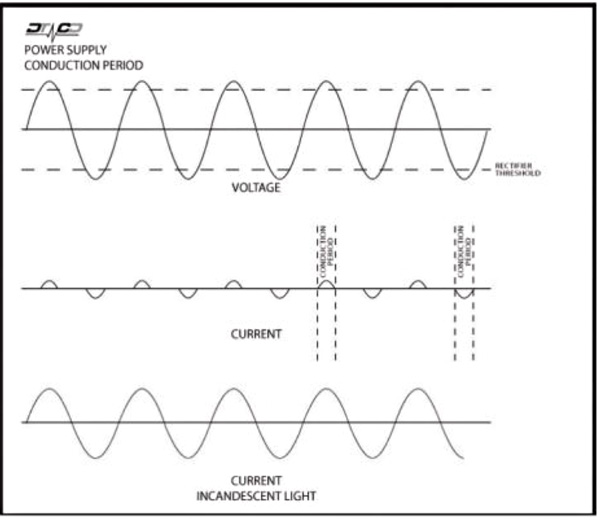
According to DTCD inventor and Shunyata Research founder Caelin Gabriel, all modern power supplies that rectify the incoming AC pull current in pulses (fig.1), which is why, he says, traditional measurements of capacitance and inductance used to "measure" power cords and declare them "all the same" doesn't really prove anything. Gabriel is not blowing magic-clock smoke; his background includes being recruited by a military division of the National Security Agency, where power-supply design was part of his training.
Except that, as anyone who has bothered to actually listen will testify, they do matter, and they can be heard. Those measurable differences are what, among other things, people hear when they hear differences among power cords. Now the differences that are heard can be measured.
In fact, Caelin Gabriel says that he can measure differences among short pieces of various cables, and among different contacts, switches, even fuses. Anything that conducts current can be measured using the DTCD. And that includes power conditioners.
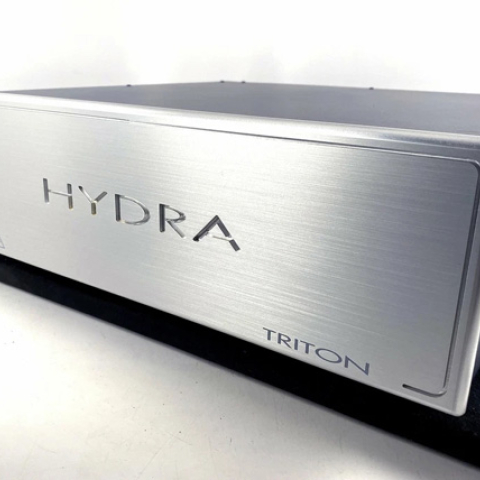
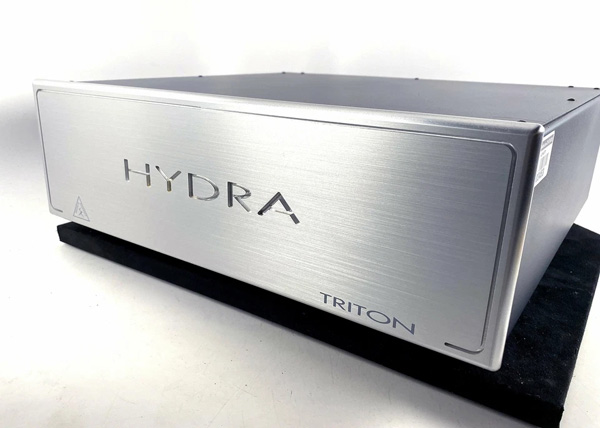
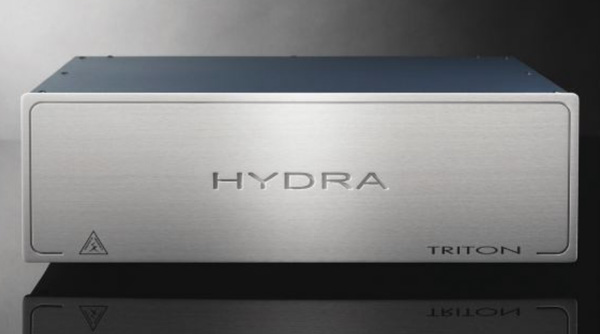 Shunyata Research Hydra Triton power conditioner
Today, most audiophiles understand that the power coming from the wall is usually "dirty," with voltage spikes superimposed on the 60Hz sinewaves. The spikes can come from your refrigerator, or even your neighbor's. (In their tests, Shunyata Research (footnote 3) uses a worst-case scenario: a paper shredder.) What you hear through your speakers is essentially the power line modulated by a musical signal, so clean power is important: The less stuff on the line, the cleaner the power. That's why the sound is usually better when you listen late at night.
But even the gear in your own system sends noise back down the line, and from there it can get into the other components. A truly effective power conditioner would isolate the AC jacks from one another to prevent such cross-contamination.
Over the years, Shunyata's Caelin Gabriel has designed power conditioners based on his knowledge of how power supplies work, and how to best filter out line noise while minimizing current-draw loss or producing a reactive load. But until he devised the DTCD, it was difficult to measure results. It was mostly design by theory and listen.
I've long appreciated the sonic benefits of Shunyata's Hydra conditioners. Their effects aren't subtle in a high-performance system, and include blacker backgrounds and greatly improved resolution of low-level detail, as well as an intensification and clarification of subtle spatial cues. In other words, good power conditioning allows a system to express the "plasma" that brings recorded music to life.
But I've always felt there was a trade-off involved, as there almost always is with anything you attempt to do to a high-end system to extract from it that last nugget of performance. While each iteration of the Hydra improved on its noise-killing powers, even the Hydra 8 gave the music a slight transient edge or etch. Was it worth the benefits? I always thought so, but based on reader comments, not everyone does.
Hydras (prior to the Triton and Talos) use proprietary capacitor arrays and are effective at reducing noise. However, Gabriel explained to me that the indiscriminate use of large capacitors and inductors can cause serious resonances. Results with capacitor-based filtering systems conditioners can vary greatly; as far as Gabriel is concerned, even the good outcomes aren't as good as what he gets without such filters.
While all of this sounds reasonable in theory, once you see it play out across the screen of the DTCD's oscilloscope, it becomes clear in reality—and that went for the sonic problems I heard with the Hydra 8, but didn't hear with the new Hydra Triton ($4995). (Shunyata's new Hydra Talos uses the same technology in a smaller package for $2995.)
Gabriel laid it all out for me during my visit last spring to Shunyata's plant, in Poulsbo, Washington. First he showed me a comparison of a baseline trace showing the current draw over a very short (48 microseconds) pulse. (As I said earlier, with typical products, the current delivery occurs as a series of short pulses.) The baseline trace indicates more current pulled with the DTCD plugged directly into the wall than into a Hydra 8.
So yes, going through the power conditioner does somewhat limit current delivery on the initial pulse, but the drop is linear and controlled, and, at the 48µs mark, the differences are small. The benefit, of course, is in how much noise is filtered out.
Another graph showed the baseline voltage drop and current draw with no conditioner inserted. The voltage drops in the hot and neutral conductors drop off identically, as does the current. However, through a Hydra 4, the neutral leg drops voltage faster—mostly because it contains a magnetic circuit breaker. Removing the breaker would improve the measurement, but not including overcurrent protection is unacceptable. According to Gabriel, a thermal breaker measures considerably worse than a magnetic type.
Looking at the point where current begins to be conducted with the Hydra 4 in-circuit, you can see a tiny bit of ringing. It's controlled, well damped, and disappears in a few picoseconds, but it's greater than in the baseline curve. More than in the "baseline" curve? That's the filter showing up in the measurement. Getting the noise out has its benefits and costs.
Next up was the Hydra 8. Its measurements look identical to the 4's, except that there's even more ringing! Why? The Hydra 8 has more filtering. It produced an improvement in background blackness compared to the 4, but at the cost of introducing more of that leading edge ringing, slight though it is.
Before showing me how the new Hydra Triton measures, Gabriel showed me another well-regarded line conditioner, this one using large capacitors, inductors, and ferrites in a standard L, T, and Pi filter configuration to produce a low-pass filter. Compared to the neat curves produced by the Hydras, these are a mess. The conditioner starts to conduct current, then goes flat, then decreases current, then increases it, then decreases. The measurement shows a long oscillation in the delivery of current. The hot and neutral traces diverge wildly, with a dramatic drop in impedance in one, and a huge increase in the other as the voltage drops dramatically. Gabriel says the result will be current resonances across the rectifiers within the power supplies of the devices connected to it. The effect on sound quality is hard to predict and depends on the power supply of the products connected to this conditioner, which is one reason some people react positively to this unnamed but well-regarded power conditioner and others don't.
Gabriel had answers for the inevitable charge from some that, whatever these measurements show, none of them can possibly affect the sound. That's the skeptics' fallback position from "You can't measure any differences" among these products, once it's proven that you can.
Gabriel's designs don't use transformers, inductors, ferrites, or conventional capacitors common in low-pass filters because, he says, they seriously impede instantaneous current flow and are highly reactive. Looking at the Triton's measurements, you see impedance-drop and current-flow curves with linear shapes like those produced by the Hydra 8, but with less current flow because of the new model's noise-isolation chambers with their massive copper inserts. These chambers, along with Shunyata's new Multi-Phase Differential Array (MPDA) filters, result in excellent noise reduction without the need to create an erratic, reactive device. But more important, as I immediately noted, the ringing seen in the other charts is now imperceptible, essentially disappearing within a picosecond of the pulse, and the voltage drops of the hot and neutral legs closely match the baseline. It's all neat and tidy, and guess what? That's how it made my system sound.
The Hydra Triton is the first Shunyata Research product created using the DTCD, and Gabriel was able to tailor its design around the measured results. No more guessing and listening, though listening was indeed part of the development process—in the company's meticulous sound room, featuring Wilson Audio Sashas driven by Audio Research electronics.
 Exactly What's Inside the Triton?
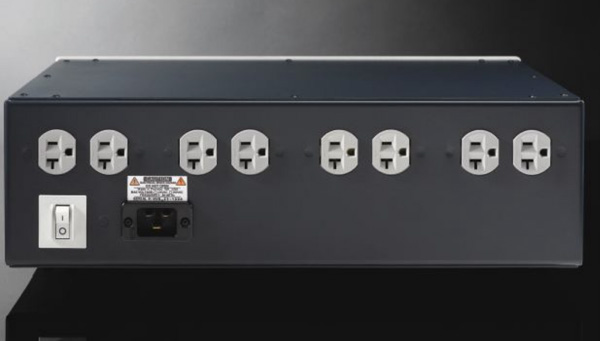
Only the breaker and the outlets (a total of eight) remain from the Hydra 8. Everything else, from the active and passive filtering to the bus structure and the chassis and internal wiring, is new. A 38 lb power strip it's not! The new MPDA filter system is an array of 30 microfilters, each aimed at specific noise components, surface-mounted on a very small circuit board. Three large, cylindrical chambers, one each for hot, neutral, and ground, are mounted at the center of the chassis and filled with a patented substance, ZrCa-2000. These filter out noise in the mega- and gigahertz regions. For every conductive element in the Triton, Shunyata uses brass with a high copper content (the material is not plated, and so exhibits no diode-like effects): bus bars, the blades of its custom SR-Z1 outlets, even the connecting screws. The internal wire geometry was designed using the DTCD.
No one is suggesting plugging a $3000 audio rig into a $4995 power conditioner, but if you've invested considerably more in your system, consider trying a Triton. The worst that will happen is you'll return it and get your money back. The second-worst outcome will be that you'll drop another $4995 on your system. But if the results you get are like what I got, you'll probably conclude it's worth the investment.
But expect a long and very audible break-in period. If you've got a dehumidifier or some other power-sucking motorized device, break in the Triton with that, plugging it into each of the Triton's eight AC jacks for at least a day.
The Triton doesn't limit current, and can handle the biggest amplifiers in the world—so after break-in, plug them in too. Shunyata sent me a second Triton for the amplifier end of the system, and I plugged in all four AC cables of a pair of MBL 9011 monoblocks.
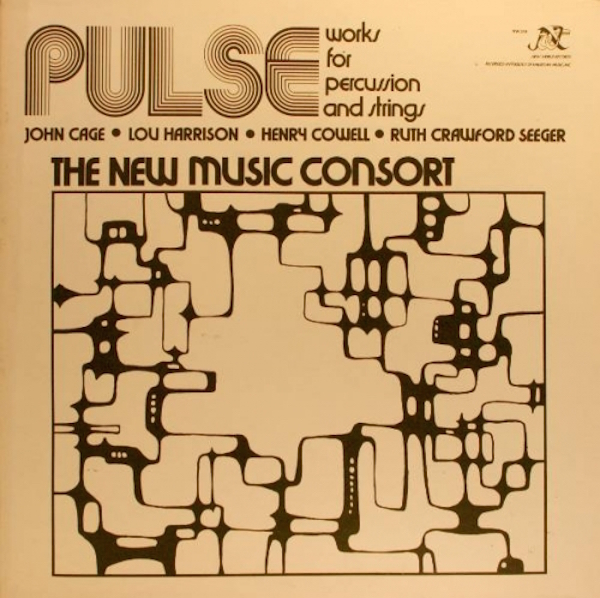 But before doing so, I played that sonic spectacular by the New Music Consort: Pulse: Works for Percussion and Strings (LP, New World/Classic NW319). Then I plugged the amplifiers into the Triton and listened again, being certain that the MBL 6010 D preamplifier's volume control was set both times to "71."
I wasn't expecting to hear much of a difference, compared to the obvious improvement the Triton made in the low-level front end of the system. I couldn't have been more surprised. The improvements in transparency, spatiality, and resolution of low-level detail were obvious, as were the greater grace and cleanness (but not "filteriness") of the transients. Most ridiculous, though, was that it all sounded louder. I had to turn down the volume from "71"—although, for the first play minus the Triton, I didn't. I'll leave the 'splainin' of that to others.
Finally, I can listen with a Shunyata Research conditioner in my system and not tell myself "It's worth the trade-off." There's no trade-off. The filtering is effective and doesn't leave any kind of residue, sonic or measured. Instead, the music emerges, clarified, from deep black space, with transients that are neither smoothed over nor exaggerated with etch. Transparency and overall coherence reach an exalted state. Hear for yourself, or return it if you don't.
But before doing so, I played that sonic spectacular by the New Music Consort: Pulse: Works for Percussion and Strings (LP, New World/Classic NW319). Then I plugged the amplifiers into the Triton and listened again, being certain that the MBL 6010 D preamplifier's volume control was set both times to "71."
I wasn't expecting to hear much of a difference, compared to the obvious improvement the Triton made in the low-level front end of the system. I couldn't have been more surprised. The improvements in transparency, spatiality, and resolution of low-level detail were obvious, as were the greater grace and cleanness (but not "filteriness") of the transients. Most ridiculous, though, was that it all sounded louder. I had to turn down the volume from "71"—although, for the first play minus the Triton, I didn't. I'll leave the 'splainin' of that to others.
Finally, I can listen with a Shunyata Research conditioner in my system and not tell myself "It's worth the trade-off." There's no trade-off. The filtering is effective and doesn't leave any kind of residue, sonic or measured. Instead, the music emerges, clarified, from deep black space, with transients that are neither smoothed over nor exaggerated with etch. Transparency and overall coherence reach an exalted state. Hear for yourself, or return it if you don't.
Sidebar: In Heavy Rotation 1) Weather Report, Heavy Weather, Columbia/ORG 45rpm 180gm LPs (2) 2) Oscar Peterson, We Get Requests, Verve/Analogue Productions 45rpm 180gm LPs (2) 3) Joe Lovano Us Five, Folk Art, Blue Note/Pure Pleasure 180gm LPs (2) 4) Dexter Gordon, A Swingin' Affair, Blue Note/Music Matters 180gm 45rpm LPs (2) 5) Jóhann Jóhannsson, Virthulegu Forsetar, Touch LPs (2) 6) The Kinks, Kinda Kinks!, Pye/4 Men with Beards 180gm LP 7) Drive-By Truckers, Ugly Buildings, Whores & Politicians: Greatest Hits 1998–2009, New West 180gm LPs (2) 8) Tony Bennett, I Left My Heart in San Francisco, Columbia/Mobile Fidelity Sound Lab 180gm LP 9) Eric Clapton, Unplugged, Reprise 180gm LP 10) Nick Lowe, The Old Magic, Yep Roc 45rpm 180gm LP
Footnote 1: See https://shunyata.com/technology/. Footnote 2: Shunyata cautions on its website that DTCD is not the only design parameter that separates the performance of power products. However, due to the foundational nature of current and voltage integrity it is clear that a product will have severely impaired performance if it has significantly low or diminished DTCD. Footnote 3: Shunyata Research, 26273 Twelve Trees Lane, Suite D, Poulsbo, WA 98370. Tel: (360) 598-9935. Fax: (360) 598-9936. Web: www.shunyata.com.
Fig.1 Voltage and current delivery with an audio component using a conventional rectified power supply.
Shunyata's DTCS graphs (footnote 2) provide a visual explanation. They show measured current-delivery differences between AC cords with molded plugs that have a thin blade contact and those with higher-quality, screwed-on or soldered plugs that provide better contact. You can see measured differences between wires of different thicknesses, and between cords configured with various geometries. The DTCD tosses out the window claims that differences among power cords can't be measured.
Don't expect that to silence the skeptics. Now they'll say, "Well, those difference can't be heard," or "Well, those differences don't matter in the real world."
Shunyata Research Hydra Triton power conditionerToday, most audiophiles understand that the power coming from the wall is usually "dirty," with voltage spikes superimposed on the 60Hz sinewaves. The spikes can come from your refrigerator, or even your neighbor's. (In their tests, Shunyata Research (footnote 3) uses a worst-case scenario: a paper shredder.) What you hear through your speakers is essentially the power line modulated by a musical signal, so clean power is important: The less stuff on the line, the cleaner the power. That's why the sound is usually better when you listen late at night.
Exactly What's Inside the Triton?Only the breaker and the outlets (a total of eight) remain from the Hydra 8. Everything else, from the active and passive filtering to the bus structure and the chassis and internal wiring, is new. A 38 lb power strip it's not! The new MPDA filter system is an array of 30 microfilters, each aimed at specific noise components, surface-mounted on a very small circuit board. Three large, cylindrical chambers, one each for hot, neutral, and ground, are mounted at the center of the chassis and filled with a patented substance, ZrCa-2000. These filter out noise in the mega- and gigahertz regions. For every conductive element in the Triton, Shunyata uses brass with a high copper content (the material is not plated, and so exhibits no diode-like effects): bus bars, the blades of its custom SR-Z1 outlets, even the connecting screws. The internal wire geometry was designed using the DTCD.
But before doing so, I played that sonic spectacular by the New Music Consort: Pulse: Works for Percussion and Strings (LP, New World/Classic NW319). Then I plugged the amplifiers into the Triton and listened again, being certain that the MBL 6010 D preamplifier's volume control was set both times to "71."
I wasn't expecting to hear much of a difference, compared to the obvious improvement the Triton made in the low-level front end of the system. I couldn't have been more surprised. The improvements in transparency, spatiality, and resolution of low-level detail were obvious, as were the greater grace and cleanness (but not "filteriness") of the transients. Most ridiculous, though, was that it all sounded louder. I had to turn down the volume from "71"—although, for the first play minus the Triton, I didn't. I'll leave the 'splainin' of that to others.
Finally, I can listen with a Shunyata Research conditioner in my system and not tell myself "It's worth the trade-off." There's no trade-off. The filtering is effective and doesn't leave any kind of residue, sonic or measured. Instead, the music emerges, clarified, from deep black space, with transients that are neither smoothed over nor exaggerated with etch. Transparency and overall coherence reach an exalted state. Hear for yourself, or return it if you don't.
Sidebar: In Heavy Rotation 1) Weather Report, Heavy Weather, Columbia/ORG 45rpm 180gm LPs (2) 2) Oscar Peterson, We Get Requests, Verve/Analogue Productions 45rpm 180gm LPs (2) 3) Joe Lovano Us Five, Folk Art, Blue Note/Pure Pleasure 180gm LPs (2) 4) Dexter Gordon, A Swingin' Affair, Blue Note/Music Matters 180gm 45rpm LPs (2) 5) Jóhann Jóhannsson, Virthulegu Forsetar, Touch LPs (2) 6) The Kinks, Kinda Kinks!, Pye/4 Men with Beards 180gm LP 7) Drive-By Truckers, Ugly Buildings, Whores & Politicians: Greatest Hits 1998–2009, New West 180gm LPs (2) 8) Tony Bennett, I Left My Heart in San Francisco, Columbia/Mobile Fidelity Sound Lab 180gm LP 9) Eric Clapton, Unplugged, Reprise 180gm LP 10) Nick Lowe, The Old Magic, Yep Roc 45rpm 180gm LP
Footnote 1: See https://shunyata.com/technology/. Footnote 2: Shunyata cautions on its website that DTCD is not the only design parameter that separates the performance of power products. However, due to the foundational nature of current and voltage integrity it is clear that a product will have severely impaired performance if it has significantly low or diminished DTCD. Footnote 3: Shunyata Research, 26273 Twelve Trees Lane, Suite D, Poulsbo, WA 98370. Tel: (360) 598-9935. Fax: (360) 598-9936. Web: www.shunyata.com.