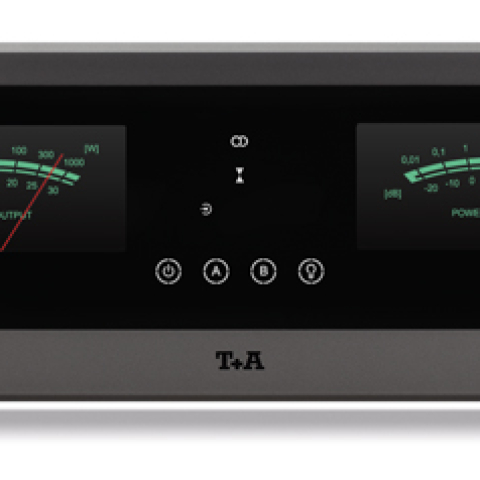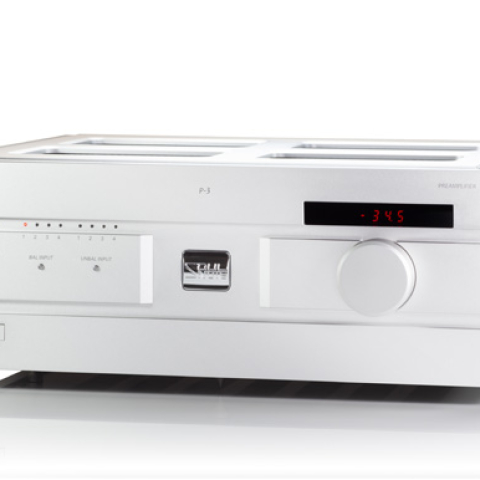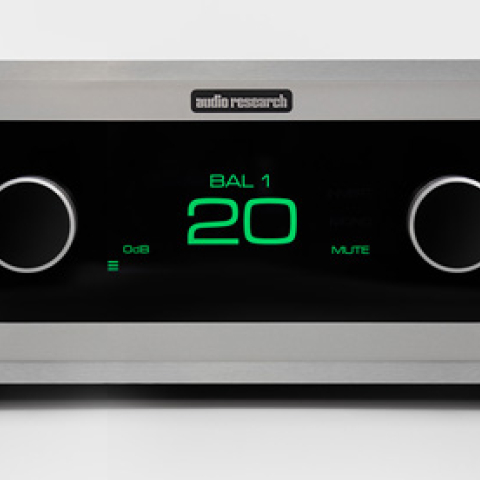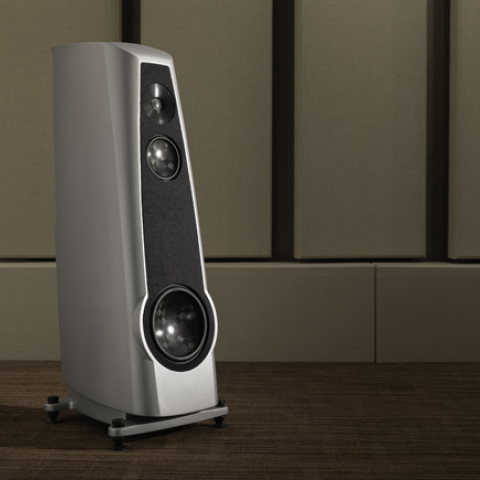

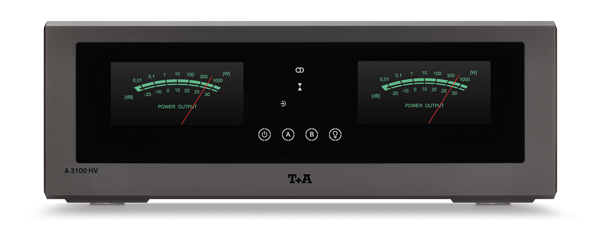
When we first took an interest in reviewing the T+A elektroakustik A 3100 HV Reference fully balanced dual-mono solid state stereo power amplifier ($29,900), every existing unit had been earmarked for a dealer. Then, just as Jim Austin and I were scratching our heads, trying to determine what might fill the gap in my newly reconstituted postsurgery review schedule, T+A founder Siegfried "Siggi" Amft informed Jim Shannon, T+A's longtime US media contact and reassuring presence, that he could expedite an amplifier—just one—from Germany. There was no hope for a mono pair, and once it arrived, it would need at least eight days of break-in. But I would be able to hear and review it.
As I sat thinking about the tight timeline and how unhappy the husband might be when he saw the electricity bill, I reminded myself how much I'd enjoyed the T+A PA 3100 HV integrated amplifier ($23,500 when I reviewed it in 2021). Sure, it was a bit of a tight squeeze, but based on that earlier experience, I expected sound I'd remember long after the amplifier had moved on to someone else's hands.
Then, as I skimmed the manual posted on T+A's updated website, I realized I had never written about the evolution and design philosophy of the company, the name of which is short for Theorie und Anwendung, which translates as "Theory and Application." Who better to ask for an explication than Siggi Amft himself, who, as he approaches age 76, speaks with vitality and clarity?
History
Siggi Amft studied plasma physics, then electroacoustics under Herr Dr. Fritz Sennheiser, then founded T+A in his garage, in 1978. Neither his father nor his new wife was enthused by the idea, but he'd been building speakers and electronic components since he was a young boy. He was, he says, "fixed" on audio. "I used to play violin and sing in a chorus," Amft said at the start of a Teams chat that also included Shannon and Siggi's son, T+A CEO Conradin Amft (footnote 1). "I was and still am attached to classical music. But, growing up in the 1960s, I also loved rock music. I don't like country, but I like metal, and I like classics. It's a little bit funny." Such varied training worked in T+A's favor. The family company—Siggi's wife works in T+A's finance department—has grown to around 80 employees, including 15 engineers.
I asked Siggi if, when he founded T+A with two employees, he had a specific sonic model in mind. Siggi told me that he found the so-called German sound of the later '70s and early '80s a bit too aggressive. "There was too much treble, too much bass response; it was not linear. It did not sound like an orchestra or instruments. So, I decided to make very linear, well-designed loudspeakers. We were the first German company to build transmission-line speakers."
Ten years later, T+A was one of the biggest speaker companies in Germany. Sales remained confined to German-speaking European countries until 1988, when T+A displayed at CES in Chicago. Sales took off in 2000 when Stirling Trayle became T+A's American distributor and Jim Shannon came on board after stints with Mark Levinson and Wadia.
Nineteen eighty-eight, though, was the banner year. Having finally acquired enough capital to build a factory and hire four hardware engineers and a software engineer, Siggi branched out into electronics. Just four years later, more than half of T+A sales were of electronics. Currently, the split is 60% electronics, 20% speakers, and—due to the influence of young Conradin—20% headphones.
In 2003, the company's 25th anniversary, T+A released its V series of components, including the V10 amplifier. V was for valves, or vacuum tubes. "We loved it," Siggi said of the V series. "It sounded great. We think valves can have huge advantages, but they have even bigger disadvantages, in reliability, stability, and endurance."
The T+A team decided that the wonderful sound of tube amplifiers was due to the high voltage they operated at. They decided to incorporate "tube philosophy" into the new, solid state HV series, which they launched in 2014.
"We like valves very much because they have a high voltage of 350V and a very linear amplification curve," Siggi said. "This is why valves sound so clear and so natural. Sometimes they're a little bit too warm due to too much k2 distortion (footnote 2). But the valve itself is extremely fast, and its linearity sounds so good.
"The problem is that as the tube is used, the active material in a valve is transported from the heated cathode to the anode until it's gone. After two years, the valve is no longer as good as it had been before. Nor are many reliable. So, our longtime chief of development, the now retired Lothar Weimann, decided to try building the behavior of a valve into a solid state amp. Doing so requires operating at very high voltages, which you can only do when you have no op-amps (footnote 3) and only use discrete circuits."
After noting that his sonic models include the violin, orchestra, voices, and a solo Spanish guitar, Siggi said, "We really try our best to recreate the sound of whatever we hear. We know that we will never achieve that perfectly. But we don't want to build something because people suddenly like more bass or extremely loud treble. We want reproduced music to sound as natural as possible. If an instrument does not sound good or pleasant in person, it has to be reproduced that way. Some people in the United States may find our sound not warm enough or big enough, or too analytic, but we always try to make it true without adding things or taking things away."
Asked what kinds of music T+A uses to evaluate components, CEO Conradin said, "I like rock music, but I don't use it to develop or set up my systems. Our team always listens to different kinds of music, but I really prefer to use classical music as my model. When I let friends of mine listen to our systems through our headphones, I usually see them blown away by how rich music can sound. Our equipment creates a hunger to experience music deeper, and to have your system reproduce the real sound of an instrument rather than a distorted version of it."
 Understanding T+A's top-line HV (high voltage) series
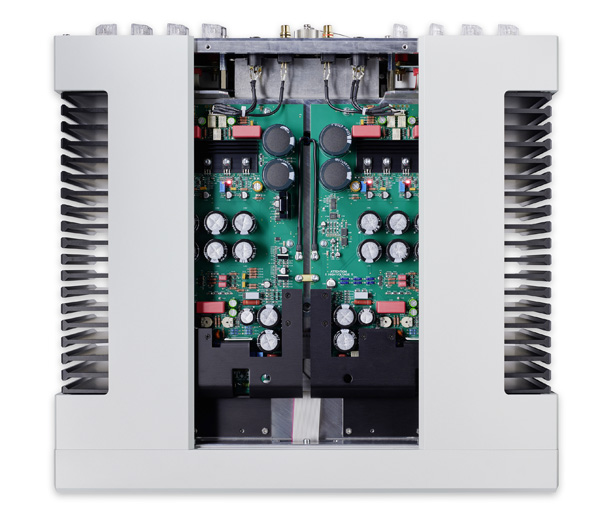
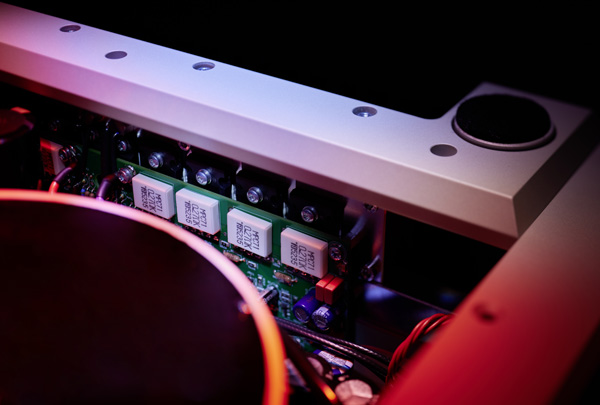
The T+A A 3100 HV Reference replaces the A 3000 HV, which cost $25,000 at the end of its 10+-year run. Designed by the same core group of engineers, it incorporates 270 small and large refinements made possible, in part, by the development of new components. While the discontinued A 3000 HV ran only in High Power mode, the 3100 can operate in either High Power or High Current mode. To institute this change, T+A designed a completely new large toroidal transformer with separate windings for each mode. The HV series high-voltage circuit, which is derived from the tube circuit employed in the discontinued V series, utilizes high supply voltages for certain stages; "only a few, high linear amp stages"; "very low" overall feedback; discrete circuits (no integrated op-amps); and one single-ended class-A output stage. T+A claims no zero-crossing distortion as is found in push-pull amplifiers and an extremely linear transfer function with less distortion, less need for feedback, and higher signal dynamics than in the 3000 and other amplifiers. The HV amplifier is divided into two stages: the voltage stage and the current stage. The voltage amplifier, which is said to be "extremely fast and linear," supplies high voltages to the 3100 HV's special amplifier stages. The current amplifier is said to output high current without delay, at an "extremely stable operating voltage," to produce fast, responsive, dynamic output power.
In High Power mode, the transformer operates at its full operating voltage—all its windings—to produce 500Wpc into 4 ohms in class-AB. An optional PS 3100 HV external power supply, which was not yet available at the time of the review, can improve voltage stability. According to Shannon, the optional power supply is used "almost exclusively by customers who must use the 'High Power Mode' because they have either enormous rooms or particularly inefficient speakers. ... While we feel it is very important to build products with options for all possible system configurations, the PS is not something we feel is always needed or even appropriate for most situations."
 In High Current mode—the mode I used for 99% of my listening—the transformer operates at half its operating voltage with half its windings. Understanding the T+A A 3100 HV's various class-A and class-A + class-AB output specs in mono and stereo for 8 ohms and 4 ohms—most but not all listed under "Specifications"—requires a technical discussion that, for reasons that will soon become clear, every other manufacturer I've interviewed has chosen to skip. But for this review, with an extremely knowledgeable and refreshingly forthcoming company founder who isn't afraid to dive deep into a very black hole, I chose to drill down further. With some apparent trepidation, Siggi responded:
"We speak of class-A operation as long as the quiescent current through the active amplifying de-vice (transistors or vacuum tube) remains constant through both transistors and conducts current across the entire 360 degrees of the input signal cycle. When the total current increases above the quiescent due to higher input signals, we move into class-AB and the transistors work separately." That is classic class-AB operation.
"When quiescent currents flow through the transistors, they are relatively small, normally about 60 to 70mA. The A 3100 HV has 400mA of quiescent current in High Power mode, which is good, and 1.2A in High Current mode, which is a lot! But if we want to stay in class-A mode, the output power is limited due to the limitation of the quiescent current.
"Here is the problem. People are used to hearing that an amplifier has a higher power output into 4 ohms than into 8 ohms. This is true because the current through the amp increases in class-AB mode. But if the current is constant, the output power is determined by the impedance of the connected speakers.
"Power can be calculated as P = V × I (voltage times current) or P = I2 × R (current squared times resistance). For example, if we have a constant, effective current of 1.66A and a speaker impedance of 8 ohms, then the calculated output power is 22W (22W = 1.662 × 8). If we have 4 ohm speakers"—same current—"the output power is 11W. Because most readers may think that 11W is not enough, most manufacturers do not give out any information about class-A power, which is very low. Some companies that build class-A amps supply only 8 ohm values. This is not incorrect, because the impedance of a loudspeaker is never a straight line. This is especially true in the most important bass area, where impedance values are so high that you operate in 8 ohms."
Perhaps you understand now why many amplifier manufacturers simplify their specifications.
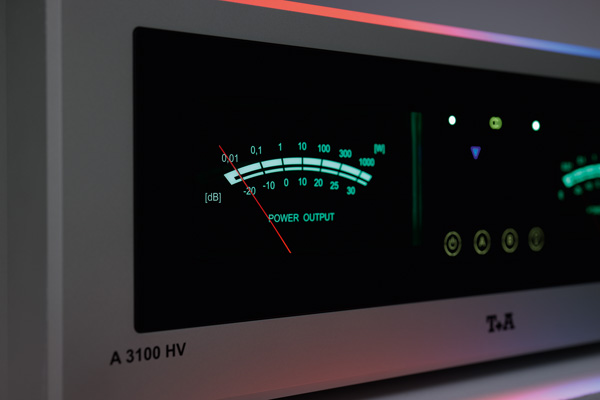 Siggi describes High Current mode as the A 3100 HV's "audiophile mode," with current that is extremely high and "absolutely constant," enabling the amp to operate mainly in pure class-A, with an absolutely linear transient curve. "For smaller speakers in smaller rooms, if you don't listen extremely loud, it's more than enough," he said. "It's our most natural-sounding mode. The A 3100 HV will become warm, and your electricity cost will rise, but the sound is much more refined than class-AB." (footnote 4)
The A 3100 HV can be used either as a single stereo amplifier or, by running two and paralleling the left and right outputs, as a monoblock. (Bridged amplifiers can output huge voltages, but they don't increase current.) In mono mode, power marginally increases, but current delivery (which drives and controls speakers) and pure class-A output double. This is especially important with difficult speaker loads.
Footnote 1: Conradin studied at a university with a graduate program in "family-business economics." Apparently such things do exist.
Footnote 2: Using kn to denote harmonics is a German convention. k is short for Klirrfaktor, the German word for harmonic distortion.
Footnote 3: Siggi says that op-amps limit voltage. Discrete components may cost more money, require more space, and output more heat, but they sound better and can function at 150V.
Footnote 4: When Jim Shannon visited Port Townsend with his charming wife, Norie, to check my setup, he felt that High Current mode's 75W of class-A power was sufficient for my room. More on this later.
Siggi Amft studied plasma physics, then electroacoustics under Herr Dr. Fritz Sennheiser, then founded T+A in his garage, in 1978. Neither his father nor his new wife was enthused by the idea, but he'd been building speakers and electronic components since he was a young boy. He was, he says, "fixed" on audio. "I used to play violin and sing in a chorus," Amft said at the start of a Teams chat that also included Shannon and Siggi's son, T+A CEO Conradin Amft (footnote 1). "I was and still am attached to classical music. But, growing up in the 1960s, I also loved rock music. I don't like country, but I like metal, and I like classics. It's a little bit funny." Such varied training worked in T+A's favor. The family company—Siggi's wife works in T+A's finance department—has grown to around 80 employees, including 15 engineers.
Understanding T+A's top-line HV (high voltage) seriesThe T+A A 3100 HV Reference replaces the A 3000 HV, which cost $25,000 at the end of its 10+-year run. Designed by the same core group of engineers, it incorporates 270 small and large refinements made possible, in part, by the development of new components. While the discontinued A 3000 HV ran only in High Power mode, the 3100 can operate in either High Power or High Current mode. To institute this change, T+A designed a completely new large toroidal transformer with separate windings for each mode. The HV series high-voltage circuit, which is derived from the tube circuit employed in the discontinued V series, utilizes high supply voltages for certain stages; "only a few, high linear amp stages"; "very low" overall feedback; discrete circuits (no integrated op-amps); and one single-ended class-A output stage. T+A claims no zero-crossing distortion as is found in push-pull amplifiers and an extremely linear transfer function with less distortion, less need for feedback, and higher signal dynamics than in the 3000 and other amplifiers. The HV amplifier is divided into two stages: the voltage stage and the current stage. The voltage amplifier, which is said to be "extremely fast and linear," supplies high voltages to the 3100 HV's special amplifier stages. The current amplifier is said to output high current without delay, at an "extremely stable operating voltage," to produce fast, responsive, dynamic output power.
In High Current mode—the mode I used for 99% of my listening—the transformer operates at half its operating voltage with half its windings. Understanding the T+A A 3100 HV's various class-A and class-A + class-AB output specs in mono and stereo for 8 ohms and 4 ohms—most but not all listed under "Specifications"—requires a technical discussion that, for reasons that will soon become clear, every other manufacturer I've interviewed has chosen to skip. But for this review, with an extremely knowledgeable and refreshingly forthcoming company founder who isn't afraid to dive deep into a very black hole, I chose to drill down further. With some apparent trepidation, Siggi responded:
"We speak of class-A operation as long as the quiescent current through the active amplifying de-vice (transistors or vacuum tube) remains constant through both transistors and conducts current across the entire 360 degrees of the input signal cycle. When the total current increases above the quiescent due to higher input signals, we move into class-AB and the transistors work separately." That is classic class-AB operation.
Siggi describes High Current mode as the A 3100 HV's "audiophile mode," with current that is extremely high and "absolutely constant," enabling the amp to operate mainly in pure class-A, with an absolutely linear transient curve. "For smaller speakers in smaller rooms, if you don't listen extremely loud, it's more than enough," he said. "It's our most natural-sounding mode. The A 3100 HV will become warm, and your electricity cost will rise, but the sound is much more refined than class-AB." (footnote 4)
The A 3100 HV can be used either as a single stereo amplifier or, by running two and paralleling the left and right outputs, as a monoblock. (Bridged amplifiers can output huge voltages, but they don't increase current.) In mono mode, power marginally increases, but current delivery (which drives and controls speakers) and pure class-A output double. This is especially important with difficult speaker loads.
Footnote 1: Conradin studied at a university with a graduate program in "family-business economics." Apparently such things do exist.