No grand pronouncements on the state of the industry or the even grander universe. No ruminations about the mysteries of the high end or the ultimate interconnect to immortality. Rather, a single, simple, indisputable fact: I needed a preamp. For months, I had longed for a preamp. Not just any preamp. An excellent preamp—one that delivered a generous helping of the glorious color, image weight, bass heft, and clarity of my former reference preamp (footnote 1). Which accounts for my excitement when the new EMM Labs PREi stereo preamplifier ($28,900; footnote 2)—the first of at least three new preamps I'm slated to review over the next year—arrived for review just days after its release, in February 2026.
The latest and final release in EMM Labs' new reference "i" series, the PREi boasts discrete, dual-balanced signal paths, a class-A analog output stage, and a 100-step precision analog volume control with intelligently calculated graduated steps (footnote 3) that never left me wishing for the "in between" volume setting as regular 1dB steps occasionally do.
The PREi's other main features include custom ceramic circuit boards by MCeraTek with pure-gold traces, ultralow capacitance, and minimized parasitic effects; Meitner's proprietary Universal X-Power (MXPower3) switch-mode power supply system (footnote 4); a high-contrast OLED display with Zoom capabilities that can be set to automatically switch off once the desired volume has been achieved; a machined-aluminum infrared volume control mechanism; programmable settings including three volume presets per input; field-programmable firmware (with a hitch—see below); and an RS-232 port for wired remote control and firmware updates. The unit comes with a detachable 15A Kimber Kable PK14 Base series power cord, though during the evaluation period, I replaced it with a Nordost Odin 2.
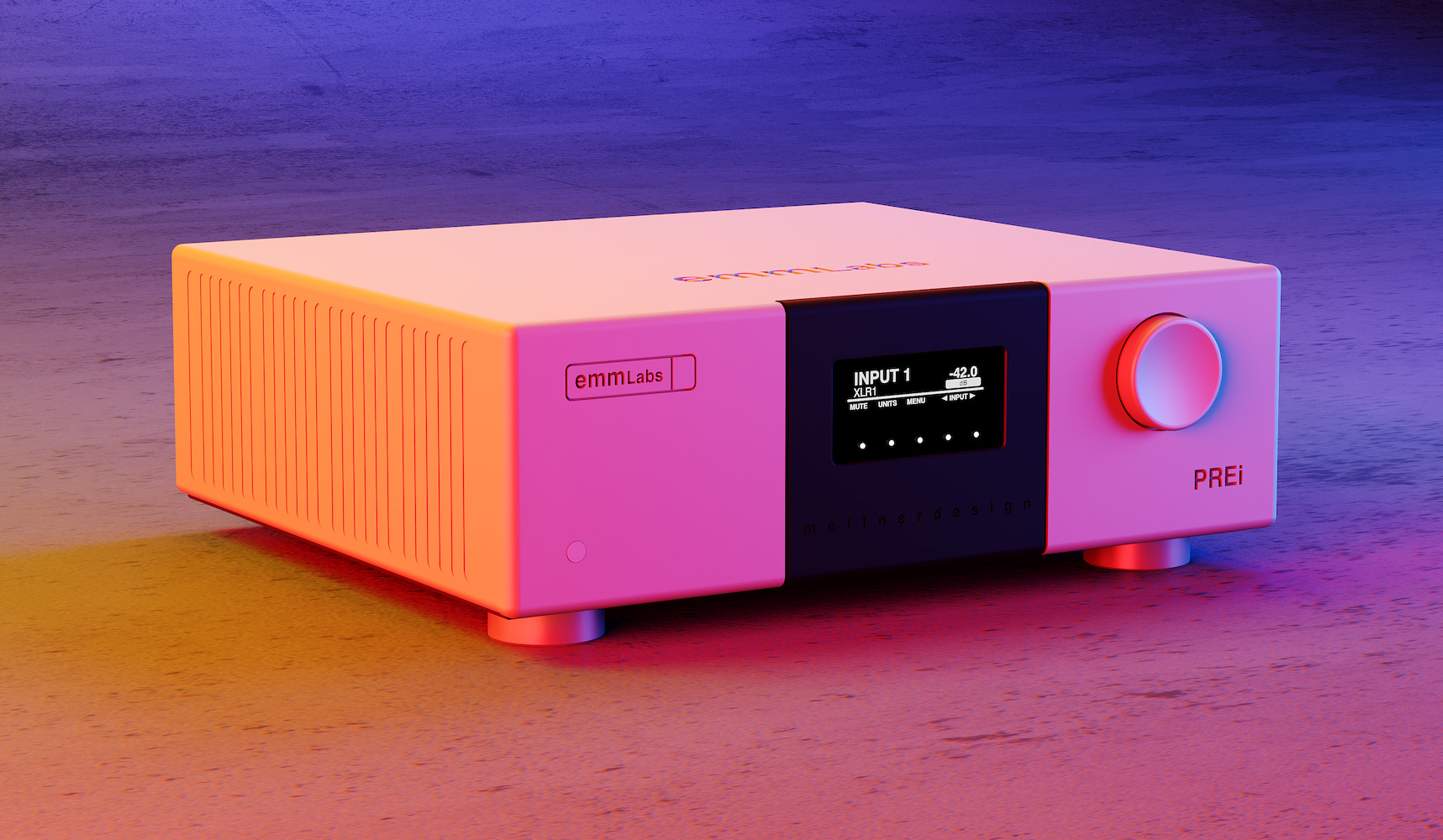
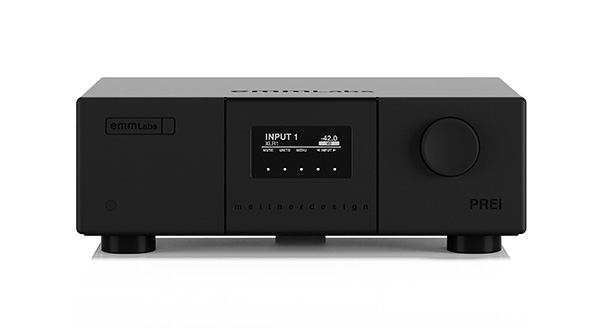
The front panel projects no-nonsense functionality. Apart from the obligatory engraved logo, which is tastefully not ostentatious, six buttons control power on/off, mute, dB, numerical unit display, menu access, and left and right input. There's also a large volume-control knob.
Everything you need to check, including input, volume level, and volume-preset choice, is displayed on the OLED screen. Menu access allows control of balance, display brightness, a screen saver, factory reset, and XZoom UI, which, as the name suggests, allows the size of displayed numbers and letters to be adjusted. (I didn't bother to explore it because I could easily read the screen from 11' away.) The option to turn the screen saver on after 55 seconds, to protect the unit from OLED burnout, was engaged when the PREi arrived. I kept it on.
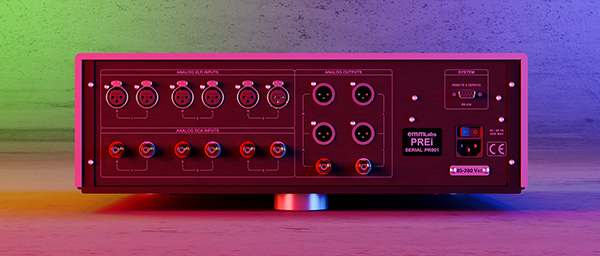
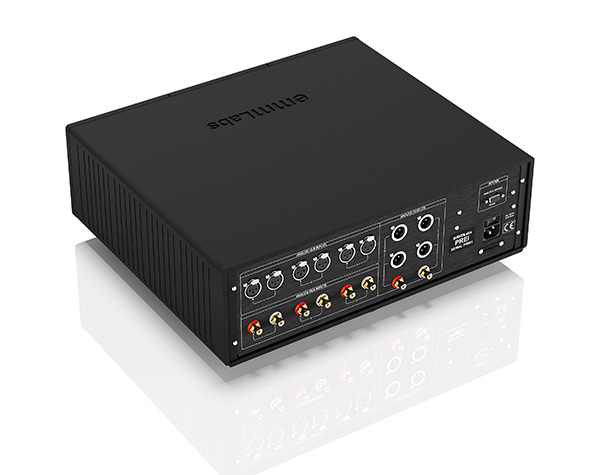 The rear panel is intelligently laid out, with good separation between XLR and RCA inputs and outputs. The IEC inlet and main power button are on the far right of the unit, which also helps make cable separation easy. Besides product model, serial number, and voltage indicator, there's that RS-232 control port. Clean, simple, and usable.
I used the remote control for only two functions: volume adjustment and mute. I have but two wishes for Remote Control Version 3.0: more responsive buttons, and more space between the two vertically arranged volume buttons and the three horizontally laid-out preset buttons to prevent users from constantly pushing "preset volume B" and wondering why the volume seems stuck.
Firmware updates must be performed using Windows 10 or 11. That earns a resounding boo from me, who long ago planted a flag in the Apple ecosystem. For now, I'll simply urge EMM Labs to forge a more ecumenical firmware-update path.
Unpacking the goodies
The rear panel is intelligently laid out, with good separation between XLR and RCA inputs and outputs. The IEC inlet and main power button are on the far right of the unit, which also helps make cable separation easy. Besides product model, serial number, and voltage indicator, there's that RS-232 control port. Clean, simple, and usable.
I used the remote control for only two functions: volume adjustment and mute. I have but two wishes for Remote Control Version 3.0: more responsive buttons, and more space between the two vertically arranged volume buttons and the three horizontally laid-out preset buttons to prevent users from constantly pushing "preset volume B" and wondering why the volume seems stuck.
Firmware updates must be performed using Windows 10 or 11. That earns a resounding boo from me, who long ago planted a flag in the Apple ecosystem. For now, I'll simply urge EMM Labs to forge a more ecumenical firmware-update path.
Unpacking the goodies
I've conducted so many Zoom and WhatsApp chats with EMM Labs and Meitner Audio Managing Director Amadeus "Deus" Meitner that Siri once asked impertinently if I wanted to make our chats a recurrent entry in my iCalendar. To which I replied, "That's between God, my editor, and my hairdresser!" That shut down Siri's train of nonthought.
I began the Zoom with a slight challenge. "Is the PREi the best preamp Ed Meitner and his design team (footnote 5) can produce?" In the age of multibox preamps, external power supplies, and ultra-expensive parts, why had EMM Labs stuck to a one-box design priced considerably lower than many top-line preamps? This is, after all, the new flagship preamplifier.
 "We've never really believed in the external power supply route," Deus replied. "Instead, we designed our own isolated state-of-the-art switch-mode supply. If you were using a linear supply, like most people do, you might want to keep the magnetics away from sensitive circuitry and components, including the big toroidal transformers that a bunch of people use inside their preamps.
But our switch-mode supply, which is CE certified, has no effect on adjacent components and sensitive circuits. It is fundamentally resistant to powerline distortions, including EMI and power ripple.
"All preamps ... amplify everything, including interference produced from magnetics. That is why we use our proprietary switch-mode power supply in all our electronics. We even have a modified version of the switch-mode supply in one stage of our amplifiers. Because our switch-mode supply performs the way it does, we don't need to use an external power supply." Deus said that the PREi takes the "straight wire with gain" concept as far as EMM Labs can take it. "The preamp does not add or detract anything with volume. It really only takes the incoming signal, buffers it, puts it through our analog output stage, and applies gain to it in a very secret way, in which our digitally controlled analog volume control plays a part. Everything in the signal path is analog, but gain is applied in a digital manner without putting the signal that an A to D, D to A, or any of that shit."
EMM Labs considers the preamp the "heart and main artery of a system, where all front-end components converge. For this reason, it needs to be as transparent and musical as possible—like a pane of glass."
"We really believe that neutrality is the key to good sound," Deus continued. "That's why our preamp is perfectly linear, with ultralow distortion, and has a class-A analog output stage of our own design. It also has four of our custom-designed voltage regulators per input—two per side—and four more per output. They all measure exactly the same. That means that all the preamp's stages are perfectly powered. And we've also maxed out on parts quality."
EMM designed the PREi's internal cabling. Because their cable has very low capacitance, they use it to replace traces from inputs to outputs. The company also tests every connection to ensure that the preamp is "perfectly phase aligned" throughout. In Deus's words, "it's a very clean design, where we maximize the amount of bandwidth we get." EMM Labs remains supremely confident that its measurements will be identical to John Atkinson's and that the PREi will emerge squeaky clean.
Beyond measurement lies subjective listening, for EMM Labs and Meitner. Because Ed Meitner, company founder and a 50-year veteran of analog circuit design, "never leaves something alone," he kept examining and eventually discovered, shortly before the PREi's release, a sonic improvement that involved resistor value and routing changes.
"Ed also pays a lot of attention to trace length," Deus said of his father. "That's a big part. He labors for hours and hours, examining his circuits to make sure that they're perfectly symmetrical from left and right and plus to minus. Everything has to be exactly the same. In this respect, he's very German."
In the introduction, I mentioned the PREi's custom ceramic circuit boards and pure gold traces. According to an article in the company's February 2026 newsletter, ceramic boards "directly impact how faithfully music is reproduced. Unlike fiberglass (FR-4), ceramic has exceptionally low dielectric loss and a stable dielectric constant across frequency and temperature ranges. This stability preserves signal integrity, ensuring that delicate analog waveforms aren't smeared by phase shift, crosstalk, or inconsistencies in frequency response. In simple terms, the music comes through with more purity and less compromise."
The article also says that ceramic substrate conducts heat up to 100 times more efficiently than fiberglass. "Critical analog stages, such as DAC output sections or amplifier voltage gain stages, remain thermally stable. When components run cooler and more consistently, thermal noise drops, bias points hold steady, and the music retains its clarity and dynamic ease. ... Ceramic expands very little with temperature, keeping resistors, capacitors, and matched networks in perfect alignment even as operating conditions change. This kind of precision is essential in circuits where tiny mismatches can lead to distortion or drift. ... Perhaps most importantly for the listener, ceramic boards reduce electrical noise and crosstalk. With their uniform dielectric and high insulation resistance, they prevent leakage paths and parasitic capacitances that can blur stereo imaging or add distortion. ... It's no accident that ceramic is used in aerospace, military, and medical instrumentation, fields where reliability and precision are non-negotiable."
One of the PREi's most unusual features is what EMM Labs calls "charge management technology," a copper plate below the chassis's top panel with looping copper traces. It is said to repel and absorb "floating fields" and also to provide some mechanical resonance control. Optional add-on IsoAcoustics footers will soon be available for all EMM Labs products, perhaps by the time this review is published.
"We've never really believed in the external power supply route," Deus replied. "Instead, we designed our own isolated state-of-the-art switch-mode supply. If you were using a linear supply, like most people do, you might want to keep the magnetics away from sensitive circuitry and components, including the big toroidal transformers that a bunch of people use inside their preamps.
But our switch-mode supply, which is CE certified, has no effect on adjacent components and sensitive circuits. It is fundamentally resistant to powerline distortions, including EMI and power ripple.
"All preamps ... amplify everything, including interference produced from magnetics. That is why we use our proprietary switch-mode power supply in all our electronics. We even have a modified version of the switch-mode supply in one stage of our amplifiers. Because our switch-mode supply performs the way it does, we don't need to use an external power supply." Deus said that the PREi takes the "straight wire with gain" concept as far as EMM Labs can take it. "The preamp does not add or detract anything with volume. It really only takes the incoming signal, buffers it, puts it through our analog output stage, and applies gain to it in a very secret way, in which our digitally controlled analog volume control plays a part. Everything in the signal path is analog, but gain is applied in a digital manner without putting the signal that an A to D, D to A, or any of that shit."
EMM Labs considers the preamp the "heart and main artery of a system, where all front-end components converge. For this reason, it needs to be as transparent and musical as possible—like a pane of glass."
"We really believe that neutrality is the key to good sound," Deus continued. "That's why our preamp is perfectly linear, with ultralow distortion, and has a class-A analog output stage of our own design. It also has four of our custom-designed voltage regulators per input—two per side—and four more per output. They all measure exactly the same. That means that all the preamp's stages are perfectly powered. And we've also maxed out on parts quality."
EMM designed the PREi's internal cabling. Because their cable has very low capacitance, they use it to replace traces from inputs to outputs. The company also tests every connection to ensure that the preamp is "perfectly phase aligned" throughout. In Deus's words, "it's a very clean design, where we maximize the amount of bandwidth we get." EMM Labs remains supremely confident that its measurements will be identical to John Atkinson's and that the PREi will emerge squeaky clean.
Beyond measurement lies subjective listening, for EMM Labs and Meitner. Because Ed Meitner, company founder and a 50-year veteran of analog circuit design, "never leaves something alone," he kept examining and eventually discovered, shortly before the PREi's release, a sonic improvement that involved resistor value and routing changes.
"Ed also pays a lot of attention to trace length," Deus said of his father. "That's a big part. He labors for hours and hours, examining his circuits to make sure that they're perfectly symmetrical from left and right and plus to minus. Everything has to be exactly the same. In this respect, he's very German."
In the introduction, I mentioned the PREi's custom ceramic circuit boards and pure gold traces. According to an article in the company's February 2026 newsletter, ceramic boards "directly impact how faithfully music is reproduced. Unlike fiberglass (FR-4), ceramic has exceptionally low dielectric loss and a stable dielectric constant across frequency and temperature ranges. This stability preserves signal integrity, ensuring that delicate analog waveforms aren't smeared by phase shift, crosstalk, or inconsistencies in frequency response. In simple terms, the music comes through with more purity and less compromise."
The article also says that ceramic substrate conducts heat up to 100 times more efficiently than fiberglass. "Critical analog stages, such as DAC output sections or amplifier voltage gain stages, remain thermally stable. When components run cooler and more consistently, thermal noise drops, bias points hold steady, and the music retains its clarity and dynamic ease. ... Ceramic expands very little with temperature, keeping resistors, capacitors, and matched networks in perfect alignment even as operating conditions change. This kind of precision is essential in circuits where tiny mismatches can lead to distortion or drift. ... Perhaps most importantly for the listener, ceramic boards reduce electrical noise and crosstalk. With their uniform dielectric and high insulation resistance, they prevent leakage paths and parasitic capacitances that can blur stereo imaging or add distortion. ... It's no accident that ceramic is used in aerospace, military, and medical instrumentation, fields where reliability and precision are non-negotiable."
One of the PREi's most unusual features is what EMM Labs calls "charge management technology," a copper plate below the chassis's top panel with looping copper traces. It is said to repel and absorb "floating fields" and also to provide some mechanical resonance control. Optional add-on IsoAcoustics footers will soon be available for all EMM Labs products, perhaps by the time this review is published.
 Goody or gooey?
I asked Deus if, in a system like mine that only uses one pair of a preamp's inputs, an active preamp is even necessary. "What I find is that a preamp and a volume control either add flavor or they don't. You can just add gain and that's that. In my opinion, our products sound better—our DACs sound better—when you put them through a preamp. It adds more air and texture and ooey gooey bottom-of-your-stomach kind of feeling." Because the PREi's outputs are all active at the same time, it is starting to be used to biamp and tri-amp systems. "One of our distributors in Korea is currently using the PREi to connect four of our monoblock amps to the big Marten Orchestras. It's crazy. He said that when they used a single preamp to go from two monos to four monos, it was a revelation. Ultimately, it's about giving people options. That's the most important thing." As Deus and I ruminated about life and age—Ed Meitner is one month older than I am—Deus opined that his father, Ed, "is in the most creative era I've ever seen him in. He's really coming up with some amazing things that are setting the ground for the next generation of products to come from us. What he's doing in the lab is quite stunning. I'm happy that I get to come in, watch over his shoulder, and ask six to seven questions before he gets really annoyed and I need to leave."
I mentioned my recent visit to D'Agostino headquarters in Arizona, where Dan D'Agostino, who is close to Ed and me in age, said that he revisited some of his old designs, examined their strengths and weaknesses, and found ways to magnify the good elements and eliminate the detriments. "Ed, too, is looking at old ways he did things," Deus replied. "With the knowledge he's gained, he's asking why he did it that way and if there's something there that maybe he can use and make better. That's exactly what happened the other day with a development that will be very, very interesting.
"It's harder to remove something and have the same effect than it is to add something. Nonetheless, in our eyes, simplification of a circuit translates into better sound. If you can do the same thing with two amplification or gain stages that you can with three, you should do it with two.
"We're doing everything that we can to advance the state of the art. We look at our products as living things, constantly under evaluation. The large scope of products that we make allows us to look at things with different lenses. There's always a problem to solve, and there's always something to make better."
Preparing for goody
After placing the PREi on the Grand Prix Monza rack, I had a choice of footers. Although EMM Labs is going the optional IsoAcoustics footer route—many companies are, for good reason—Deus gave me the okay to instead use the superb-sounding Wilson Audio Pedestals. That kept supports constant with the other preamps I've evaluated in my system. Connections were a snap. Before connecting the two dCS Varèse mono DACs to the preamp, I turned the Varèse system's volume to unity gain (0) to ensure I would hear the PREi at its unadulterated best. Then I used the Innuos Nazaré music server/streamer's InnuOS software to play files either stored on its plugged-in SSDs or streamed from Qobuz and Tidal. My goal was to audition the PREi with my two different-sounding pairs of reference monoblocks, the just-discontinued solid state D'Agostino Momentum M400 MxV and the tubed Audio Research 330M. The hitch was that in a reference system that requires a minimum of 18 power cables—20 or more with some reviews—I had run out of sufficient top-quality 20A power cables to maintain sonic consistency while moving between the D'Agostinos, which require 15A power cables, and the Audio Researches, which require 20A power cables. My profound appreciation to Nathan Vander Stoep of Turnbull Audio, and Ed DeVito of Turnbull dealership Audio-Ultra, for making available a Turnbull Prestige 20A power cable. Without its solidity, my conclusions would not have been as certain as they are.
 Goody!
Few are the times when changing components does not instantly precipitate a prolonged period of take-a-step-back, head-vies-with-heart evaluation. This time was one of the few. Listening to the PREi felt like coming home. Everything about it felt so right. When, as soon as it had settled in, I used it to review the new recording of the Brahms Trio Op.114 (and related, all-in-the-family works) by violist Tabea Zimmermann, cellist Jean-Guihen Queyras, and pianist Javier Perianes (24/96 WAV, Harmonia Mundi/download), I felt no desire to listen any other way. I reveled in Zimmermann's "impassioned, immensely pleasing sound"—a sound that, in Robert Schumann's Three Romances, was imbued with "old-world richness" and "heartfelt longing." I praised all three artists for beautifully underscoring the Romances' "songful expressiveness." As the PREi enabled Brahms and these artists to sing directly to my soul, I closed my eyes and took it all in, blissfully. Eventually, I grew anxious. Not because of the sound, which I found just as satisfying on the other wonderful recording I reviewed, Ever Yours: Chamber Works by Osvaldo Golijov (24/96 WAV, Phenotypic Recordings/download). Rather, it was because of an equally vital if more mundane reality: I had a deadline. I had to say something more than "I love it; go buy it."
After a lot of bending, leaning, and replacement of fallen, luridly colored Styrofoam cable separators—peering behind my multibox system is not for the faint of heart—I'd bypassed the PREi and connected the two dCS Varèse DACs directly to the D'Agostino monoblocks. The time for before/after comparisons had begun.
My initial playlist, varied in genre, octave span, and complexity, consisted entirely of tracks I either knew extremely well or had recently auditioned. For the sake of brevity, I'll stick to artist, title, resolution, and streaming source (if any): Aretha's "Bridge Over Troubled Water" (24/96 FLAC, Qobuz); the Beatles' "Come Together (2019 Mix)" (24/96 FLAC, Qobuz); the first movement of Mahler Symphony No.4 from François-Xavier Roth's Les Siècles (24/96 WAV); Schubert's Piano Trio No.2 from Christian Tetzlaff, Tanja Tetzlaff, and Lars Vogt (24/96 WAV); the first movement of Mahler Symphony No.5 from Rafael Payare and Orchestre symphonique de Montréal (24/96 WAV); multiple tracks from Thomas Adès's wonderful Forgotten Dances, performed by guitarist Sean Shibe on his eponymously titled album (24/192 FLAC); Sandrine Piau's unforgettable rendition of Loewe's "Ach neige, du Schmerzenreiche" (24/96 WAV); and a bit of Garth Neustadter and Kjell van Sice's very different Seaborne, performed by The Percussion Collective (24/96 FLAC).
 The results were consistent. Without the EMM Labs PREi, colors were neither as rich nor as intense. The background wasn't as black or transparent, and there was a subtle barrier between me and the sound. With the PREi, the veil was lifted. I heard more color and detail. The difference was not subtle. Which led me to wonder, if the PREi can improve the sound of a five-piece state-of-the-art DAC/streamer that retails for over a quarter-million dollars, what might it do for DACs or analog setups that cost considerably less?
With the PREi back in, I explored another recording I wished to review, of multiple works by Schubert including the String Quintet, aka cello quintet, performed by cellist Emmanuelle Bertrand and the Quatuor Parisii (24/96 WAV, Harmonia Mundi/download). I ultimately chose not to review the recording because I took issue with Bertrand's tempos and expressive reticence one too many times, but I loved how beautifully the PREi highlighted her singing tone and sensitivity.
The results were consistent. Without the EMM Labs PREi, colors were neither as rich nor as intense. The background wasn't as black or transparent, and there was a subtle barrier between me and the sound. With the PREi, the veil was lifted. I heard more color and detail. The difference was not subtle. Which led me to wonder, if the PREi can improve the sound of a five-piece state-of-the-art DAC/streamer that retails for over a quarter-million dollars, what might it do for DACs or analog setups that cost considerably less?
With the PREi back in, I explored another recording I wished to review, of multiple works by Schubert including the String Quintet, aka cello quintet, performed by cellist Emmanuelle Bertrand and the Quatuor Parisii (24/96 WAV, Harmonia Mundi/download). I ultimately chose not to review the recording because I took issue with Bertrand's tempos and expressive reticence one too many times, but I loved how beautifully the PREi highlighted her singing tone and sensitivity.
 Glutton for punishment that I am, I tackled Chris Jones's "No Sanctuary Here" (24/44.1 FLAC, Stockfisch-Records/Qobuz) with and without the PREi. As overplayed as the track maybe, it's a marvelous bass test for many a system. While no preamp I've auditioned at home so far can deliver the bass weight, image size and density, and infinite color variations of the mighty D'Agostino Relentless, the EMM Labs PREi was a marked improvement over the Varèse by itself. "More gray between notes" was the most telling comment I scribbled in my notes about the sound minus preamp.
I felt the same on Ike Quebec's "Blues for Charlie" from Blue and Sentimental (24/192 FLAC, Blue Note Records/Qobuz) and Kristian Bezuidenhout's fortepiano rendition of the first two movements of Mozart's Piano Concerto No.23, K.488, performed with the Freiburger Barockorchester (24/96 WAV, Harmonia Mundi/download). "More color, more grace, and more air around strings," I noted in a scribble that would have made many doctors envious, back when doctors wrote 'scrips by hand.
I greatly enjoyed another listening session (this time with audiophiles Rey Alvarado and Josh Kout), where classical orchestras and fortepiano ceded to Jessica Williams, ZZ Top, Robert Plant, Lionel Hampton, and Carly Simon. I'm probably the last person on Planet Earth to learn that one of the backup singers on Simon's "You're So Vain" is Mick Jagger. Then again, did you know that, on the famed 1933 recording of Richard Strauss's opera, Der Rosenkavalier, light-voiced soprano Elisabeth Schumann stepped in to sing the final "Ja, Ja" because the heavier-voiced Lotte Lehmann forgot she had one more line to sing and had already left the premises? Do you care? Well, I care about Mick Jagger, whom I danced to on the beer-soaked floor of Alpha Theta Xi in Amherst, Massachusetts, many moons ago. Even if you don't care about background singers, light-voiced sopranos, or my dance moves, let me assure you that the PREi made the 24/192 Qobuz stream of "You're So Vain" one fabulous romp.
Glutton for punishment that I am, I tackled Chris Jones's "No Sanctuary Here" (24/44.1 FLAC, Stockfisch-Records/Qobuz) with and without the PREi. As overplayed as the track maybe, it's a marvelous bass test for many a system. While no preamp I've auditioned at home so far can deliver the bass weight, image size and density, and infinite color variations of the mighty D'Agostino Relentless, the EMM Labs PREi was a marked improvement over the Varèse by itself. "More gray between notes" was the most telling comment I scribbled in my notes about the sound minus preamp.
I felt the same on Ike Quebec's "Blues for Charlie" from Blue and Sentimental (24/192 FLAC, Blue Note Records/Qobuz) and Kristian Bezuidenhout's fortepiano rendition of the first two movements of Mozart's Piano Concerto No.23, K.488, performed with the Freiburger Barockorchester (24/96 WAV, Harmonia Mundi/download). "More color, more grace, and more air around strings," I noted in a scribble that would have made many doctors envious, back when doctors wrote 'scrips by hand.
I greatly enjoyed another listening session (this time with audiophiles Rey Alvarado and Josh Kout), where classical orchestras and fortepiano ceded to Jessica Williams, ZZ Top, Robert Plant, Lionel Hampton, and Carly Simon. I'm probably the last person on Planet Earth to learn that one of the backup singers on Simon's "You're So Vain" is Mick Jagger. Then again, did you know that, on the famed 1933 recording of Richard Strauss's opera, Der Rosenkavalier, light-voiced soprano Elisabeth Schumann stepped in to sing the final "Ja, Ja" because the heavier-voiced Lotte Lehmann forgot she had one more line to sing and had already left the premises? Do you care? Well, I care about Mick Jagger, whom I danced to on the beer-soaked floor of Alpha Theta Xi in Amherst, Massachusetts, many moons ago. Even if you don't care about background singers, light-voiced sopranos, or my dance moves, let me assure you that the PREi made the 24/192 Qobuz stream of "You're So Vain" one fabulous romp.
 From goodies to getties
I often feel that if I provide just one more example—if I spend the next five hours revisiting every adjective in this review and thinking of how many new ways I can say the same thing—I will convince someone, somewhere that the EMM Labs PREi can open a transparent doorway to musical truth. But I'm not going to do that. No matter how you say it, slice it, or dice it, the EMM PREi is among the finest preamps I've reviewed. I haven't heard enough preamps in my system to declare with certainty that it's top in its price range. I do know that if you're searching for a one-piece stereo line preamplifier in the sub-$30,000 range that makes everything sound better, has three pairs of XLR inputs and three more pairs of RCA inputs, and has enough outputs to biamp and tri-amp some systems, the EMM Labs PREi should be on your short list. Most highly recommended.
Footnote 1: The three-piece D'Agostino Relentless, which retails for $165,000. Footnote 2: Less if purchased in a bundle with other EMM Labs products. Owners of the just-discontinued PRE can upgrade their units for $10,900. The "i" stands for "improved." Footnote 3: From the top of the control range, 6dB (Step 100), down to –33dB (step 22), the steps are 0.5dB apart. From –33dB (step 22) down to –40dB (step 15), steps are 1dB. From there down to –68dB (step 1), steps are 2dB. The volume indicator can show either gain in decibels (dB) or volume steps. My preamp was set to volume steps, which suited me fine. Footnote 4: According to the manual, MXPower3 was designed to provide "absolute stability, industry-leading noise performance, exceptional rejection of line-borne anomalies, and speed that keeps pace with the fastest transient swings."
Footnote 5: Ed Meitner designs the analog circuitry, Mariusz Pawlicki and his team develop the digitally controlled analog volume control, and another engineer, Hong, designs the power supply.
The rear panel is intelligently laid out, with good separation between XLR and RCA inputs and outputs. The IEC inlet and main power button are on the far right of the unit, which also helps make cable separation easy. Besides product model, serial number, and voltage indicator, there's that RS-232 control port. Clean, simple, and usable.
I've conducted so many Zoom and WhatsApp chats with EMM Labs and Meitner Audio Managing Director Amadeus "Deus" Meitner that Siri once asked impertinently if I wanted to make our chats a recurrent entry in my iCalendar. To which I replied, "That's between God, my editor, and my hairdresser!" That shut down Siri's train of nonthought.
"We've never really believed in the external power supply route," Deus replied. "Instead, we designed our own isolated state-of-the-art switch-mode supply. If you were using a linear supply, like most people do, you might want to keep the magnetics away from sensitive circuitry and components, including the big toroidal transformers that a bunch of people use inside their preamps.
But our switch-mode supply, which is CE certified, has no effect on adjacent components and sensitive circuits. It is fundamentally resistant to powerline distortions, including EMI and power ripple.
Goody or gooey?I asked Deus if, in a system like mine that only uses one pair of a preamp's inputs, an active preamp is even necessary. "What I find is that a preamp and a volume control either add flavor or they don't. You can just add gain and that's that. In my opinion, our products sound better—our DACs sound better—when you put them through a preamp. It adds more air and texture and ooey gooey bottom-of-your-stomach kind of feeling." Because the PREi's outputs are all active at the same time, it is starting to be used to biamp and tri-amp systems. "One of our distributors in Korea is currently using the PREi to connect four of our monoblock amps to the big Marten Orchestras. It's crazy. He said that when they used a single preamp to go from two monos to four monos, it was a revelation. Ultimately, it's about giving people options. That's the most important thing." As Deus and I ruminated about life and age—Ed Meitner is one month older than I am—Deus opined that his father, Ed, "is in the most creative era I've ever seen him in. He's really coming up with some amazing things that are setting the ground for the next generation of products to come from us. What he's doing in the lab is quite stunning. I'm happy that I get to come in, watch over his shoulder, and ask six to seven questions before he gets really annoyed and I need to leave."
After placing the PREi on the Grand Prix Monza rack, I had a choice of footers. Although EMM Labs is going the optional IsoAcoustics footer route—many companies are, for good reason—Deus gave me the okay to instead use the superb-sounding Wilson Audio Pedestals. That kept supports constant with the other preamps I've evaluated in my system. Connections were a snap. Before connecting the two dCS Varèse mono DACs to the preamp, I turned the Varèse system's volume to unity gain (0) to ensure I would hear the PREi at its unadulterated best. Then I used the Innuos Nazaré music server/streamer's InnuOS software to play files either stored on its plugged-in SSDs or streamed from Qobuz and Tidal. My goal was to audition the PREi with my two different-sounding pairs of reference monoblocks, the just-discontinued solid state D'Agostino Momentum M400 MxV and the tubed Audio Research 330M. The hitch was that in a reference system that requires a minimum of 18 power cables—20 or more with some reviews—I had run out of sufficient top-quality 20A power cables to maintain sonic consistency while moving between the D'Agostinos, which require 15A power cables, and the Audio Researches, which require 20A power cables. My profound appreciation to Nathan Vander Stoep of Turnbull Audio, and Ed DeVito of Turnbull dealership Audio-Ultra, for making available a Turnbull Prestige 20A power cable. Without its solidity, my conclusions would not have been as certain as they are.
Goody!Few are the times when changing components does not instantly precipitate a prolonged period of take-a-step-back, head-vies-with-heart evaluation. This time was one of the few. Listening to the PREi felt like coming home. Everything about it felt so right. When, as soon as it had settled in, I used it to review the new recording of the Brahms Trio Op.114 (and related, all-in-the-family works) by violist Tabea Zimmermann, cellist Jean-Guihen Queyras, and pianist Javier Perianes (24/96 WAV, Harmonia Mundi/download), I felt no desire to listen any other way. I reveled in Zimmermann's "impassioned, immensely pleasing sound"—a sound that, in Robert Schumann's Three Romances, was imbued with "old-world richness" and "heartfelt longing." I praised all three artists for beautifully underscoring the Romances' "songful expressiveness." As the PREi enabled Brahms and these artists to sing directly to my soul, I closed my eyes and took it all in, blissfully. Eventually, I grew anxious. Not because of the sound, which I found just as satisfying on the other wonderful recording I reviewed, Ever Yours: Chamber Works by Osvaldo Golijov (24/96 WAV, Phenotypic Recordings/download). Rather, it was because of an equally vital if more mundane reality: I had a deadline. I had to say something more than "I love it; go buy it."
The results were consistent. Without the EMM Labs PREi, colors were neither as rich nor as intense. The background wasn't as black or transparent, and there was a subtle barrier between me and the sound. With the PREi, the veil was lifted. I heard more color and detail. The difference was not subtle. Which led me to wonder, if the PREi can improve the sound of a five-piece state-of-the-art DAC/streamer that retails for over a quarter-million dollars, what might it do for DACs or analog setups that cost considerably less?
Glutton for punishment that I am, I tackled Chris Jones's "No Sanctuary Here" (24/44.1 FLAC, Stockfisch-Records/Qobuz) with and without the PREi. As overplayed as the track maybe, it's a marvelous bass test for many a system. While no preamp I've auditioned at home so far can deliver the bass weight, image size and density, and infinite color variations of the mighty D'Agostino Relentless, the EMM Labs PREi was a marked improvement over the Varèse by itself. "More gray between notes" was the most telling comment I scribbled in my notes about the sound minus preamp.
I felt the same on Ike Quebec's "Blues for Charlie" from Blue and Sentimental (24/192 FLAC, Blue Note Records/Qobuz) and Kristian Bezuidenhout's fortepiano rendition of the first two movements of Mozart's Piano Concerto No.23, K.488, performed with the Freiburger Barockorchester (24/96 WAV, Harmonia Mundi/download). "More color, more grace, and more air around strings," I noted in a scribble that would have made many doctors envious, back when doctors wrote 'scrips by hand.
From goodies to gettiesI often feel that if I provide just one more example—if I spend the next five hours revisiting every adjective in this review and thinking of how many new ways I can say the same thing—I will convince someone, somewhere that the EMM Labs PREi can open a transparent doorway to musical truth. But I'm not going to do that. No matter how you say it, slice it, or dice it, the EMM PREi is among the finest preamps I've reviewed. I haven't heard enough preamps in my system to declare with certainty that it's top in its price range. I do know that if you're searching for a one-piece stereo line preamplifier in the sub-$30,000 range that makes everything sound better, has three pairs of XLR inputs and three more pairs of RCA inputs, and has enough outputs to biamp and tri-amp some systems, the EMM Labs PREi should be on your short list. Most highly recommended.
Footnote 1: The three-piece D'Agostino Relentless, which retails for $165,000. Footnote 2: Less if purchased in a bundle with other EMM Labs products. Owners of the just-discontinued PRE can upgrade their units for $10,900. The "i" stands for "improved." Footnote 3: From the top of the control range, 6dB (Step 100), down to –33dB (step 22), the steps are 0.5dB apart. From –33dB (step 22) down to –40dB (step 15), steps are 1dB. From there down to –68dB (step 1), steps are 2dB. The volume indicator can show either gain in decibels (dB) or volume steps. My preamp was set to volume steps, which suited me fine. Footnote 4: According to the manual, MXPower3 was designed to provide "absolute stability, industry-leading noise performance, exceptional rejection of line-borne anomalies, and speed that keeps pace with the fastest transient swings."