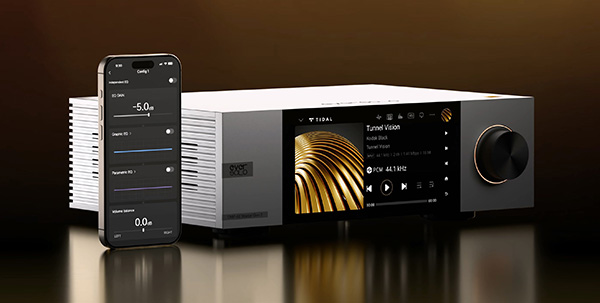
I am not big on streaming overall, but I do like to find new releases on Qobuz, enjoy the live feed from the Berlin Philharmonic via their Digital Concert Hall, and sample multichannel music on Apple Music. If I really like something, I buy discs or downloads to add to my local collection. (Usually I can find one or the other.) Unless you already have a big library—a huge library—streaming has its attractions. Plus, I must admit, as much as I dislike the cheesy adjective, audio streamers are hot!
And why not? They efficiently encapsulate so many functions that one might regard a streamer as an entire audio system in a box—including, with a subscription and an internet connection, the music itself. A versatile streamer can access local music files and, via myriad apps, almost any nonlocal music source. It can display and provide access to all via a color touchscreen, then output the chosen content to digital, powered speakers, or an amplifier if your speakers are passive.
This wealth of options may appeal to music lovers just beginning to investigate hi-fi and the wealth of music from the Web's wide world, but up to now, I have not considered acquiring one. I'm happy with a computer as a source. Music programs like JRiver and Roon access and play my local music files. The few streaming sites I access offer nice desktop and handheld remote apps.
It was time to investigate. Would a streamer access the large local library on my NAS? Would it support multichannel? Would its DAC (if it had one) be good enough to replace what I now have? (footnote 1)
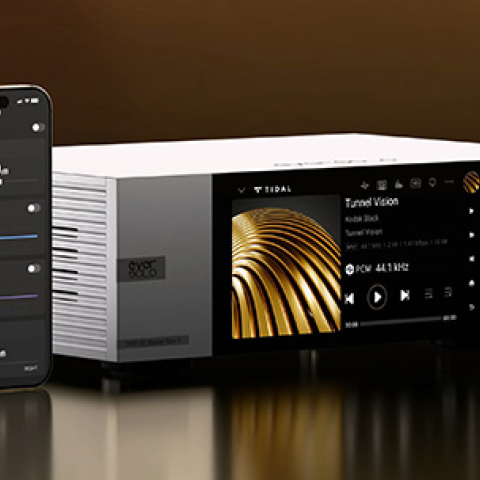
The Eversolo DMP-A6 Master Edition Gen 2 seems to have everything I demand: It employs cutting-edge D/A technology, accesses local files and a wide range of Web apps and services, and it's physically compact and reasonably priced (footnote 2). Moreover, and of particular interest to me, it includes EQ options, room correction, and (mirabile dictu!) multichannel, though its multichannel efficacy is limited.
The out-of-the-box experience was quite positive for fit and finish, but—in common with many internet-adjacent products—there was no instruction manual to get me started. Eversolo does supply a single, three-panel folded sheet with dim, silver-gray print on a black background. It showed me how the volume-control knob works (duh) and how to add an SSD to expand local storage. There was a large (but still dim) diagram of rear-panel inputs and outputs, an image of the home screen, and three QR codes, one for downloading a PDF of a user manual which, regrettably, is not searchable.
I learned more about how to operate the DMP-A6 from reading Rogier van Bakel's Stereophile reviews of the Eversolo DMP-A8 streaming preamplifier and the Eversolo Play CD Edition streaming integrated amplifier. The DMP-A8 is a comprehensive digital and analog preamp-streamer that sports AKM's AK4191EQ+AK4499EX devices (which separate digital processing and D/A conversion onto separate chips), while the less expensive Play CD Edition is a music streamer/DAC with a power amplifier—there's even a CD player!
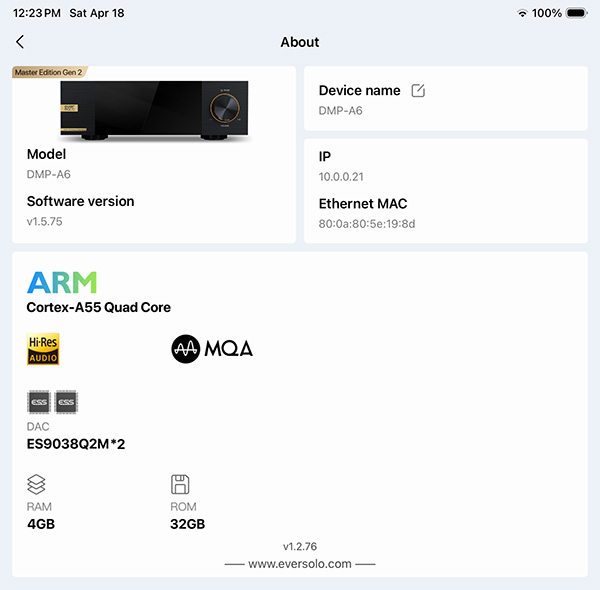
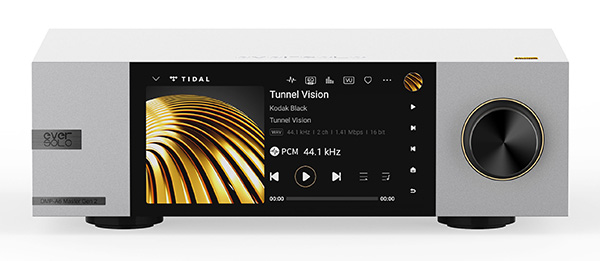 The product under review—the DMP-A6 Master Edition Gen 2—looks much like the DMP-A8, but it's slightly smaller and lacks the A8's analog inputs. It also resembles the Play but without the CD drive and power amp. The DMP-A6 Master Edition Gen 2 uses the more plebeian stepped attenuator in place of the R-2R switched attenuator in the A8, but its digital output is handled by the arguably competitive ESS Sabre ES9038Q2M chips, and the two components share the XMOS 3rd Gen XU316 processor for digital signal processing, including room correction and EQ. All three share the same user interface.
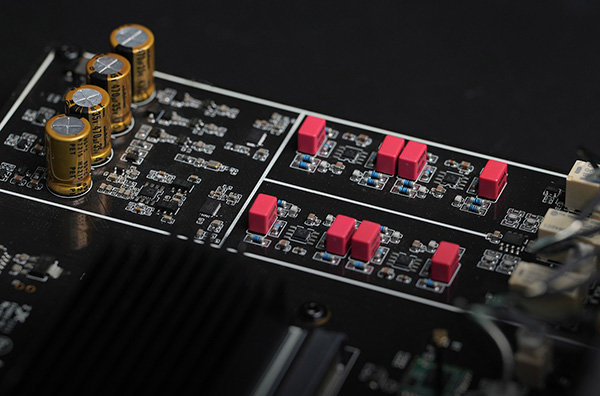
This version of the DMP-A6—the Master Edition Gen 2—adds to the more basic A6 a low-noise linear power supply in place of the original switching power supply, an HDMI ARC input for TV input, a 12V trigger output, a USB-B input in place of a USB-C (which some will find more convenient; others less so), a Wake-on-LAN option in the app, and new color options for front-panel illumination. It carries over the Gen 2 internal enhancements including use of paired Accusilicon femtosecond oscillators (to lower jitter), OPA1612 op-amp chips (to lower noise and distortion), and dual ESS Sabre ES9038Q2M DACs.
The product under review—the DMP-A6 Master Edition Gen 2—looks much like the DMP-A8, but it's slightly smaller and lacks the A8's analog inputs. It also resembles the Play but without the CD drive and power amp. The DMP-A6 Master Edition Gen 2 uses the more plebeian stepped attenuator in place of the R-2R switched attenuator in the A8, but its digital output is handled by the arguably competitive ESS Sabre ES9038Q2M chips, and the two components share the XMOS 3rd Gen XU316 processor for digital signal processing, including room correction and EQ. All three share the same user interface.
This version of the DMP-A6—the Master Edition Gen 2—adds to the more basic A6 a low-noise linear power supply in place of the original switching power supply, an HDMI ARC input for TV input, a 12V trigger output, a USB-B input in place of a USB-C (which some will find more convenient; others less so), a Wake-on-LAN option in the app, and new color options for front-panel illumination. It carries over the Gen 2 internal enhancements including use of paired Accusilicon femtosecond oscillators (to lower jitter), OPA1612 op-amp chips (to lower noise and distortion), and dual ESS Sabre ES9038Q2M DACs.
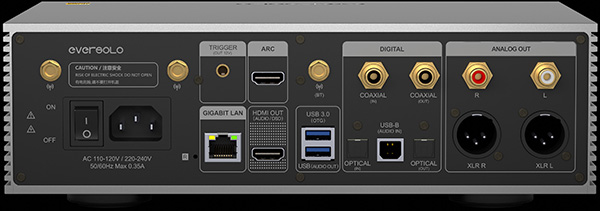 On the back panel of the DMP-A6, starting from the left, is a master power switch, an IEC AC connector, and a cluster with a 12V trigger output, an HDMI ARC jack, an HDMI audio out jack, and a 1GB LAN RJ45 connection. Next in line are two USB-A jacks, one an OTG (in/out, footnote 3) and the other designated for audio output. The next subpanel bears, at the top, a pair of RCA jacks for S/PDIF in and out and, below, a triplet of jacks: TosLink In, USB-B audio In, and TosLink Out. Finally, at right are four analog output jacks: right and left RCAs above right and left XLRs.
 Here goes
For me, the easiest way to get familiar with the DMP-A6 was to use a known source, so I downloaded and installed Eversolo's ASIO driver to my PC server and connected its USB output to the USB-B jack on the streamer. With the XLR outputs connected to the inputs of my Benchmark amplifiers, I powered up the streamer and followed the instructions on the setup screen (location, language, etc.). The "Source" icon appeared in the middle of the screen. Tapping it allowed me to select both a source (USB-B In) and output (XLR/RCA). The music choice was easy. When I install a new component, I always play what's at the top of my current mental playlist. These days it is Frisson, a brilliant collection of delightful music for woodwind orchestra played by the Czech Philharmonic Wind Ensemble conducted by Shea Lolin (24/96 FLAC download, Divine Art); Lolin is also responsible for the arrangements. The opening of Franz Krommer's Octet-Partita in F major, Op.57, simply blooms. The eight instruments on this transparent recording range from flute to bassoon. With the DMP-A6, I could easily discern each one. The soundstage via the DMP-A6 was a bit wider than my speaker spread. There was a comfortable aura of ambiance, but I was more impressed by its presence.
 The sound was enjoyable but not entirely what I expected. The bass was good but just a little light, and the midrange seemed a bit reticent compared to my standard setup. I puzzled over whether my memory was failing me or whether it was something else. Either way, the DMP-A6 gets excellent grades, an A if not an A+.
That's when it occurred to me that my standard setup includes a critical adjustment for my Blade 2 Meta speakers. Derived from Klippel-based "anechoic" measurements, it linearizes the predicted in-room response rather than the on-axis response and adds a slight –1dB per octave tilt over the whole spectrum. The five parametric filters that implement this adjustment look subtle, but I have found their effect unsubtle, especially once I was fully adapted to the change. Which renders the above criticism, slight as it is, unfair, especially considering that the Eversolo incorporates its own parametric EQ.
I used the Eversolo app on my iPad to insert the parametric filters into the DMP-A6—a great convenience, since entering multiple decimal numbers via the touchscreen would be possible but tedious. This adjustment leveled the playing field, correcting the minor aberrations I initially attributed to the DMP-A6 DAC. Listening was now more rewarding. I was better able to relish the ensemble and its textures as the Partita chortled and bounced along. The adjusted Eversolo clearly delineated the emphatic support the contrabass clarinet provides throughout the album. The "pedal" conclusion to the Chaconne in Guy Woolfenden's "More Gordian Knots" was considerably more satisfying.
The sound was enjoyable but not entirely what I expected. The bass was good but just a little light, and the midrange seemed a bit reticent compared to my standard setup. I puzzled over whether my memory was failing me or whether it was something else. Either way, the DMP-A6 gets excellent grades, an A if not an A+.
That's when it occurred to me that my standard setup includes a critical adjustment for my Blade 2 Meta speakers. Derived from Klippel-based "anechoic" measurements, it linearizes the predicted in-room response rather than the on-axis response and adds a slight –1dB per octave tilt over the whole spectrum. The five parametric filters that implement this adjustment look subtle, but I have found their effect unsubtle, especially once I was fully adapted to the change. Which renders the above criticism, slight as it is, unfair, especially considering that the Eversolo incorporates its own parametric EQ.
I used the Eversolo app on my iPad to insert the parametric filters into the DMP-A6—a great convenience, since entering multiple decimal numbers via the touchscreen would be possible but tedious. This adjustment leveled the playing field, correcting the minor aberrations I initially attributed to the DMP-A6 DAC. Listening was now more rewarding. I was better able to relish the ensemble and its textures as the Partita chortled and bounced along. The adjusted Eversolo clearly delineated the emphatic support the contrabass clarinet provides throughout the album. The "pedal" conclusion to the Chaconne in Guy Woolfenden's "More Gordian Knots" was considerably more satisfying.
 Spurred by that result, I pulled out a rarely played guilty pleasure, "Jazz Variants," from the O-Zone Percussion Group's La Bamba (FLAC CD rip, Klavier KD 77017). This is a showoff piece for the ensemble and a challenge for loudspeakers, with a huge dynamic range and a frequency response extended at both ends. I am haunted by my memory of playing it on the largest Focal JMlab Grand Utopia speakers I have ever seen, in a ballroom at an audio show in the late '90s. With the level set high, it sucked people in from the hallways and adjacent rooms as it roared and pounded. Now channeled through the DMP-A6, with its volume approaching maximum, my KEF Blades (without subs) became monsters, depicting with clarity and precision the triangle and cymbals and the timpani and bass drums with seemingly infinite power and depth. I was transported back to that earlier time. I didn't know my system could do that. The DMP-A6 DAC earned a very big thumbs-up.
On its own
Spurred by that result, I pulled out a rarely played guilty pleasure, "Jazz Variants," from the O-Zone Percussion Group's La Bamba (FLAC CD rip, Klavier KD 77017). This is a showoff piece for the ensemble and a challenge for loudspeakers, with a huge dynamic range and a frequency response extended at both ends. I am haunted by my memory of playing it on the largest Focal JMlab Grand Utopia speakers I have ever seen, in a ballroom at an audio show in the late '90s. With the level set high, it sucked people in from the hallways and adjacent rooms as it roared and pounded. Now channeled through the DMP-A6, with its volume approaching maximum, my KEF Blades (without subs) became monsters, depicting with clarity and precision the triangle and cymbals and the timpani and bass drums with seemingly infinite power and depth. I was transported back to that earlier time. I didn't know my system could do that. The DMP-A6 DAC earned a very big thumbs-up.
On its own
It was time to let the DMP-A6 run the show, as it is intended to do. I plugged in a network cable, and my NAS (and lots of other stuff) was visible on the LAN (footnote 4). It took more than four hours to scan the music on my NAS into its own library; if that sounds like a long time, consider that the NAS holds more than 40TB of music. I switched the source to Internal Player, and all the files and album covers were displayed along with search, play, and other options and settings. Using my iPad, I was able to work with the app's expanded text-based menus, or I could see an enlarged presentation of what was on the DMP-A6's full-color touchscreen. During play, the display (and the app) show album art, technical parameters and controls, or, if one wants, one of a library of volume and spectral meters.
Searching my large library ((footnote 5) was not as smooth or swift as it is with Roon or JRiver. A particular annoyance was the Eversolo's autocorrect, which frequently "corrected" my search attempts incorrectly. For example, I could not search for "Jacobs" (conductor René Jacobs) because Eversolo insisted on changing it to "Jacob's," which returned nothing. Using only "Jacob" instead returned every performer with that surname.
Playing files from my NAS via its internal library, the DMP-A6 sounded just as transparent and balanced as it did when I fed its DAC from my PC server. It played everything I threw at it, at any resolution, and was able to reveal remarkable detail and nuance, to the very limits of modern recording technology, at least as I have experienced it. An example is a one-off single by singer Shanti Snyder of the Goffin/King pop hit "Up on the Roof," recorded in Onkio Haus Studio #1 in Tokyo, Japan, in 2018. I was able to listen in native form, auditioning this DSD256 recording as a DSD256 download from NativeDSD. From the piano introduction at the beginning, by pianist and producer Philip Woo, it is warm and intimate; you can almost breathe the space. Shanti's soft voice fits right in; the relaxed tempo does as well. The antithesis of flashy, it grooves gently. The DMP-A6 Master Edition Gen 2 revealed this track to be an all-too-short exemplar of modern realistic music reproduction.
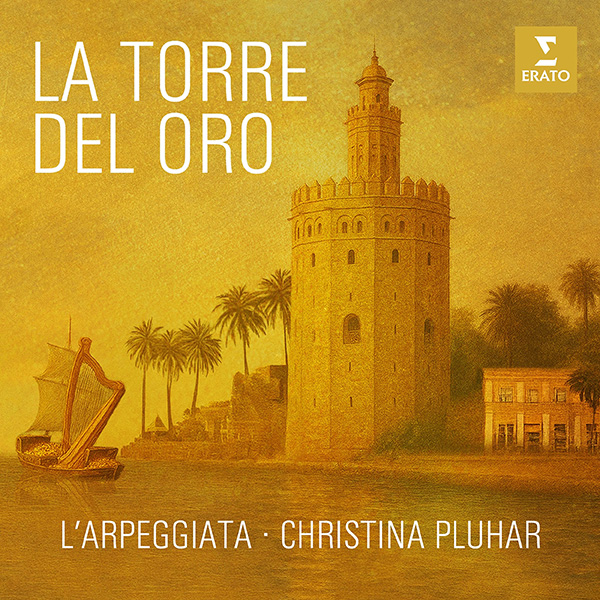 La Torre del Oro (16/44.1 WAV download, Warner Classics/Erato), a new recording from Christina Pluhar (the fifth in my collection), stood in startling contrast, bursting from my speakers. For this new recording, Pluhar, who has enriched my life with a series of brilliant surveys and adaptations of traditional and pre-classical music composed in middle Europe, turned to the music of Spain and Portugal as it passed across the Atlantic to South and Central America. The instrumentation is, as always, flavorful, and the music is expertly performed by Pluhar and her instrumental group, L'Arpeggiata.
The music is vivacious, with Latin rhythms. The opening track, "Guayabo Zarandeao" (Venezuelan traditional), should be loud, with voice and instruments up close, to express its exuberance. The DMP-A6 handled it without a sweat, allowing plenty of breathing space all around. Over the ensuing pieces, varying in tempo and mood, the music and presentation remained charming. Voices, horns, plucked strings, drums, tambourines—all were crystal clear, and the occasional bass drum had great impact.
La Torre del Oro (16/44.1 WAV download, Warner Classics/Erato), a new recording from Christina Pluhar (the fifth in my collection), stood in startling contrast, bursting from my speakers. For this new recording, Pluhar, who has enriched my life with a series of brilliant surveys and adaptations of traditional and pre-classical music composed in middle Europe, turned to the music of Spain and Portugal as it passed across the Atlantic to South and Central America. The instrumentation is, as always, flavorful, and the music is expertly performed by Pluhar and her instrumental group, L'Arpeggiata.
The music is vivacious, with Latin rhythms. The opening track, "Guayabo Zarandeao" (Venezuelan traditional), should be loud, with voice and instruments up close, to express its exuberance. The DMP-A6 handled it without a sweat, allowing plenty of breathing space all around. Over the ensuing pieces, varying in tempo and mood, the music and presentation remained charming. Voices, horns, plucked strings, drums, tambourines—all were crystal clear, and the occasional bass drum had great impact.
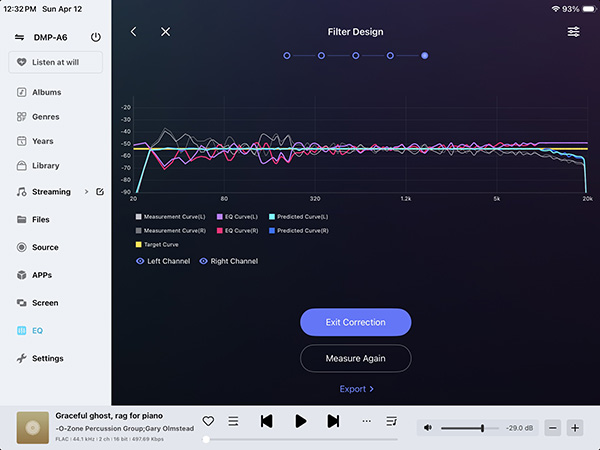 The DMP-A6 sports a measurements-based room correction option, which could be a useful alternative to the anechoic EQ I discussed above. The recommended procedure involves setting up a microphone, such as a miniDSP UMIK-1, at the listening seat at ear level, plugging it into the "on the go" USB input, loading the mike-correction file (if there is one), and letting it go. It plays one long sweep into each speaker and creates left and right correction curves, as parametric or FIR filters. This is a one-position measurement, not a sampling of positions in and around the listening seat (footnote 6). I chose FIR, which showed that there was little to correct above 300Hz—nothing but a minor rolloff in the extreme treble—but the improvement was audible. I find my anechoic EQ correction better, but I recommend experimenting with the DMP-A6's room correction. It's good.
I should also note that more than half of my collection consists of multichannel albums, both DSD and PCM, and even these multichannel files played back on the DMP-A6, converted and downmixed to PCM stereo (footnote 7). In instances where I could compare multichannel mixdown with the stereo version of the same recording, they sounded pretty much identical in balance, transparency, and weight. As testament to that, I was happy to listen to recordings without conscious regard to whether they were stereo or multichannel mixed down. The DMP-A6 is likely applying a fixed downmix algorithm, but with only a few heavily discrete/immersive pop/rock recordings did I notice any congestion.
The DMP-A6 sports a measurements-based room correction option, which could be a useful alternative to the anechoic EQ I discussed above. The recommended procedure involves setting up a microphone, such as a miniDSP UMIK-1, at the listening seat at ear level, plugging it into the "on the go" USB input, loading the mike-correction file (if there is one), and letting it go. It plays one long sweep into each speaker and creates left and right correction curves, as parametric or FIR filters. This is a one-position measurement, not a sampling of positions in and around the listening seat (footnote 6). I chose FIR, which showed that there was little to correct above 300Hz—nothing but a minor rolloff in the extreme treble—but the improvement was audible. I find my anechoic EQ correction better, but I recommend experimenting with the DMP-A6's room correction. It's good.
I should also note that more than half of my collection consists of multichannel albums, both DSD and PCM, and even these multichannel files played back on the DMP-A6, converted and downmixed to PCM stereo (footnote 7). In instances where I could compare multichannel mixdown with the stereo version of the same recording, they sounded pretty much identical in balance, transparency, and weight. As testament to that, I was happy to listen to recordings without conscious regard to whether they were stereo or multichannel mixed down. The DMP-A6 is likely applying a fixed downmix algorithm, but with only a few heavily discrete/immersive pop/rock recordings did I notice any congestion.
 The DMP-A6 does real multichannel file playback
The DMP-A6 can play back multichannel music. This is the real reason I wanted to review this multitalented little box. It's a hidden feature, sort of, not found in most streamers today. It's limited, though: It doesn't accept multichannel via LAN—that is, as a streamer, it's stereo-only; it can only play back multichannel files when they're local. Also, multichannel only works via the HDMI output, so I can't use it via LAN or USB with my multichannel DACs. Still, this is a rare feature on a music-only machine... ...and that's exactly what the DMP-A6 is: a music-only machine. It does not support video playback, and it has no output to send on-screen menus, album art, or GUI to an external display. What it can do is play downloaded or ripped multichannel DSD or PCM files, as long as you have a way of distributing the music from that HDMI connection to multiple channels. I pulled a Marantz AV8802A pre-pro up from deep storage, hooked it up to my 5.1 amp/speaker setup, and connected a 2m AudioQuest Carbon HDMI cable between it and the Eversolo's HDMI output. Son of a gun, it worked! Click on any DSD64 or PCM file (footnote 8) up to 192kHz, and the Marantz treats it just like any other HDMI input. The sound via this pre-pro was just fine.
Most people with a collection of multichannel files are likely to have higher-resolution files that the DMP-A6 can't play back, and also equipment and a strategy for playing them back. Given these limitations, few will purchase this streamer specifically for multichannel, but the DMP-A6 could help a few people discover this wide world, which is welcome.
What about streaming?
Streaming is undoubtedly the main attraction for the DMP-A6, even if I do it only occasionally. If I owned a DMP-A6, that might change, because it makes streaming so easy. Almost all the streaming services anyone might want are available with just a click, and even those that aren't can be added. I used the same three sites I mention at the beginning of this review; Qobuz and Apple Music were already installed and only needed me to sign in. As for the Berlin Digital Concert Hall, their site had an APK (Android Package Kit), which I downloaded and installed on the DMP-A6.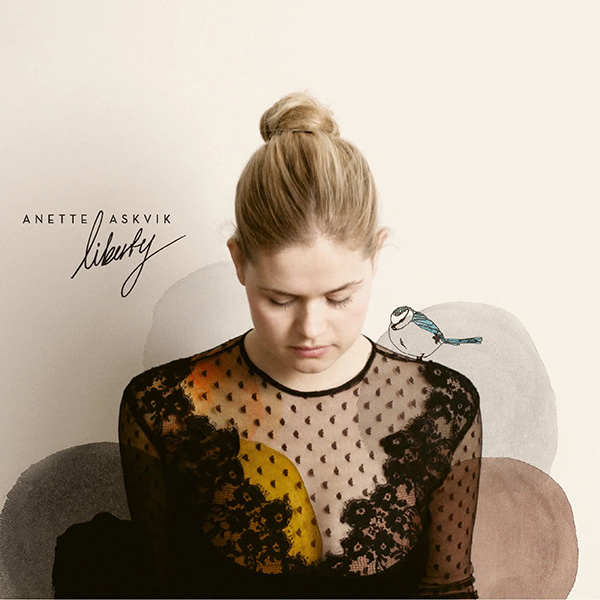 No surprise, the DMP-A6 was a champ at streaming. Streaming was as swift and responsive as any of the apps on my PC server, perhaps more, and the sound quality was at least equivalent. This was demonstrated with a recently popular track, originally recorded in 2011 but recently rereleased: Anette Askvik's "Liberty," from the album of the same name. Qobuz offers an "original" from 2011 and a new "immersive" version from 2025, both stereo. In 2025, Gaute Nistov remixed and 2L's Morten Lindberg remastered a multichannel "immersive" version for Atmos. From this, they created an "immersive" stereo version. Both versions stream on Qobuz at 24/48.
Streamed by the DMP-A6, the immersive track is strikingly open, Askvik's voice front and center in an almost eerie presence with the accompanying instruments sparsely distributed but also quite present in space.
The DMP-A6 also clearly exposes the differences: The "original" is congested and woolly; the new mix is much clearer. The same comparison via the Qobuz app on my PC streamer and the Merging Devices Hapi II did no better.
Conclusions
No surprise, the DMP-A6 was a champ at streaming. Streaming was as swift and responsive as any of the apps on my PC server, perhaps more, and the sound quality was at least equivalent. This was demonstrated with a recently popular track, originally recorded in 2011 but recently rereleased: Anette Askvik's "Liberty," from the album of the same name. Qobuz offers an "original" from 2011 and a new "immersive" version from 2025, both stereo. In 2025, Gaute Nistov remixed and 2L's Morten Lindberg remastered a multichannel "immersive" version for Atmos. From this, they created an "immersive" stereo version. Both versions stream on Qobuz at 24/48.
Streamed by the DMP-A6, the immersive track is strikingly open, Askvik's voice front and center in an almost eerie presence with the accompanying instruments sparsely distributed but also quite present in space.
The DMP-A6 also clearly exposes the differences: The "original" is congested and woolly; the new mix is much clearer. The same comparison via the Qobuz app on my PC streamer and the Merging Devices Hapi II did no better.
Conclusions
The Eversolo DMP-A6 is an amazing device for the many feats it can perform and for how well it performs them. Its D/A converters render beautiful stereo music, regardless of what or from where you feed it: from its internal library, as the output vehicle for servers like Roon and JRiver, or streaming music from various internet sites. In this post–physical media era, the DMP-A6 is a cost-effective entry to a world of music. Its clear, balanced sound makes it a suitable partner for sophisticated amps and speakers many times its modest price. The multichannel output is a bonus.
Footnote 1: As for me, I prefer to think of a streamer with a DAC as a network player. To me, a streamer is digital-only: A streamer is the transport of networked audio. The rest of the world, though, doesn't embrace this terminology, or not consistently. Kal is not wrong to describe as "streamer" a networked music appliance that contains a DAC.—Jim Austin Footnote 2: My prior and only previous experience with a streamer was in 2024 with the excellent Grimm MU2; its base price was $17,500. Footnote 3: "OTG" stands for "On the Go." It means that the connected device can serve either as host or peripheral. You can connect a USB drive, or you can connect your iPhone and use it as a music source. Most USB-C connections are "OTG."
Footnote 4: I use only wired Ethernet. My home Wi-Fi is generally inadequate for music.
Footnote 5: If I initiated a search for an artist, album, or track while playing from the DMP-A6 library (which feeds files from my NAS), the sound could become irregular or simply stop. I suspect that the DMP-A6's 4GB RAM is too small to manage both functions simultaneously given the large size of my library. Eversolo says that for "very large music libraries based in NAS, search operations and metadata indexing during playback will consume more system resources, which could affect the stability. Adding internal SSD will be helpful to reduce the system load and improve the performance to speed up library operations."
Footnote 6: One could do a sort of averaging by moving the microphone randomly around the listening position during the measurement. I didn't.
Footnote 7: This is via the two-channel, analog outputs—but see below.
Footnote 8: The DMP-A6 did, also, accommodate a few 7.1 channel files, but it will not transmit encoded formats such as Atmos, Dolby Digital, DTS, etc., or, of course, files of higher resolution than specified.
The product under review—the DMP-A6 Master Edition Gen 2—looks much like the DMP-A8, but it's slightly smaller and lacks the A8's analog inputs. It also resembles the Play but without the CD drive and power amp. The DMP-A6 Master Edition Gen 2 uses the more plebeian stepped attenuator in place of the R-2R switched attenuator in the A8, but its digital output is handled by the arguably competitive ESS Sabre ES9038Q2M chips, and the two components share the XMOS 3rd Gen XU316 processor for digital signal processing, including room correction and EQ. All three share the same user interface.
This version of the DMP-A6—the Master Edition Gen 2—adds to the more basic A6 a low-noise linear power supply in place of the original switching power supply, an HDMI ARC input for TV input, a 12V trigger output, a USB-B input in place of a USB-C (which some will find more convenient; others less so), a Wake-on-LAN option in the app, and new color options for front-panel illumination. It carries over the Gen 2 internal enhancements including use of paired Accusilicon femtosecond oscillators (to lower jitter), OPA1612 op-amp chips (to lower noise and distortion), and dual ESS Sabre ES9038Q2M DACs.
On the back panel of the DMP-A6, starting from the left, is a master power switch, an IEC AC connector, and a cluster with a 12V trigger output, an HDMI ARC jack, an HDMI audio out jack, and a 1GB LAN RJ45 connection. Next in line are two USB-A jacks, one an OTG (in/out, footnote 3) and the other designated for audio output. The next subpanel bears, at the top, a pair of RCA jacks for S/PDIF in and out and, below, a triplet of jacks: TosLink In, USB-B audio In, and TosLink Out. Finally, at right are four analog output jacks: right and left RCAs above right and left XLRs.
Here goesFor me, the easiest way to get familiar with the DMP-A6 was to use a known source, so I downloaded and installed Eversolo's ASIO driver to my PC server and connected its USB output to the USB-B jack on the streamer. With the XLR outputs connected to the inputs of my Benchmark amplifiers, I powered up the streamer and followed the instructions on the setup screen (location, language, etc.). The "Source" icon appeared in the middle of the screen. Tapping it allowed me to select both a source (USB-B In) and output (XLR/RCA). The music choice was easy. When I install a new component, I always play what's at the top of my current mental playlist. These days it is Frisson, a brilliant collection of delightful music for woodwind orchestra played by the Czech Philharmonic Wind Ensemble conducted by Shea Lolin (24/96 FLAC download, Divine Art); Lolin is also responsible for the arrangements. The opening of Franz Krommer's Octet-Partita in F major, Op.57, simply blooms. The eight instruments on this transparent recording range from flute to bassoon. With the DMP-A6, I could easily discern each one. The soundstage via the DMP-A6 was a bit wider than my speaker spread. There was a comfortable aura of ambiance, but I was more impressed by its presence.
The sound was enjoyable but not entirely what I expected. The bass was good but just a little light, and the midrange seemed a bit reticent compared to my standard setup. I puzzled over whether my memory was failing me or whether it was something else. Either way, the DMP-A6 gets excellent grades, an A if not an A+.
That's when it occurred to me that my standard setup includes a critical adjustment for my Blade 2 Meta speakers. Derived from Klippel-based "anechoic" measurements, it linearizes the predicted in-room response rather than the on-axis response and adds a slight –1dB per octave tilt over the whole spectrum. The five parametric filters that implement this adjustment look subtle, but I have found their effect unsubtle, especially once I was fully adapted to the change. Which renders the above criticism, slight as it is, unfair, especially considering that the Eversolo incorporates its own parametric EQ.
I used the Eversolo app on my iPad to insert the parametric filters into the DMP-A6—a great convenience, since entering multiple decimal numbers via the touchscreen would be possible but tedious. This adjustment leveled the playing field, correcting the minor aberrations I initially attributed to the DMP-A6 DAC. Listening was now more rewarding. I was better able to relish the ensemble and its textures as the Partita chortled and bounced along. The adjusted Eversolo clearly delineated the emphatic support the contrabass clarinet provides throughout the album. The "pedal" conclusion to the Chaconne in Guy Woolfenden's "More Gordian Knots" was considerably more satisfying.
Spurred by that result, I pulled out a rarely played guilty pleasure, "Jazz Variants," from the O-Zone Percussion Group's La Bamba (FLAC CD rip, Klavier KD 77017). This is a showoff piece for the ensemble and a challenge for loudspeakers, with a huge dynamic range and a frequency response extended at both ends. I am haunted by my memory of playing it on the largest Focal JMlab Grand Utopia speakers I have ever seen, in a ballroom at an audio show in the late '90s. With the level set high, it sucked people in from the hallways and adjacent rooms as it roared and pounded. Now channeled through the DMP-A6, with its volume approaching maximum, my KEF Blades (without subs) became monsters, depicting with clarity and precision the triangle and cymbals and the timpani and bass drums with seemingly infinite power and depth. I was transported back to that earlier time. I didn't know my system could do that. The DMP-A6 DAC earned a very big thumbs-up.
On its ownIt was time to let the DMP-A6 run the show, as it is intended to do. I plugged in a network cable, and my NAS (and lots of other stuff) was visible on the LAN (footnote 4). It took more than four hours to scan the music on my NAS into its own library; if that sounds like a long time, consider that the NAS holds more than 40TB of music. I switched the source to Internal Player, and all the files and album covers were displayed along with search, play, and other options and settings. Using my iPad, I was able to work with the app's expanded text-based menus, or I could see an enlarged presentation of what was on the DMP-A6's full-color touchscreen. During play, the display (and the app) show album art, technical parameters and controls, or, if one wants, one of a library of volume and spectral meters.
La Torre del Oro (16/44.1 WAV download, Warner Classics/Erato), a new recording from Christina Pluhar (the fifth in my collection), stood in startling contrast, bursting from my speakers. For this new recording, Pluhar, who has enriched my life with a series of brilliant surveys and adaptations of traditional and pre-classical music composed in middle Europe, turned to the music of Spain and Portugal as it passed across the Atlantic to South and Central America. The instrumentation is, as always, flavorful, and the music is expertly performed by Pluhar and her instrumental group, L'Arpeggiata.
The DMP-A6 sports a measurements-based room correction option, which could be a useful alternative to the anechoic EQ I discussed above. The recommended procedure involves setting up a microphone, such as a miniDSP UMIK-1, at the listening seat at ear level, plugging it into the "on the go" USB input, loading the mike-correction file (if there is one), and letting it go. It plays one long sweep into each speaker and creates left and right correction curves, as parametric or FIR filters. This is a one-position measurement, not a sampling of positions in and around the listening seat (footnote 6). I chose FIR, which showed that there was little to correct above 300Hz—nothing but a minor rolloff in the extreme treble—but the improvement was audible. I find my anechoic EQ correction better, but I recommend experimenting with the DMP-A6's room correction. It's good.
I should also note that more than half of my collection consists of multichannel albums, both DSD and PCM, and even these multichannel files played back on the DMP-A6, converted and downmixed to PCM stereo (footnote 7). In instances where I could compare multichannel mixdown with the stereo version of the same recording, they sounded pretty much identical in balance, transparency, and weight. As testament to that, I was happy to listen to recordings without conscious regard to whether they were stereo or multichannel mixed down. The DMP-A6 is likely applying a fixed downmix algorithm, but with only a few heavily discrete/immersive pop/rock recordings did I notice any congestion.
The DMP-A6 does real multichannel file playbackThe DMP-A6 can play back multichannel music. This is the real reason I wanted to review this multitalented little box. It's a hidden feature, sort of, not found in most streamers today. It's limited, though: It doesn't accept multichannel via LAN—that is, as a streamer, it's stereo-only; it can only play back multichannel files when they're local. Also, multichannel only works via the HDMI output, so I can't use it via LAN or USB with my multichannel DACs. Still, this is a rare feature on a music-only machine... ...and that's exactly what the DMP-A6 is: a music-only machine. It does not support video playback, and it has no output to send on-screen menus, album art, or GUI to an external display. What it can do is play downloaded or ripped multichannel DSD or PCM files, as long as you have a way of distributing the music from that HDMI connection to multiple channels. I pulled a Marantz AV8802A pre-pro up from deep storage, hooked it up to my 5.1 amp/speaker setup, and connected a 2m AudioQuest Carbon HDMI cable between it and the Eversolo's HDMI output. Son of a gun, it worked! Click on any DSD64 or PCM file (footnote 8) up to 192kHz, and the Marantz treats it just like any other HDMI input. The sound via this pre-pro was just fine.
Streaming is undoubtedly the main attraction for the DMP-A6, even if I do it only occasionally. If I owned a DMP-A6, that might change, because it makes streaming so easy. Almost all the streaming services anyone might want are available with just a click, and even those that aren't can be added. I used the same three sites I mention at the beginning of this review; Qobuz and Apple Music were already installed and only needed me to sign in. As for the Berlin Digital Concert Hall, their site had an APK (Android Package Kit), which I downloaded and installed on the DMP-A6.
No surprise, the DMP-A6 was a champ at streaming. Streaming was as swift and responsive as any of the apps on my PC server, perhaps more, and the sound quality was at least equivalent. This was demonstrated with a recently popular track, originally recorded in 2011 but recently rereleased: Anette Askvik's "Liberty," from the album of the same name. Qobuz offers an "original" from 2011 and a new "immersive" version from 2025, both stereo. In 2025, Gaute Nistov remixed and 2L's Morten Lindberg remastered a multichannel "immersive" version for Atmos. From this, they created an "immersive" stereo version. Both versions stream on Qobuz at 24/48.
The Eversolo DMP-A6 is an amazing device for the many feats it can perform and for how well it performs them. Its D/A converters render beautiful stereo music, regardless of what or from where you feed it: from its internal library, as the output vehicle for servers like Roon and JRiver, or streaming music from various internet sites. In this post–physical media era, the DMP-A6 is a cost-effective entry to a world of music. Its clear, balanced sound makes it a suitable partner for sophisticated amps and speakers many times its modest price. The multichannel output is a bonus.
Footnote 1: As for me, I prefer to think of a streamer with a DAC as a network player. To me, a streamer is digital-only: A streamer is the transport of networked audio. The rest of the world, though, doesn't embrace this terminology, or not consistently. Kal is not wrong to describe as "streamer" a networked music appliance that contains a DAC.—Jim Austin Footnote 2: My prior and only previous experience with a streamer was in 2024 with the excellent Grimm MU2; its base price was $17,500. Footnote 3: "OTG" stands for "On the Go." It means that the connected device can serve either as host or peripheral. You can connect a USB drive, or you can connect your iPhone and use it as a music source. Most USB-C connections are "OTG."