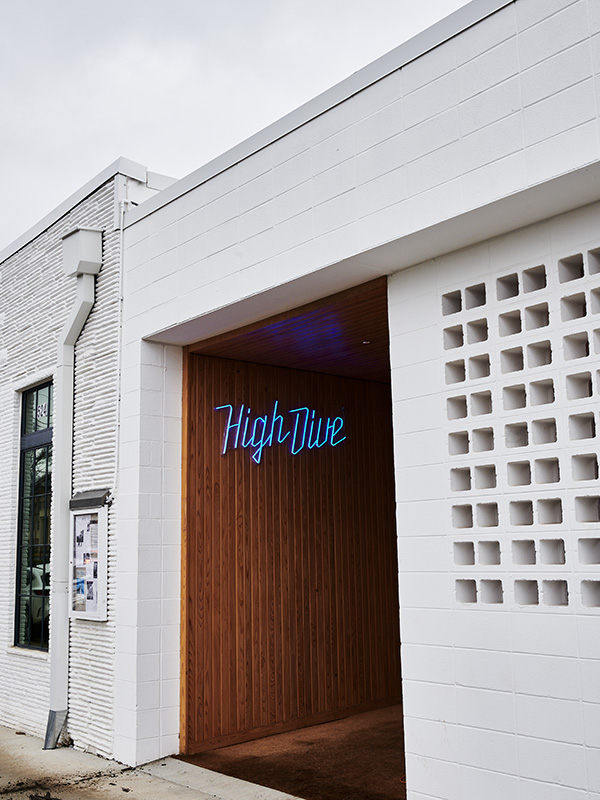
Hi-fi listening bars have expanded far beyond Tokyo, which was their Ground Zero. They can be found in cities from Miami to London, from Brooklyn to Berlin. Recently, in Birmingham, Alabama, Bart Stephens opened High Dive, a listening lounge and restaurant that does things a little differently.
High Dive is intended to be a social place, where people can connect as they listen to music, whether it's live or recorded. "We don't want people to come in and be observers of our show. We want them to be at the center of the experience," Stephens told me in a recent interview.
High Dive is one part of Stephens's Lakeview Marina development, a 20,000ft2 space that combines retail, dining, and entertainment in Birmingham's Lakeview neighborhood. High Dive seats 75. A patio can seat an additional 45. Beyond the main room is an outdoor area, dubbed Lakeview Marina Music Park, which can seat—or at least admit—500 people. There's also space for food trucks.
Stephens intends "Marina" ironically, tongue in cheek. Once, a long time ago, there was a lake nearby—hence "Lakeview"—but it was filled in.
Stephens is making the Marina a hotspot for music. Seasick Records, a Birmingham institution that also hosts live music events, recently moved to the complex. Indie radio station BMR, Birmingham Mountain Radio, 107.3 on the FM dial, will follow soon.
During COVID, Stephens got the idea to develop a creative hub in downtown Birmingham. He took his time, did a lot of research, traveled to hi-fi bars in the US and abroad. "I had the opportunity to see what worked and what didn't," he told me.
Stephens is "a bit of a music omnivore," so he decided his place wouldn't specialize as so many kissa do. The space itself is hybrid: a bar/restaurant/live music/recording studio/nightclub. The audio system combines vinyl with digital, stereo with immersive audio. It started with the room, Stephens realized.
"We came to it more with a perspective of, we're going to build an extremely capable and flexible room. And then we're going to try to let the community have a strong voice in how we use it."
Stephens hired Jeff Minnich, the acoustician who designed Studio A at Capitol Studios, and Nathaniel Kunkel, an audio engineer; Kunkel put together the sound system. Jim Pace was their primary pro-audio guy. Dolby Atmos was dialed in by specialists. Local architect Bruce Lanier glued everything together.
There's a slight rake toward the front of the room. Fabric panels and wood slats make for about a 50/50 combination of absorption and diffusion. "The walls and the insulation at the front of the room are much thicker than they are in the back," Stephens said. "The back wall has 18 or 24" of insulation"—enough to help control the bass. To minimize mechanical noise, all condensers and compressors are outside.
 The system features a pair of Japan-sourced Technics SL-1200 Mk5 turntables with KAB mods—just like Tom Fine's vinyl setup—with the ubiquitous Ortofon Concorde deejay cartridge. These are connected to an Alpha Theta Euphonia rotary mixer (footnote 1). High Dive also owns an OJAS turntable "based on a Technics SL-1200G motor," with two tonearms connected to a tubed phono stage. There's a TASCAM cassette deck and an MCI reel-to-reel.
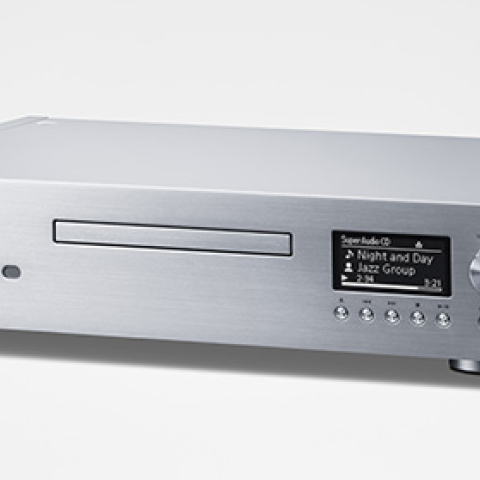
What about digital? There's an Aurender hi-rez streamer and an Oppo SACD/CD player. "We have an old CD jukebox on the wall that's a lot of fun," Stephens added. There's also a Panasonic Blu-ray disc player they use to project movies and football games onto a flat white wall.
"We use Dante at 24/96 to route audio to the different spaces," Stephens said. The music played on High Dive's stage can be piped to the record store nearby. Music from the record store or the radio station can be played in the listening lounge.
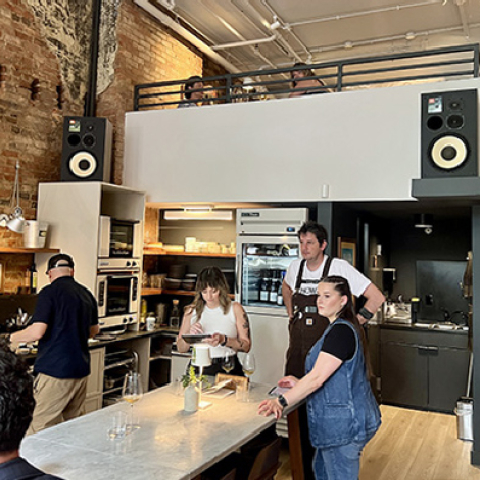
The system in the main room uses JBL M2 monitors for left, right, and center, dual 15" subwoofers, arrays of JBL 708i studio monitors for side speakers, and eight JBL 708 monitors overhead, paired with 10" subs. It's not just for immersive audio. "It is not only a distributed stereo system for listening to two-channel that is even around the room that allows us to play at even volumes and lower volumes." Stereo, multichannel, and Dolby Atmos immersive formats are also supported.
"I wanted flexibility," Stephens told me. "If you're going to build a room like this, it's a treat certainly for people who love music, but also for people that love the technology."
High Dive hosts live music: jazz on Thursdays, singer-songwriters on Sundays. Those Technics 'tables get a workout in deejay sets on Fridays and Saturdays.
Stephens is a self-described Deadhead. "As a Deadhead, I have a soft spot in my heart for cassette," Stephens noted. That's because the Grateful Dead's exhaustive touring and openness to recording resulted in endless collectable bootlegs. Swapping cassettes eventually led Stephens to seek better equipment on which to enjoy his favorite music. But his delight is in music as a shared experience. He doesn't want to shush people. He believes that at the High Dive, with its excellent acoustics, music listening and conversation are compatible. "People do not have to speak loudly to be heard. And they can hear the music crystal clear wherever they are."
The system features a pair of Japan-sourced Technics SL-1200 Mk5 turntables with KAB mods—just like Tom Fine's vinyl setup—with the ubiquitous Ortofon Concorde deejay cartridge. These are connected to an Alpha Theta Euphonia rotary mixer (footnote 1). High Dive also owns an OJAS turntable "based on a Technics SL-1200G motor," with two tonearms connected to a tubed phono stage. There's a TASCAM cassette deck and an MCI reel-to-reel.
What about digital? There's an Aurender hi-rez streamer and an Oppo SACD/CD player. "We have an old CD jukebox on the wall that's a lot of fun," Stephens added. There's also a Panasonic Blu-ray disc player they use to project movies and football games onto a flat white wall.
"We use Dante at 24/96 to route audio to the different spaces," Stephens said. The music played on High Dive's stage can be piped to the record store nearby. Music from the record store or the radio station can be played in the listening lounge.
The system in the main room uses JBL M2 monitors for left, right, and center, dual 15" subwoofers, arrays of JBL 708i studio monitors for side speakers, and eight JBL 708 monitors overhead, paired with 10" subs. It's not just for immersive audio. "It is not only a distributed stereo system for listening to two-channel that is even around the room that allows us to play at even volumes and lower volumes." Stereo, multichannel, and Dolby Atmos immersive formats are also supported.
"I wanted flexibility," Stephens told me. "If you're going to build a room like this, it's a treat certainly for people who love music, but also for people that love the technology."
High Dive hosts live music: jazz on Thursdays, singer-songwriters on Sundays. Those Technics 'tables get a workout in deejay sets on Fridays and Saturdays.
Stephens is a self-described Deadhead. "As a Deadhead, I have a soft spot in my heart for cassette," Stephens noted. That's because the Grateful Dead's exhaustive touring and openness to recording resulted in endless collectable bootlegs. Swapping cassettes eventually led Stephens to seek better equipment on which to enjoy his favorite music. But his delight is in music as a shared experience. He doesn't want to shush people. He believes that at the High Dive, with its excellent acoustics, music listening and conversation are compatible. "People do not have to speak loudly to be heard. And they can hear the music crystal clear wherever they are."
Footnote 1: A rotary mixer is a deejay mixer with round, not linear, faders. They typically have superior sonics, and they facilitate smooth transitions between tracks.
The system features a pair of Japan-sourced Technics SL-1200 Mk5 turntables with KAB mods—just like Tom Fine's vinyl setup—with the ubiquitous Ortofon Concorde deejay cartridge. These are connected to an Alpha Theta Euphonia rotary mixer (footnote 1). High Dive also owns an OJAS turntable "based on a Technics SL-1200G motor," with two tonearms connected to a tubed phono stage. There's a TASCAM cassette deck and an MCI reel-to-reel.
What about digital? There's an Aurender hi-rez streamer and an Oppo SACD/CD player. "We have an old CD jukebox on the wall that's a lot of fun," Stephens added. There's also a Panasonic Blu-ray disc player they use to project movies and football games onto a flat white wall.
Footnote 1: A rotary mixer is a deejay mixer with round, not linear, faders. They typically have superior sonics, and they facilitate smooth transitions between tracks.