
I first heard the Consonance Compact Monitor ($1680/pair) at AXPONA 2025. I called the room—Mike Stephens's Western HiFi of Farmersville, Texas—"one of the ... top five systems at AXPONA." Even though it was built from modestly priced parts, I noted, "it stopped people in their tracks and kept them planted in their seats—including me."
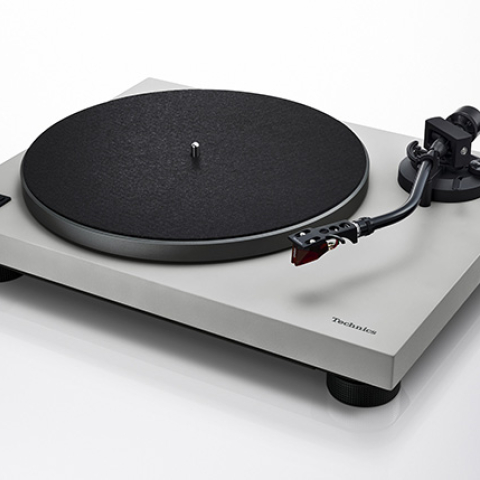
After noting the equipment in the system, which in addition to the Consonance monitors included a Well Tempered Lab Turntable and Consonance amplification, I took a seat to listen. Then I wrote, "Spinning At Fillmore East by The Allman Brothers Band, the system delivered Gregg's voice, Duane's guitar, and the thunder of the Trucks/Johanson double drumming with more cohesiveness and punch than I've heard from many larger rigs." I could have added "more expensive."
I judged that the Consonance Compact Monitor provided much of the magic and mojo in that diminutive system, exciting both room and (my) brain with a soundstage that extended beyond the walls, speakers disappearing while delivering shockingly good resolution, physicality, layering and separation, and what some call "musicality."
When Mike Stephens offered a pair for review, I jumped on the invitation, pronto. For starters, the speakers are delivered in a single box no bigger than a small microwave, making for an easy leap up the stairs.
Design
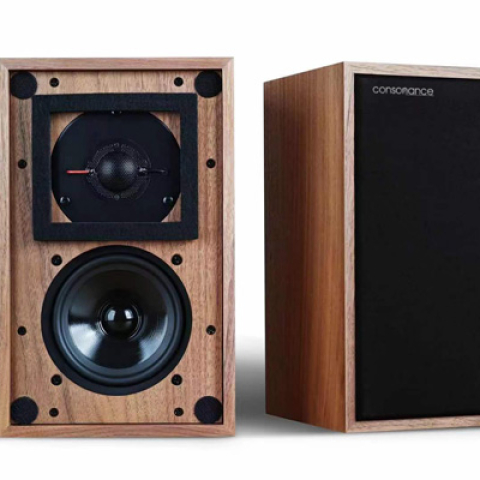
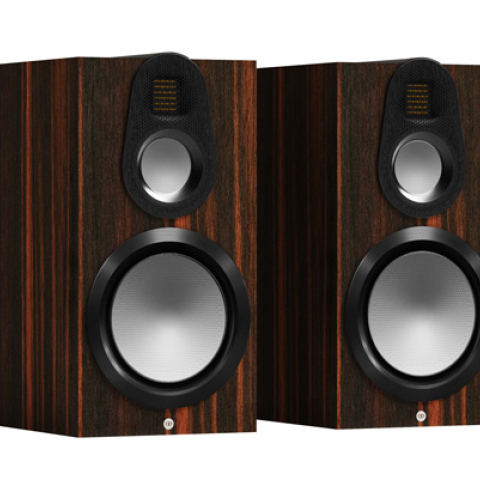
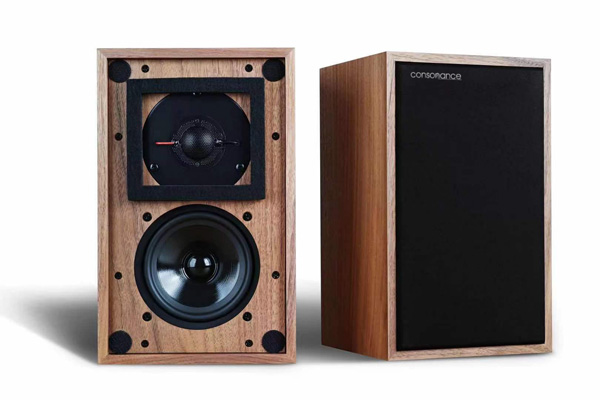
Standing a mere 7.5" wide, 12" high, and 6.5" deep and weighing 10.5 lb, the Consonance Compact Monitor (CCM) pairs a 0.75" silk-dome tweeter with a 4.5" polypropylene mid/bass driver. Its design draws on the classic BBC LS3/5a monitor, the UK radio industry standard from roughly 1975 to 1998. Various manufacturers have marketed their own versions of the LS3/5a in the years since. "The Consonance Compact Monitor is inspired by a longstanding tradition of the highest quality British studio monitors," states the Western HiFi site. "All aspects of its construction have been developed to allow an open window to the original performance. The cabinet is wood veneered inside and out for long term stability. The modern drive units and high-quality crossover components are chosen and voiced to blend seamlessly, leaving the music with its heart and soul intact."
The CCM's 0.75" silk-dome tweeter employs magnetic fluid cooling and an anti-diffraction felt surround, a holdover from one of the earliest iterations of the LS3/5a developed by the BBC Research Department at Kingswood Warren, a Gothic mansion in Surrey, southwest of London (footnote 1).
"The felt strips function as a shallow waveguide for the tweeter," Stephens clarified. "As I understand it, tweeters naturally radiate sound in a narrowing pattern as frequencies increase, and a waveguide helps spread that sound more evenly across a wider listening area. You'll notice that there is less of a 'sweet spot' with these speakers and less beaming of the treble. The felt surround helps to create a more balanced, natural soundfield and imaging and helps to smooth the transition between the tweeter and the woofer."
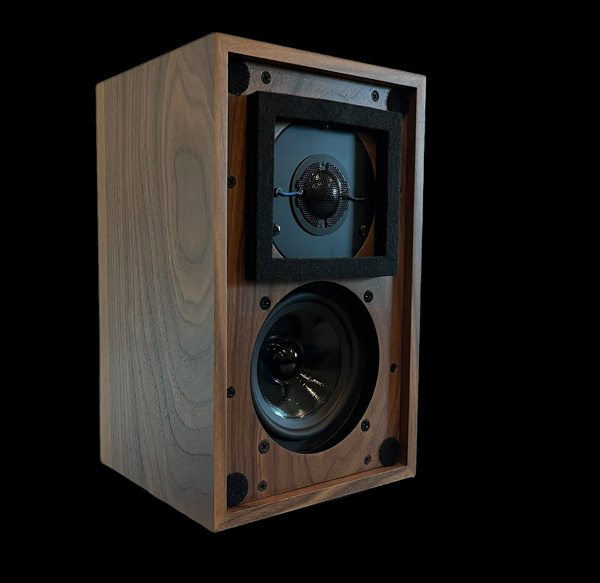 The 4.5" mid/bass driver consists of a cast aluminum frame, polypropylene cone material double-coated front and back with a water-based damping compound, and a large ferrite magnet. Both tweeter and woofer are manufactured in Beijing for Opera Audio Co. Ltd, the parent company that makes Consonance products; Opera Audio Co. Ltd should not be confused with Opera Loudspeaker, the Italian manufacturer of luxury-class loudspeakers.
Who, specifically, designed this LS3/5a variant? "The Consonance Compact Monitors were developed by a speaker-designer friend of Eric Liu, owner of Opera Audio Co., the company that produces the speakers," he replied via email. "They were designed using measurements and, more importantly, extensive listening tests. Opera Audio is primarily an OE manufacturer in the high-end audio industry. Consonance is Opera Audio's house brand under Mr. Liu's decades of design expertise."
Opera Audio Co. Ltd was founded in 1994 by "Eric" Shi Hui Liu. In addition to making the Consonance product line, Opera makes products for "other high-end audio companies," Stephens elaborated. "Opera Audio has grown from a home startup into one of the oldest and largest high-end audio manufacturers in China, with a presence in more than 30 countries. An optical-mechanical engineer by training, Liu crafted a tube amplifier for his personal use out of his passion for music—particularly European opera. When friends heard the amplifier and requested their own, he formally established Opera-Consonance in 1994. What made this venture historically significant was that Opera Audio became the first turntable manufacturer in China, demonstrating a commitment to analog audio at a time when digital was becoming dominant."
How closely is the Consonance Compact Monitor based on the original BBC LS3/5a?
"The Consonance Compact Monitor is inspired by rather than based on the British design," Stephens clarified. The original LS3/5a mid/bass driver, which was manufactured by KEF, was discontinued during the 1990s (footnote 2). That was the beginning of the "derivation"—Stephens's word—of the Compact Monitor. "The Compact Monitor has been designed around a simpler crossover, sealed cabinet"—the original also had a sealed cabinet—"better bass response, and lifelike vocals."
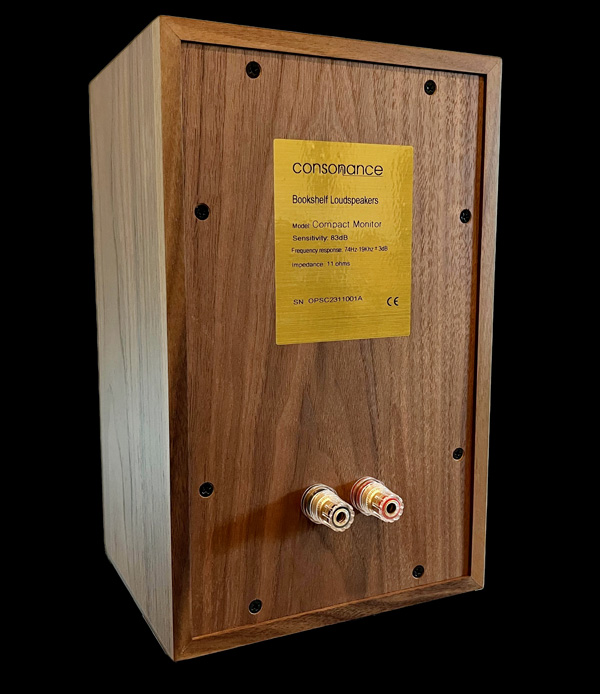
"Overall dimensions are the same as the familiar design," Stephens added. "It is made with 9mm-thick MDF cabinet and baffle walls, which I believe was an early British design spec, and veneered with walnut inside and out for stability of the MDF cabinet walls as well as sound character of the speakers (footnote 3). We apply two coats of natural oil and wax finish to the exterior of each cabinet, which gives the walnut a natural luster and helps to preserve the wood. The cabinet has wood bracing internally around the perimeter. Overall impedance is 11 ohms, which makes the Compact Monitors a better match for many amplifiers and allows for a more responsive, modern sound."
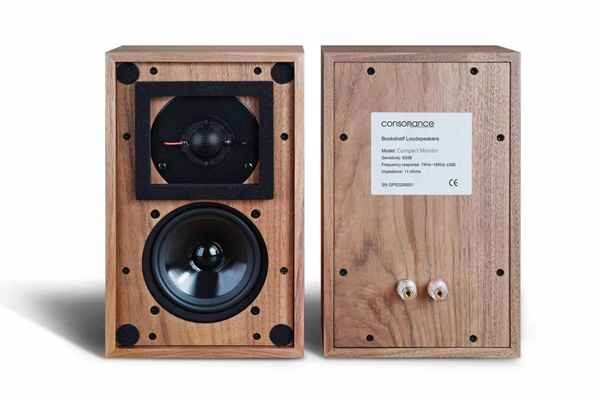 Stephens insists the drivers are also "more modern." Rather than the [KEF T27] Mylar-dome tweeter of the original, a silk-dome tweeter with magnetic fluid cooling is used; Stephens says this allows for a simpler crossover because it doesn't need to adjust for high-frequency peaks as Mylar tweeters require. As noted, the tweeter features a square anti-diffraction felt surround, said to result in more lifelike vocal presentation. The original BBC LS3/5a used a KEF B110 Bextrene cone mid/bass driver; the CCM woofer is made with a nanomaterial rubber surround and double-sided water-based damping compound. Combined with the cabinet design, the mid/bass driver produces a lower frequency response cutoff at 74Hz (compared to the original LS3/5a's 80Hz). In addition to this greater extension, this alternative design is said to produce superior bass texture.
The CCM crossover uses precision wirewound resistors, XPP capacitors, a large cross-section core inductor, and Litz wire. The baffle and back panel are secured with sealing strips and wood screws, while the drivers are mounted to the cabinet using EVA sealing rings and machine screws and nuts. Inside, bitumen-based damping sheets line the side, top, and bottom walls; these are supplemented by foam sheets covering all interior surfaces, essentially filling the sealed cabinet to optimize Q (which measures how sharply a speaker's bass response peaks or rolls off near its resonant frequency once the driver is mounted in its enclosure).
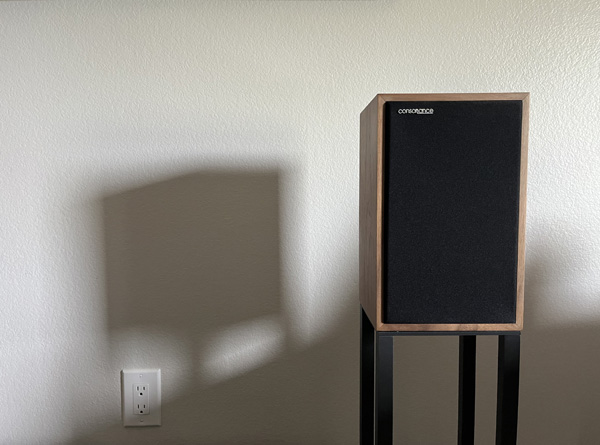
A single pair of sturdy brass five-way binding posts handles connections. The grilles are wrapped in acoustically transparent thin polyester and attached via hook-and-loop pads. The speakers are voiced with the grilles in place, but I removed them for testing.
 Why bother? What's the intent of the redesign? "To maintain the strengths of classic monitors but with a more open, even, and expressive performance of the music using modern materials at an approachable price," Stephens said.
Art Dudley speaks
It's nigh impossible to write a review of a new LS3/5a without noting Art Dudley's thorough examinations into the subject, which appeared in his Listening columns, and Herb Reichert's ongoing explorations.
Art compared modern iterations from Falcon Acoustics and Graham Audio and revisited the Rogers LS3/5a. Streaming Nick Drake, Art wrote, "Through the Graham LS3/5a's, [Drake's] finger-picked steel-string guitar ... came across with remarkably good physicality: Like Drake's voice, that instrument was right there, between the speakers, sounding for all the world like a Martin D-28 with strings that were perhaps less than new. Drake's voice was reproduced without apparent colorations, his characteristically drawn-out sibilants conveyed in a manner I've come to regard as correct—likewise the manner in which he holds back on his plosives. Drake's sustained vocal tones were appropriately rich and dark: Though tonally neutral, these LS3/5a's didn't stint on color."
Two paragraphs later: "I then tried the same Nick Drake tracks with the Falcon LS3/5a's—and the sound was noticeably different. Through the Falcons, the recorded sound as a whole was considerably more open; not only were the voice and guitar even more present, their textures more apparent, but the acoustic space around those elements was wider and taller and altogether more audible than through the Grahams. That the Falcons delivered more treble-range content was apparent after matching the system's loudness through the two different speakers: The 15-ohm Falcons played a little more quietly than the 11-ohm Grahams at the same volume-knob position."
Art praised the Graham/Chartwell LS3/5a for its physicality, rich tonal balance, and presence and the Falcon for its sense of openness and air. He didn't value the LS3/5a for surgical clarity; instead he valued its warmth, immediacy, and unique way of conveying the flow of a performance. Listening to a vintage Rogers LS3/5a, he noted how the historic nearfield monitors expressed an intimate, human connection to the music. As it always did with Art, the music came first.
How would this new, LS3/5a-inspired loudspeaker fare?
 Setup
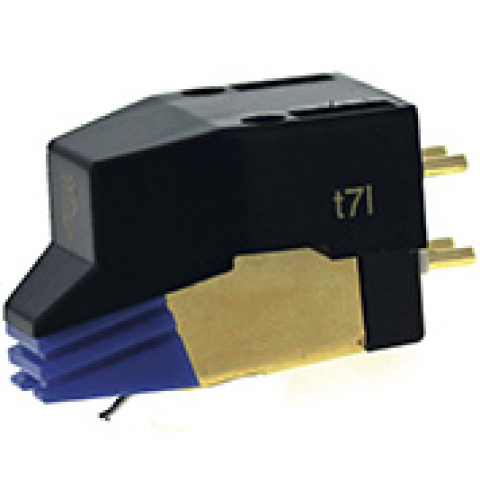
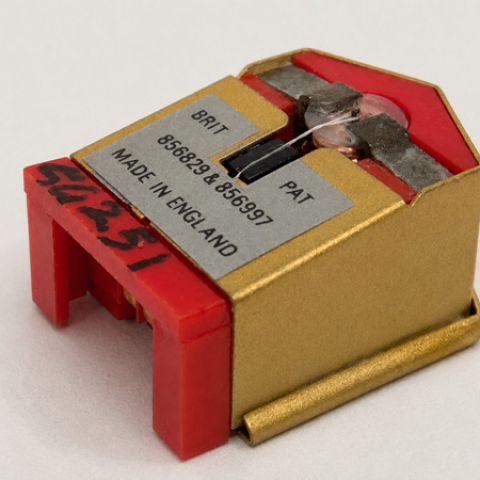
Right out of the box—one box, two speakers—I sited the CCMs on my 24" stands, which are so old that I can't remember the brand. Four dots of Blu Tack, which were supplied, secured speaker to stand and provided some vibration isolation. The speakers were easy to set up and took well to wide spacing. They also weren't overly sensitive to placement near the front wall—unsurprising considering the sealed boxes. Placing them almost at the wall produced slightly better bass but reduced their presence, clarity, and immediacy—a bad bargain. I finished with the little speakers 62" apart from edge to edge and roughly 75" from my listening seat. The CCMs were sensitive to cables. I tried cables from AudioQuest (my all-round go-to), Triode Wire Labs, ArgentPur, Danacable, and, of course, Auditorium 23, which provided the bulk of listening content. I used the same MC cartridge throughout: the Sumiko Oriole, which was introduced in January. The Oriole features an orange open-body design said to help reduce resonance and distortion, along with a detail-scouring nude Shibata line-contact stylus. It's handmade in Yokohama, Japan, by Excel Sound. It delivered a beautifully balanced sound, with a gossamer, sweetly extended treble; a solid, richly textured midrange; and pure, authoritative bass. It's one of the most exquisite cartridges I've heard—and at $1699, it's a relative bargain.
 Listening
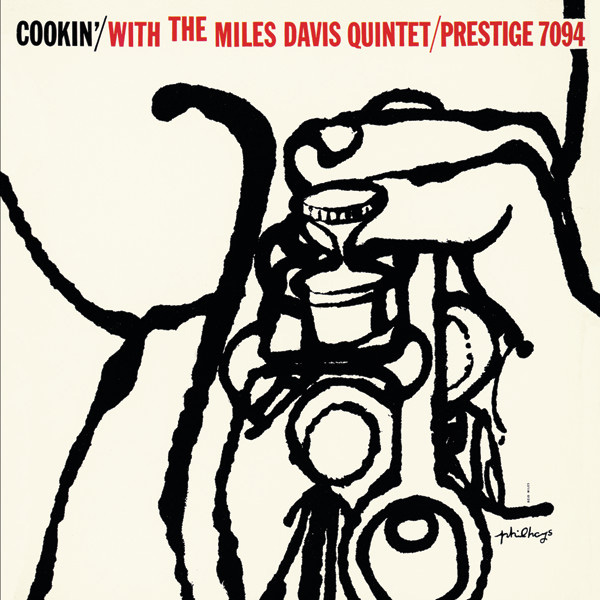
I began listening using the Aurorasound HFSA-02 integrated amplifier ($9900), in for review. The Aurorasound is an all-tube amplifier, made in Japan, with a push-pull output configuration using EL34s. It's said to deliver 31Wpc into 8 ohms. The HFSA-02's build quality is excellent. It features custom Japanese power and choke transformers and Lundahl output transformers. The CCMs rendered each recording with its own sonic signature, with exceptional clarity and period-accurate framing. Spinning early pressings of Teddy Edwards's Together Again!!!! (Contemporary M3588) and Cookin' with the Miles Davis Quintet (Prestige 7094)—both mono, both showcasing mono's peculiar soundstage capabilities—the differences were stark. The Edwards leaned warm and veiled, while the Davis record had far more air and resolution. What struck me most was how faithfully the CCMs re-created these recorded events—not just the performances but the production. Small monitors are expected to play with speed and energy, but the CCMs went further, digging up intricacies I'd never heard before while remaining coherent, focused, and clearheaded. Philly Joe Jones's cymbals had shimmer and definition. Paul Chambers's bass was taut and focused. Depth, physicality, tonal liquidity—all present and accounted for.
The CCM may be the cleanest, clearest, most concentrated loudspeaker I've had in my listening room. Chief among its virtues was a natural way of framing the production and ambient cues—the air around the notes—that few speakers of any size manage to pull off. This was the same sound that knocked me out at AXPONA—that made me sit, listen, and want to keep listening (footnote 4).
 I often use Kraftwerk's Tour de France (Kling Klang 50999 9 66109 16) to appraise layering and bass—not just its extension but how well it's executed. This record's rolling synths, morphing tones, and deep synth bass build a hypnotic vista that shifts and swells like a climate change–fueled thunderstorm. Through the CCMs, the layering felt more compressed—and as you'd expect, the bass was less commanding. On the jazz recordings, by contrast, bass was taut and deep enough if not especially weighty. I rarely felt that anything was missing down low.
To investigate the bass further, I reached for music built entirely around bass: Loscil's ominous, oddly comforting Sketches from New Brighton (Kranky krank171). Like a trawler dragging the seafloor for wreckage, the album lives in still, silent ambience: oceanic atmospherics punctuated by slow-moving bass notes that erupt with weight and force. The CCM reconstructed those bass bombs with striking fidelity. They lacked great sustain, but they still dug low, heavy—and deep enough to deliver much of the desired effect. How a 4.5" driver could pull this off I do not know, but I heard it.
Focus, focus, focus
It's easy to see why the design the CCM is based on earned such reverence as a studio monitor. The CCMs demonstrated the ability to layer and separate musical lines within a coherent whole—to do so across a remarkably large soundstage, and to essentially disappear. Time and again, the CCMs rendered music—even studio-produced music—as live events, capturing the original production's milieu with flesh and blood attached, bringing joy from familiar recordings and revelation from newer ones. The CCMs also sorted production differences between Acoustic Sounds UHQR pressings by the same artist. Steely Dan's The Royal Scam (Analogue Productions UHQR 0013-45) sounded cluttered and a touch hashy, while Gaucho (Analogue Productions UHQR 0015-45) came across pristine, focused, and simpler. Boxes this small have limitations. I like to play music loud—I want it to fill the room like a concert stage. Pushed to those levels, the CCMs' tweeters could turn hot and hard. Driven too hard, the little 4.5" mid/bass drivers chuffed, huffed, and occasionally buzzed. But you don't buy LS3/5a's and their ilk to play music that loud. It probably won't be an issue for most listeners.
 I ended the Aurorasound session with a band called Animals as Leaders and their album Weightless (Prosthetic Records PROS105691). This trio—a raging instrumental prog-metal band from Washington, DC—reminds me of King Crimson. AAL's music is a blend of metal pummel and advanced prog smarts, each musician a master in his genre. The Aurorasound/CCM combo produced a weighty wall of metal overlord combustion from the AAL disc, a wide soundstage populated with images tied together like prisoners in a police lineup. This was full-scale, oceans-crashing, comets-exploding energy.
I switched from the Aurorasound to the Audio Note OTO Phono SE Signature integrated (also in for review), which uses EL84s and is specified to produce a mere 10Wpc, and put the album on again. Surprisingly, the Audio Note/CCM team produced an even larger, more grandly scaled soundstage, with a slight loss of deep frequency extension and weight, and more upper midrange and treble detail.
I changed amplification again, to a pair of Rogue Audio separates: the RP7 preamplifier and the Stereo 100 power amplifier, which offers an abundant 100Wpc. The result was greater ease from the CCMs and a deeper, more atmospheric soundstage. Detail was not as acute, and layering was less accomplished, but the sound filled more of the room, was easier to get lost in, and was somehow more sensuous and whole.
Conclusion
Hearing the Consonance Compact Monitor in my own room, after it floored me at AXPONA, sealed the deal. Considering its price and especially its size, this is a stupidly capable little speaker, with focus and coherence that plenty of bigger, pricier boxes never touch. Every record was reproduced with its production fingerprint intact, which made for one satisfying surprise after another. Got a small or smallish room and want to hear every last detail (above a certain frequency, of course) dug out with real tone, fidelity, and superb layering in a massive stage? The CCM might just be your mighty mite.
Footnote 1: See ls35a.org/kingswood-warren/. Footnote 2: The B110 driver was discontinued in steps. The original driver, the 8 ohm B110(A) SP1003, was discontinued in the early 1990s; the later, 6 ohm B110C SP1228 was manufactured until about 2000. These drivers were manufactured in Tovil, Maidstone, Kent. (KEF stands, or once stood, for Kent Engineering and Foundry.) There may have been a brief production run of B110 drivers in China, ending in 2003.—Jim Austin
Footnote 3: The original LS3/5a specification called for 12mm birch plywood with "fillets" of beech, although the original specification for the predecessor LS3/5 called for 9mm plywood. (A fillet is a strip of wood with a triangular cross section to reinforce the joint between two plates.) Look hard enough on internet forums, and you'll find claims that some licensed LS3/5a's used MDF. Look hard enough on internet forums, and you'll find claims of just about everything. What's true is that some licensed LS3/5a clones have used thinner, 9mm baffles, sometimes with alternative materials—like Panzerholz, which was used for the baffle on the Rogers LS3/5a Classic SE. Panzerholz isn't wood, strictly speaking. It's a manufactured wood product in which slices of wood veneer (usually beech) are combined with phenolic resin and compressed to half their original thickness. New tech? Hardly: Panzerholz gets its name from one of its former uses, as armor in German tanks.—Jim Austin
Footnote 4: According to their manufacturer, the CCMs are –3dB at 74Hz. The lowest note on an upright bass is at a frequency of 41.2Hz. That's almost the bass's whole bottom octave missing. So how could it be that, as KM puts it, "on the jazz recordings, ... I rarely felt that anything was missing down low"? Also, why did he find bass reproduction so much more satisfying in his jazz recordings than he did on Tour de France? Because plucked bass notes in the lowest octave almost always have more energy in the second harmonic than they do in the fundamental—far more; see the spectral analysis in fig.3 here. Also when the fundamental of a bass note is missing, the ear-brain tends to restore the missing energy. Put these two facts together, and even with a speaker that's 12" tall, not much that matters is missing. None of this applies, of course, to Kraftwerk synth-bass. When it's missing, it's missing.—Jim Austin
Standing a mere 7.5" wide, 12" high, and 6.5" deep and weighing 10.5 lb, the Consonance Compact Monitor (CCM) pairs a 0.75" silk-dome tweeter with a 4.5" polypropylene mid/bass driver. Its design draws on the classic BBC LS3/5a monitor, the UK radio industry standard from roughly 1975 to 1998. Various manufacturers have marketed their own versions of the LS3/5a in the years since. "The Consonance Compact Monitor is inspired by a longstanding tradition of the highest quality British studio monitors," states the Western HiFi site. "All aspects of its construction have been developed to allow an open window to the original performance. The cabinet is wood veneered inside and out for long term stability. The modern drive units and high-quality crossover components are chosen and voiced to blend seamlessly, leaving the music with its heart and soul intact."
The 4.5" mid/bass driver consists of a cast aluminum frame, polypropylene cone material double-coated front and back with a water-based damping compound, and a large ferrite magnet. Both tweeter and woofer are manufactured in Beijing for Opera Audio Co. Ltd, the parent company that makes Consonance products; Opera Audio Co. Ltd should not be confused with Opera Loudspeaker, the Italian manufacturer of luxury-class loudspeakers.
Stephens insists the drivers are also "more modern." Rather than the [KEF T27] Mylar-dome tweeter of the original, a silk-dome tweeter with magnetic fluid cooling is used; Stephens says this allows for a simpler crossover because it doesn't need to adjust for high-frequency peaks as Mylar tweeters require. As noted, the tweeter features a square anti-diffraction felt surround, said to result in more lifelike vocal presentation. The original BBC LS3/5a used a KEF B110 Bextrene cone mid/bass driver; the CCM woofer is made with a nanomaterial rubber surround and double-sided water-based damping compound. Combined with the cabinet design, the mid/bass driver produces a lower frequency response cutoff at 74Hz (compared to the original LS3/5a's 80Hz). In addition to this greater extension, this alternative design is said to produce superior bass texture.
The CCM crossover uses precision wirewound resistors, XPP capacitors, a large cross-section core inductor, and Litz wire. The baffle and back panel are secured with sealing strips and wood screws, while the drivers are mounted to the cabinet using EVA sealing rings and machine screws and nuts. Inside, bitumen-based damping sheets line the side, top, and bottom walls; these are supplemented by foam sheets covering all interior surfaces, essentially filling the sealed cabinet to optimize Q (which measures how sharply a speaker's bass response peaks or rolls off near its resonant frequency once the driver is mounted in its enclosure).
Why bother? What's the intent of the redesign? "To maintain the strengths of classic monitors but with a more open, even, and expressive performance of the music using modern materials at an approachable price," Stephens said.
Art Dudley speaksIt's nigh impossible to write a review of a new LS3/5a without noting Art Dudley's thorough examinations into the subject, which appeared in his Listening columns, and Herb Reichert's ongoing explorations.
SetupRight out of the box—one box, two speakers—I sited the CCMs on my 24" stands, which are so old that I can't remember the brand. Four dots of Blu Tack, which were supplied, secured speaker to stand and provided some vibration isolation. The speakers were easy to set up and took well to wide spacing. They also weren't overly sensitive to placement near the front wall—unsurprising considering the sealed boxes. Placing them almost at the wall produced slightly better bass but reduced their presence, clarity, and immediacy—a bad bargain. I finished with the little speakers 62" apart from edge to edge and roughly 75" from my listening seat. The CCMs were sensitive to cables. I tried cables from AudioQuest (my all-round go-to), Triode Wire Labs, ArgentPur, Danacable, and, of course, Auditorium 23, which provided the bulk of listening content. I used the same MC cartridge throughout: the Sumiko Oriole, which was introduced in January. The Oriole features an orange open-body design said to help reduce resonance and distortion, along with a detail-scouring nude Shibata line-contact stylus. It's handmade in Yokohama, Japan, by Excel Sound. It delivered a beautifully balanced sound, with a gossamer, sweetly extended treble; a solid, richly textured midrange; and pure, authoritative bass. It's one of the most exquisite cartridges I've heard—and at $1699, it's a relative bargain.
ListeningI began listening using the Aurorasound HFSA-02 integrated amplifier ($9900), in for review. The Aurorasound is an all-tube amplifier, made in Japan, with a push-pull output configuration using EL34s. It's said to deliver 31Wpc into 8 ohms. The HFSA-02's build quality is excellent. It features custom Japanese power and choke transformers and Lundahl output transformers. The CCMs rendered each recording with its own sonic signature, with exceptional clarity and period-accurate framing. Spinning early pressings of Teddy Edwards's Together Again!!!! (Contemporary M3588) and Cookin' with the Miles Davis Quintet (Prestige 7094)—both mono, both showcasing mono's peculiar soundstage capabilities—the differences were stark. The Edwards leaned warm and veiled, while the Davis record had far more air and resolution. What struck me most was how faithfully the CCMs re-created these recorded events—not just the performances but the production. Small monitors are expected to play with speed and energy, but the CCMs went further, digging up intricacies I'd never heard before while remaining coherent, focused, and clearheaded. Philly Joe Jones's cymbals had shimmer and definition. Paul Chambers's bass was taut and focused. Depth, physicality, tonal liquidity—all present and accounted for.
I often use Kraftwerk's Tour de France (Kling Klang 50999 9 66109 16) to appraise layering and bass—not just its extension but how well it's executed. This record's rolling synths, morphing tones, and deep synth bass build a hypnotic vista that shifts and swells like a climate change–fueled thunderstorm. Through the CCMs, the layering felt more compressed—and as you'd expect, the bass was less commanding. On the jazz recordings, by contrast, bass was taut and deep enough if not especially weighty. I rarely felt that anything was missing down low.
To investigate the bass further, I reached for music built entirely around bass: Loscil's ominous, oddly comforting Sketches from New Brighton (Kranky krank171). Like a trawler dragging the seafloor for wreckage, the album lives in still, silent ambience: oceanic atmospherics punctuated by slow-moving bass notes that erupt with weight and force. The CCM reconstructed those bass bombs with striking fidelity. They lacked great sustain, but they still dug low, heavy—and deep enough to deliver much of the desired effect. How a 4.5" driver could pull this off I do not know, but I heard it.
It's easy to see why the design the CCM is based on earned such reverence as a studio monitor. The CCMs demonstrated the ability to layer and separate musical lines within a coherent whole—to do so across a remarkably large soundstage, and to essentially disappear. Time and again, the CCMs rendered music—even studio-produced music—as live events, capturing the original production's milieu with flesh and blood attached, bringing joy from familiar recordings and revelation from newer ones. The CCMs also sorted production differences between Acoustic Sounds UHQR pressings by the same artist. Steely Dan's The Royal Scam (Analogue Productions UHQR 0013-45) sounded cluttered and a touch hashy, while Gaucho (Analogue Productions UHQR 0015-45) came across pristine, focused, and simpler. Boxes this small have limitations. I like to play music loud—I want it to fill the room like a concert stage. Pushed to those levels, the CCMs' tweeters could turn hot and hard. Driven too hard, the little 4.5" mid/bass drivers chuffed, huffed, and occasionally buzzed. But you don't buy LS3/5a's and their ilk to play music that loud. It probably won't be an issue for most listeners.
I ended the Aurorasound session with a band called Animals as Leaders and their album Weightless (Prosthetic Records PROS105691). This trio—a raging instrumental prog-metal band from Washington, DC—reminds me of King Crimson. AAL's music is a blend of metal pummel and advanced prog smarts, each musician a master in his genre. The Aurorasound/CCM combo produced a weighty wall of metal overlord combustion from the AAL disc, a wide soundstage populated with images tied together like prisoners in a police lineup. This was full-scale, oceans-crashing, comets-exploding energy.
I switched from the Aurorasound to the Audio Note OTO Phono SE Signature integrated (also in for review), which uses EL84s and is specified to produce a mere 10Wpc, and put the album on again. Surprisingly, the Audio Note/CCM team produced an even larger, more grandly scaled soundstage, with a slight loss of deep frequency extension and weight, and more upper midrange and treble detail.
I changed amplification again, to a pair of Rogue Audio separates: the RP7 preamplifier and the Stereo 100 power amplifier, which offers an abundant 100Wpc. The result was greater ease from the CCMs and a deeper, more atmospheric soundstage. Detail was not as acute, and layering was less accomplished, but the sound filled more of the room, was easier to get lost in, and was somehow more sensuous and whole.
Hearing the Consonance Compact Monitor in my own room, after it floored me at AXPONA, sealed the deal. Considering its price and especially its size, this is a stupidly capable little speaker, with focus and coherence that plenty of bigger, pricier boxes never touch. Every record was reproduced with its production fingerprint intact, which made for one satisfying surprise after another. Got a small or smallish room and want to hear every last detail (above a certain frequency, of course) dug out with real tone, fidelity, and superb layering in a massive stage? The CCM might just be your mighty mite.
Footnote 1: See ls35a.org/kingswood-warren/. Footnote 2: The B110 driver was discontinued in steps. The original driver, the 8 ohm B110(A) SP1003, was discontinued in the early 1990s; the later, 6 ohm B110C SP1228 was manufactured until about 2000. These drivers were manufactured in Tovil, Maidstone, Kent. (KEF stands, or once stood, for Kent Engineering and Foundry.) There may have been a brief production run of B110 drivers in China, ending in 2003.—Jim Austin