
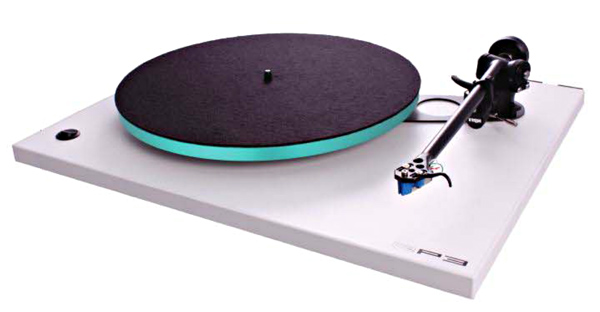
The last time I visited Rega, back in 1998, vinyl was struggling. The company was still manufacturing turntables and phono cartridges at its facility in Westcliff-on-Sea, in Essex, England, in an old mill that Rega founder Roy Gandy had converted in 1980 to a hi-fi factory and offices. But the real action was at Rega's new factory, down the road in Southend-on-Sea—an ultramodern standalone building where they made speakers, amplifiers, and CD players. As vinyl appeared to be dying a slow, painful death, it was reasonable to assume that Rega faced the unpleasant prospect of eventually having to shut down the Westcliff-on-Sea plant.
But as we all now know, an amazing thing happened. Vinyl has risen from the nearly mortal wounds it received from the one-two punch of first cassettes, then CDs. As repellent as I find CDs for so many reasons, I'm grateful to the format for running interference and preventing vinyl's humiliating death at the hands of the audio cassette.
When I spoke about Rega's new RP3 turntable with my old friend Phil Freeman, a 32-year Rega veteran and now the company's CEO (footnote 1), I asked him about turntable sales during vinyl's decline. He told me that the darkest year was 1991, when sales of turntables were down to 500 or 600 units a month. Sales picked up again in the 1990s, perhaps due to people buying one last new turntable out of fear that they soon wouldn't be able to. But by 2003, 'table sales were again way down.
Today Rega is enjoying by far the best rate of turntable sales in its almost 40-year history, selling more than 2500 a month worldwide—1000 more than I'd guessed. That's a lot of turntables from one company. You gotta love it.
Vinyl's return and the increase in turntable sales encouraged Gandy and Freeman to begin work three years ago on a cost-no-object turntable—as an exercise, with no urgency to bring it to market. What they learned in the process convinced them that they could produce a complete redesign of the P3-24 (see my review in the July 2008 Stereophile) that would significantly up its performance without greatly increasing its price.
A Farewell to Arm: Back in 1983, when everyone saw the laser writing on the pit walls and began backing away from turntables and tonearms, Rega did a crazy thing: rather than take a write-off on its five-year investment in designing a bespoke tonearm, they spent the next two years working with a casting company to finalize a one-piece tonearm of die-cast aluminum. The arm was unique in that the tube's wall thickness tapered and it went on to win an award for excellence in die-casting. More importantly, the diecast tube was incorporated in the RB300 and RB250, the most popular tonearms in the history of vinyl playback.
Now, almost 30 years after the introduction of the RB300 and RB250, Rega has come up with a brand-new tonearm, the RB303. This is also die-cast, but using a new tool created using state-of-the-art computer programming that mathematically calculates factors such as the distribution of mass to reduce and control resonances. While the new arm looks similar to the old one, a closer inspection reveals many changes: a different shape for the armtube; a new headshell, counterweight, and bearing assembly; and a reworked version of the RB301's three-point mount. In other words, it's a brand-new tonearm.
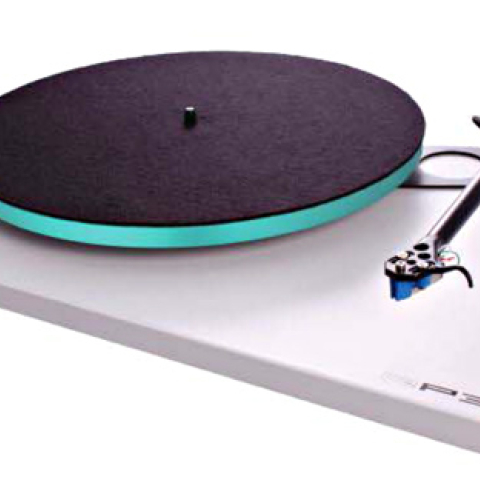
 Looks Can Be Deceiving: The RP3's plinth looks superficially the same as that Rega used in the original Planar 3, but it, too, is brand-new—it's actually the first fundamental change in Rega's plinth design in 30 years. It retains the old paradigm of a rigid, lightweight, energy-dissipating platform, but instead of being made of a composite material entirely coated with phenolic resin, the stiffening element in the new plinth is concentrated in a flat brace of superhard phenolic that couples the tonearm mount to the main hub platter/bearing assembly, both atop and below the plinth.
The new brace is a total of 4mm thick. The result is a far thicker and stiffer bracing material that concentrates stiffness where it produces the most benefit. The new design also reduces the plinth's mass, and the elimination of the phenolic coating allows Rega to improve the plinth's appearance by using furniture-grade finishes in gray, titanium, or white. Freeman told me that the redesign of the plinth has resulted in a 50–60% improvement in the sound.
The RP3's drive system is the same as the P3-24's: a high-quality 24V motor and dual-ganged pulley driven by a phase-angle trimmed internal electronic circuit. The elastomer-isolated motor is attached directly to the plinth. Via a dual ganged pulley of machined metal (which is an upgrade from a plastic one on the P3-24), the motor drives, via an O-ring, a molded hub attached to a steel shaft that's seated in a brass bearing sleeve and rides on a steel ball. Atop this hub is a glass platter fitted with a felt mat.
But despite all these upgrades, the price remains the same as the P3-24, at least in the US: $895 for the basic turntable and arm, or $1095 fitted with the Elys 2 MM cartridge (which saves you $95 on the purchase of an Elys 2, which costs $295 when bought separately). You can add a deluxe drive belt ($59), and Rega's TT PSU motor controller ($375), which adds pushbutton two-speed control. In addition to convenience, the TT PSU delivers, via quartz-synthesized 60Hz, a purer signal to the motor than does the standard wall-wart power supply, and moves the electronics from under the RP3 to a remote location.
So Rega has produced a brand-new turntable based on the proven design of its P3-24. There's a case to be made for high-mass turntables, but if you're going that way, you'd better make it really high mass, so that any unwanted vibrational energy "sinks," and what's left resonates at a very low frequency and dies out weakly and doesn't return to the stylus in the groove.
The opposite is true of low-mass designs: You'd better make the mass as minimal as possible, so unwanted vibrations are transmitted out of the system as quickly as possible at as high a frequency as possible. In short, Rega's new ultra-low-mass, stiffly braced plinth greatly improves on the original 30-year-old design with a lighter, stiffer platform. The only disadvantage of the low-mass approach is that, in the presence of wide-bandwidth speakers playing at high SPLs, the turntable is likely to sympathetically vibrate with the music. Therefore, where and on what you place the RP3 will likely affect its performance. And because the 'table sits on three nonadjustable rubber feet, it's critical to begin with a perfectly level platform.
Sonics: The review sample of the RP3 came with an Elys 2 cartridge already installed. First I listened to the 'table, with standard drive belt and Elys 2, to hear what $1095 buys these days. Graham Engineering's latest phono preamplifier, the Slee Reflex M ($1240), had recently arrived and had been breaking in, so I used that as well as Graham Slee's original Era Gold V phono preamp, which distributor LP Gear had let me hold on to as a reference (more about the Slee Reflex M in a future column).
First things first: Did the RP3's platter rotate at the correct speeds? I'm amazed how many turntable reviews gloss over this obvious basic question, especially when the model reviewed includes no way to adjust the speed.
I used the Dr. Feickert Analogue 7" test record and PlatterSpeed App for iPhone (footnote 2). With the standard belt and wall-wart power supply, the low speed varied from 33.43 to 33.52rpm, running mostly in the middle of that range. When the program's readout is red, it means the speed is off by at least 0.3%. It was almost always red: the RP3 ran at least 0.3% fast. The high speed varied from 44.96 to 45.02rpm mostly in the center of that range, and the readout was always green, which means that its range of deviation was less than 0.3%; ie, very close to perfect. With the optional belt and the wall wart, the speed ranges were 33.43–33.51rpm (mostly red) and 44.92–44.95rpm (mostly green). With standard belt and TT PSU: 33.37–33.54rpm (half red, half green) and 45.24–45.33rpm (red). With optional belt and TT PSU: 33.42–33.50rpm (mostly red) and 45.25–45.32rpm (always red).
In short, I got closest to 33.33rpm with the deluxe belt and the TT PSU, but closest to 45rpm with . . . [drumroll] the standard belt and wall wart—the only combo with which the speed stayed in the green the entire time! Still, your results might vary from mine. One of the things you pay extra for with more expensive gear is close-tolerance design and quality control. With a relatively inexpensive product such as this, there are sure to be greater variations in pulley size and belt diameter than with a more expensive one.
However, I still thought the TT PSU produced audible improvements, particularly in the loss of excessive etching in the upper-frequency transients. The power-supply upgrade didn't smooth over transients; it just tamed hyper-edgy ones. Roy Gandy says the improvement in sound provided by the TT PSU can't be quantified, and that the degree of improvement (or not) will depend on the quality of your electricity.
Regardless of which combo you use or end up with, the RP3's basic personality is similar to the P3-24's, with one easily noticed improvement (based on a rereading of my review of the P3-24): The RP3's bottom end was much tighter and better controlled. This removed a degree of warmth from the sound, but now I think the warmth was a coloration. The new 'table sounded leaner and cleaner.
 When a 45rpm reissue of Weather Report's Heavy Weather arrived (2 LPs, Columbia/ORG Music PC 34418), it went right on the RP3. I haven't played the original in way too many years, but I thought I knew Joe Zawinul's "Birdland" pretty well from hearing it often when it was first issued, in 1977. But I really did not know "Birdland"! This reissue produces an exceptionally wide stage with ear-popping three-dimensionality. It sounds as if the recording engineer and mixer were purposely manipulating certain elements in order to produce such vivid dimensionality. Instrumental separation was also pronounced. Maybe I'd have to play my original LP to see how much of this is a system improvement and how much of it is enhancements due to the remastering and pressing of this new edition and the higher speed. Whichever it was, the RP3, the Elys 2 cartridge, the RB303 arm, and the Graham Slee Reflex M phono preamp clearly communicated that separation. The RP3 was a nimble, metaphorically tight-sprung (it has no springs), fast-sounding turntable. By fast here I mean what sounds like a more rapid release of energy through the tonearm-turntable system. But with the wall wart supply, the RP3's platter is fast in the wrong way, rotating a bit too quickly.
Fast, clean, maybe a bit crystalline, with chameleon-like bass. I think the Rega combo—I'm not yet sure what's contributing what—was a little shy in the midbass, because it missed a bit of the warmth of even warm-sounding LPs. But in my opinion, that's preferable to excess warmth in this region.
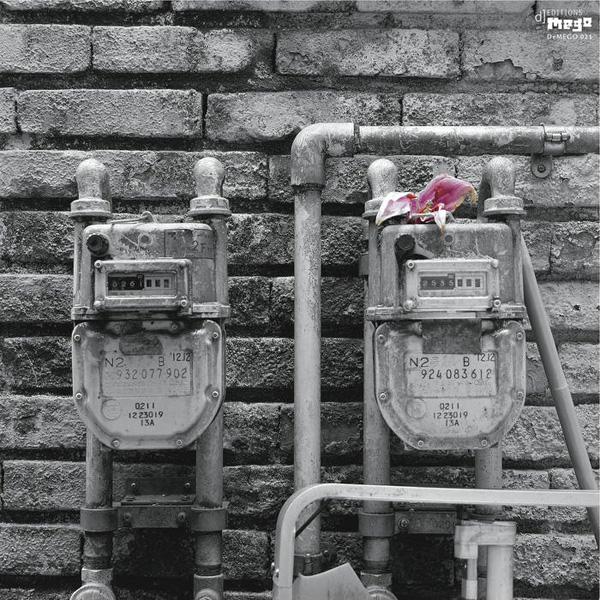 However, just when I'd concluded that the RP3 also lacked good low-frequency extension, I played a record containing deep bass that demonstrated that it didn't suffer from that lack. It won't be everyone's cup of musical swill, but Jim O'Rourke and Oren Ambarchi recorded an improvised set, playing guitar, synth, percussion, strings, last January in Tokyo, and issued the result, the Eno-esque Indeed (Editions Mego DeMEGO 021), on vinyl only. Its gurgling, erupting electronica sometimes goes very deep. The RP3 took a pass on a few of the midbass sections, but it came to life on the fundamental deep notes, delivering the sustained punch I expect only from more expensive 'tables. The RP3's bottom-end extension was clearly superior to the P3-24's, as I remember the latter.
Like the old RB300, the new RB303 tonearm can handle just about any moving-coil or moving-magnet cartridge you install in it, though because you can't adjust the vertical tracking angle or stylus rake angle without the use of shims, I'd advise against a cartridge with a Shibata or other severe stylus geometry—unless you know that its height, when installed in the RB303, puts the stylus contact area at an angle of at least 90°, and preferably 92°, to the record surface.
I installed a Lyra Helikon SL cartridge and set the Soundsmith MCP2 phono preamplifier's variable loading pot to 500 ohms. I'll take Peter Lederman's word that my negative reaction in the October issue to the MMP3, the moving-magnet version (identical innards, minus the MCP2's step-up transformers) resulted from its interaction with the Shure V15VxMR cartridge; driving the MCP2, the Helikon SL sounded quite dynamic and well fleshed out overall.
 Through this combo I listened to Mobile Fidelity Sound Lab's excellent reissue of The Concert Sinatra (LP, Reprise/MFSL 1-345), recorded with a large orchestra on 35mm tape in the cavernous Goldwyn soundstage. It's the kind of recording that can confuse a turntable incapable of dealing with its warm acoustic and slightly distant miking, yet the RP3 did a great job of sorting it all out, particularly with the Helikon SL: Sinatra in three dimensions was forward at center stage, the orchestra spread well behind him, and a suggestion of the acoustic behind it—all as it should have sounded through a more expensive combination, and a pleasant surprise from the Rega.
The better the cartridge, the better the RP3 will sound. Of course, the Helikon produced a far more sophisticated, detailed, and nuanced spread than the Elys 2, but it costs more than twice the price of the RP3, RB303, and Elys 2 together!
I suggest buying the TT PSU only if you can return it for a refund, should it produce no audible improvement. Rega also offers a thicker, 18mm glass platter/subplatter option that I didn't get to try. I'd upgrade my cartridge before I spent anything on any of the other options.
Bottom line: Using modern design techniques and better materials, Rega has considerably upgraded the sonic performance of one of its classic designs, and—because they've managed to do so without raising the price—its value as well. For $1095, the RP3–RB303–Elys 2 combo is a plug'n'play package that's beautifully built, well engineered, and sounds wonderful. It's easy to recommend—and I do!
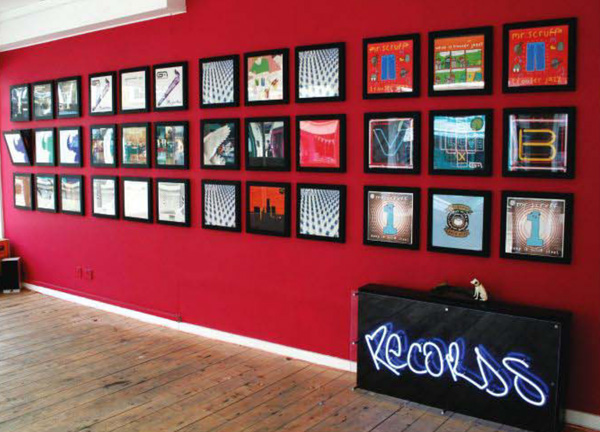
One of the benefits of being a vinyl fanatic is decent-sized album art—and no, kids aren't getting into vinyl just for the "ritual." It's the sound that has them hooked. That's what they tell me. But there's so much cool album art that we tend to forget other than on two occasions: when we pull a record out to play it, and when we move house and they all come out to get packed in boxes. When you see only the spines, you forget the faces. (Kind of like dating in the 1970s.) Wall frames for LPs have appeared now and then over the years, but none I've seen has been as well designed and attractive as the Play & Display Flip Frame from Art Vinyl, Ltd., a UK company whose products are now distributed in the US (footnote 3). I met a public-relations representative of Art Vinyl at a turntable-setup seminar I did at New York's Stereo Exchange last spring, and she was kind enough to send me a few Flip Frames to try.
The attractive, well-made Flip Frames can be bought singly ($53) or in a Triplepack ($139). They're made of heavy-gauge plastic with a black or white matte finish and a clear Plexiglas window. The frame is hinged along one edge to ease the switching out of album covers—you can quickly rotate your favorites without removing the frame from the wall. The Play & Display Flip Frame makes a nice addition to any man cave, and a great Christmas gift for you from your significant other.
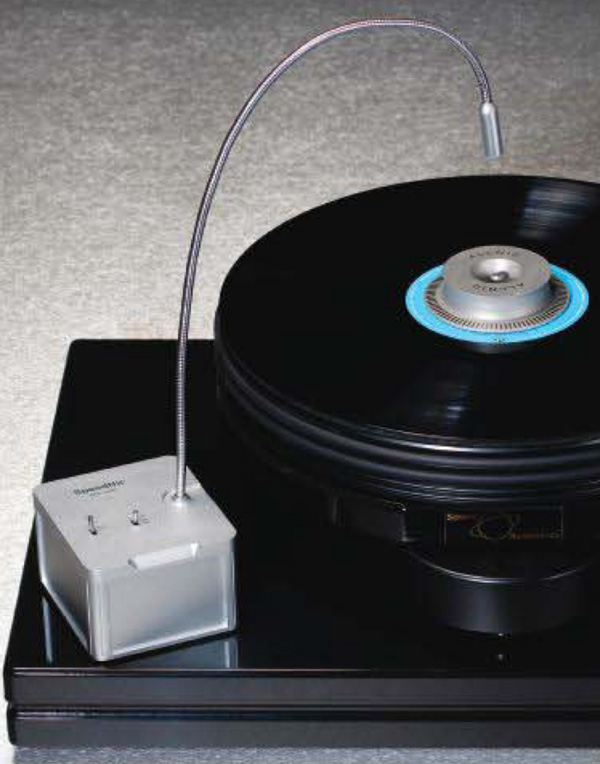 Allnic Audio SpeedNic turntable speed checker
Here's another cool Yule gift: The Allnic Audio SpeedNic ($349, footnote 4) is a strobing platter-speed checker (33.33, 45, 78rpm) that uses a gooseneck LED lamp on an attractive aluminum base in silver or anodized black, which also holds the three C batteries. The strobe pattern is etched into a metal disc that doubles as a record weight. Put the disc on the spindle, turn on the SpeedNic, choose the speed to be checked, and adjust the platter's speed until the strobe marks don't move. It works as advertised. However, technology marches on—you can download to your iPhone or Android device Dr. Feickert Analogue's free PlatterSpeed speed-check software, which in real time gives you the precise speed (33.33 or 45rpm), accurate to three decimal points. However, it requires a test LP with a 3150Hz tone. (Feickert makes one, pressed on 7" vinyl.) One thing about the Allnic SpeedNic, though: It works better as a gift wrapped in a box and placed under the tree than does an app on a phone—and it includes a record weight!
Sidebar: In Heavy Rotation 1) Dengue Fever, Cannibal Courtship, Fantasy LP 2) Petteri Iivonen, Art of the Violin, Yarlung 180gm LP 3) Nina Simone, At Carnegie Hall, Colpix/Pure Pleasure LP 4) John Mayall's Blues Breakers, With Eric Clapton, London/Sundazed 180gm mono LP 5) This Mortal Coil, It'll End in Tears, 4AD/ORG Music 180gm LP 6) Buddy Miller, The Majestic Silver Strings, New West 180gm LPs (2) 7) The Band, Stage Fright, Capitol/Mobile Fidelity Sound Lab 180gm LP 8) Ray Charles and Betty Carter, Ray Charles and Betty Carter, ABC Paramount/Analogue Productions 180gm LP 9) George Thorogood and the Destroyers, 2120 South Michigan Ave., Capitol LP 10) The New Elvin Jones Trio, Puttin' It Together, Blue Note/Music Matters 45rpm 180gm LPs (2)
Footnote 1: Rega Research, Ltd., 6 Coopers Way, Temple Farm Industrial Estate, Southend-on-Sea, Essex SS2 5TE, England, UK. Web: www.rega.co.uk. US distributor:, The Sound Organisation, 1009 Oakmead Drive, Arlington, TX 76011. Tel: (972) 234-0182. Web: www.soundorg.com. Footnote 2: Dr. Feickert Analogue, Stegenbachstrasse 25b 79232 March-Buchheim, Germany. Tel: +49 7665 9413718. Web: www.feickert.de. US distributor: Avatar Acoustics, Fayetteville, GA 30215. (2011); MoFi Distribution (2026). Web: www.mofidistribution.com.
Footnote 3: Art Vinyl Ltd., Memory Box UK Ltd, A4 Barnfield Road, Folkestone, CT19 5SG, England, UK. Tel: (44) (0)207-241-4129. Web: www.artvinyl.com.
Footnote 4: Allnic Audio Labs, 1105 Sicox Tower, 513–14, Sangdaewon 1dong, Jungwon-gu, Songnam-City Kyunngi-do 462-806, Korea. Tel: (82) 31-777-9447, (82) 70-8708-4468. Fax: (82) 31-777-9448. Web: www.allnicaudio.com. North American distributor: Hammertone Audio, Canada (2011); Kevalin Audio (2026), 7275 NE Avalon Drive Corvallis, Oregon, 97330. Tel: (503) 292-5592. Email: info@kevalinaudio.com. Web: kevalinaudio.com.
Looks Can Be Deceiving: The RP3's plinth looks superficially the same as that Rega used in the original Planar 3, but it, too, is brand-new—it's actually the first fundamental change in Rega's plinth design in 30 years. It retains the old paradigm of a rigid, lightweight, energy-dissipating platform, but instead of being made of a composite material entirely coated with phenolic resin, the stiffening element in the new plinth is concentrated in a flat brace of superhard phenolic that couples the tonearm mount to the main hub platter/bearing assembly, both atop and below the plinth.
The new brace is a total of 4mm thick. The result is a far thicker and stiffer bracing material that concentrates stiffness where it produces the most benefit. The new design also reduces the plinth's mass, and the elimination of the phenolic coating allows Rega to improve the plinth's appearance by using furniture-grade finishes in gray, titanium, or white. Freeman told me that the redesign of the plinth has resulted in a 50–60% improvement in the sound.
When a 45rpm reissue of Weather Report's Heavy Weather arrived (2 LPs, Columbia/ORG Music PC 34418), it went right on the RP3. I haven't played the original in way too many years, but I thought I knew Joe Zawinul's "Birdland" pretty well from hearing it often when it was first issued, in 1977. But I really did not know "Birdland"! This reissue produces an exceptionally wide stage with ear-popping three-dimensionality. It sounds as if the recording engineer and mixer were purposely manipulating certain elements in order to produce such vivid dimensionality. Instrumental separation was also pronounced. Maybe I'd have to play my original LP to see how much of this is a system improvement and how much of it is enhancements due to the remastering and pressing of this new edition and the higher speed. Whichever it was, the RP3, the Elys 2 cartridge, the RB303 arm, and the Graham Slee Reflex M phono preamp clearly communicated that separation. The RP3 was a nimble, metaphorically tight-sprung (it has no springs), fast-sounding turntable. By fast here I mean what sounds like a more rapid release of energy through the tonearm-turntable system. But with the wall wart supply, the RP3's platter is fast in the wrong way, rotating a bit too quickly.
Fast, clean, maybe a bit crystalline, with chameleon-like bass. I think the Rega combo—I'm not yet sure what's contributing what—was a little shy in the midbass, because it missed a bit of the warmth of even warm-sounding LPs. But in my opinion, that's preferable to excess warmth in this region.
However, just when I'd concluded that the RP3 also lacked good low-frequency extension, I played a record containing deep bass that demonstrated that it didn't suffer from that lack. It won't be everyone's cup of musical swill, but Jim O'Rourke and Oren Ambarchi recorded an improvised set, playing guitar, synth, percussion, strings, last January in Tokyo, and issued the result, the Eno-esque Indeed (Editions Mego DeMEGO 021), on vinyl only. Its gurgling, erupting electronica sometimes goes very deep. The RP3 took a pass on a few of the midbass sections, but it came to life on the fundamental deep notes, delivering the sustained punch I expect only from more expensive 'tables. The RP3's bottom-end extension was clearly superior to the P3-24's, as I remember the latter.
Like the old RB300, the new RB303 tonearm can handle just about any moving-coil or moving-magnet cartridge you install in it, though because you can't adjust the vertical tracking angle or stylus rake angle without the use of shims, I'd advise against a cartridge with a Shibata or other severe stylus geometry—unless you know that its height, when installed in the RB303, puts the stylus contact area at an angle of at least 90°, and preferably 92°, to the record surface.
I installed a Lyra Helikon SL cartridge and set the Soundsmith MCP2 phono preamplifier's variable loading pot to 500 ohms. I'll take Peter Lederman's word that my negative reaction in the October issue to the MMP3, the moving-magnet version (identical innards, minus the MCP2's step-up transformers) resulted from its interaction with the Shure V15VxMR cartridge; driving the MCP2, the Helikon SL sounded quite dynamic and well fleshed out overall.
Through this combo I listened to Mobile Fidelity Sound Lab's excellent reissue of The Concert Sinatra (LP, Reprise/MFSL 1-345), recorded with a large orchestra on 35mm tape in the cavernous Goldwyn soundstage. It's the kind of recording that can confuse a turntable incapable of dealing with its warm acoustic and slightly distant miking, yet the RP3 did a great job of sorting it all out, particularly with the Helikon SL: Sinatra in three dimensions was forward at center stage, the orchestra spread well behind him, and a suggestion of the acoustic behind it—all as it should have sounded through a more expensive combination, and a pleasant surprise from the Rega.
The better the cartridge, the better the RP3 will sound. Of course, the Helikon produced a far more sophisticated, detailed, and nuanced spread than the Elys 2, but it costs more than twice the price of the RP3, RB303, and Elys 2 together!
I suggest buying the TT PSU only if you can return it for a refund, should it produce no audible improvement. Rega also offers a thicker, 18mm glass platter/subplatter option that I didn't get to try. I'd upgrade my cartridge before I spent anything on any of the other options.
Art Vinyl's Play & Display Flip Frames make a nice addition to any man cave.
Art Vinyl's Play & Display Flip FrameOne of the benefits of being a vinyl fanatic is decent-sized album art—and no, kids aren't getting into vinyl just for the "ritual." It's the sound that has them hooked. That's what they tell me. But there's so much cool album art that we tend to forget other than on two occasions: when we pull a record out to play it, and when we move house and they all come out to get packed in boxes. When you see only the spines, you forget the faces. (Kind of like dating in the 1970s.) Wall frames for LPs have appeared now and then over the years, but none I've seen has been as well designed and attractive as the Play & Display Flip Frame from Art Vinyl, Ltd., a UK company whose products are now distributed in the US (footnote 3). I met a public-relations representative of Art Vinyl at a turntable-setup seminar I did at New York's Stereo Exchange last spring, and she was kind enough to send me a few Flip Frames to try.
Allnic Audio SpeedNic turntable speed checkerHere's another cool Yule gift: The Allnic Audio SpeedNic ($349, footnote 4) is a strobing platter-speed checker (33.33, 45, 78rpm) that uses a gooseneck LED lamp on an attractive aluminum base in silver or anodized black, which also holds the three C batteries. The strobe pattern is etched into a metal disc that doubles as a record weight. Put the disc on the spindle, turn on the SpeedNic, choose the speed to be checked, and adjust the platter's speed until the strobe marks don't move. It works as advertised. However, technology marches on—you can download to your iPhone or Android device Dr. Feickert Analogue's free PlatterSpeed speed-check software, which in real time gives you the precise speed (33.33 or 45rpm), accurate to three decimal points. However, it requires a test LP with a 3150Hz tone. (Feickert makes one, pressed on 7" vinyl.) One thing about the Allnic SpeedNic, though: It works better as a gift wrapped in a box and placed under the tree than does an app on a phone—and it includes a record weight!
Sidebar: In Heavy Rotation 1) Dengue Fever, Cannibal Courtship, Fantasy LP 2) Petteri Iivonen, Art of the Violin, Yarlung 180gm LP 3) Nina Simone, At Carnegie Hall, Colpix/Pure Pleasure LP 4) John Mayall's Blues Breakers, With Eric Clapton, London/Sundazed 180gm mono LP 5) This Mortal Coil, It'll End in Tears, 4AD/ORG Music 180gm LP 6) Buddy Miller, The Majestic Silver Strings, New West 180gm LPs (2) 7) The Band, Stage Fright, Capitol/Mobile Fidelity Sound Lab 180gm LP 8) Ray Charles and Betty Carter, Ray Charles and Betty Carter, ABC Paramount/Analogue Productions 180gm LP 9) George Thorogood and the Destroyers, 2120 South Michigan Ave., Capitol LP 10) The New Elvin Jones Trio, Puttin' It Together, Blue Note/Music Matters 45rpm 180gm LPs (2)
Footnote 1: Rega Research, Ltd., 6 Coopers Way, Temple Farm Industrial Estate, Southend-on-Sea, Essex SS2 5TE, England, UK. Web: www.rega.co.uk. US distributor:, The Sound Organisation, 1009 Oakmead Drive, Arlington, TX 76011. Tel: (972) 234-0182. Web: www.soundorg.com. Footnote 2: Dr. Feickert Analogue, Stegenbachstrasse 25b 79232 March-Buchheim, Germany. Tel: +49 7665 9413718. Web: www.feickert.de. US distributor: Avatar Acoustics, Fayetteville, GA 30215. (2011); MoFi Distribution (2026). Web: www.mofidistribution.com.