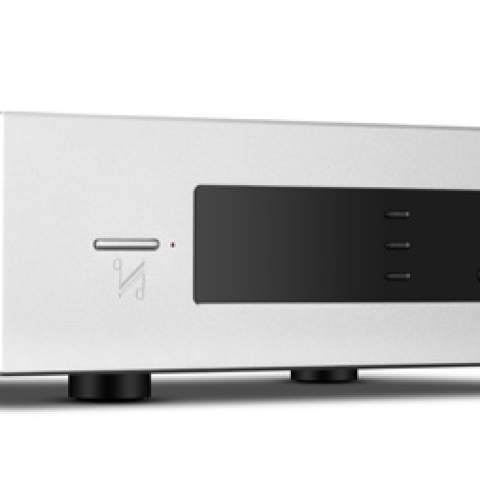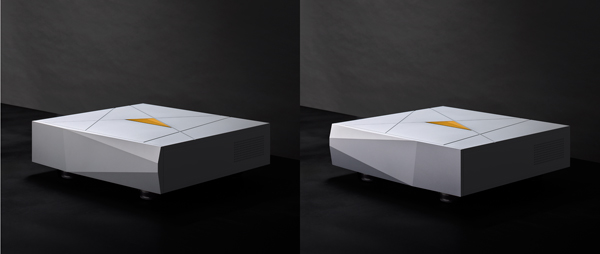
This is a most unusual review: two premium products reviewed as a set. It was intended as a short review, but the Innuos NazaréNET ($32,000) and NazaréFLOW ($32,000 base price + optional custom DAC output module) require lengthy explanations.
Although both the NazaréNET and NazaréFLOW, which I will refer to as the NET and FLOW, were designed to pair with the flagship Innuos Nazaré music streamer-server ($61,000), which I have already reviewed, they can work with any music streamer-server and DAC with a USB audio input. Given their prices, I expect they will only be used with top-line products. Owners of lower-priced music streamer-servers will likely gravitate toward either the Next-Gen NET ($15,200) and Next-Gen FLOW ($15,200 + optional $4900 DAC-specific output module), NET3 network switch ($7600), or the "entry-level" NET1 network switch ($2100 or $1680 if bundled with STREAM1). Innuos offers the NET1 as the replacement for the discontinued PhoenixNET network switch, which I have used in my system for several years.
As I mentioned to Nuno Vitorino, Innuos cofounder and director of research and development, at the start of a long WhatsApp chat, the $125,000 minimum combined price of the Nazaré, NazaréNET, and NazaréFLOW may make it the most expensive music streamer-server package on the planet. If you mate the Nazaré/NazaréNET/NazaréFLOW with a top multibox DAC system from CH Precision, dCS, MSB, or WADAX (to name but four), the price of your digital front end + premium cabling + equipment supports + power treatment is best not contemplated by anyone who suffers from vertigo.
There is also the issue of space. In my case, even without a disc transport, the Nazaré/NazaréNET/NazaréFLOW and dCS Varèse music system together occupied eight shelves on my Grand Prix double rack. That's a lot of real estate.
I can think of three reasons to make such a purchase: sound quality, obsession, and status. I, who just replaced my '94 Toyota Corolla DX with a 2008 Honda Fit, am not qualified to speak to the latter. But as one who has been obsessed with the quality and veracity of sonic reproduction since the operatic voices on my father's acoustic 78s resonated in my mother's womb, I have some thoughts to share.
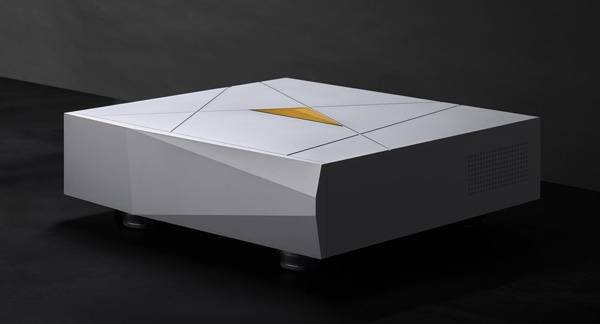
Before I interviewed Vitorino, he shared a 16-page white paper on the three Innuos Nazaré flagship products. In that paper, Vitorino states, "The highest level of digital audio performance can only be achieved by addressing every pillar of the system together, with the same engineering standard and ultrahigh-grade components applied throughout. ... The Nazaré processor is built on a custom mainboard with dedicated boards and clocks for the connections that matter most. The NazaréNET removes the network as a source of noise, with isolation strategies that go far beyond what general purpose equipment can offer." It does those things by very quietly regenerating the internet signal and correcting for the usual router limitations with better timing and power, less noise, and more precision.
"The NazaréFLOW takes the digital signal into a clean room of its own, regenerated by a single master clock and delivered to the DAC through a connection engineered specifically for it," the paper continues. "Behind all of them sits a power architecture organized around a single principle—minimizing impedance to extreme levels—and a chassis engineered to keep the electronics inside operating in a mechanically and electromagnetically quiet environment." To summarize, the NET specifically addresses electrical noise and other factors on the network that may degrade the audio signal before it reaches the server, and the FLOW ensures that the signal arrives at the DAC as clean and well-timed as Innuos's technology allows. Both regenerate the signal. Innuos strives to achieve a stable electronic and sonic environment by paying special attention to its products' power supplies and their chassis' abilities to manage electromagnetic interference (EMI), heat, and mechanical vibration.
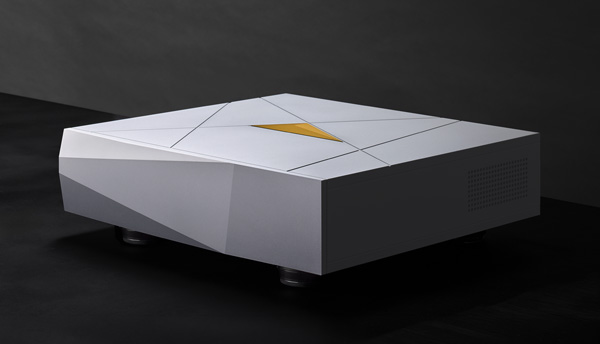
Innuos recommends what I use—a fiber connection to the NET—because it breaks "all electrical continuity between the wider home network and the audio system, severing ground loops and EMI from the router at the point of entry." The NET includes a Finisar SFP module that operates over single-mode fiber at 1310nm. Innuos prefers single-mode fiber "because it carries light along a single, tightly controlled path, eliminating the signal dispersion that requires further processing at the receiver." Because I was using a multimode SFP module from another company, Innuos's recommendation initiated a process of re-evaluation and comparison that I discuss below.
The NET's SFP fiber port can alternatively serve as a dedicated clean output to a music streamer-server with its own fiber input. My server, the Nazaré, does not include an SFP input.
The NET runs custom firmware designed for minimum noise and traffic isolation. "Once initialization is complete," it claims, "the onboard microprocessor is shut down entirely, placing the switch into a permanent ultra-low-noise mode. From this point on, no unnecessary active components are generating electrical noise while listening—the switch simply does its job and gets out of the way." As if anything were simple.
The FLOW contains a master reclocker designed to address the accumulation of phase noise that affects the signal to the DAC, a similar power supply to the NET's, and, where available, a dedicated DAC output module to match the DAC precisely (footnote 1). "The clock is the same high-end 3ppb OCXO oscillator used on the PreciseNET and PreciseUSB boards in the Nazaré, with its own dedicated power rail to ensure it operates in the cleanest possible electrical environment." With the module, if and when it is available for your DAC, the FLOW becomes what Innuos calls the streamer-server's "final, decisive voice, ... a space where the signal can be regenerated and delivered without the noise inherent in any computing environment, no matter how well engineered."
Both the NET and FLOW use SmartStack technology, "a high-performance vibration dampening system applied in collaboration with TONEO, a division of Meneta dedicated to audio applications. SmartStack is a composite material originally developed for braking systems in Formula 1 ... [that] uses very thin alternating layers of metal and rubber in a sandwich construction that absorbs medium- and high-frequency vibration and dissipates it as small amounts of heat. A switch has a lot of magnets in it that, if allowed to vibrate at high frequencies, generate parasitic currents that create noise. By reducing those vibrations, the NET and FLOW generate far less signal-degrading noise."
During our conversation, Vitorino acknowledged the difficulty some people have understanding what the FLOW does. "The FLOW cleans up the signal before it goes to the DAC, and it eliminates the need for the DAC to perform further conversions," he said. "The objective is to use the most direct protocol possible to perform conversions. The FLOW does the hard work so that the DAC can focus on digital-to-analog conversion."
For your information: The discontinued entry-level PhoenixNET used two power rails rather than four: one for the OCXO clock and one for the rest of the board. The new products are far more complex, with much higher-quality rails, resistors, and regulators. They also have much bigger capacitor banks, and they include TONEO material throughout to damp vibration.
 USB vs Ethernet
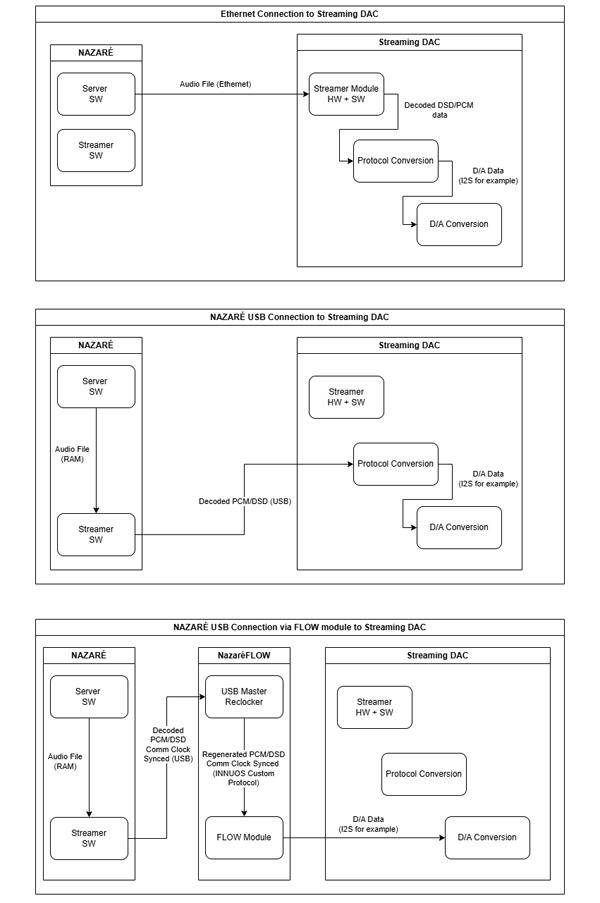
Ever since I began praising the sound of Innuos music streamer-servers at shows, and then using them with dCS DACs, some readers and audiophile friends have questioned why, when Innuos servers use their own software, Innuos sends information to DACs via USB rather than Ethernet (footnote 2). When I first presented the question to Vitorino, he sent a long reply. First, he noted that the process of playing a digital audio file consists of four steps: 1) reading the file, 2) decoding the file's PCM or DSD data before sending it to the DAC, 3) receiving the decoded 4) once that digital information reaches the DAC, converting the digital signal to an analog signal.
Normally, this process requires three components: 1) a streamer that can read and decode the digital audio file, 2) a module that receives the PCM or DSD data and converts it to I2S or another format that the DAC can decipher, and 3) a DAC that performs the digital-to-analog conversion. Many DACs with streaming capability use their own apps to control their internal streaming board, which, in turn, streams and retrieves files. dCS DACs, for example, use either dCS Mosaic or dCS Mosaic ACTUS to control streaming and retrieve files from USB sticks or other external devices.
"When you use a USB connection (or AES, coaxial, or optical for that matter), the DAC receives already-decoded PCM/DSD data," Vitorino wrote. "It then bypasses the DAC's internal audio player as it sends the decoded data, first, to the module that converts to I2S or other format, and then to the DAC. Innuos replaces the DAC's internal audio player with our external streamer. This matters because the cleanliness and timing of the digital signal make a lot of difference in the final sound. It's about finesse. Not only do you get a cleaner signal from our server-streamer, but you also eliminate the need for an additional digital component inside the DAC that may introduce its own noise and EMI pollution and negatively affect performance.
"USB is a much simpler protocol than Ethernet. USB involves serial communication with a single twisted pair of cables, whereas Ethernet requires four twisted pairs in parallel and a lot more processing and protocol layers to ensure error-free communication. USB sends fully decoded audio packets; Ethernet sends files that need to be decoded, read, and interpreted by the streaming DAC before they are sent on for digital-to-analog conversion.
"Our view is that the simplest approach—one that produces less operating noise—is better. While Ethernet is particularly good for higher speeds (1Gbps and above) at longer distances, audio doesn't require those speeds or distance. Transmitting a stereo 32/768 file requires around 49Mbps; USB 2.0 transmits at 480Mbps.
"Both USB and Ethernet benefit from reclocking performed by an audiophile switch that receives a signal and regenerates it using cleaner power. Both also benefit from simpler and less noisy chips and more precise clocks. In the context of a Nazaré stack, the job of the NazaréNET is to regenerate the input network signal to the Nazaré so there is a cleaner, better-timed signal, with less noise, entering the Nazaré. "The FLOW is more than a great USB reclocker. It also receives PCM or DSD data and converts to a format that best suits the DAC. That means we can offload that work from the DAC and relegate it to a separate chassis with dedicated power supplies, vibration dampening, and EMI protection."
In a follow-up email, Vitorino wrote, "Comparing USB to Ethernet is like comparing apples to oranges. It's not a matter of us preferring USB to Ethernet. If a user wants to connect via Ethernet, they will connect, not to the DAC itself, but rather to the streamer integrated within the DAC. In that case, they are using the Nazaré as a server only; they've chosen to use the DAC as the streamer rather than the Nazaré."
Vitorino also noted that both the software and hardware make a big difference. "When you use the Nazaré as a streamer, the overall signal quality is also determined by the hardware where the decoding software runs. The power supplies, vibration/EMI treatment, OCXO clocking, processor configuration, and more have a huge effect on how good the signal is.
"When you use the streamer board on the DAC, you have to take into account the hardware implementation where that software runs. As an example, if we ran our player software directly on the streamer hardware from a streaming DAC, it would still not sound the same as the Nazaré." (For more information, see the flow charts in "Parsing the improvements" on the next page).
Footnote 1: At press time, Innuos marketed FLOW output modules for MSB and CH Precision's proprietary links, and was finalizing pricing for EMM Labs links and DACs with IS inputs.
Footnote 2: When you use an Innuos streamer-server such as the Nazaré to run a UPnP server, you can use your DAC's streaming software to play music via Ethernet. As an example, the Nazareé, running a UPnP server, can use dCS's Mosaic ACTUS app to play music via Ethernet to the dCS Varèse.
The Innuos NazaréFLOW
What are they?Before I interviewed Vitorino, he shared a 16-page white paper on the three Innuos Nazaré flagship products. In that paper, Vitorino states, "The highest level of digital audio performance can only be achieved by addressing every pillar of the system together, with the same engineering standard and ultrahigh-grade components applied throughout. ... The Nazaré processor is built on a custom mainboard with dedicated boards and clocks for the connections that matter most. The NazaréNET removes the network as a source of noise, with isolation strategies that go far beyond what general purpose equipment can offer." It does those things by very quietly regenerating the internet signal and correcting for the usual router limitations with better timing and power, less noise, and more precision.
The Innuos NazaréNET
The NET's WaveNET board, with its single SFP input and four RJ45 inputs, contains GaN-ARC8 (custom-designed gallium nitride–based active rectification) modules developed in collaboration with Dr. Sean Jacobs. These modules are said to reduce noise during AC/DC conversion. Innuos claims "an exceptionally large energy reservoir of 376,000µF of total capacitance per module, which acts as a low-impedance current source." There are four "entirely separate, independently regulated power rails, one for each critical function of the board."
Both NET and FLOW contain custom-wound, impedance-reducing high-precision multifilar toroidal transformers whose multiple parallel secondaries are of exactly the same length. The transformers are paired with custom-made Lundahl inductors. Innuos says that its 25MHz OCXO clock, which has its own dedicated power rail and "complete isolation from the rest of the board," is more than 10,000 times more stable than oscillators "typically found" in network switches, and that its position very close to the switch chip eliminates the PLL conversion losses and jitter induced by external signal paths.
USB vs EthernetEver since I began praising the sound of Innuos music streamer-servers at shows, and then using them with dCS DACs, some readers and audiophile friends have questioned why, when Innuos servers use their own software, Innuos sends information to DACs via USB rather than Ethernet (footnote 2). When I first presented the question to Vitorino, he sent a long reply. First, he noted that the process of playing a digital audio file consists of four steps: 1) reading the file, 2) decoding the file's PCM or DSD data before sending it to the DAC, 3) receiving the decoded 4) once that digital information reaches the DAC, converting the digital signal to an analog signal.
Footnote 1: At press time, Innuos marketed FLOW output modules for MSB and CH Precision's proprietary links, and was finalizing pricing for EMM Labs links and DACs with I