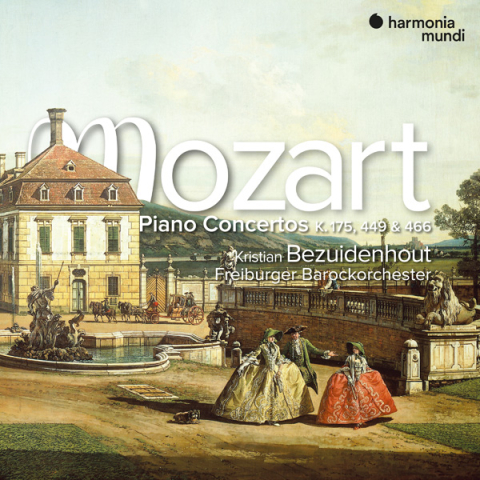

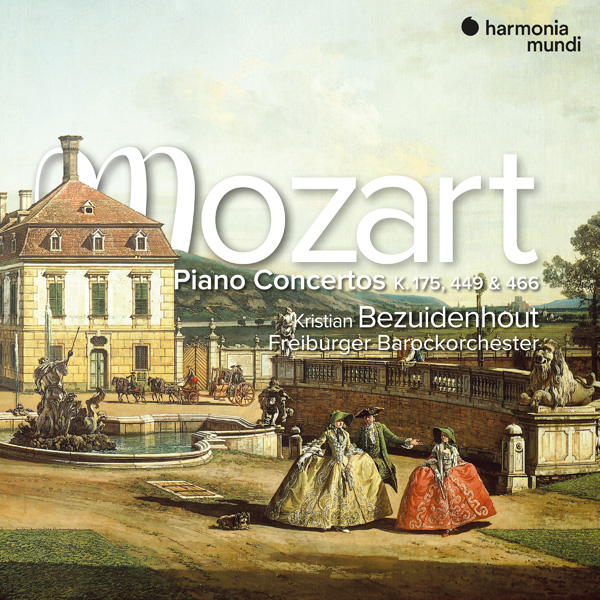
Mozart: Piano Concertos K.175, 449 & 466
Kristian Bezuidenhout, Freiburger Barockorchester
Harmonia Mundi HMM 902759 (auditioned as 24/96 pre-release WAV files). 2026. Martin Sauer, prod.; Julian Schwenkner, eng.
Performance ****½
Sonics ****½ A happy welcome to another winning installment in early music specialist Kristian Bezuidenhout's series of Mozart Piano Concertos with Freiburger Barockorchester. Here, Bezuidenhout moves back in time, from two concertos composed in Mozart's maturity—Piano Concerto 20 (K.466), written in his 29th year, and Concerto 14 (K.449), composed one year earlier—to Concerto 5 (K.175), composed when Mozart was just 17. These are very different works. Despite the sound of authentic late–18th century timpani, whose impact is dwarfed by its modern counterpart, K.466 may knock you for a loop with its unusually dramatic opening and grave exposition. A major test for a keyboardist—Bezuidenhout plays a copy of Walter & Sohn fortepiano (ca. 1805)—K.466's opening requires an artist to sound effortless while negotiating an astounding number of notes. The middle movement begins in a lovely, elegant manner, only to surprise with startling outbursts followed by a tender and delicate close. The final movement is a mile-a-minute romp up and down the keyboard destined to leave listeners cheering.
K.449 begins on a formal note, with a second movement almost regal in its stately beauty; at times it resembles a processional. Pardon me for waxing ecstatic, but I fell in love with this music. The final movement is another dramatic tour de force. K.175, by contrast, is a youthful delight.
An unusual aspect of Bezuidenhout's performances is that rather than relying on his own improvisational skills in K.466, he uses cadenzas and the shorter Eingänge Robert D. Levin improvised in his recording with Hogwood in 1997, and in K.175, a third-movement cadenza Malcolm Bilson recorded in 1987 with John Eliot Gardiner. It sounds fabulous.—Jason Victor Serinus
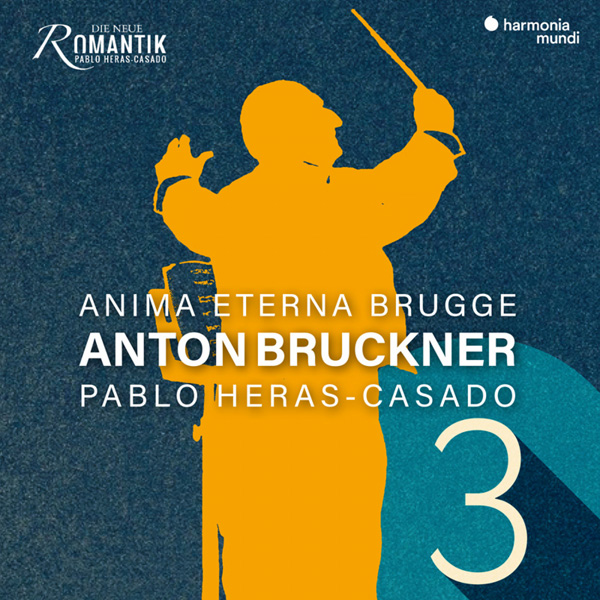 Bruckner: Symphony 3 (Novak ed., 1873)
Anima Eterna Brugge/Pablo Heras-Casado
Harmonia Mundi HMM 902760 (CD). 2026. Hans Vercauteren, prod.; Steven Maes, eng.
Performance **½
Sonics ***
Anima Eterna, which began life as a Baroque orchestra, has gradually expanded stylistically and numerically, as it must to take on later repertoire. In Bruckner, this mostly means fewer strings than usual and playing on gut strings. The booklet identifies the makers of the wind instruments.
Pablo Heras-Casado seems to have adopted a period-practice approach to tempi. The unusually swift start is effective, though you might miss the typical grounding and gravitas. The string tone isn't quite warm or full enough in the sensitively phrased second theme. Its recap, however, is joyful and optimistic. The Adagio's opening chorale, too, needs more solemnity; it flows too easily. The second theme's scansion isn't clear until the brass take it over. Both these movements end abruptly and inconclusively. Only the Scherzo, maintaining a common pulse through both themes and the Trio, is basically normal.
The quicker pacing does bring benefits. The first-movement development, now conventionally agitated, at least holds interest. And, in the Finale, the flatfooted octave syncopations, which usually get stuck in the mud, breeze by. But we lose other things along the way. The score's pastoral elements, especially, get shortchanged: The finale's second subject, while graceful, isn't bucolic. Finally, the aspect of the orchestration mimicking organ stop changes is pretty much lost. Even spatially, the instruments and groups aren't strongly differentiated. In the Finale, for example, the brass choir's entry under the initial scurrying barely registers as a discrete element.
The engineering contributes to that washy impression, offering truthful timbres but "flat" perspectives. Tuttis are constrained and sometimes congested, while lighter textures lack a sense of space and air.—Stephen Francis Vasta
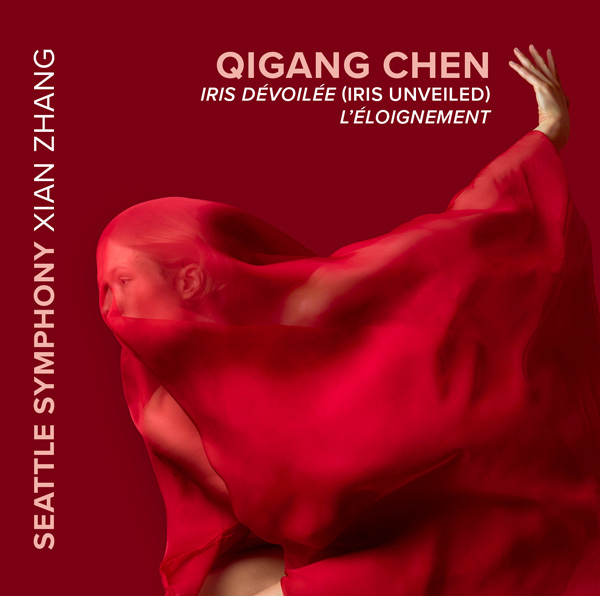 Qigang Chen: Iris Dévoilée, L'Éloignement
Seattle Symphony/Xian Zhang
Seattle Symphony Media SSM1029 (auditioned as 24/96 prerelease WAV files). 2026. Dmitriy Lipay, prod.; Alexander & Dmitriy Lipay, engs.
Performance ****½
Sonics ****½ Oddities, perhaps, but two of the more colorful oddities of their kind. Both are composed by Olivier Messiaen's final pupil, Qigang Chen (born Chen Qigang), a survivor of China's Cultural Revolution who underwent three years of "re-education" before emigrating to France in 1984 and living with Messiaen during his studies.
The recording's main work, Iris Dévoilée (Iris Unveiled), assumes a man can describe "the universal feminine." Men have long made female characters according to their image of women's nature, which they imposed via cultural norms and personal expectations. None of which makes this any less musically compelling.
The most attention-getting aspect of Iris Dévoilée is the contrast between the high-pitched vocalism of the astounding Chinese operatic soprano Meng Meng and the recording's two other sopranos, Tess Altiveros and Mei Gui Zhang. Just as fascinating is Chen's orchestral blend of modern Western symphonic instruments and the ancient sounds of Yang Jin's pipa, Cathy Yang's erhu, and Lucina Yue's zheng. Add in Seattle Symphony's new music director, Xian Zhang, and you have a true multicultural blend. I loved the luminous beginning of the fourth movement, "Sensible," with passages resembling a meeting between Debussy's Daphnis et Chloé and a mature Richard Strauss. Other movements are variously tender, mysterious, explosive, and, in their color and timbral distinctiveness, audiophile-approved.
Chen's L'Éloignement attempts to encapsulate the loss and gain some people experience when they uproot themselves and relocate to strange and different environs. Built around a peasant song, "Going beyond the western gorges," its moods fluctuate between sadness and ever-changing buzzing energy. Great stuff.—Jason Victor Serinus
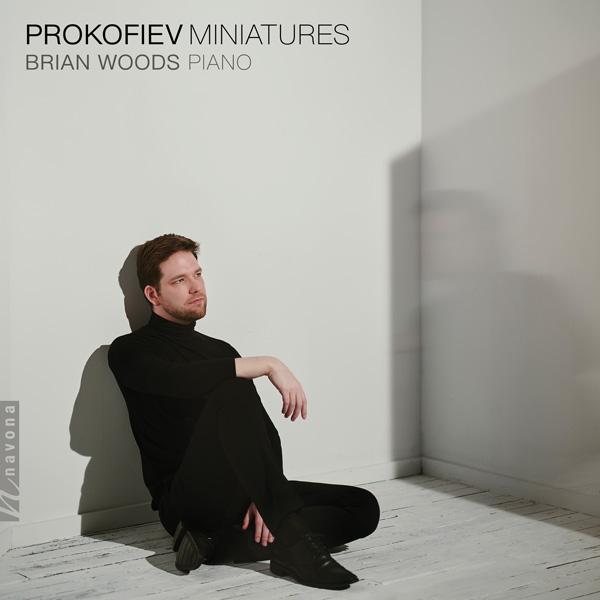 Prokofiev: Miniatures
Brian Woods, piano
Navona NV6870 (24/48 WAV download). 2026. Nathan Hershey, prod., eng.
Performance *****
Sonics ***** Prokofiev's early orchestral works, with their dissonance—the Scythian Suite, Symphony 2—suggest the bad-boy innovator. Brian Woods's collection of early piano miniatures, most around two minutes long, presents a more varied picture. The Visions fugitives are "fugitive" in the sense of "elusive." They're light and spare in texture though not wispy; several don't fully resolve, underlining emotional ambiguity. The "advanced" harmonies are fluid and unstable, not harsh and aggressive. Yet the set encompasses a full expressive range. The perky back-and-forth of Number 10 (Ridicolosamente) sets off the borderline-obsessive Number 11 (Con vivacità). Number 7 (Pittoresco) unfolds pensively; so does Number 20 (Lento irrealmente), a surprisingly reflective conclusion. 16 (Dolente) echoes the great themes of Romeo and Juliet. 13 is lyrical; so is 18, where the resonant bass notes and linear writing suggest, incongruously, a Chopin nocturne.
The four Tales of an Old Grandmother offer sturdier, folklike contours. The first and third suggest a senior's awkward gait. The Andante assai reminded me of Mussorgsky's Bydlo! Only the five Sarcasms elicit the young composer's "barbaric" aspect, with a certain amount of banging—the music, not Mr. Woods's touch—and generating propulsion with rapid repeated chords. But even here, the Allegro precipitato approaches traditional lyricism. The closing piece feels like it just "goes on."
Mr. Woods is insightful, layering even the sparser, three-part textures and highlighting midrange lines with ease. The runs—the short ones that spice up the Visions and the long, quiet one in the Sarcasms—are limpid and spankingly articulated. The uppermost notes turn a bit glassy, a failure of regulation rather than of Mr. Woods's own playing. The piano's vivid presence, while closer than in even a small hall, is pleasing.—Stephen Francis Vasta
Kristian Bezuidenhout, Freiburger Barockorchester
Harmonia Mundi HMM 902759 (auditioned as 24/96 pre-release WAV files). 2026. Martin Sauer, prod.; Julian Schwenkner, eng.
Performance ****½
Sonics ****½ A happy welcome to another winning installment in early music specialist Kristian Bezuidenhout's series of Mozart Piano Concertos with Freiburger Barockorchester. Here, Bezuidenhout moves back in time, from two concertos composed in Mozart's maturity—Piano Concerto 20 (K.466), written in his 29th year, and Concerto 14 (K.449), composed one year earlier—to Concerto 5 (K.175), composed when Mozart was just 17. These are very different works. Despite the sound of authentic late–18th century timpani, whose impact is dwarfed by its modern counterpart, K.466 may knock you for a loop with its unusually dramatic opening and grave exposition. A major test for a keyboardist—Bezuidenhout plays a copy of Walter & Sohn fortepiano (ca. 1805)—K.466's opening requires an artist to sound effortless while negotiating an astounding number of notes. The middle movement begins in a lovely, elegant manner, only to surprise with startling outbursts followed by a tender and delicate close. The final movement is a mile-a-minute romp up and down the keyboard destined to leave listeners cheering.
Bruckner: Symphony 3 (Novak ed., 1873)Anima Eterna Brugge/Pablo Heras-Casado
Harmonia Mundi HMM 902760 (CD). 2026. Hans Vercauteren, prod.; Steven Maes, eng.
Performance **½
Sonics ***
Qigang Chen: Iris Dévoilée, L'ÉloignementSeattle Symphony/Xian Zhang
Seattle Symphony Media SSM1029 (auditioned as 24/96 prerelease WAV files). 2026. Dmitriy Lipay, prod.; Alexander & Dmitriy Lipay, engs.
Performance ****½
Sonics ****½ Oddities, perhaps, but two of the more colorful oddities of their kind. Both are composed by Olivier Messiaen's final pupil, Qigang Chen (born Chen Qigang), a survivor of China's Cultural Revolution who underwent three years of "re-education" before emigrating to France in 1984 and living with Messiaen during his studies.
Prokofiev: MiniaturesBrian Woods, piano
Navona NV6870 (24/48 WAV download). 2026. Nathan Hershey, prod., eng.
Performance *****
Sonics ***** Prokofiev's early orchestral works, with their dissonance—the Scythian Suite, Symphony 2—suggest the bad-boy innovator. Brian Woods's collection of early piano miniatures, most around two minutes long, presents a more varied picture. The Visions fugitives are "fugitive" in the sense of "elusive." They're light and spare in texture though not wispy; several don't fully resolve, underlining emotional ambiguity. The "advanced" harmonies are fluid and unstable, not harsh and aggressive. Yet the set encompasses a full expressive range. The perky back-and-forth of Number 10 (Ridicolosamente) sets off the borderline-obsessive Number 11 (Con vivacità). Number 7 (Pittoresco) unfolds pensively; so does Number 20 (Lento irrealmente), a surprisingly reflective conclusion. 16 (Dolente) echoes the great themes of Romeo and Juliet. 13 is lyrical; so is 18, where the resonant bass notes and linear writing suggest, incongruously, a Chopin nocturne.